10 nouveaux francs 1971
About This Note
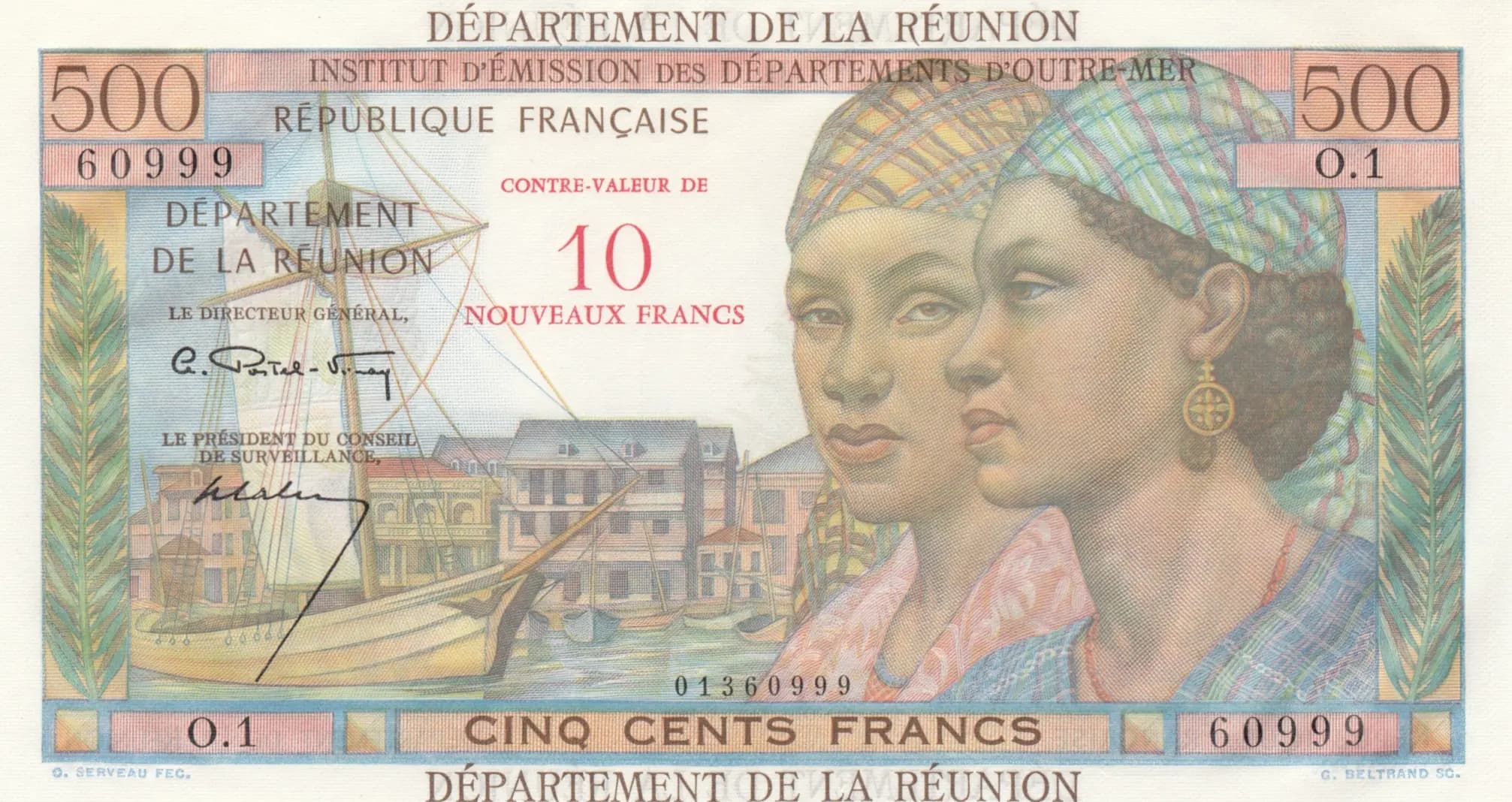
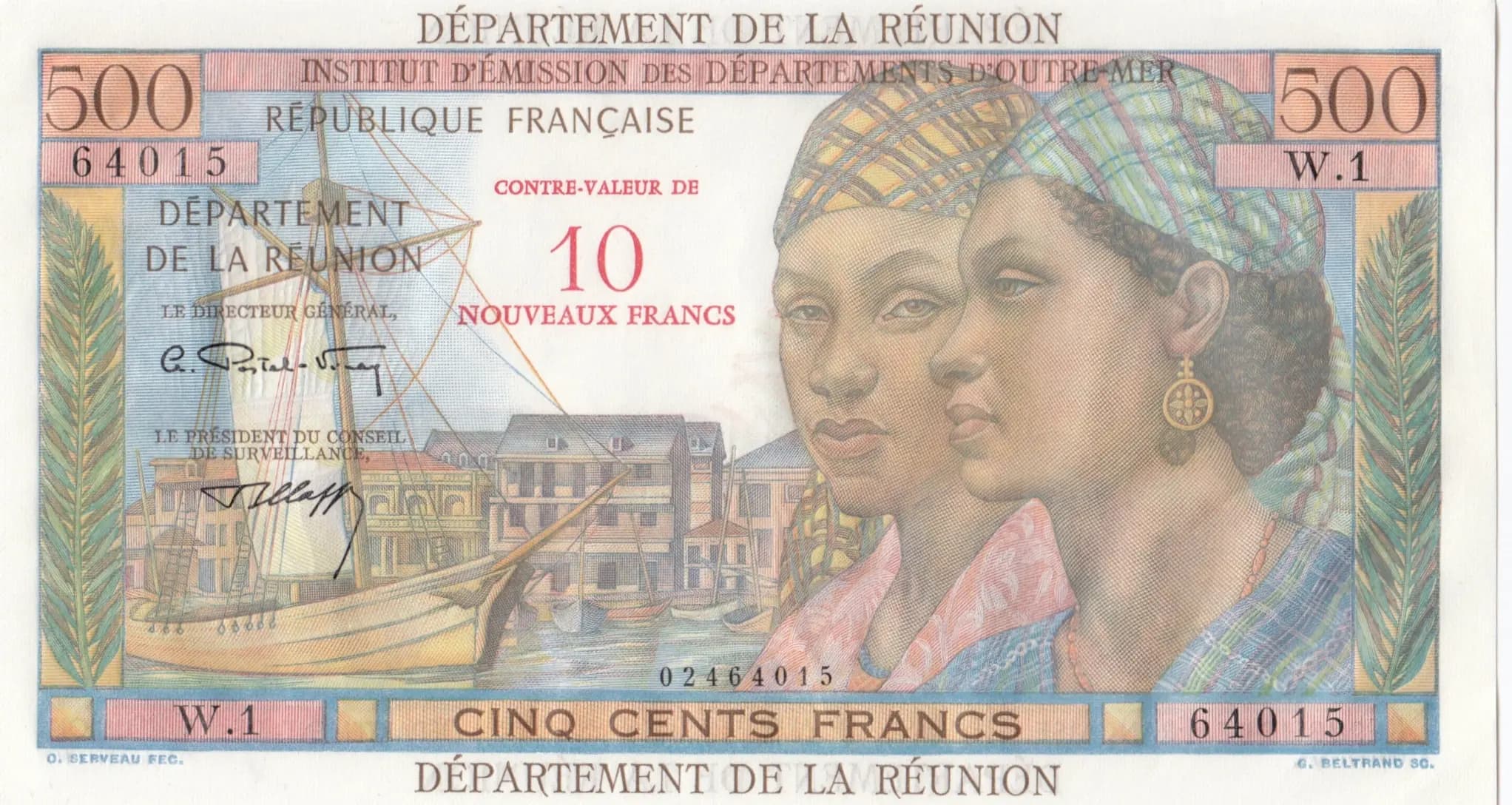
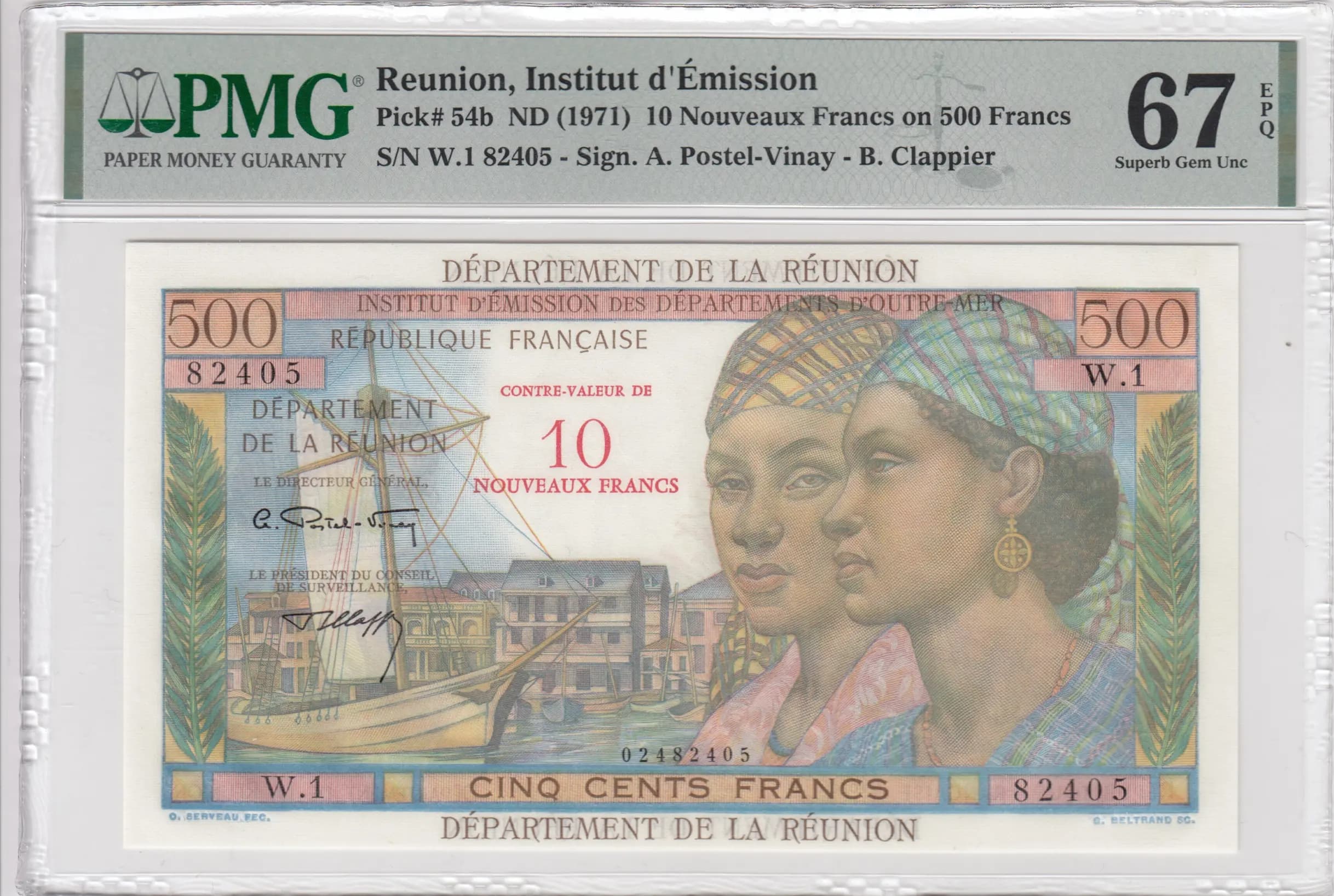
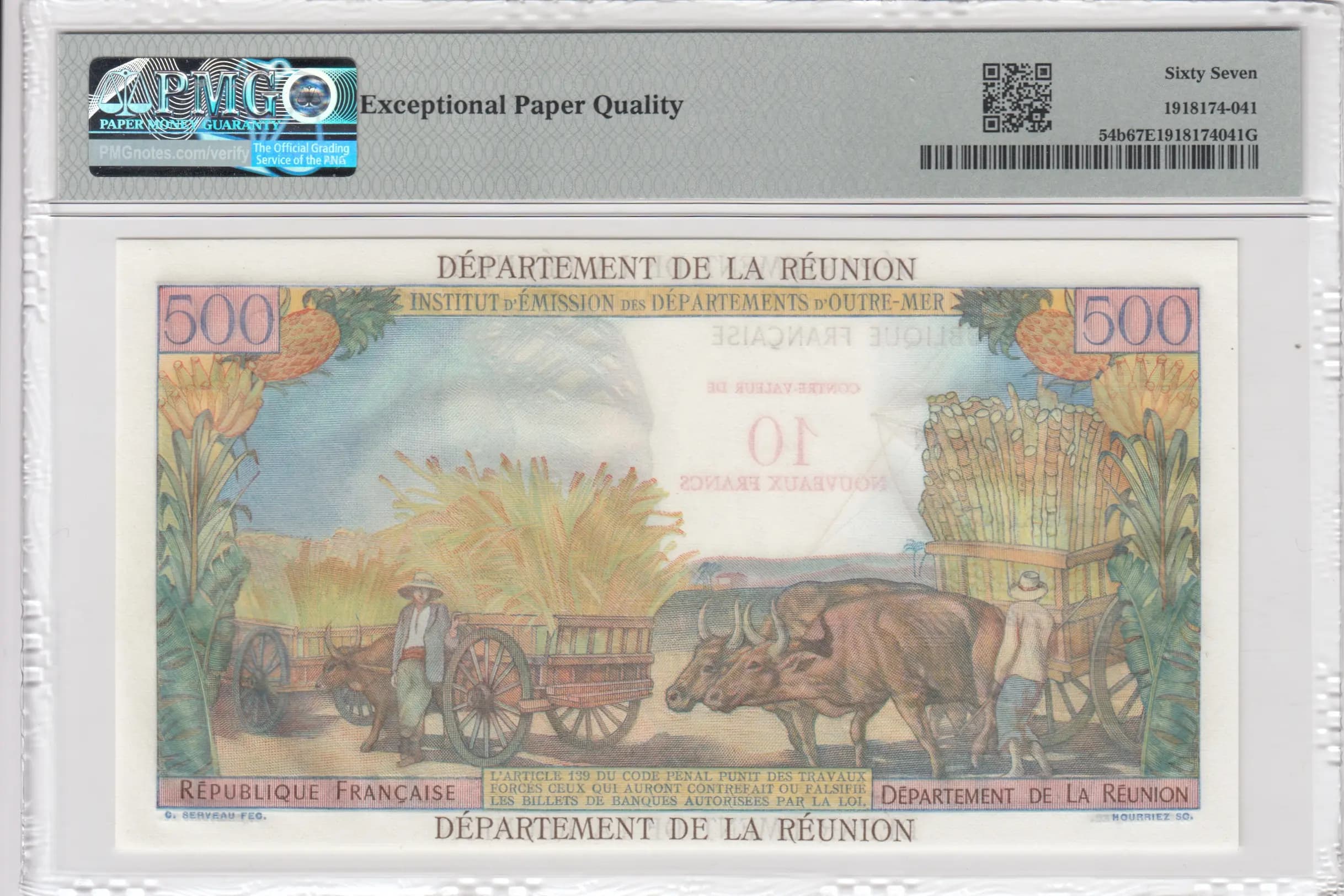
This is a PMG 67 EPQ graded Reunion 10 Nouveaux Francs on 500 Francs note from 1971, issued by the Institut d'Émission des Départements d'Outre-Mer. The note features exceptional color preservation and fine engraving detail, with the obverse depicting two colonial-era female portraits and a harbor scene, while the reverse showcases an ox cart agricultural scene—both thematic to Reunion's colonial economic heritage. The EPQ designation indicates exceptional paper quality and eye appeal, making this an attractive example for specialists in French overseas currency.
Common. The 10 Nouveaux Francs on 500 Francs series (P-54a through P-54bs) had substantial circulation during the 1967-1971 production period for Reunion's overseas department currency needs. While the PMG 67 EPQ grade represents superior condition, the base note type itself is not scarce. Production runs for IEDOM notes of this era were adequate to supply regular monetary demand, and these notes remain available in the collector market without significant premium pricing beyond normal grade-based valuation.
This note represents the transitional currency period for Reunion as an overseas department of France, issued during the 1967-1971 production run following the 1960 redenomination from 500 Francs to 10 Nouveaux Francs. The imagery deliberately references Reunion's colonial past and agricultural economy: the harbor scene evokes the island's 18th-19th century commercial importance as a colonial port, while the ox cart on the reverse symbolizes the labor-intensive sugar and agricultural production that formed the economic foundation of the island under French rule.
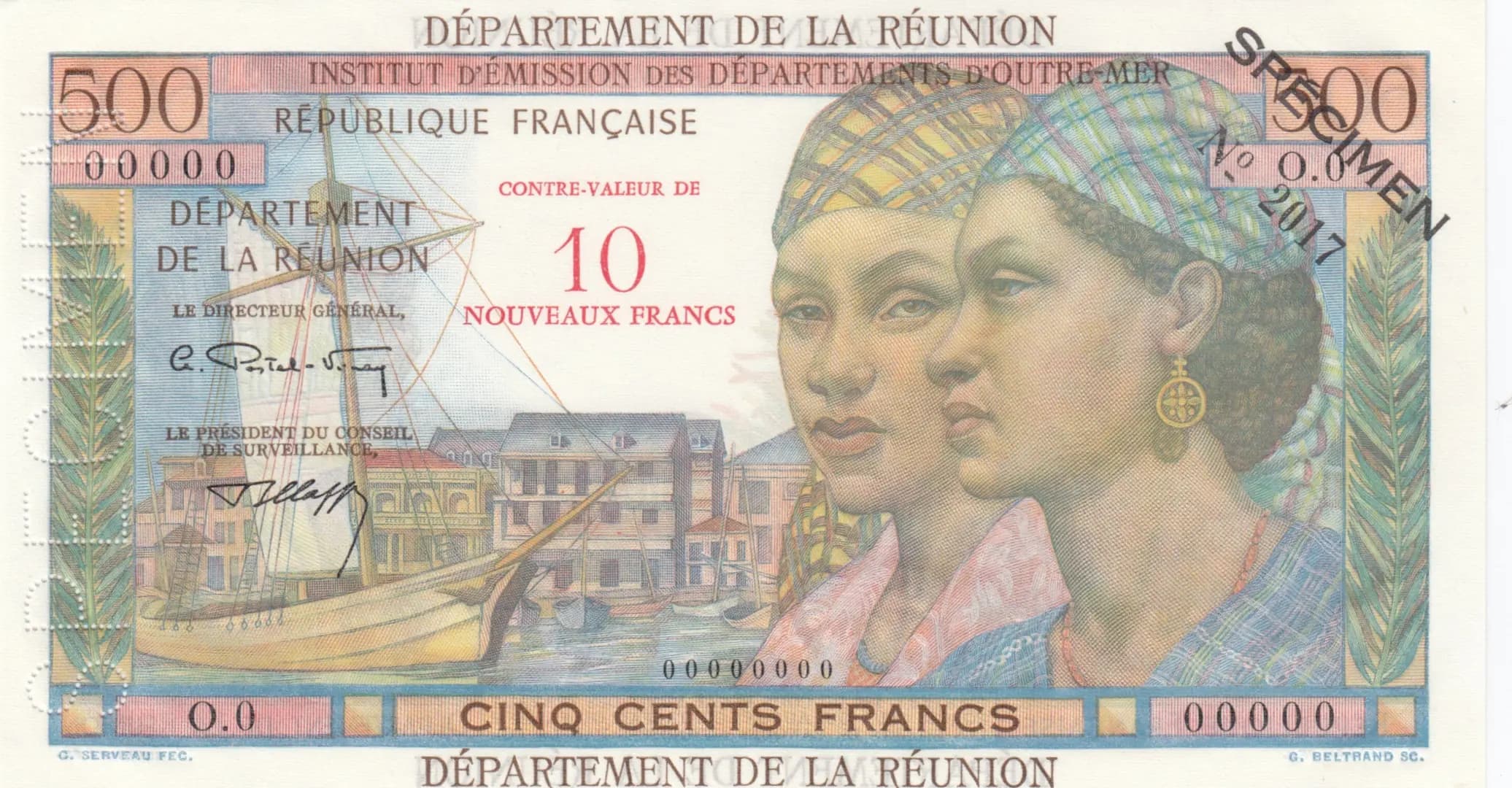
The obverse presents a colonial-era themed composition with two female portrait busts in profile on the right side, wearing head wraps and period dress representative of 18th-19th century Reunion society. The center-left depicts a colonial harbor scene with sailing vessels and colonial-period architecture, establishing the island's maritime and commercial heritage. Palm frond ornaments frame both sides, with yellow and blue decorative corner blocks. The reverse features a rural agricultural labor scene with a male worker and oxen pulling a heavily loaded cart through tropical landscape, surrounded by banana plants, palm trees, and pineapple motifs in the corners—symbolizing Reunion's plantation economy. The overprint '10 Nouveaux Francs' in red appears on the obverse, indicating this note's redenomination status from the original 500 Francs note.
OBVERSE: 'Département de la Réunion' (Department of Reunion); 'Institut d'Émission des Départements d'Outre-Mer' (Issuing Institute of Overseas Departments); 'République Française' (French Republic); 'Contre-valeur de 10 Nouveaux Francs' (Face value of 10 New Francs); 'Le Directeur Général' (The General Director); 'Le Président du Conseil de Surveillance' (The President of the Surveillance Board); 'Cinq Cents Francs' (Five Hundred Francs); '500' (denomination); 'W.1' (printer/series mark); Artist signatures 'G. Serveau PEC.' and 'G. Beltrand CC.'. REVERSE: 'Département de la Réunion' (Department of Reunion); 'Institut d'Émission des Départements d'Outre-Mer' (Issuing Institute of Overseas Departments); 'République Française' (French Republic); '500' (original denomination); 'L'Article 199 du Code Pénal punit des travaux forcés ceux qui auront contrefait ou falsifié les billets de banques autorisés par la loi' (Article 199 of the Penal Code punishes with hard labor those who counterfeit or falsify banknotes authorized by law); Artist signatures 'G. Serveau PEC.' and 'Bourrier SC.' (engraver).
This note employs intaglio engraving (taille-douce), the standard security printing method for French banknotes of the era. The fine line work, intricate background patterns, and multi-color printing visible throughout both sides are characteristic of high-security intaglio production. The printer for IEDOM notes of this period was typically the Banque de France's security printing facilities. The note exhibits the fine engraving detail signatures of G. Serveau (designer) and specialized engravers including G. Beltrand and Bourrier, typical of French national banknote production standards.
This example is cataloged as Pick P-54b variant. The four known variants (P-54a, P-54as, P-54b, P-54bs) represent different signature combinations and possibly printing sessions. This specific note carries the signatures 'G. Serveau PEC.' on both sides, with 'G. Beltrand CC.' on the obverse and 'Bourrier SC.' on the reverse as the engraver. The serial number visible (82405 / 02482405) and printer mark 'W.1' should be documented for future reference and variety attribution. The red overprint of '10 Nouveaux Francs' is consistent with the redenomination overprint standard for this series.