50 rupias 1945
About This Note
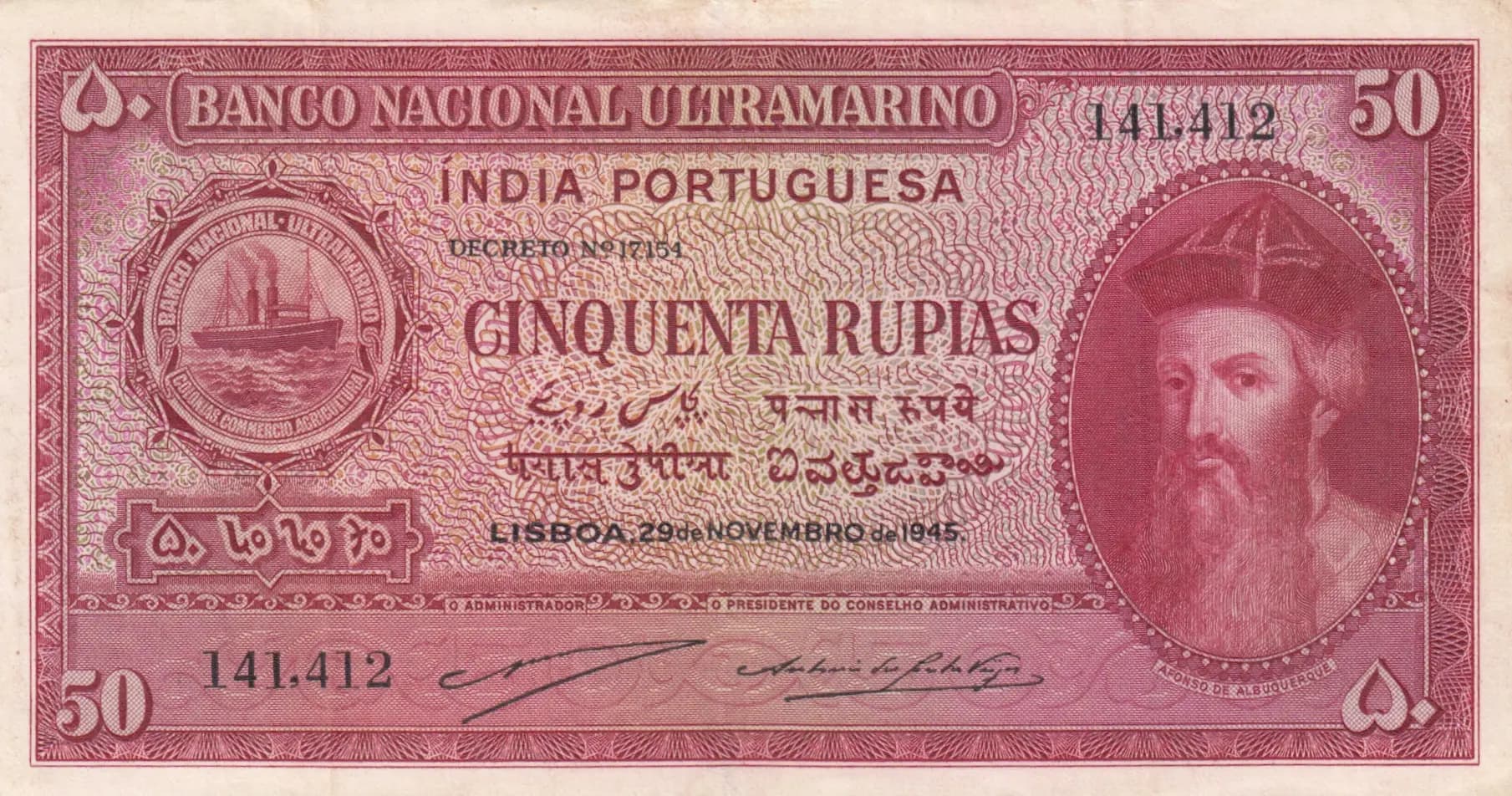
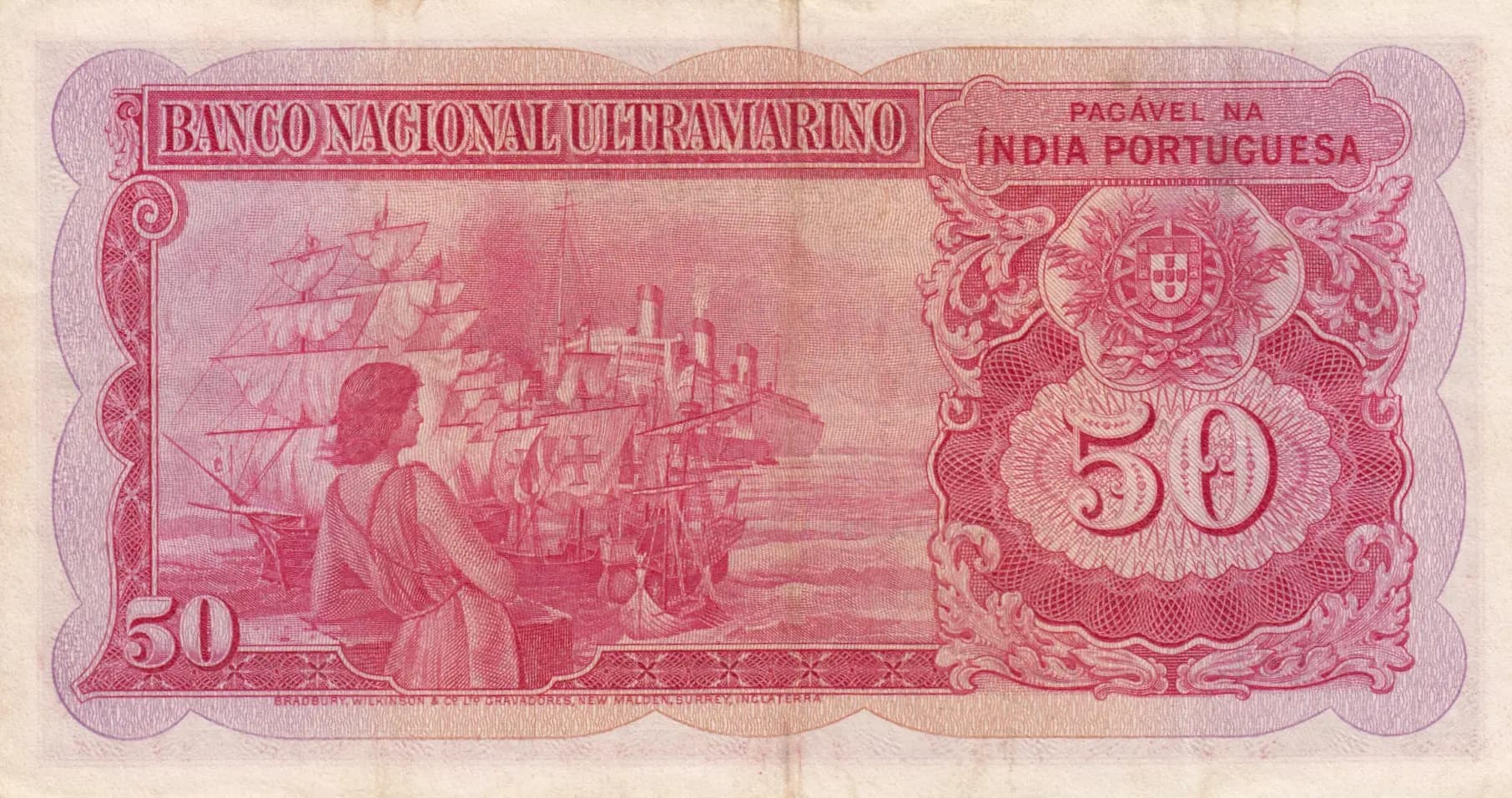
A well-preserved example of Portuguese India's 50 rupias banknote from 1945, issued by Banco Nacional Ultramarino and dated 29 November 1945. The note displays the characteristic mauve and rose color scheme typical of this series, featuring a bearded portrait on the obverse and an allegorical maritime scene on the reverse, reflecting Portugal's colonial maritime heritage. In VF condition, the note shows expected age-related patina including minor foxing and creasing, but maintains excellent visual clarity and legibility of all design elements and inscriptions.
Common. The 50 rupias denomination from the 1945 Banco Nacional Ultramarino series (Pick P-38) is regularly encountered in the collector market. Portuguese India currency, while no longer in circulation and therefore historically significant, was issued in substantial quantities during the final decade of Portuguese colonial rule. No evidence of restricted print runs, recalls, or extreme scarcity exists for this particular issue. VF condition examples are readily available to collectors at modest prices, consistent with common-grade banknotes.
This banknote was issued during the final years of World War II, when Portuguese India remained under Portuguese colonial administration and maintained a separate currency system from British India. The maritime imagery—the sailing ships depicted in both the circular seal on the front and the harbor scene on the reverse—reflects the historical importance of naval commerce and Portuguese trading routes that had defined the colony since the 16th century. The issuer, Banco Nacional Ultramarino (Overseas National Bank), was Portugal's primary instrument for managing currency and finance across its colonial territories, and this 1945 issue represents one of the last rupias denominations issued before India's independence in 1947.
The obverse features a bearded man in period dress shown in three-quarter profile within an oval frame on the right side; this portrait likely represents a Portuguese administrator or notable figure associated with the colonial administration, though the specific identity is not marked on the note. On the left is a circular seal containing a multi-masted sailing ship, symbolizing maritime commerce and Portugal's naval heritage. The reverse depicts an allegorical female figure in classical dress representing maritime commerce or navigation, positioned before a harbor scene with multiple sailing vessels and fortifications visible in the background. The right side of the reverse displays the Portuguese coat of arms with heraldic shield and crown. Both sides feature intricate geometric patterns, fine wavy lines, and decorative scrollwork as security measures. Spade suit symbols appear in opposite corners as traditional design elements. The mauve and rose color scheme is consistently applied across both sides, creating a cohesive aesthetic characteristic of Banco Nacional Ultramarino's colonial-era currency.
FRONT: 'BANCO NACIONAL ULTRAMARINO' (Overseas National Bank), 'INDIA PORTUGUESA' (Portuguese India), 'DECRETO 1/1942' (Decree 1/1942), 'CINQUENTA RUPIAS' (Fifty Rupias), 'LISBOA 29 DE NOVEMBRO DE 1945' (Lisbon, 29 November 1945), '50' (denomination), '141.412' (serial number), 'O ADMINISTRADOR' (The Administrator), 'O PRESIDENTE DO CONSELHO ADMINISTRATIVO' (The President of the Administrative Council), with additional text in Hindi and Kannada scripts reflecting the local languages of Portuguese India. BACK: 'BANCO NACIONAL ULTRAMARINO' (Overseas National Bank), 'PAGÁVEL NA INDIA PORTUGUESA' (Payable in Portuguese India), '50' (denomination), 'BRADBURY, WILKINSON & CO. LTD., ENGRAVERS, NEW MALTA STREET, LONDON, ENGLAND' (printer/engraver attribution).
Intaglio engraving, as indicated by the fine detailed line work, complex geometric background patterns, and the attribution to Bradbury, Wilkinson & Co. Ltd., a prestigious London-based security printer specializing in banknote and security document engraving. The extensive use of fine parallel lines, geometric patterns, and detailed portraiture are hallmarks of the intaglio process, which was the standard high-security printing technique for banknotes during this period.
The specific variety observed is identified by the date 'LISBOA 29 DE NOVEMBRO DE 1945' and serial number '141.412'. The inclusion of text in multiple local languages (Portuguese, Hindi, and Kannada) is standard for this issue, reflecting the multilingual nature of Portuguese India's administration. The printer attribution to 'BRADBURY, WILKINSON & CO. LTD.' is consistent across this series. No significant varieties regarding signatures, overprints, or substantial design modifications are noted for Pick P-38; the series maintained consistent design elements across its circulation period.