5 rupias 1924
About This Note
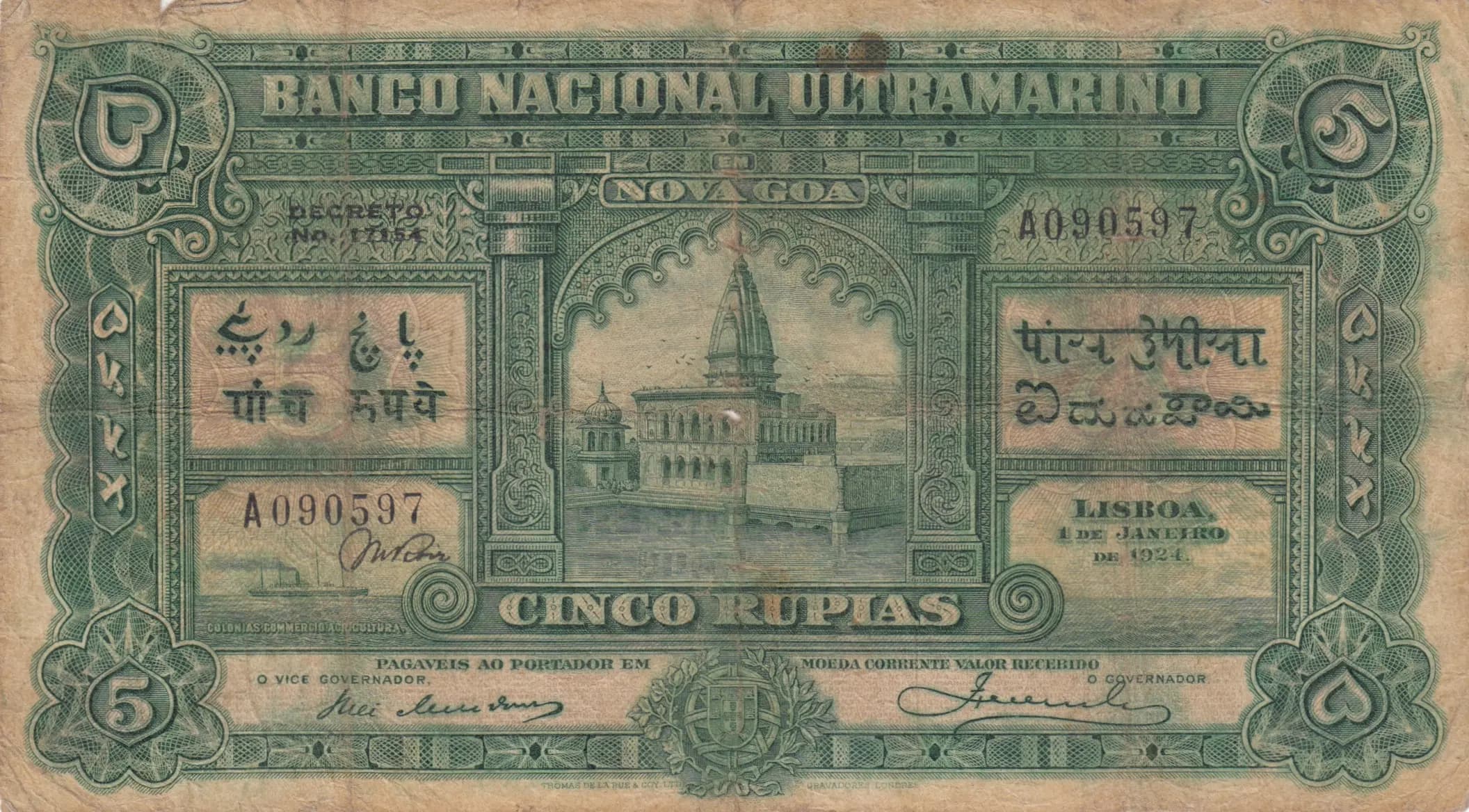
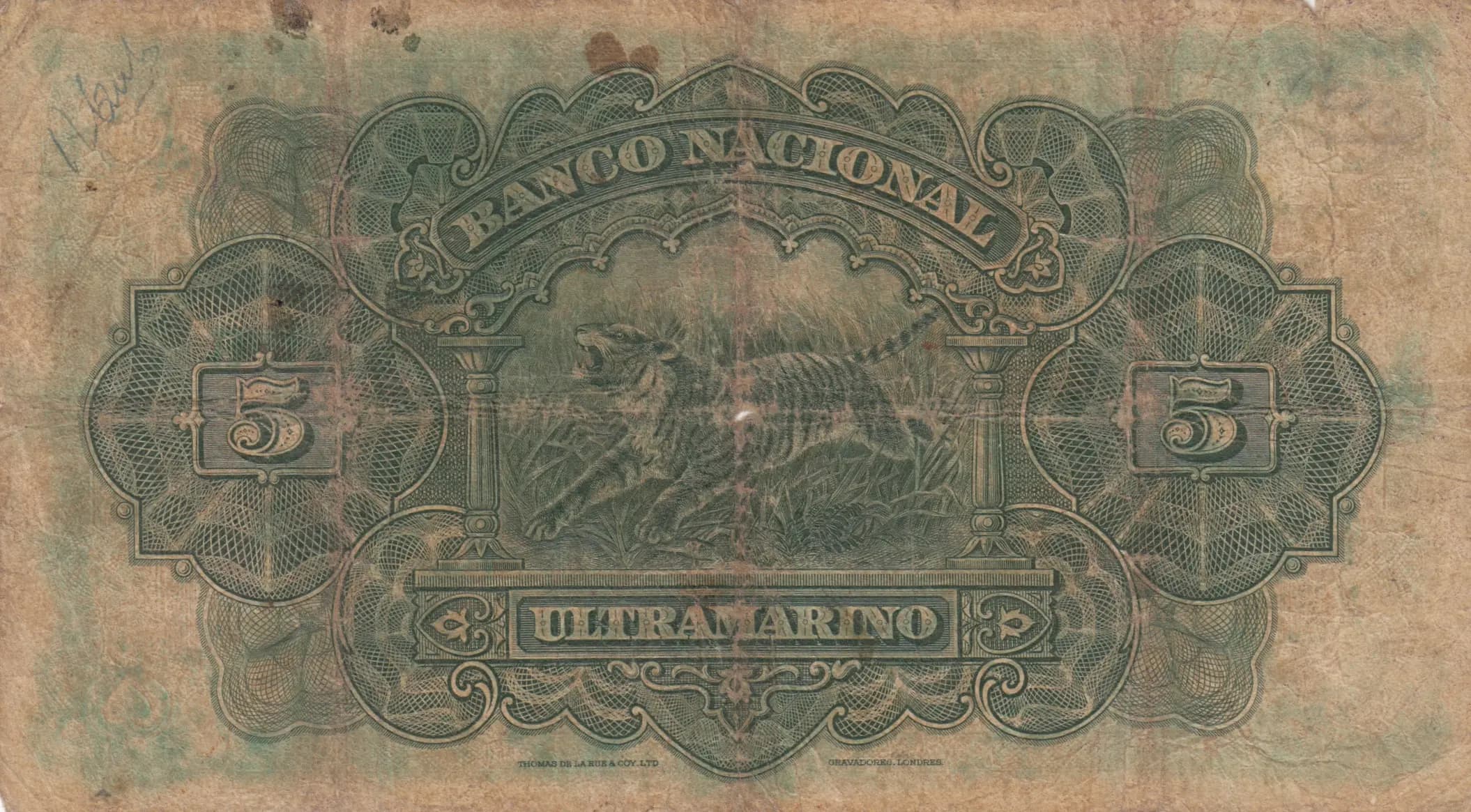
A 5 Rupias note issued by Banco Nacional Ultramarino in 1924, representing Portuguese India's currency during the colonial period. This VG-graded example displays the characteristic green color scheme and ornate engraving typical of early 20th-century Portuguese colonial currency, though the note shows expected aging with foxing, creasing, and color fading consistent with nearly a century of age. The front features an architecturally detailed fortification tower, while the reverse showcases a naturalistic tiger vignette—elements that make this note visually distinctive and historically significant as a document of Portuguese colonial numismatic design.
Common. Portuguese Indian rupias of this denomination and period are not considered scarce in numismatic markets. While not produced in the vast quantities of major world powers' currencies, the 1924 series represents standard circulation currency for a colonial territory with a significant population base. The VG condition and lack of exceptional varieties or printing anomalies do not elevate this note's rarity status. Notes of this type typically sell in modest price ranges, reflecting their common classification.
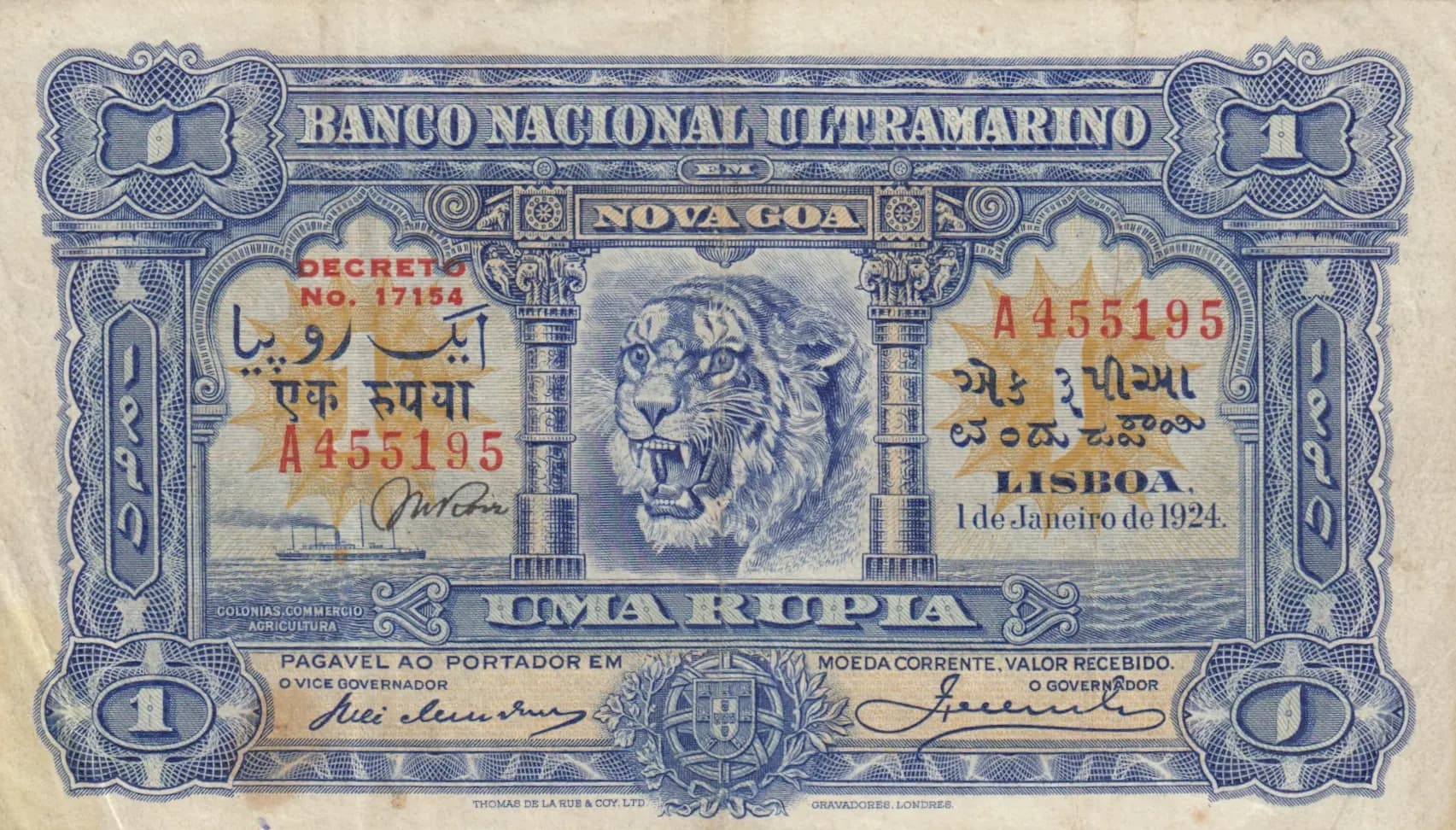
Issued on January 1, 1924, this note represents Portuguese India during the twilight of European colonial monetary systems in the subcontinent. The Banco Nacional Ultramarino, headquartered in Lisbon, administered currency for Portugal's Asian territories, and this 1924 series reflects the bank's responsibility for circulating legal tender in Nova Goa (Portuguese India's capital). The multilingual inscriptions in Portuguese, Hindi/Devanagari, and Kannada reflect the linguistic reality of Portuguese Indian colonial administration, acknowledging the diverse populations under Portuguese rule.
The front features a prominent architectural vignette depicting a colonial-era fortification tower or steeple, likely representing a landmark of Portuguese India's military or administrative heritage, rendered in fine engraving with careful attention to structural detail. The design is framed by elaborate ornamental scrollwork borders in green with beige/cream underprinting. Decorative numerals '5' in ornate cartouches anchor the left and right margins. A coat of arms or governmental seal appears at the bottom center. The reverse displays a naturalistic tiger—a powerful symbol of India and the Indian subcontinent—as the dominant central vignette, also framed by ornate scrollwork and bordered numerals. The multilingual text (Portuguese, Hindi, Kannada) demonstrates the note's intended circulation across Portuguese India's diverse linguistic regions. Both sides employ fine-line engraving and cross-hatching as anti-counterfeiting measures.
{"front":{"BANCO NACIONAL ULTRAMARINO":"Overseas National Bank","NOVA GOA":"New Goa","CINCO RUPAS":"Five Rupees","पाँच रुपया":"Five Rupees (Hindi/Devanagari)","ಐದು ರುಪಾಯೆ":"Five Rupees (Kannada)","LISBOA":"Lisbon","1 DE JANEIRO DE 1924":"1st of January of 1924","PAGAVEIS AO PORTADOR EM":"Payable to the bearer in","O GOVERNADOR":"The Governor","O VICE GOVERNADOR":"The Vice Governor","MOEDA CORRENTE VALOR RECEBIDO":"Current currency value received","SerialNumbers":"A090597 and 4090597"},"back":{"BANCO NACIONAL ULTRAMARINO":"Overseas National Bank","THOMAS DE LA RUE & CO. LTD":"Printer identification (De La Rue, renowned British security printer)","GRAVACORO, LIGUERE":"Engraving reference/production notation"}}
Intaglio/engraving process, as evidenced by the fine line work, detailed cross-hatching, and crisp ornamental patterns throughout both sides. The note was printed by Thomas de la Rue & Co. Ltd, one of the world's premier security printers of the era, whose name appears on the reverse. The engraving quality and security features (fine line borders, ornamental scrollwork, detailed animal vignette) are characteristic of De La Rue's high-security banknote production standards of the 1920s.
The visual analysis identifies this as Pick 25A based on catalog data provided. The note bears serial numbers A090597 (left) and 4090597 (right), with the 'A' prefix on one side suggesting a specific serial series. The date of issue (1 January 1924) and signatures of the Governor and Vice Governor are standard for this emission. No overprints, color variations, or other anomalies are noted that would indicate a rare variety. This appears to be a standard example of the 1924 denomination from the Banco Nacional Ultramarino's regular production run.