10 rupias 1938
About This Note
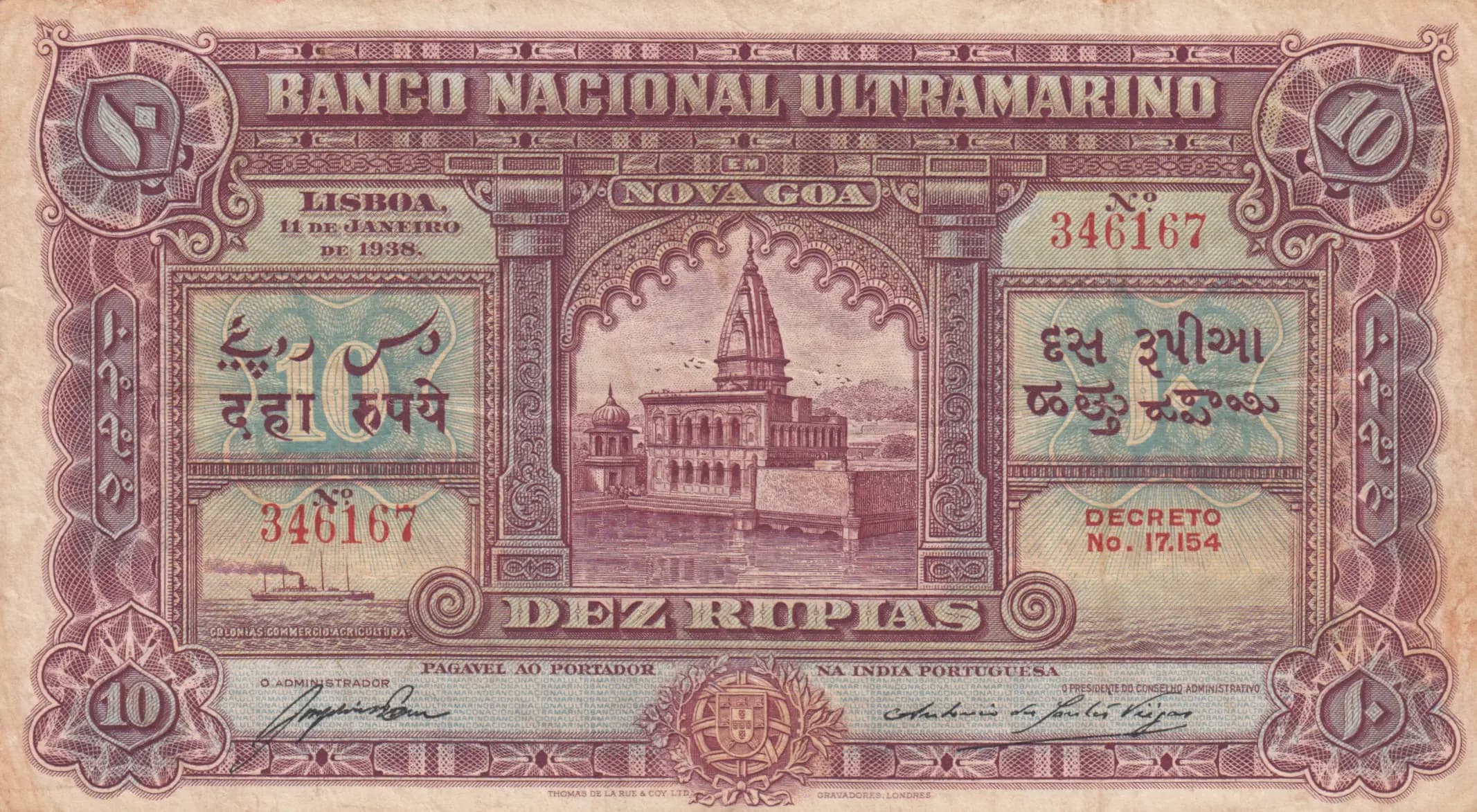
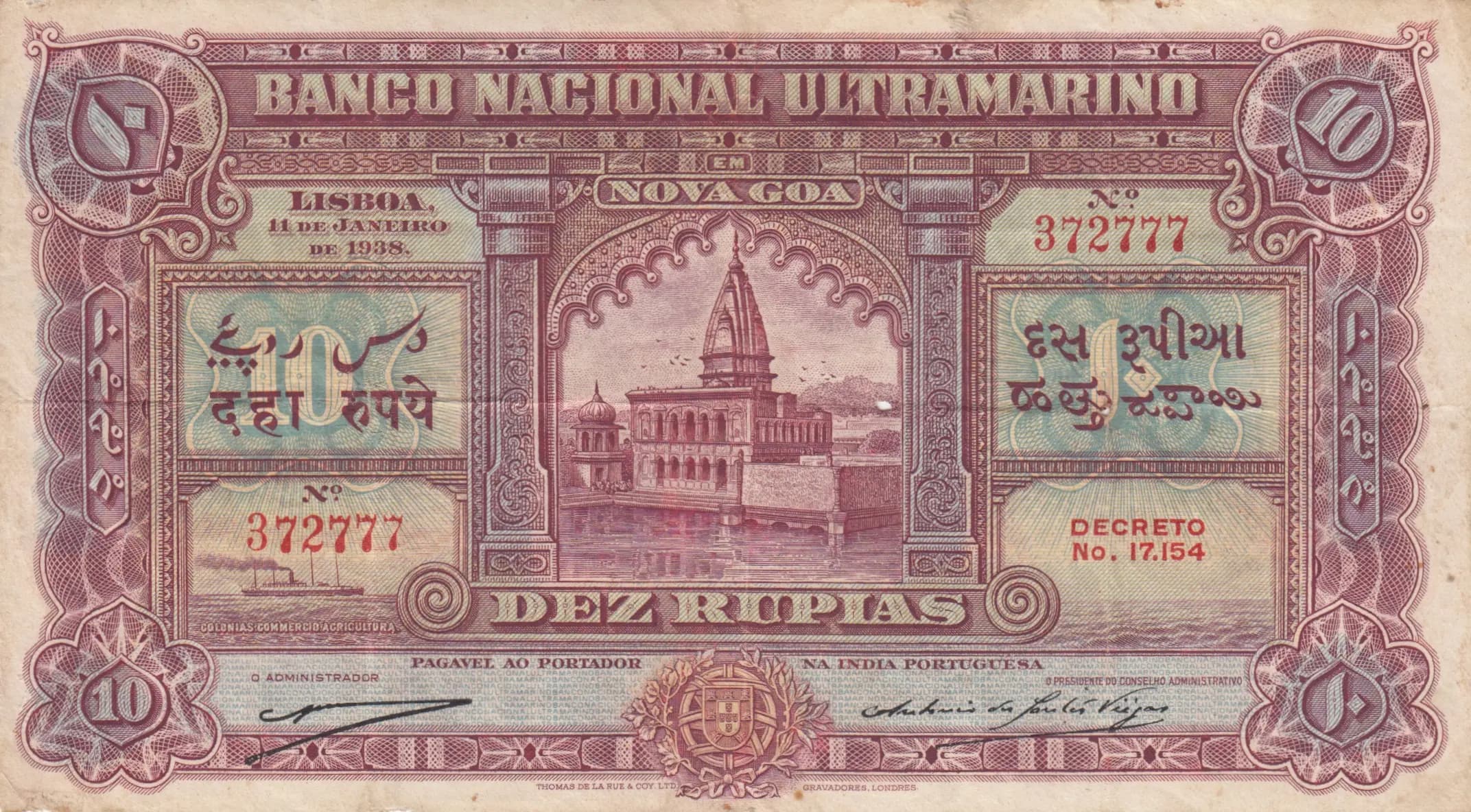
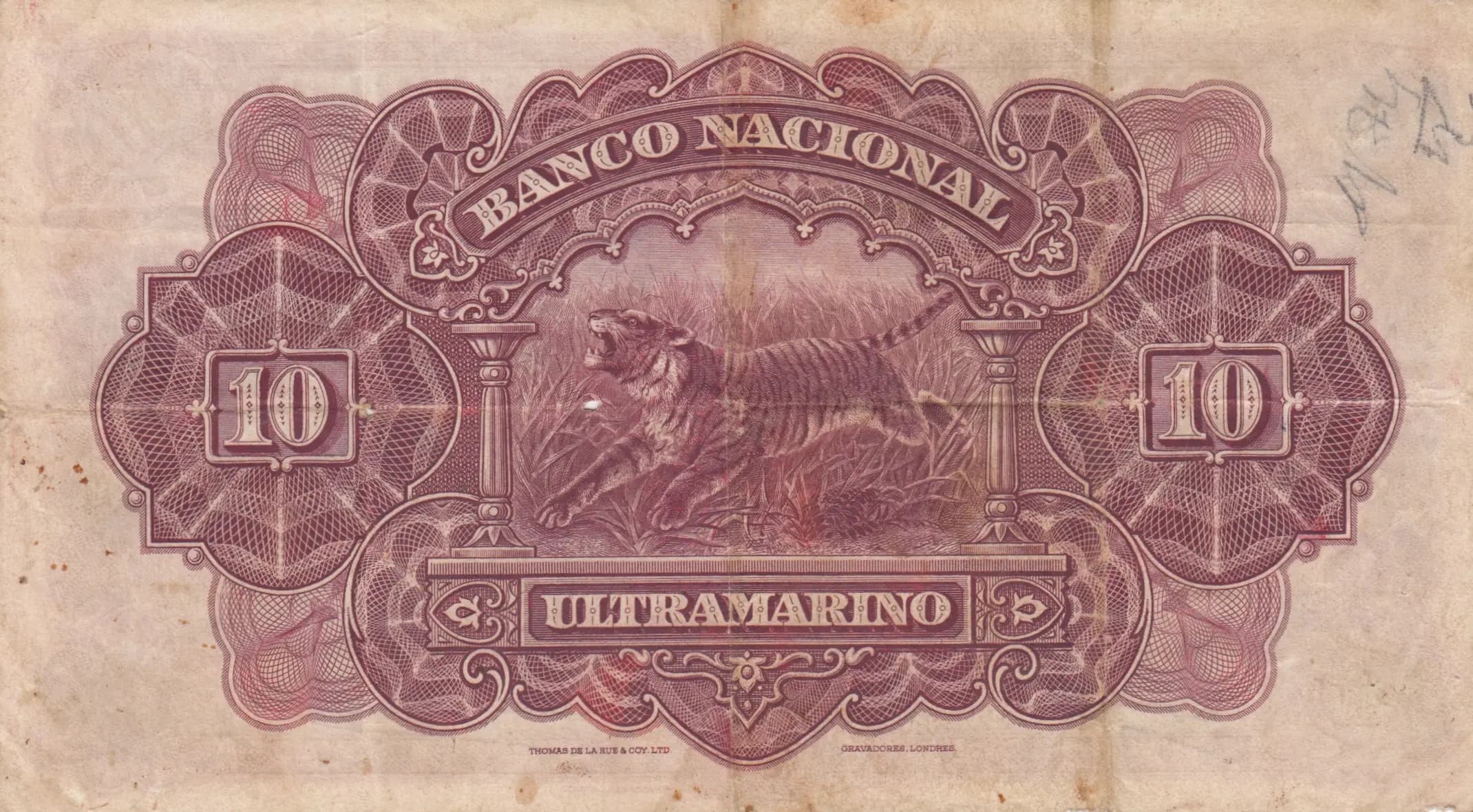
A handsome Portuguese India 10 Rupias note from 1938 issued by Banco Nacional Ultramarino, featuring distinctive Art Deco design with purple/mauve coloring and ornate baroque-style borders. The front displays a prominent Hindu temple structure with bilingual Portuguese and Devanagari inscriptions, while the reverse showcases a detailed engraved bear in naturalistic pose. The note exhibits significant aging with foxing and tan discoloration consistent with nearly a century of storage, grading VF with visible creases and wear patterns from historical circulation.
Common. Portuguese India banknotes from the 1930s-1940s circulated in limited geographic areas but were produced in sufficient quantities for circulation within the Portuguese colonial administration. The 10 Rupias denomination was a standard mid-range note in the Portuguese India currency system. While Portuguese colonial banknotes are increasingly difficult to find due to the passage of time and Portugal's loss of these territories in 1961, this particular Pick number does not represent a short print run, special issue, or recalled variety. Notes of this type trade regularly in the collector market at moderate prices, indicating common classification despite their age and historical interest.
This note represents Portuguese India's monetary system during the late colonial period, issued by Banco Nacional Ultramarino during a time when Portugal maintained its Asian territories. The inclusion of both Portuguese text and Devanagari script reflects the bilingual colonial administration, while the Hindu temple imagery on the front acknowledges the religious and cultural landscape of Portuguese-controlled Indian territories. The 1938 date places this note in the interwar period, when Portugal was consolidating control over its overseas possessions under the Estado Novo regime.
The obverse features an ornate Art Deco composition centered on a Hindu temple with prominent spire and architectural details, rendered in fine engraving with intricate cross-hatching and line work. The temple is framed by multiple rectangular cartouches containing Portuguese and Devanagari inscriptions, with the denomination 'DEZO RUPIAS' prominently displayed. Elaborate baroque-style decorative borders with scrollwork, geometric rosette patterns, and circular medallions containing the numeral 10 frame all edges. The Portuguese coat of arms or heraldic emblem appears at bottom center. The reverse presents a large naturalistic engraved portrait of a bear depicted in profile/three-quarter view, standing in natural terrain with vegetation, equally surrounded by ornate baroque borders with scrollwork and corner medallions bearing the numeral 10. Both sides display the signature line for 'O ADMINISTRADOR' and 'O PRESIDENTE DO CONSELHO ADMINISTRATIVO,' standard for administrative authorization on Portuguese colonial currency.
FRONT: 'BANCO NACIONAL ULTRAMARINO' (National Bank of the Overseas); 'DEZO RUPIAS' (Ten Rupees); 'PAGAVEL AO PORTADOR' (Payable to Bearer); 'NA INDIA PORTUGUEZA' (In Portuguese India); 'NOVA GOA' (New Goa); 'LISBOA' (Lisbon); '11 DE JANEIRO' (11th of January); '1924' (year of decree authorization, note issued 1938); 'DECRETO No. 17154' (Decree No. 17154); 'O ADMINISTRADOR' (The Administrator); 'O PRESIDENTE DO CONSELHO ADMINISTRATIVO' (The President of the Administrative Council); 'THOMAS DE LA RUE & COY LTD' (printer); 'GRAVADORES. LONDRES.' (Engravers. London.); Devanagari script text in left and right panels (unable to transcribe precisely from image quality, but likely denomination and issuer information in Hindi). BACK: 'BANCO NACIONAL ULTRAMARINO' (National Bank of the Overseas); '10' (denomination); 'THOMAS DE LA RUE & COY. LTD' (printer); 'GRAVADORES. LONDRES.' (Engravers. London.)
Intaglio engraving (line engraving) on banknote paper, executed by Thomas de la Rue & Company Limited of London, the renowned British security printer. The fine detail visible in the engraved lines, cross-hatching patterns for shading, and intricate ornamental borders are characteristic of high-security intaglio production. The precision of the temple architecture and bear illustration, combined with complex background patterns and security borders, reflects the advanced engraving techniques of the 1930s security printing industry.
Pick catalog P-32 (1938 issue). Visual analysis confirms this matches the 1938 date on the decree authorization (though bearing the original 1924 decree reference). The note displays serial number 372177 in red. Variety status within P-32 depends on signature combinations and serial number prefixes, which would require comparison with standard cataloging references. The bilingual Portuguese/Devanagari inscription design and temple/bear imagery are standard for this pick number. No overprints or modifications from standard printing are evident in the observed images.