10 rupias 1924
About This Note
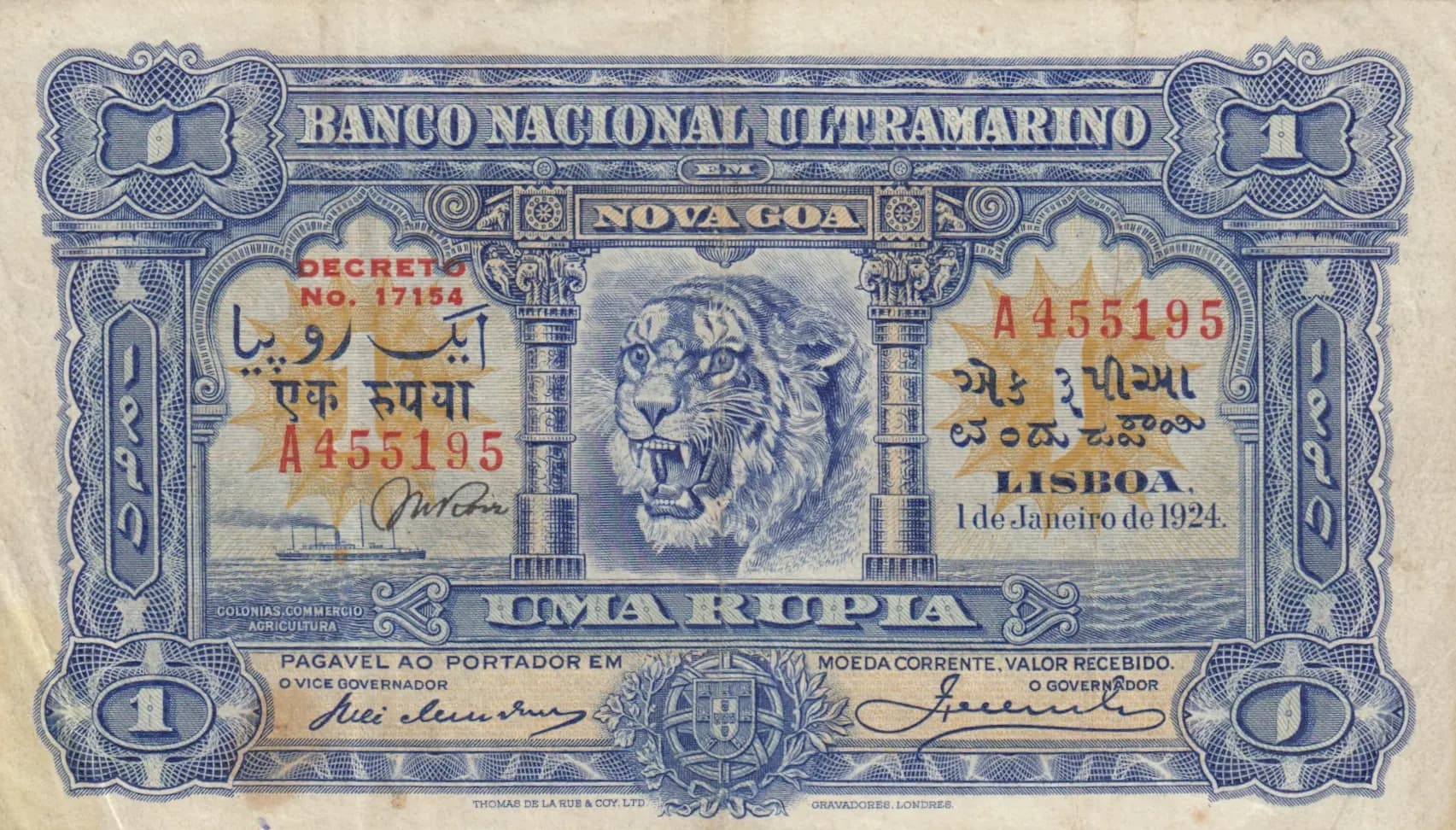
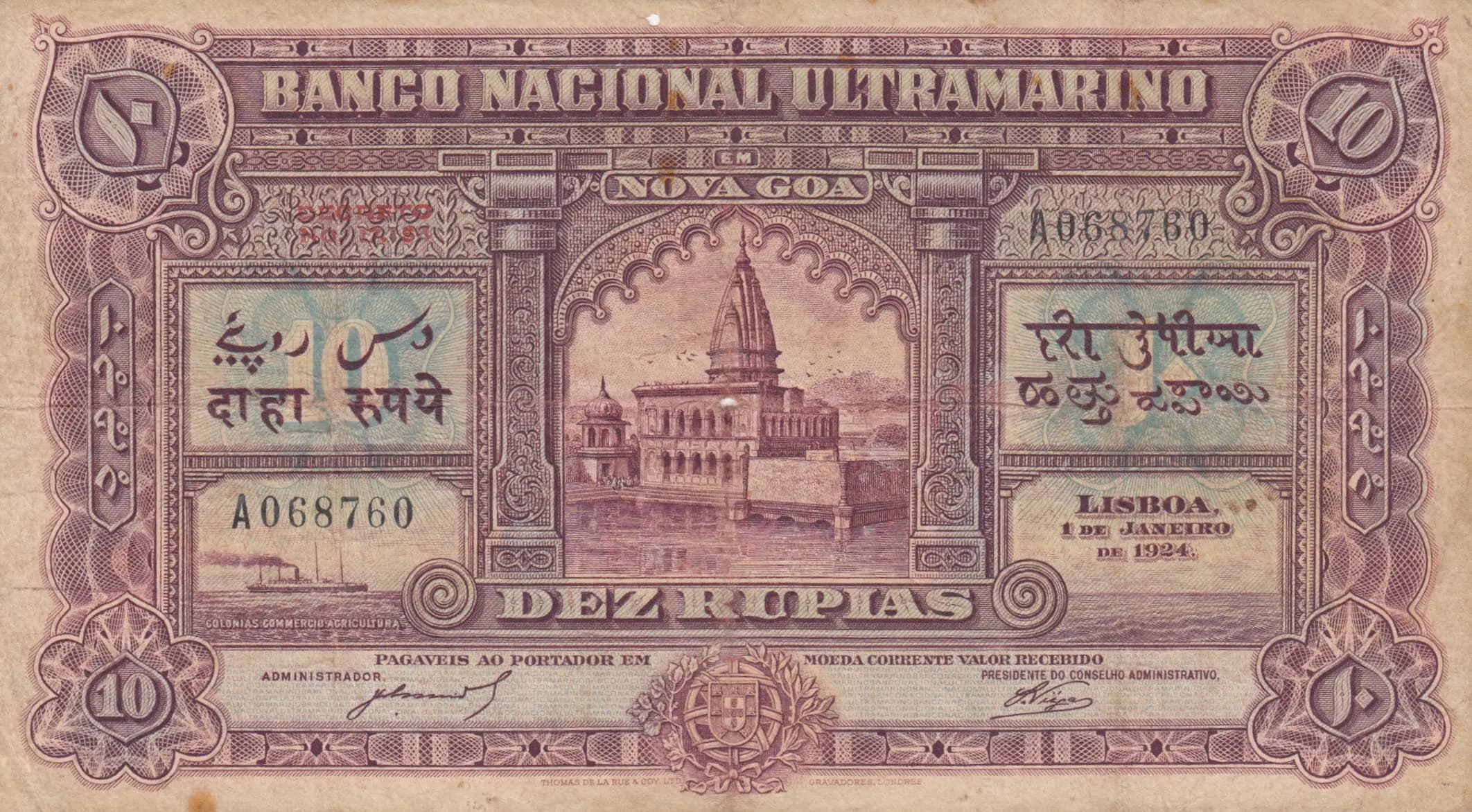
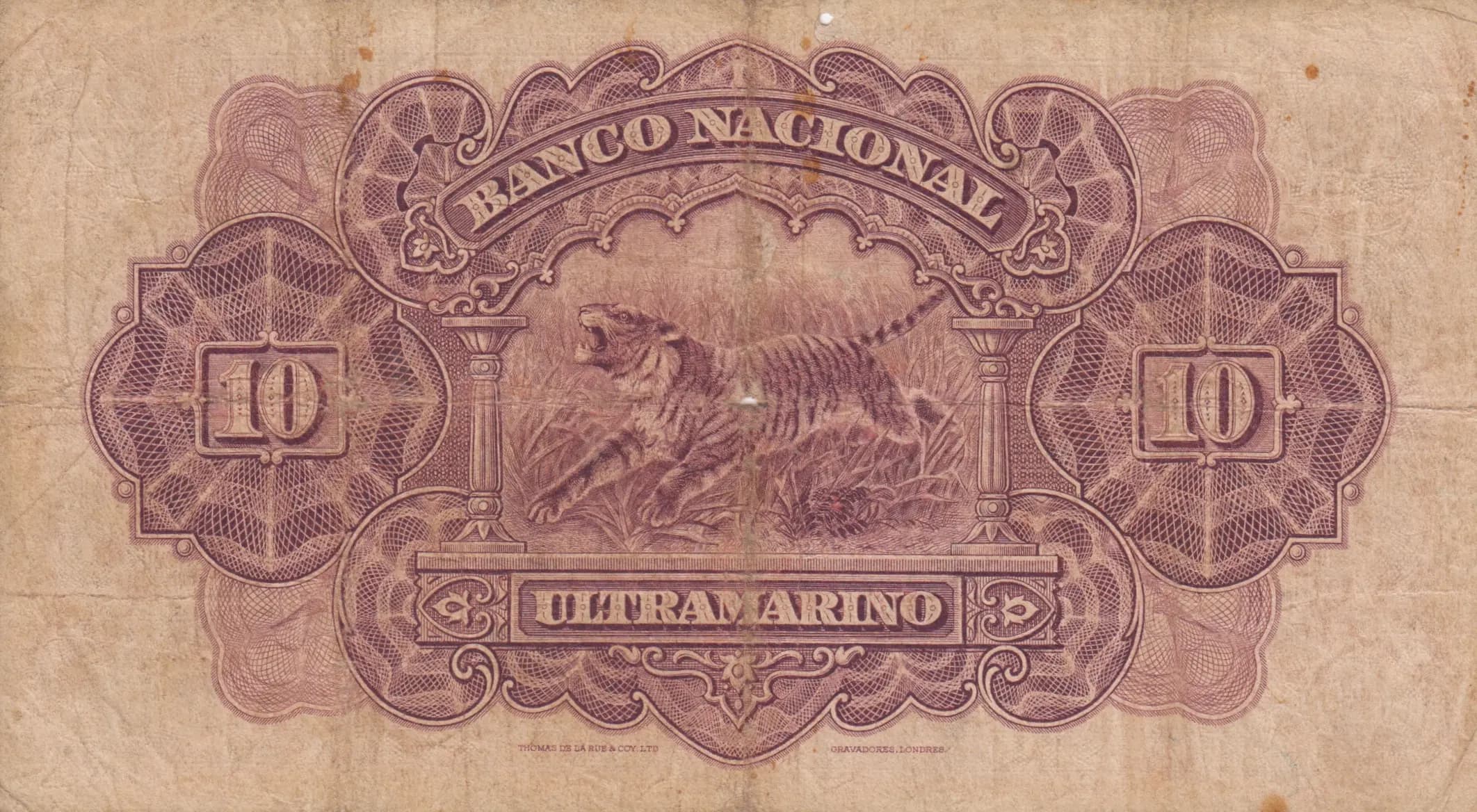
A scarce 10 Rupias banknote issued by Banco Nacional Ultramarino on February 4, 1924, representing Portuguese India's colonial currency during the final decades of Portuguese rule in Goa. The note exhibits the characteristic ornate purple/mauve color scheme typical of early 20th-century Portuguese colonial currency, featuring a prominent Hindu temple on the obverse—a culturally significant design choice reflecting Goa's diverse population—and a commanding lion on the reverse, both rendered in fine engraved detail by Thomas De La Rue & Co. The specimen shows honest wear consistent with circulation and age (approximately 100 years old), with period-appropriate foxing and staining, and grades Fair (F), making it a historically interesting artifact of Portuguese India's numismatic heritage.
Uncommon. While Portuguese India banknotes from this period are not rare in absolute terms, the 1924 10 Rupias Pick-26A is less frequently encountered than notes from later issues. The denomination was in circulation during a relatively brief period before subsequent reissues and design changes, and the passage of a century has resulted in significant attrition. The Fair condition grade further reduces availability, as most surviving specimens are either better preserved or significantly more worn. This note represents a mid-range rarity for Portuguese Indian currency—scarce enough to merit collector interest but not so rare as to command premium pricing.
This note was issued during the twilight era of Portuguese India, approximately two decades before the currency system would ultimately be replaced following India's independence and Portuguese withdrawal from Goa in 1961. The multilingual design—featuring Portuguese, Hindi/Devanagari, and likely Konkani scripts—reflects the complex linguistic and cultural reality of Portuguese colonial Goa, where Portuguese administrators governed a predominantly Hindu and Christian Indian population. The Hindu temple depicted on the obverse is a rare and politically significant design choice for a European colonial currency, suggesting Portuguese efforts to present themselves as respectful stewards of local religious and cultural institutions.
The obverse features a meticulously engraved Hindu temple with a distinctive tall spire characteristic of Goan Vaishnava temple architecture, prominently positioned in the center and framed by ornate scrollwork and baroque-style ornamentation. The temple design reflects the religious plurality of Portuguese India and serves as a cultural symbol of Goa's indigenous population. Flanking the central vignette are decorative cartouches containing the denomination '10' in numerals. The bilateral inscription panels display text in Devanagari script (likely Hindi) on the left and Konkani script on the right, demonstrating the issuing authority's attempt to address local populations in their own languages. The reverse displays a commanding roaring lion in profile, centrally positioned within an elaborate oval frame with fine scrollwork, symbolizing Portuguese imperial authority. The lion is rendered in dynamic pose with careful attention to anatomical detail and mane texture, typical of Thomas De La Rue's high-quality engraving standards. Both sides employ the characteristic cream and purple color palette with supporting text in Portuguese, establishing clear authority and denomination.
FRONT SIDE: 'BANCO NACIONAL ULTRAMARINO' (National Overseas Bank); 'NOVA GOA' (New Goa); 'DEZ RUPIAS' (Ten Rupias); 'LISBOA 4 DE FEVEREIRO DE 1924' (Lisbon, February 4, 1924); 'PAGAVEIS AO PORTADOR EM MOEDA CORRENTE VALOR RECEBIDO' (Payable to Bearer in Current Currency Value Received); 'ADMINISTRADOR' (Administrator); 'PRESIDENTE DO CONSELHO ADMINISTRATIVO' (President of Administrative Board); 'COLONIAS COMMERCIALAGRICULTURA' (Colonial Commercial Agriculture); Text in Devanagari/Konkani script (specific transcription unclear from image resolution). BACK SIDE: 'BANCO NACIONAL ULTRAMARINO' (National Overseas Bank); 'THOMAS DE LA RUE & CO LTD' (Thomas De La Rue & Company Limited); 'GRAVADORES LONDREA' (Engravers London).
Intaglio engraving by Thomas De La Rue & Co Ltd (noted as 'GRAVADORES LONDREA' on the reverse), the preeminent British security printer of the period. The note exhibits the hallmark characteristics of quality intaglio production: fine line work throughout borders and decorative elements, detailed stippling and cross-hatching in background areas creating depth and security against counterfeiting, and sharp, precisely engraved architectural and animal details. Multiple color printing was employed to achieve the purple/mauve and cream color scheme, applied through successive passes characteristic of early 20th-century security printing methods.
Pick-26A designation indicates this is variant A of the 1924 10 Rupias issue. The serial number visible on the obverse is 'A068760', indicating the A-series prefix typical of the primary printing run. The date notation 'LISBOA 4 DE FEVEREIRO DE 1924' (Lisbon, February 4, 1924) confirms the official issue date. Printer attribution to Thomas De La Rue & Co Ltd is confirmed on the reverse. No overprints or post-printing modifications are evident on this specimen. The note represents the standard variety for this Pick number without indication of rare signature or administrative board variations, though complete signature identification would require clearer image resolution of the signature cartouches at bottom center.