50 escudos 1971
About This Note
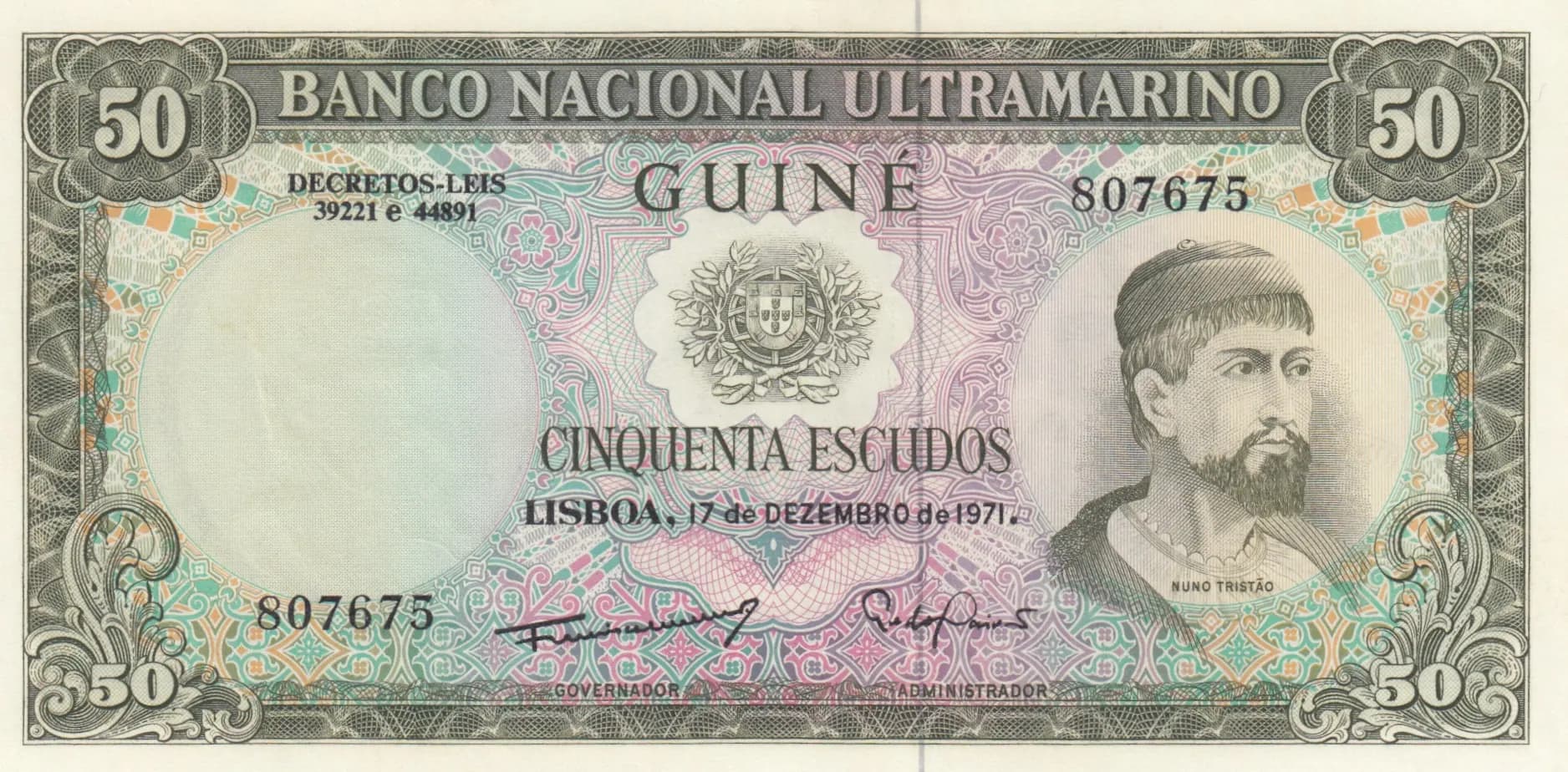
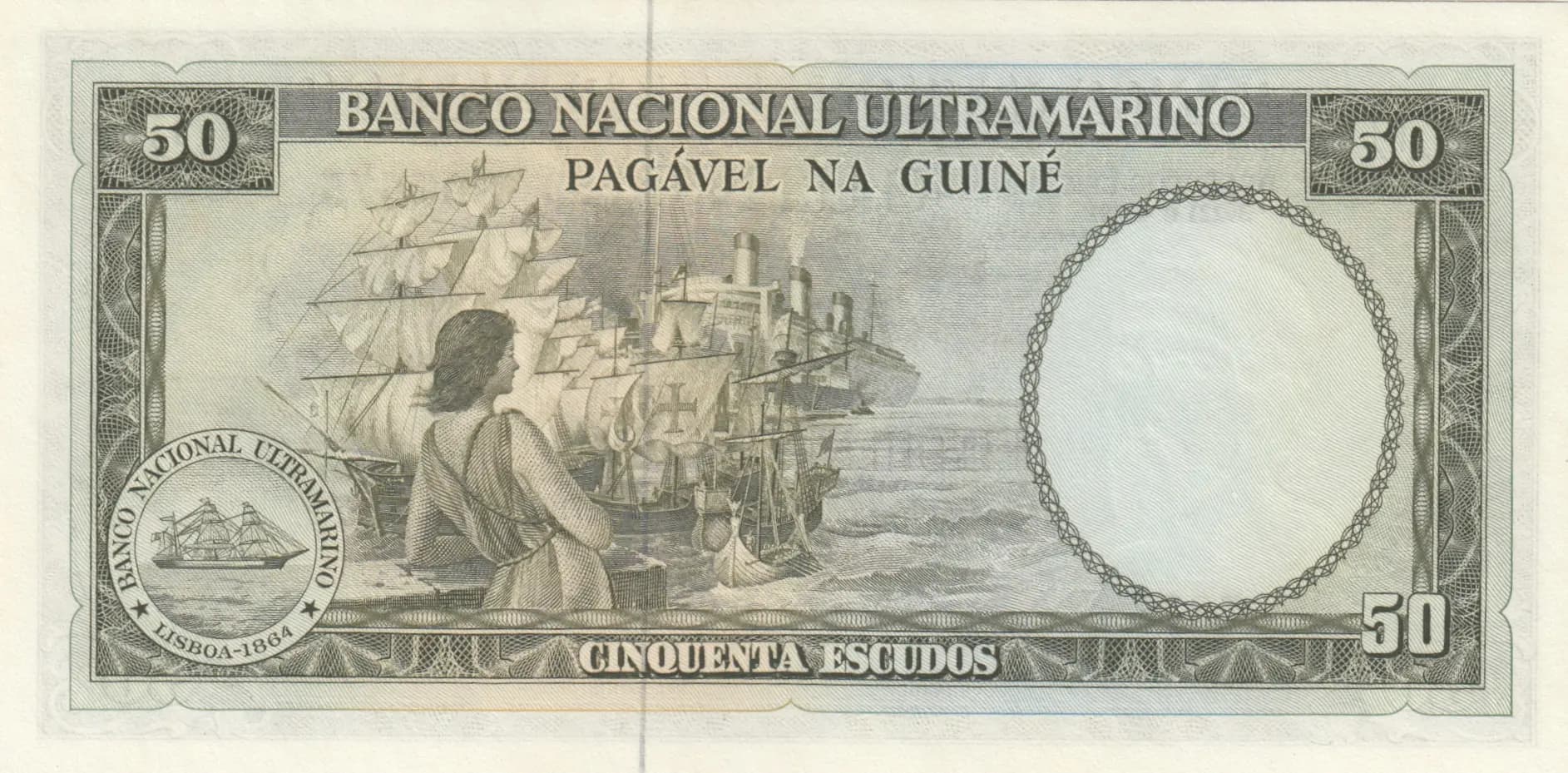
This is an uncirculated 1971 Portuguese Guinea 50 Escudos note (Pick P-44) issued by the Banco Nacional Ultramarino, displaying exceptional preservation with sharp printing and no visible wear. The front features a striking portrait of the Portuguese explorer Nuno Tristão with ornate multi-colored borders, while the reverse depicts a historically significant maritime scene reflecting Portugal's colonial and trading heritage. The note exemplifies the quality engraving standards of mid-20th century Portuguese colonial currency, making it a desirable example for collectors of Portuguese and African colonial numismatics.
Common. The 50 Escudos Portuguese Guinea note (P-44) from 1971 was issued in substantial quantities as a standard circulation denomination of the Banco Nacional Ultramarino during the final years of Portuguese colonial administration. No evidence of limited print runs, early recalls, or exceptional scarcity exists for this Pick number. While Portuguese colonial currency has collector interest, this particular denomination and issue remain readily available in the secondary market at modest valuations typical of common colonial-era banknotes. The UNC condition grade adds desirability but does not materially increase rarity, as many unissued notes from this period survive in pristine condition.
This note was issued during the final years of Portuguese colonial rule in Guinea, as the Banco Nacional Ultramarino maintained monetary authority over Portuguese overseas territories. The imagery reflects Portugal's historical identity: the reverse's detailed maritime harbor scene with sailing vessels references the nation's Age of Discovery and continued commercial interests in its African colonies, while the obverse's portrait of Nuno Tristão, a 15th-century Portuguese navigator, emphasizes the colonial narrative of Portuguese exploration. Issued just months before the 1974 Carnation Revolution that would ultimately end Portuguese colonial presence in Africa, this denomination represents a transitional moment in Guinea's monetary history.
The obverse features a left-facing profile portrait of Nuno Tristão, the 15th-century Portuguese explorer and navigator, positioned prominently on the right side of the note. The composition is framed by ornate decorative borders in green, purple, and tan, with the Portuguese coat of arms (shield with heraldic device and dual laurel wreaths) positioned centrally, symbolizing state authority. The reverse depicts an allegorical maritime commercial scene with a classically-dressed figure observing a bustling harbor filled with period sailing vessels and a coastal cityscape with fortified structures, emphasizing Portugal's mercantile and colonial maritime heritage. The bank's circular seal with sailing ship motif appears in the lower left of the reverse, reinforcing the Banco Nacional Ultramarino's identity and Portugal's overseas commercial interests. Both sides employ fine-line engraving with considerable detail work throughout.
FRONT: 'Banco Nacional Ultramarino' (Overseas National Bank) - issuing authority; 'Decretos-Leis 39221 e 44891' (Decrees-Laws 39221 and 44891) - regulatory basis; 'Guiné' (Guinea) - territory designation; 'Cinquenta Escudos' (Fifty Escudos) - denomination; 'Lisboa, 17 de Dezembro de 1971' (Lisbon, 17 December 1971) - authorization date; 'Nuno Tristão' - portrait identification; 'Governador' (Governor) and 'Administrador' (Administrator) - signature titles; Serial number 807675. BACK: 'Banco Nacional Ultramarino' (Overseas National Bank); 'Pagável na Guiné' (Payable in Guinea) - payment obligation; 'Cinquenta Escudos' (Fifty Escudos); 'Lisboa-1864' (Lisbon-1864) - bank founding reference within the institutional seal.
This note was produced using intaglio engraving (line engraving), the standard security printing method for Banco Nacional Ultramarino currency of this period. The technique is evident from the fine line work, detailed portrait rendering, ornate border patterns, and the characteristic crisp, sharp impression visible throughout the design. The Portuguese colonial note series was typically printed by Casa da Moeda (Portuguese Mint) or contracted European security printers such as Waterlow & Sons or De La Rue, though specific printer attribution for P-44 would require additional documentation. Security features include watermark areas (visible as blank spaces), fine engraving patterns as anti-counterfeiting measures, and the elaborate decorative borders integral to the intaglio process.
Based on PMG population data, three cataloged variants exist for Pick P-44: P-44a (standard 50 Escudos), P-44cts (likely specimen or test note variant), and P-44s (possibly signature or special issue variant). The examined note is consistent with P-44a, the standard circulation issue. Serial number 807675 places this note within the standard production series. Specific identification of variant type would require comparison of signature combinations, printing locations, or serial number ranges, which are not definitively distinguishable from the visual analysis alone. No overprints, date variations, or unusual serial characteristics are evident in the observed specimen.