1000 reis 1909
About This Note
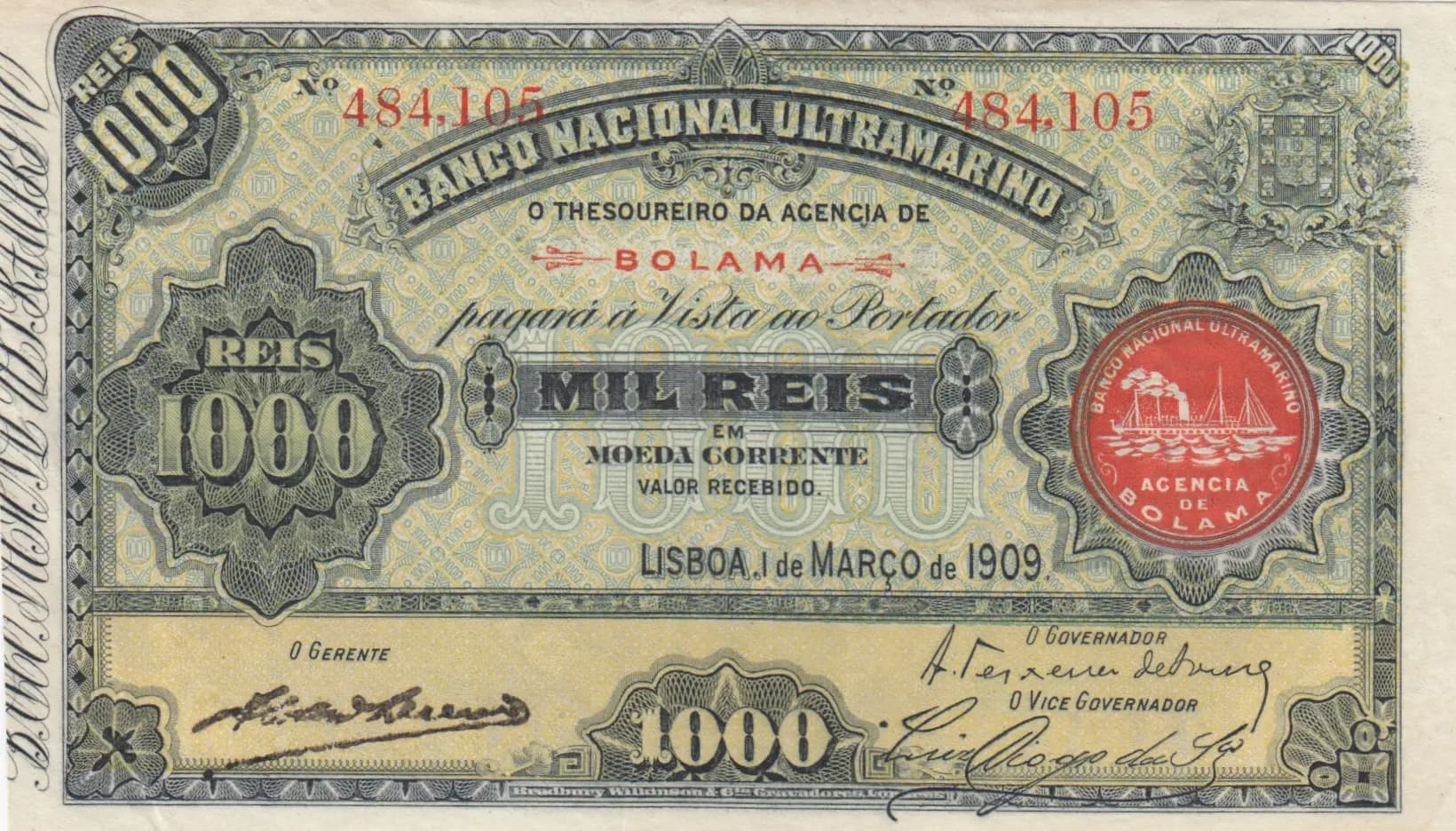
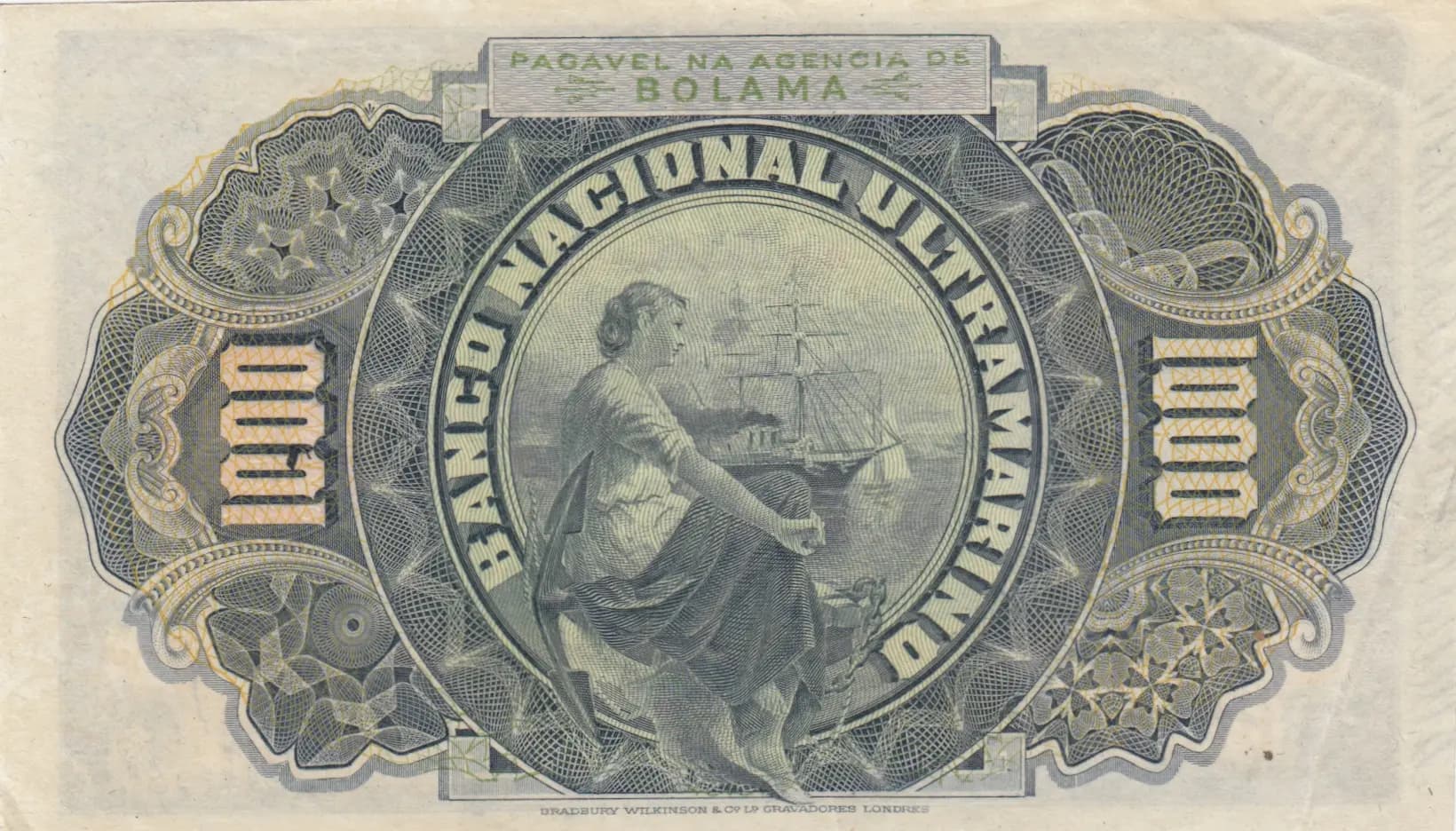
This is a VF-graded 1000 reis banknote from Portuguese Guinea issued by Banco Nacional Ultramarino on March 1, 1909, representing the earliest denomination in the Bolama Agency series. The note exhibits the hallmarks of early 20th century Portuguese colonial currency: ornate engraved decoration, a distinctive red circular seal featuring the Agencia de Bolama emblem, and classical allegorical imagery on the reverse. Despite visible foxing on the left margin and age-related yellowing typical of this era, the note remains structurally sound with crisp engraving details and legible signatures, making it a significant example of Portuguese Guinea's monetary history.
Common. This is the base Pick catalog number (P-1) for Portuguese Guinea's 1909 reis series, representing a standard-issue denomination from a colonial territory with a substantial circulation period (1909 onwards). While individual notes show age-related wear, the denomination was widely circulated throughout the Bolama Agency's administration. VF-graded examples represent a middle-ground condition state with no particular scarcity premium. The Pick catalog's notation of 22 variants for this base number indicates a substantial population of graded examples across different states and varieties.
Issued during the twilight of Portuguese colonialism in West Africa, this banknote represents the Banco Nacional Ultramarino's monetary authority over Portuguese Guinea's Bolama Agency, the colonial capital at the time. The allegorical female figure holding a sailing ship on the reverse symbolizes Portugal's maritime trading heritage and imperial commercial interests in Africa, while the formal governmental signatures (Governor, Vice Governor, Manager) underscore the colonial administrative hierarchy. The use of reis currency and Portuguese language reflects the peninsular power's grip on Guinea until the 1974 revolution.
The obverse presents a formal colonial administrative document layout with the Banco Nacional Ultramarino's authority statement centered, flanked by ornate star-shaped denomination frames. The dominant red circular seal on the right bears the Agencia de Bolama maritime emblem, symbolizing the agency's commercial and shipping authority. The reverse features a classical allegorical figure representing Commerce or Liberty, rendered in fine cross-hatched engraving, positioned within a circular medallion and holding a model sailing ship—a direct visual reference to Portuguese maritime commercial dominance. Decorative corner flourishes with botanical elements frame the composition symmetrically. The note's geometric border patterns and serif typography exemplify the refined security engraving standards of the Edwardian era.
FRONT SIDE: 'BANCO NACIONAL ULTRAMARINO' (Ultramarino National Bank) / 'O THESOUREIRO DA AGENCIA DE BOLAMA' (The Treasurer of the Bolama Agency) / 'Promete a Vista ao Portador' (Promises to Pay to the Bearer on Sight) / 'MIL REIS' (One Thousand Reis) / 'EM MOEDA CORRENTE VALOR RECEBIDO' (In Current Currency Value Received) / 'LISBOA, 1 de MARÇO de 1909' (Lisbon, 1st of March 1909) / 'O GERENTE' (The Manager) / 'O GOVERNADOR' (The Governor) / 'O VICE GOVERNADOR' (The Vice Governor) / Serial number: 484,105. BACK SIDE: 'PAGAVEL NA AGENCIA DE BOLAMA' (Payable at the Bolama Agency) / 'BANCO NACIONAL ULTRAMARINO' (Ultramarino National Bank) / 'BRADBURY WILKINSON & Co GRAVADORES LONDRES' (Bradbury Wilkinson & Co Engravers London).
Steel plate line engraving, executed by the London-based security printer Bradbury Wilkinson & Co (as credited on the reverse). The intricate fine-line work, detailed cross-hatching in the portrait, complex decorative borders, and geometric patterns are characteristic of high-security engraved banknote production of the period. The crisp impression quality visible in the surviving example demonstrates the precision of Edwardian engraving technology.
This note is identified as Pick P-1 (Bolama, 1000 reis). The visual analysis confirms the base characteristics: 1909 Lisbon issue date, serial number 484,105 in red, signatures of the colonial administrative triumvirate (Governor, Vice Governor, Treasurer/Manager), and the Bradbury Wilkinson engraving credit. The PMG population data indicates multiple signed variants exist (P-1, P-1A, P-1s, P-1As), suggesting signature sequence variations are recognized. This specific example, with its legible signature marks and complete inscription set, appears to be from the primary printing run. No overprints or modifications are evident from the visual analysis.