10 centavos 1914
About This Note
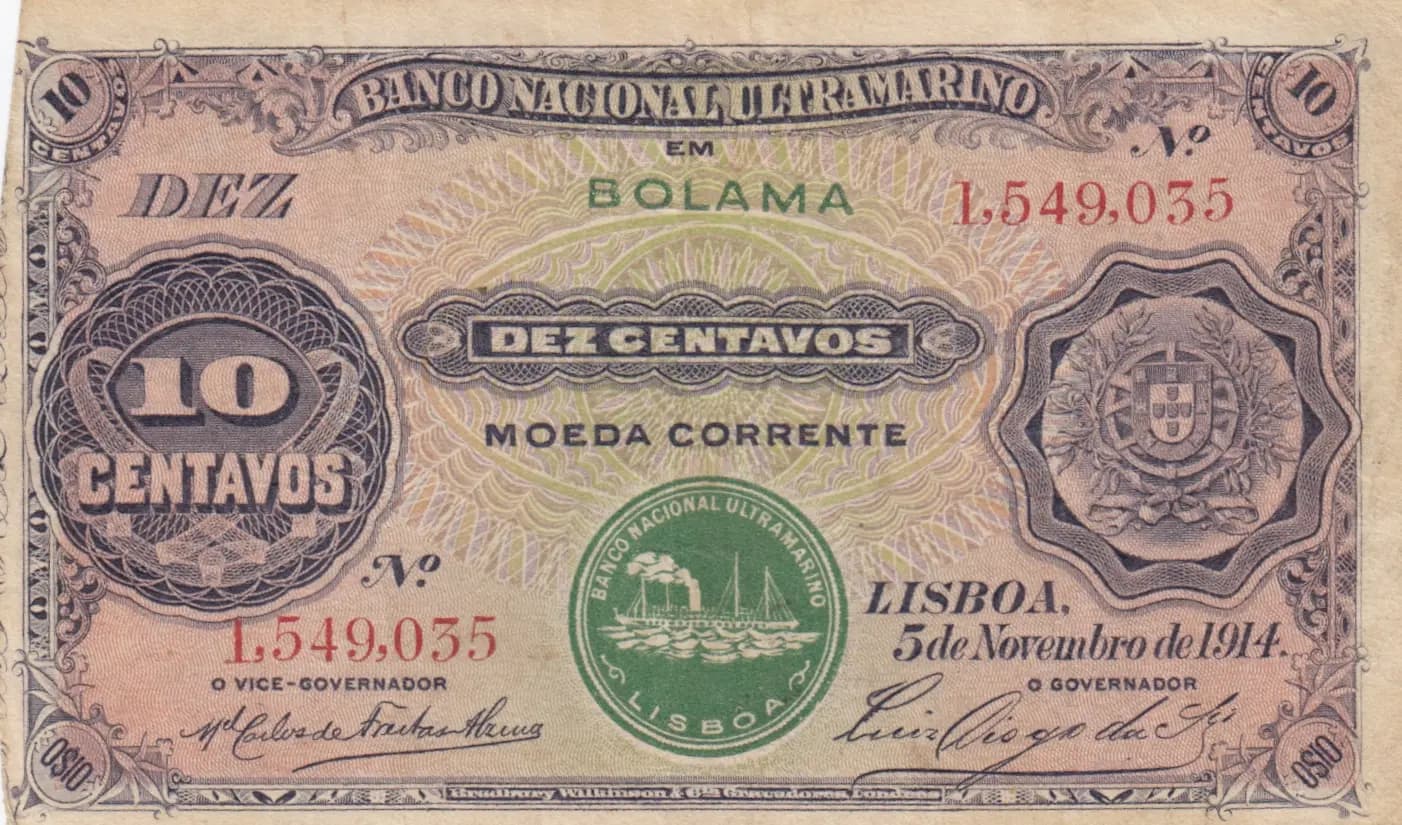
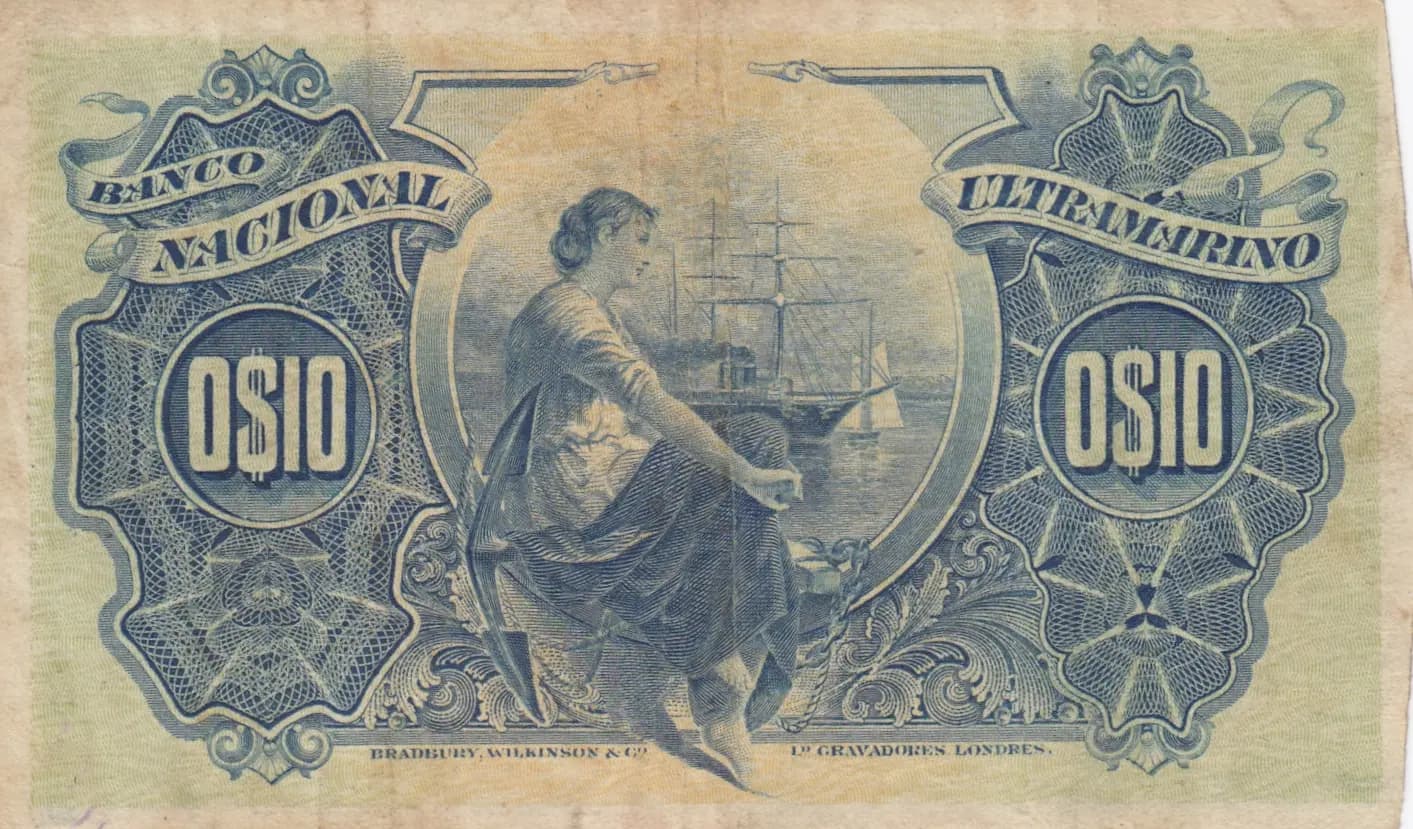
This is a 10 centavos banknote from Portuguese Guinea issued by the Banco Nacional Ultramarino in 1914, graded in Fine condition. The note features ornate belle époque engraving with a maritime theme on both sides—a circular emblem with a sailing ship anchors the front, while the reverse showcases an allegorical female figure gesturing toward a harbor scene. Despite minor age-related discoloration and handling wear consistent with its century-old circulation history, the engraved details remain relatively well-preserved, making this an interesting example of early Portuguese colonial currency.
Common. The 10 centavos denomination from Portuguese Guinea's 1914 issue is a standard circulating denomination from a relatively straightforward colonial currency series. While specific population data is limited, the denomination and period suggest a reasonably substantial print run typical of everyday currency needs in the colony. Notes in Fine condition are not exceptionally scarce, though better-preserved examples may command premiums among colonial currency specialists.
This note was issued during the height of the Portuguese colonial era, specifically from the territory of Portuguese Guinea (now Guinea-Bissau), with the date marked as 'Lisbon, November 5, 1914.' The maritime imagery—the prominent sailing ship on the front circular emblem and the harbor scene with the allegorical figure on the reverse—reflects Portugal's historical identity as a maritime trading nation and the importance of naval commerce to the colonial enterprise. The Banco Nacional Ultramarino, established to manage currency across Portugal's overseas territories, issued this denomination to facilitate trade and commerce within the colonial possession of Bolama.
The front features a formal layout with decorative Art Nouveau-style borders in the corners and a central circular emblem at the bottom containing a sailing ship with the issuer's name and location mark (Lisboa). The denomination appears in ornamental circular markers in all four corners. The Portuguese coat of arms (shield) is positioned on the right side. The reverse showcases a classical allegorical composition, likely representing Commerce or Navigation, depicted as a female figure in Greco-Roman dress positioned prominently in the center, gesturing toward a multi-masted sailing ship in a harbor setting. Shield-shaped heraldic elements frame the central vignette in the upper corners, labeled 'Banco Nacional' and 'Ultramarino' respectively. The color scheme combines purple/mauve and green on the front with blue/teal on the reverse, all on cream-colored paper characteristic of early 20th-century banknote production.
FRONT SIDE: 'Banco Nacional Ultramarino' (National Overseas Bank); 'Dez Centavos' / 'DEZ' (Ten Centavos / Ten); 'Em Bolama' (In Bolama); 'Moeda Corrente' (Current Currency); 'Lisboa, 5 de Novembro de 1914' (Lisbon, November 5, 1914); 'Vice-Governador' (Vice-Governor); 'Governador' (Governor); Serial number '1,549,055'. BACK SIDE: 'Banco Nacional' (National Bank); 'Ultramarino' (Overseas); 'Bradbury, Wilkinson & Co' (the engraving company); 'L'd Gravadores Londres' (The Engravers London); 'OSIO' (maker's mark or abbreviation, likely related to the engraver).
Intaglio engraving (copperplate/steel plate engraving), as evidenced by the fine line work, detailed cross-hatching, and intricate decorative patterns visible throughout both sides. The note was engraved and printed by Bradbury, Wilkinson & Co, Ltd., a renowned London-based security printer specializing in banknote and currency production during this period. This firm was known for high-quality intaglio work and produced many colonial and international banknotes during the early 20th century.
This note is cataloged as Pick P-6 for the 10 centavos denomination issued in Bolama. PMG records indicate two variants exist for this base Pick number: P-6 and P-6s (specimen note), both designated as '10 Centavos - Bolama.' The observed note represents the standard circulating variety (P-6) rather than a specimen issue. The serial number '1,549,055' visible on this example places it within the normal circulation series. No overprints, signature variations, or other notable markings that would constitute a distinct variety are apparent in the visual analysis.