1000 escudos 1964
About This Note
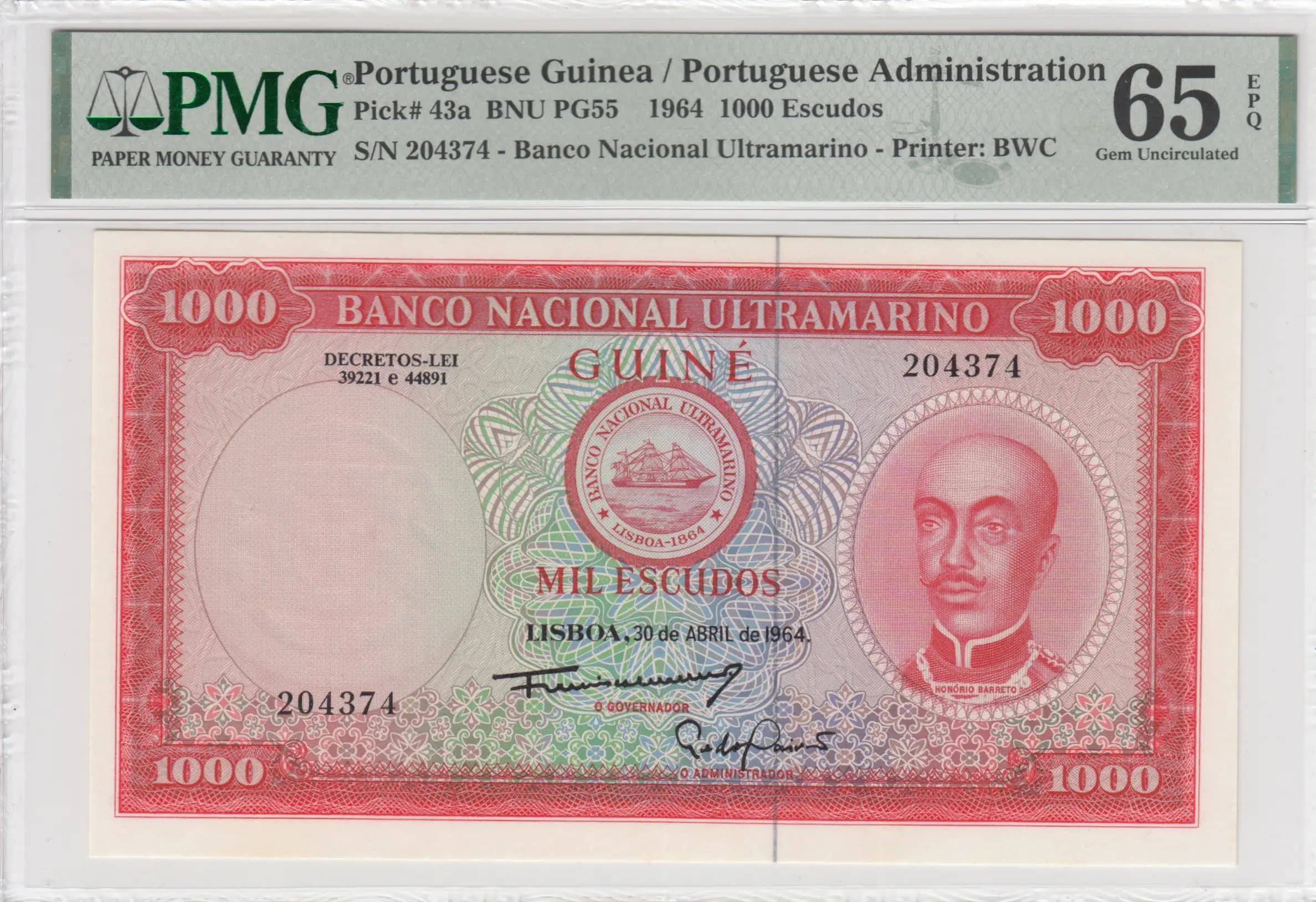
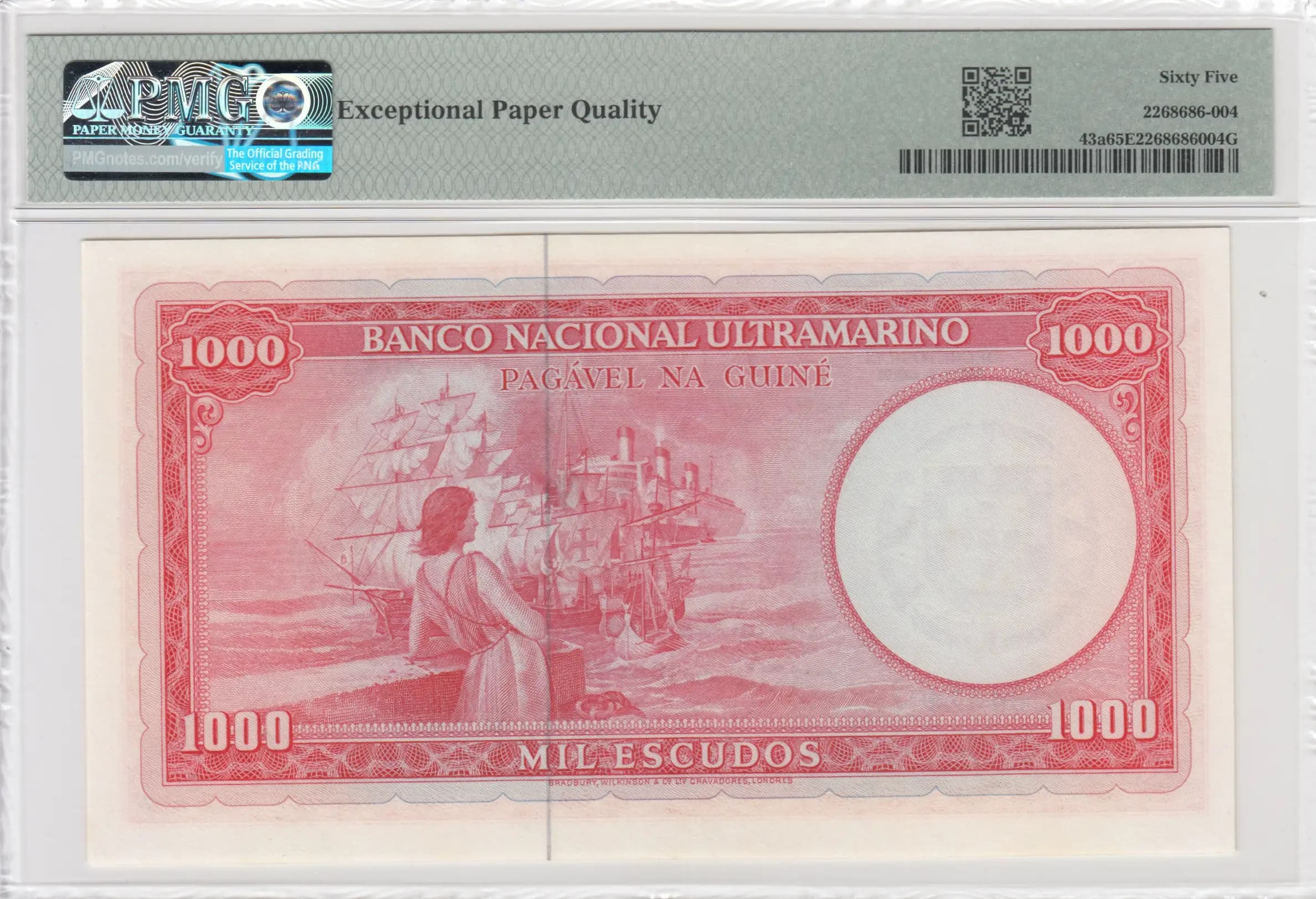
This is a gem uncirculated Portuguese Guinea 1000 escudos banknote from 1964, graded PMG 66 EPQ, issued by the Banco Nacional Ultramarino in Lisbon. The note features a striking portrait of Horacio Barreto on the front rendered in red and pink tones with ornate decorative borders, while the reverse depicts an allegorical colonial maritime scene with sailing vessels and a fortified settlement. The pristine condition, intricate intaglio printing, and historical significance as currency from Portuguese Guinea during the late colonial period make this an attractive addition to Portuguese and colonial banknote collections.
Common. Portuguese Guinea 1000 escudos notes from 1964 (Pick P-43 and its variants) were produced in substantial quantities as a standard high-denomination currency for the territory. While Portuguese Guinea currency is less frequently encountered in the global numismatic market compared to European banknotes, the 1000 escudos denomination from this series was not subject to limited print runs or early recall. The existence of four catalogued variants (P-43a, P-43cts, P-43r, P-43s) with PMG grades suggests adequate surviving populations across the variants. Notes of this type typically trade at modest prices consistent with common colonial currency, and the PMG 66 EPQ grade, while representing excellent condition, does not indicate rarity of the type itself.
This 1000 escudos note was issued on April 30, 1964, by the Banco Nacional Ultramarino (National Ultramarine Bank), the Portuguese colonial banking institution that managed currency throughout Portugal's overseas territories. The reverse's depiction of Portuguese maritime commerce and colonial fortifications reflects the era's celebration of Portugal's imperial heritage, issued during a period when Portugal still maintained firm control over its African colonies, which would not gain independence until a decade later. Horacio Barreto, whose portrait graces the front, was a prominent figure in Portugal's colonial administration during this period.
The obverse features a right-facing profile portrait of Horacio Barreto, a Portuguese colonial administrator, rendered in multicolor intaglio with red, pink, and green tones. The Banco Nacional Ultramarino's circular seal—featuring a ship and inscribed 'LISBOA-1864'—appears at the top center, establishing the bank's historical legitimacy dating back to its 1864 founding. Ornate decorative rosette patterns and scrollwork in red and green frame the denomination and official text. The reverse depicts an allegorical scene of Portuguese colonial maritime commerce, with a female figure in classical dress representing Portugal or commerce, accompanied by a multi-masted sailing ship and fortified colonial settlement architecture in the background, all framed by elaborate red decorative borders. A large blank circular area on the reverse right side was reserved for central bank stamps or additional markings.
Front Side: '1000' (One thousand); 'BANCO NACIONAL ULTRAMARINO' (National Ultramarine Bank); 'GUINÉ' (Guinea); 'MIL ESCUDOS' (One Thousand Escudos); 'DECRETOS-LEI' (Decree-Laws); '39221 e 44891' (Decree-Laws numbers 39221 and 44891); '204374' (Serial number); 'LISBOA, 30 de ABRIL de 1964' (Lisbon, April 30, 1964); 'O GOVERNADOR' (The Governor); 'O ADMINISTRADOR' (The Administrator); 'HORACIO BARRETO' (Horacio Barreto - depicted person). Back Side: '1000' (One thousand); 'BANCO NACIONAL ULTRAMARINO' (National Ultramarine Bank); 'PAGÁVEL NA GUINÉ' (Payable in Guinea); 'MIL ESCUDOS' (One Thousand Escudos).
Intaglio printing (engraving) on a single pass with multicolor overlay, employing fine line work and guilloche patterns throughout. The ornate decorative borders, intricate portrait rendering, and complex architectural details visible in the colonial settlement and maritime scenes demonstrate the high security printing standards of the Banco Nacional Ultramarino's contracted security printer. The Portuguese colonial notes of this era were typically produced by Casa da Moeda (Portuguese Mint) or contracted European security printers such as Waterlow & Sons or similar firms specialized in Portuguese banknote production.
This note is catalogued as Pick P-43a, one of four recognized variants of the 1000 escudos 1964 issue. The Pick catalog lists P-43cts, P-43r, and P-43s as variants, likely distinguished by signature combinations, date variations, or security feature differences. The observed specimen bears the date 'LISBOA, 30 de ABRIL de 1964' and displays signatures of 'O GOVERNADOR' (The Governor) and 'O ADMINISTRADOR' (The Administrator) with serial number 204374. Specific signature identification would be required to confirm whether this note represents the base P-43a variety or corresponds to another catalogued variant; however, the standard April 30, 1964 date and dual signature format are consistent with the primary 1964 issue type.