100 escudos 1971
About This Note
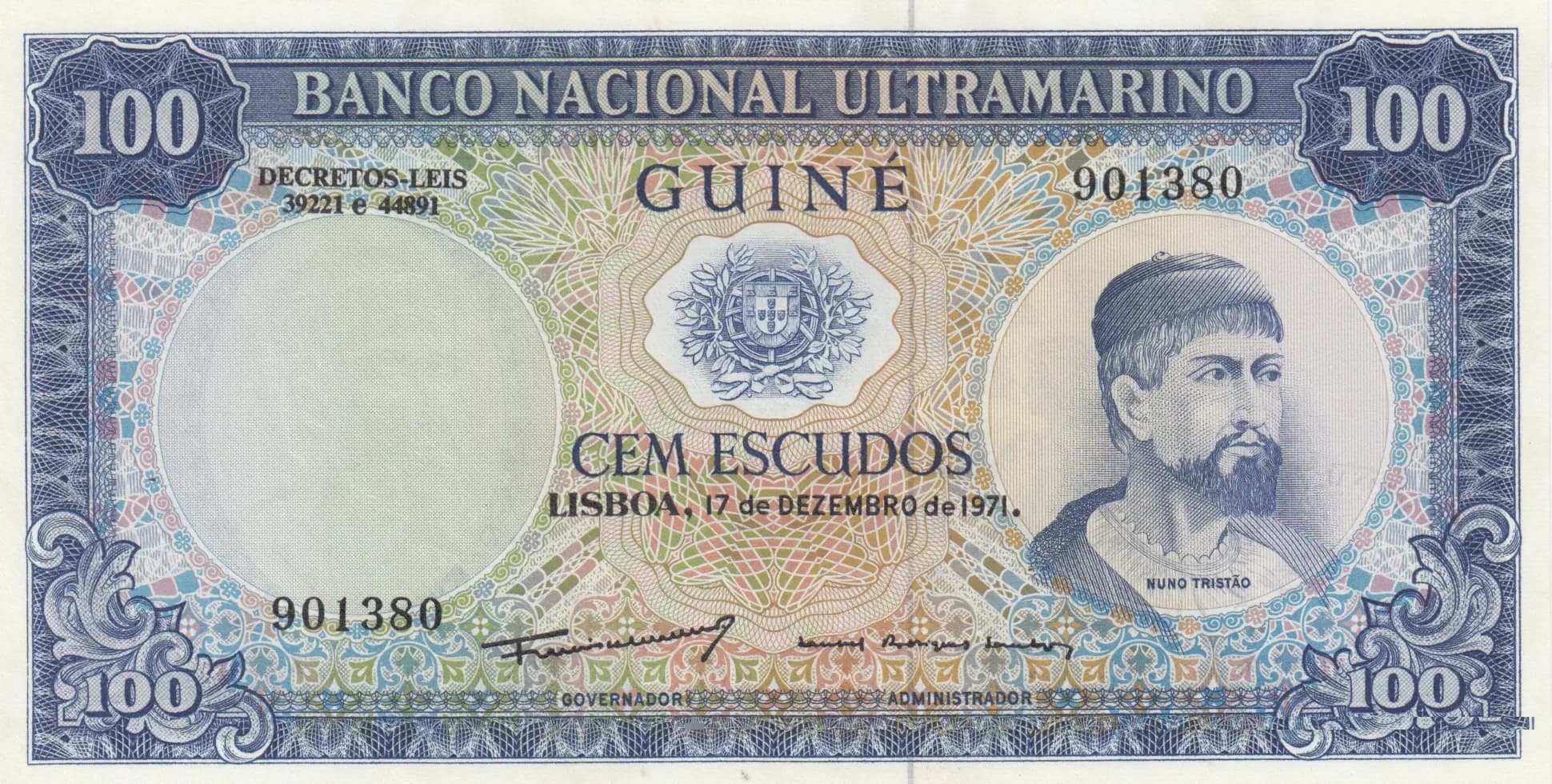
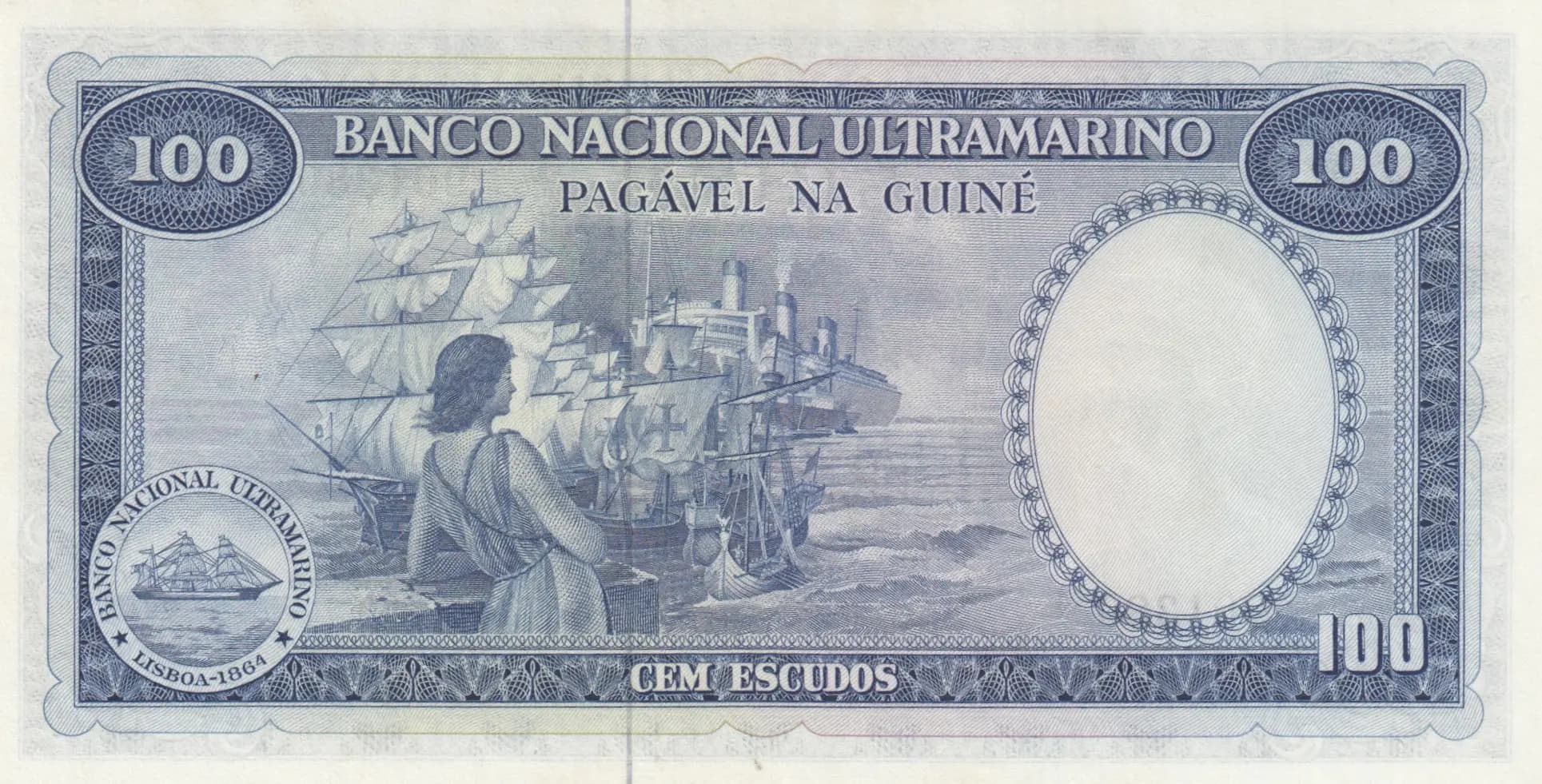
This is an uncirculated 100 Escudos banknote from Portuguese Guinea, issued by the Banco Nacional Ultramarino on December 17, 1971. The note features exceptional engraved detail with a portrait of the Portuguese explorer Nuno Tristão on the obverse and a classical maritime scene on the reverse, reflecting Portugal's colonial heritage and exploration history. In UNC condition with crisp paper and vibrant multi-colored printing, this example displays the fine line work and ornate geometric patterning characteristic of high-security banknote production from this era.
Common. The 100 Escudos denomination from Portuguese Guinea's final colonial period was issued in substantial quantities before Guinea-Bissau's independence in 1974. No evidence of restricted print runs, early recalls, or short circulation periods exists for this Pick number. Standard collector circulation and survival rates suggest this denomination remains common in both used and uncirculated grades. As a late-colonial note from a relatively short-lived issuing authority (pre-1974), it holds historical interest but not numismatic rarity.
This banknote was issued during the final years of Portuguese colonial rule in Guinea-Bissau, when Portugal's Ultramarino National Bank maintained control of Guinea's currency. The obverse features Nuno Tristão, a 15th-century Portuguese navigator and explorer who was instrumental in early Portuguese maritime expansion along the African coast—a symbolic choice reflecting Portugal's justification of its colonial presence through historical exploration narratives. The reverse's maritime scene with sailing vessels emphasizes the oceanic trade routes and naval dominance that formed the foundation of the Portuguese empire, making this note a numismatic artifact of late-colonial Portuguese Africa.
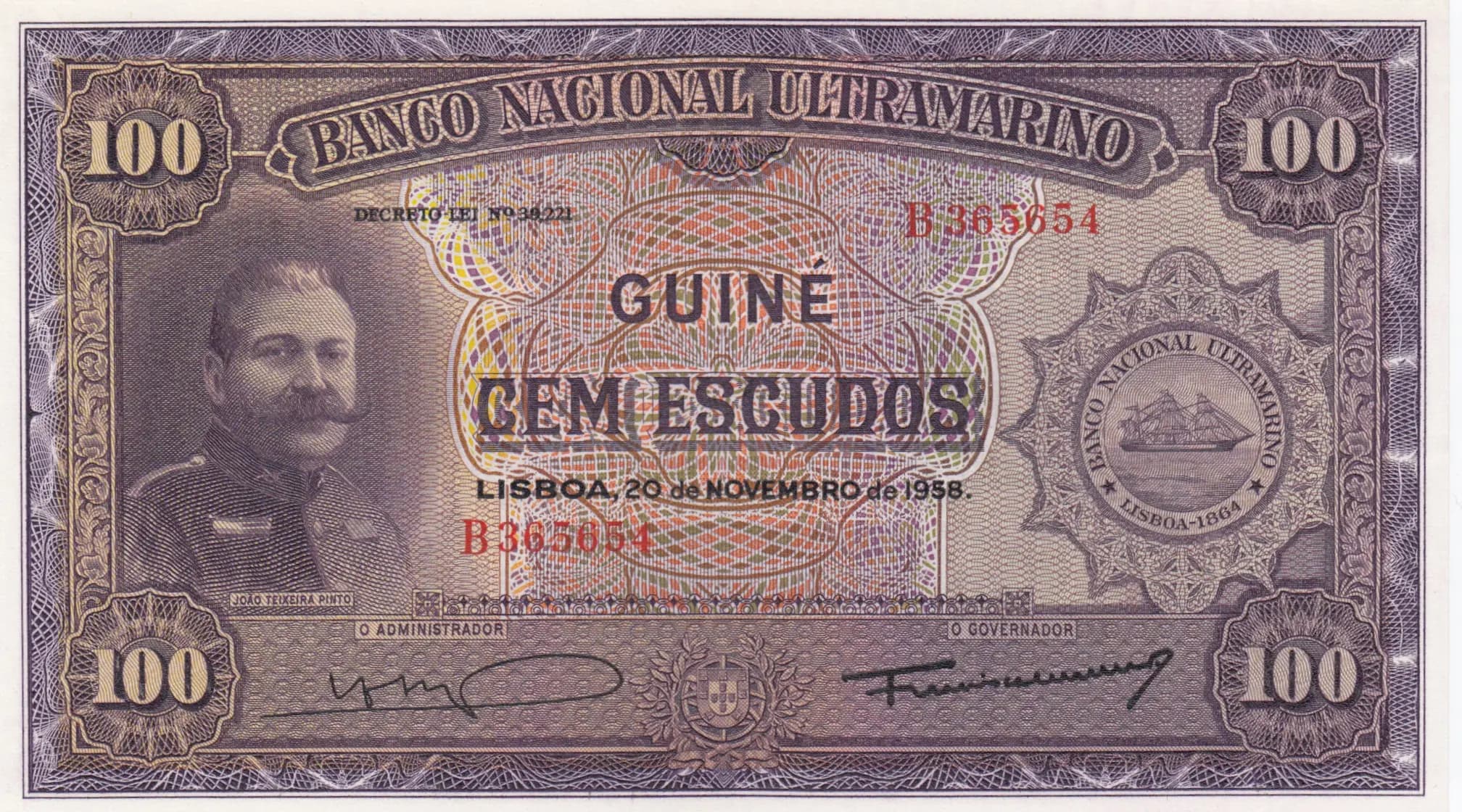
The obverse features a classical numismatic design centered on the Portuguese national coat of arms with shield flanked by ornamental laurel wreaths, symbolizing official state authority. To the right is a profile portrait of Nuno Tristão, the 15th-century Portuguese explorer and navigator, rendered in fine engraved detail showing his bearded visage in classical style. The note is bordered by ornate corner ornaments with curved flourishes, and the denomination 100 appears in large numerals in all four corners. The reverse depicts a historical maritime scene with a classical or Renaissance-period figure gazing toward multiple full-rigged sailing ships under sail, reinforcing themes of Portuguese maritime exploration and colonial expansion. The Banco Nacional Ultramarino emblem featuring a ship and the founding date 'Lisboa-1864' appears on the lower left, anchoring the design to the institution's establishment during the height of the Portuguese empire. The entire design employs intricate line work and geometric background patterns as anti-counterfeiting measures.
FRONT: Banco Nacional Ultramarino (Ultramarino National Bank) | Guine (Guinea) | Decretos-Leis 39221 e 44891 (Decrees-Laws 39221 and 44891) | Cem Escudos (One Hundred Escudos) | Lisboa, 17 de Dezembro de 1971 (Lisbon, December 17, 1971) | Nuno Tristão (proper name) | Governador (Governor) | Administrador (Administrator) | Serial number: 901380. BACK: Banco Nacional Ultramarino (Ultramarino National Bank) | Pagável na Guine (Payable in Guinea) | Cem Escudos (One Hundred Escudos) | Lisboa-1864 (Lisbon-1864, commemorating the bank's establishment) | Denomination markers: 100.
Intaglio (engraved) printing on banknote paper, characteristic of Banco Nacional Ultramarino currency production from this period. The fine line work, detailed geometric patterns, and three-dimensional relief quality visible in the imagery indicate professional security banknote printing. The multi-color printing (dark blue, light blue, green, yellow, and pink) was applied using multiple passes typical of 1970s banknote production standards. The Portuguese security printer for Ultramarino banknotes during this period was typically Waterlow & Sons or similar specialized facilities.
The observed specimen appears to be Pick-45a based on PMG's cataloging system. The note displays the standard 1971 design with serial number 901380. Variants P-45cts and P-45s exist in the PMG population, likely representing different signature combinations or administrative official variants typical of Ultramarino currency production. The December 17, 1971 date shown on this example is the standard issue date for this series.