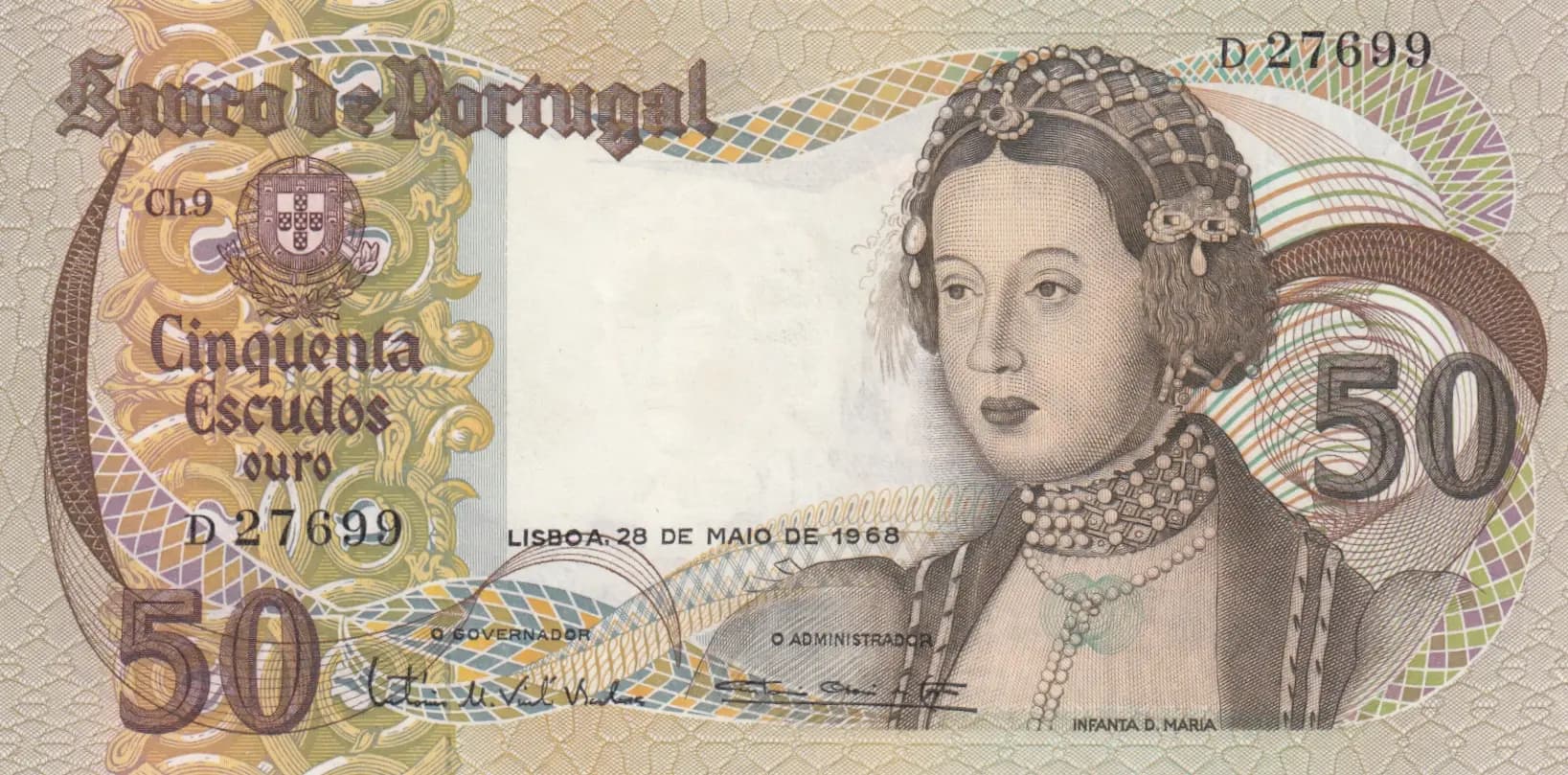
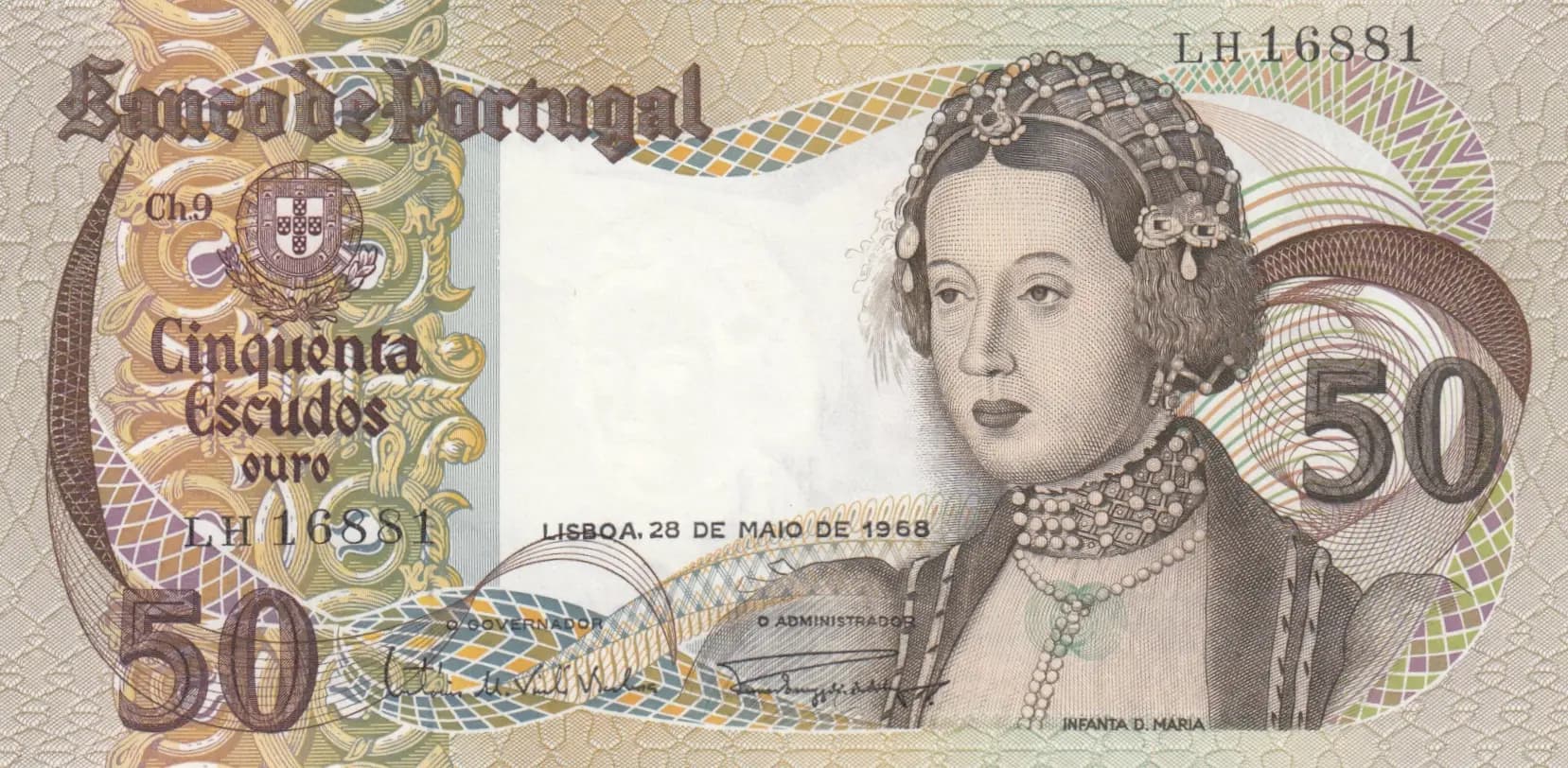
50 escudos 1968
Market Prices
19 salesAbout This Note
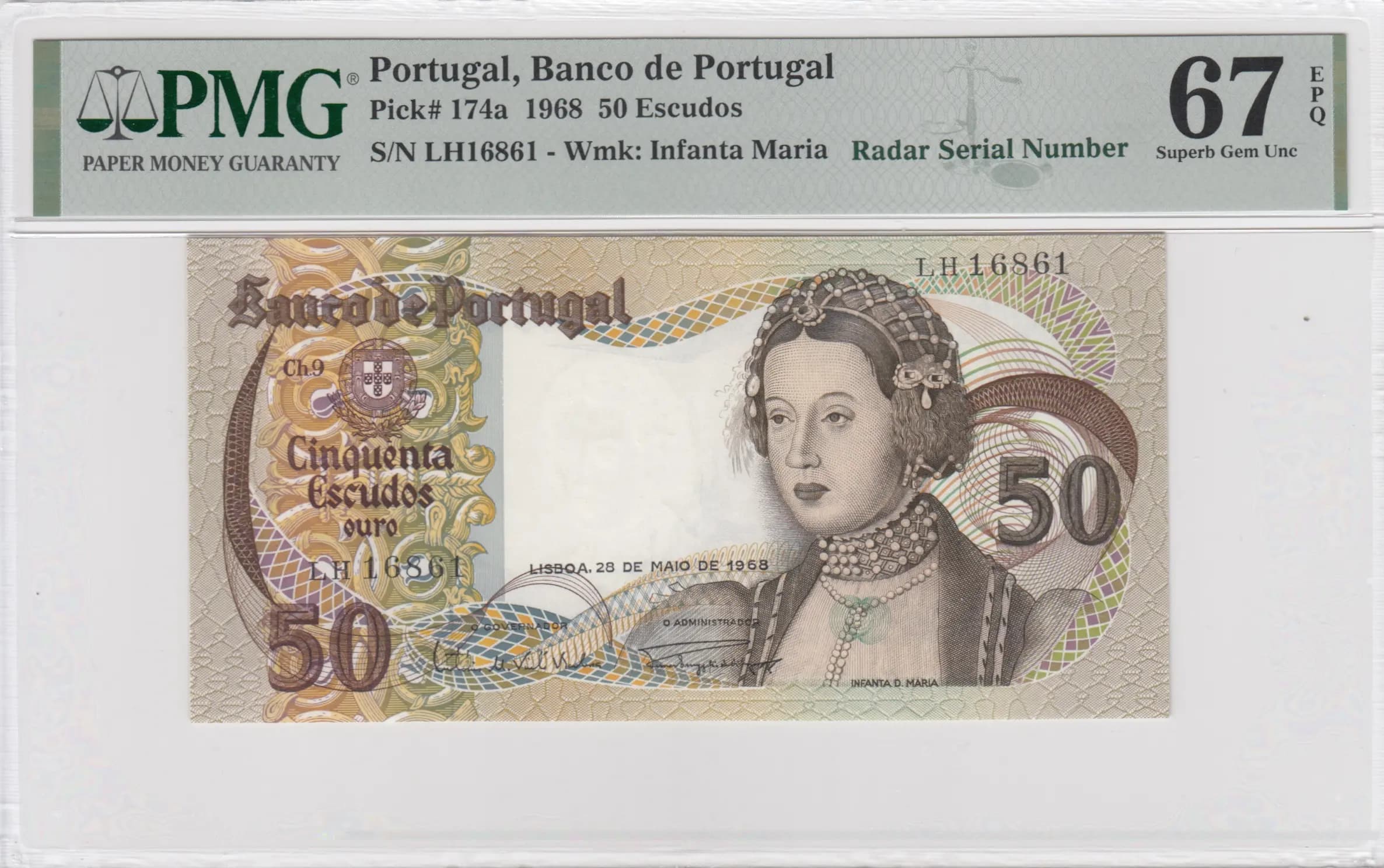
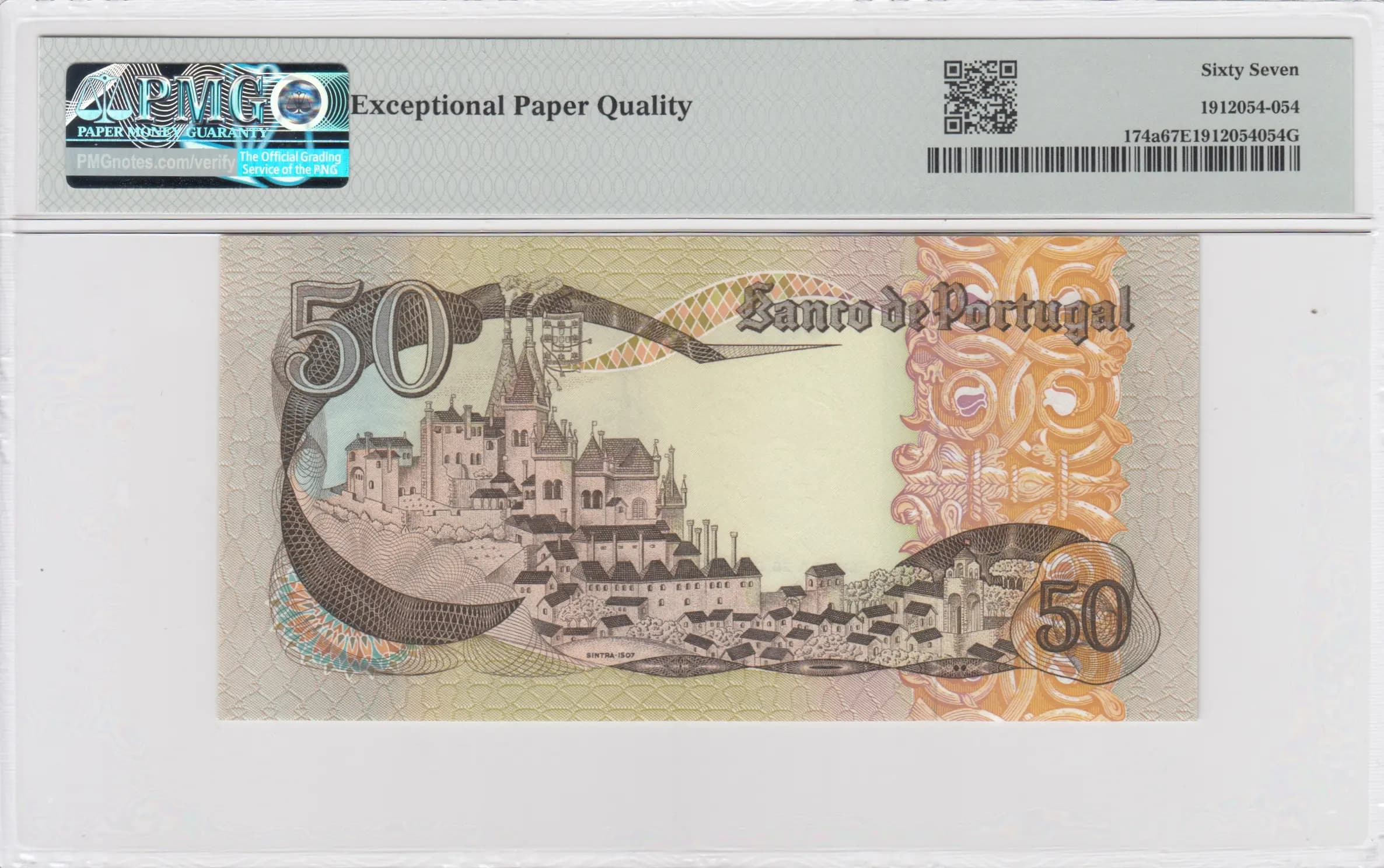
This is an exceptional example of the Portuguese 50 Escudos 1968 issued by Banco de Portugal, graded PMG 67 EPQ. The note features an elegant portrait of Infanta D. Maria in elaborate 16th-century attire with pearl necklaces on the obverse, paired with a detailed engraving of the medieval castle of Sintra on the reverse. In this near-gem uncirculated condition, the note displays pristine paper quality, sharp printing throughout, and vibrant multicolored security features including geometric guilloche patterns and color-shifting elements—making it an attractive example for Portuguese currency collectors.
Common. eBay auction price history shows consistent sales in the $2-$6 range for VF-EF examples, with PMG-graded examples at this grade level (PMG 65-68) selling in the $23-$85 range, indicating steady collector interest but no scarcity premium. The 1968 issue had substantial print runs, and this note type remains readily available in the numismatic market. The PMG 67 EPQ grade represents an above-average example but not a rare or exceptional find for this series.
Issued on May 28, 1968, during the Estado Novo period under the Salazar regime, this note commemorates Portugal's royal heritage through the portrait of Infanta D. Maria, a member of the Portuguese royal family. The reverse depicts Sintra's historic castle complex, one of Portugal's most iconic landmarks symbolizing the nation's medieval power and architectural legacy. The note's design reflects Portugal's cultural nationalism during this period, emphasizing both royal lineage and national patrimony.
The obverse features a three-quarter length portrait of Infanta D. Maria positioned at right, rendered in the refined style of 16th-century Portuguese court dress, complete with elaborate pearl necklaces, a jeweled headdress, and period-appropriate clothing. The left side displays the Portuguese coat of arms and ornamental elements including a decorative cross in a circular medallion, with 'Cinquenta escudos ouro' inscribed above. The reverse presents a detailed architectural scene of the medieval fortified settlement of Sintra, depicted from an elevated perspective showing multiple towers, crenellated defensive walls, and clustered buildings typical of Portuguese medieval architecture. Both sides are framed by sophisticated geometric and floral ornamental borders in period style. The color palette combines cream and beige base tones with multicolored security features in purple, green, gold, brown, and orange.
Front side: 'Banco de Portugal' (Bank of Portugal), 'Cinquenta escudos ouro' (Fifty escudos gold), 'LISBOA, 28 DE MAIO DE 1968' (Lisbon, May 28, 1968), 'INFANTA D. MARIA' (Infanta D. Maria), 'O ADMINISTRADOR' (The Administrator), 'Ch9' (Charter 9 - signature variety designation), '50' (denomination), 'LH16861' (serial number). Back side: '50' (denomination, appears in corners), 'Banco de Portugal' (Bank of Portugal), 'SINTRA 1629' (Sintra 1629 - though visual analysis notes this may be a different date; catalog reference indicates 1507).
Intaglio engraving (recess printing), the standard method for Portuguese banknotes of this era, executed with exceptional skill evident in the fine guilloche patterns, detailed portraiture, and complex line work. The note incorporates color-shifting security threads and multicolored security printing typical of Banco de Portugal's high-security production standards for this denomination. The printer is not specified in available documentation but would have been Banco de Portugal's authorized security printing facility.
This note is identified as Pick P-174a, with Pick catalog recognizing at least one variant (P-174b) for this denomination and issue. The note exhibits 'Ch. 9' (Charter 9), indicating the ninth signature variety. The visual analysis identifies signature elements ('O ADMINISTRADOR' and administrator signature), confirming the note's signature variety. The catalog reference notes 7 signature varieties exist for this issue. The serial number LH16861 and the specific date of May 28, 1968, are consistent with standard production of this variety. No overprints or exceptional printing variations are evident.