50 escudos 1968
Market Prices
19 salesAbout This Note
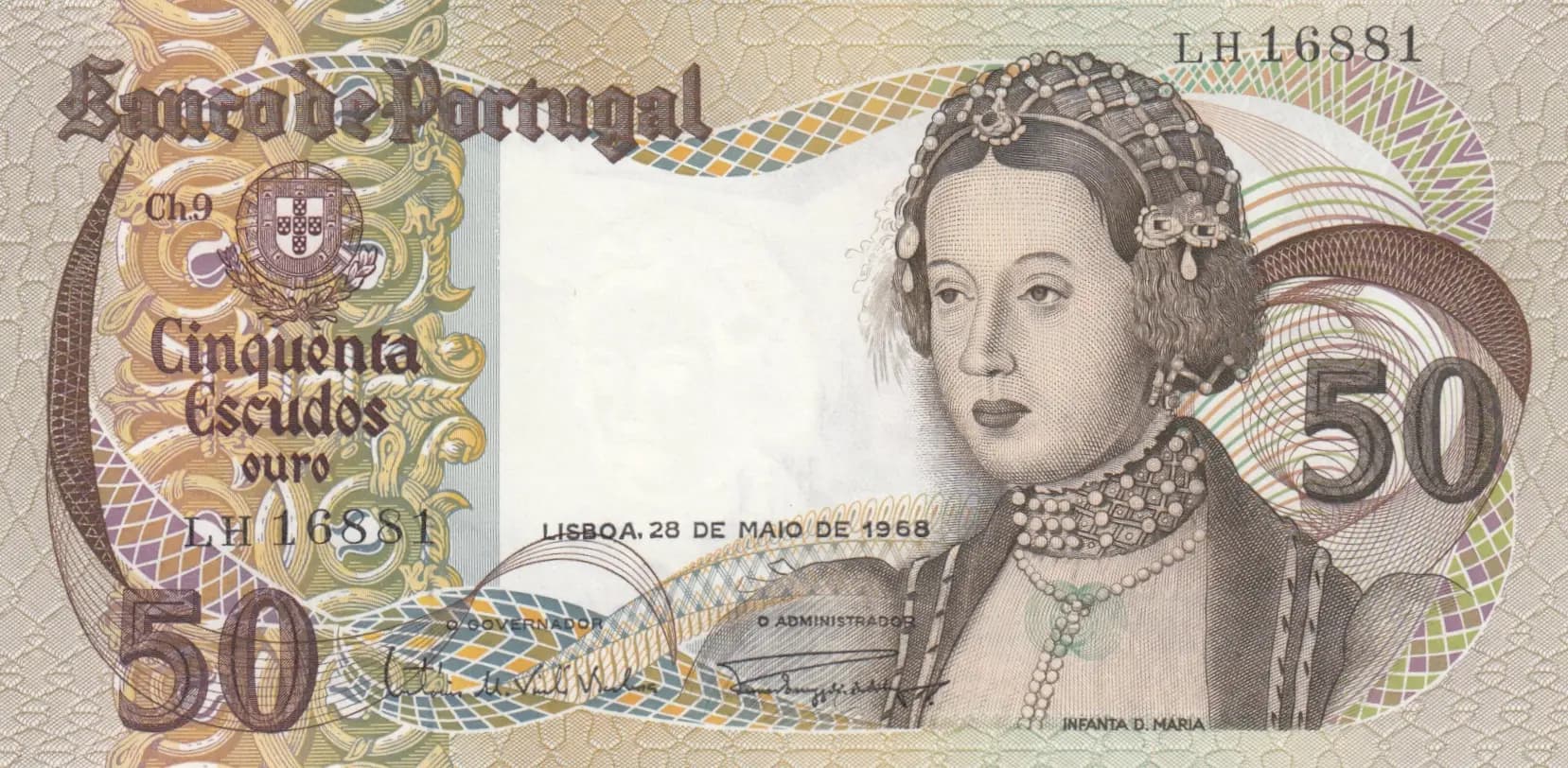
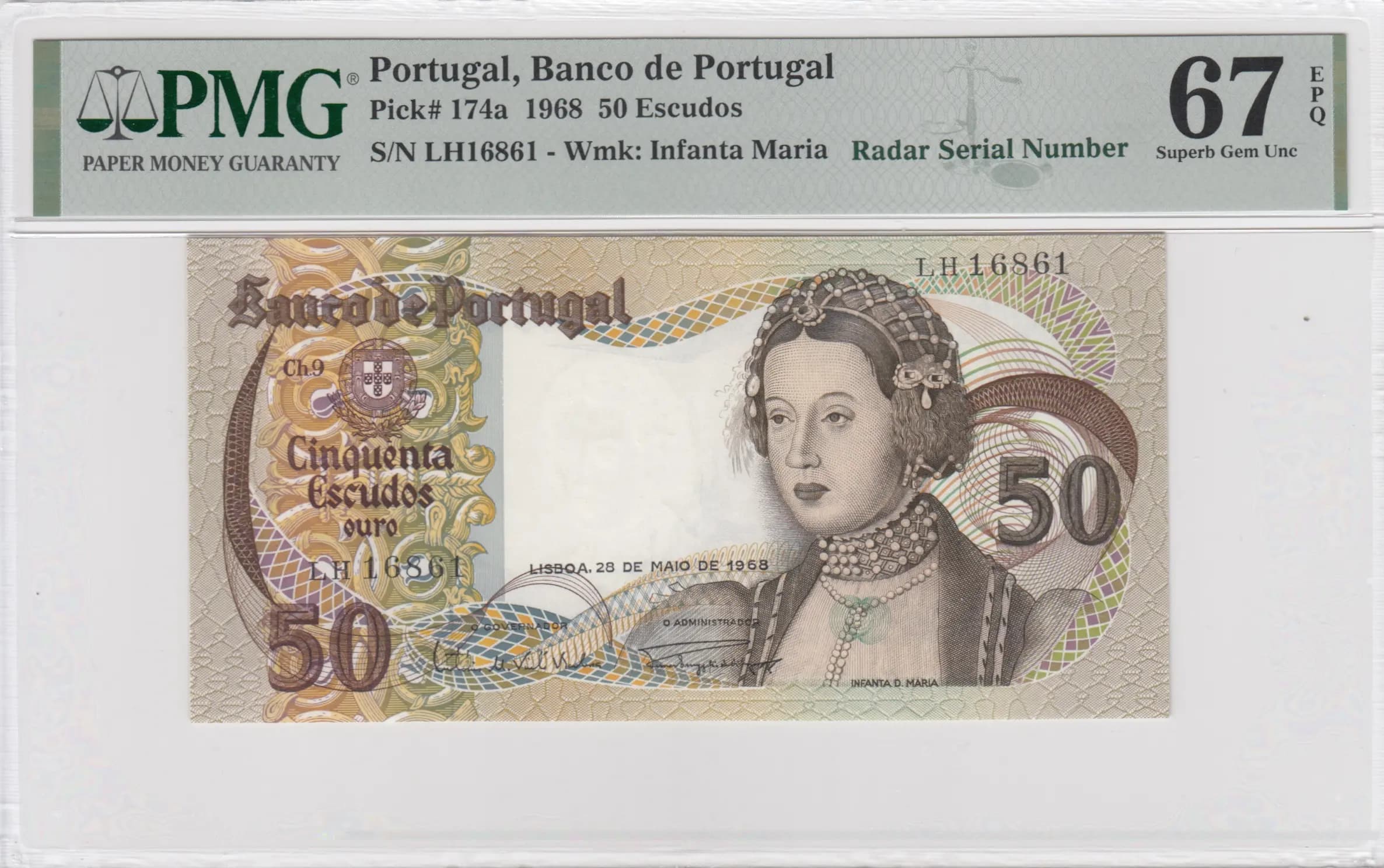
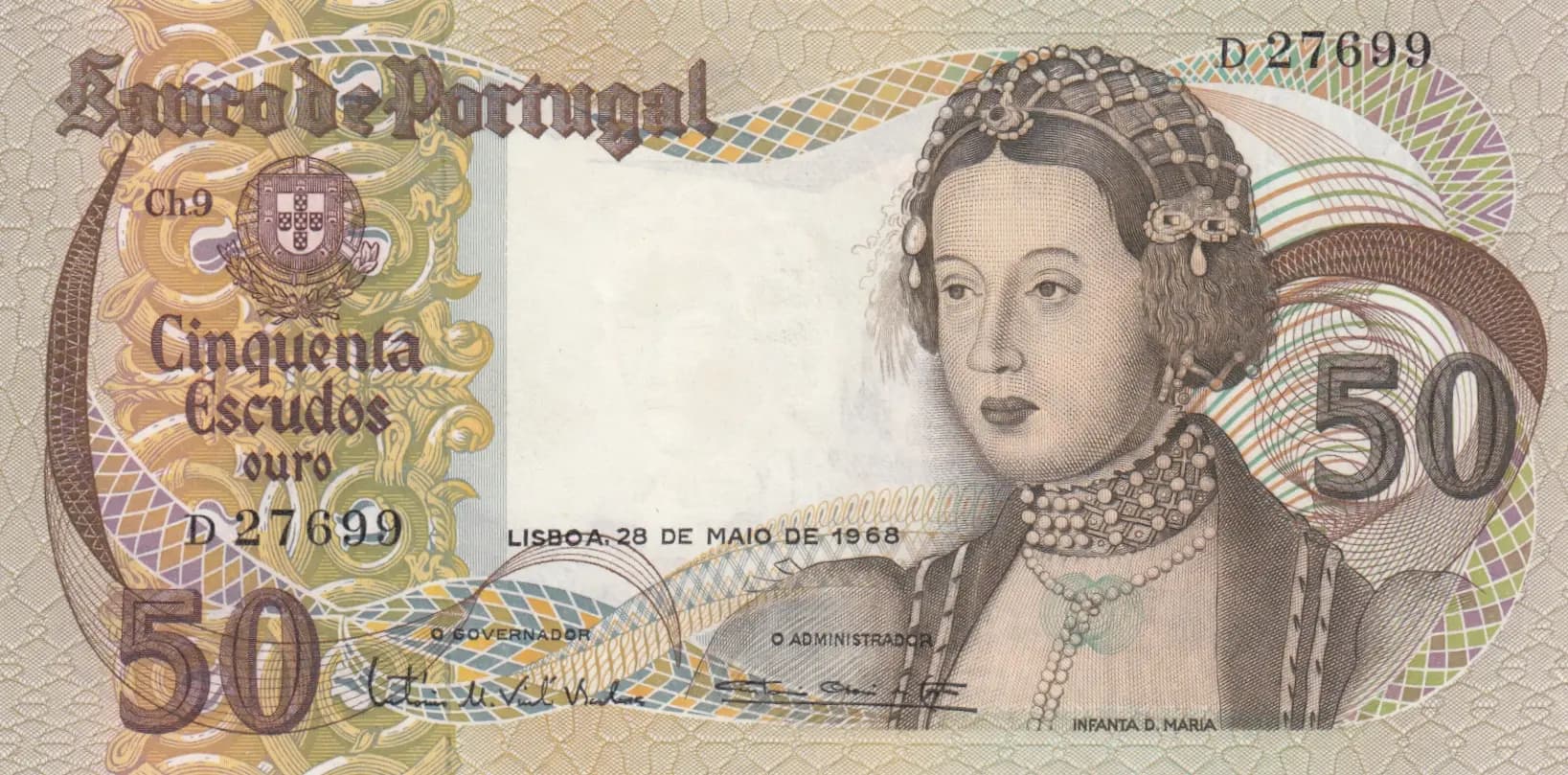
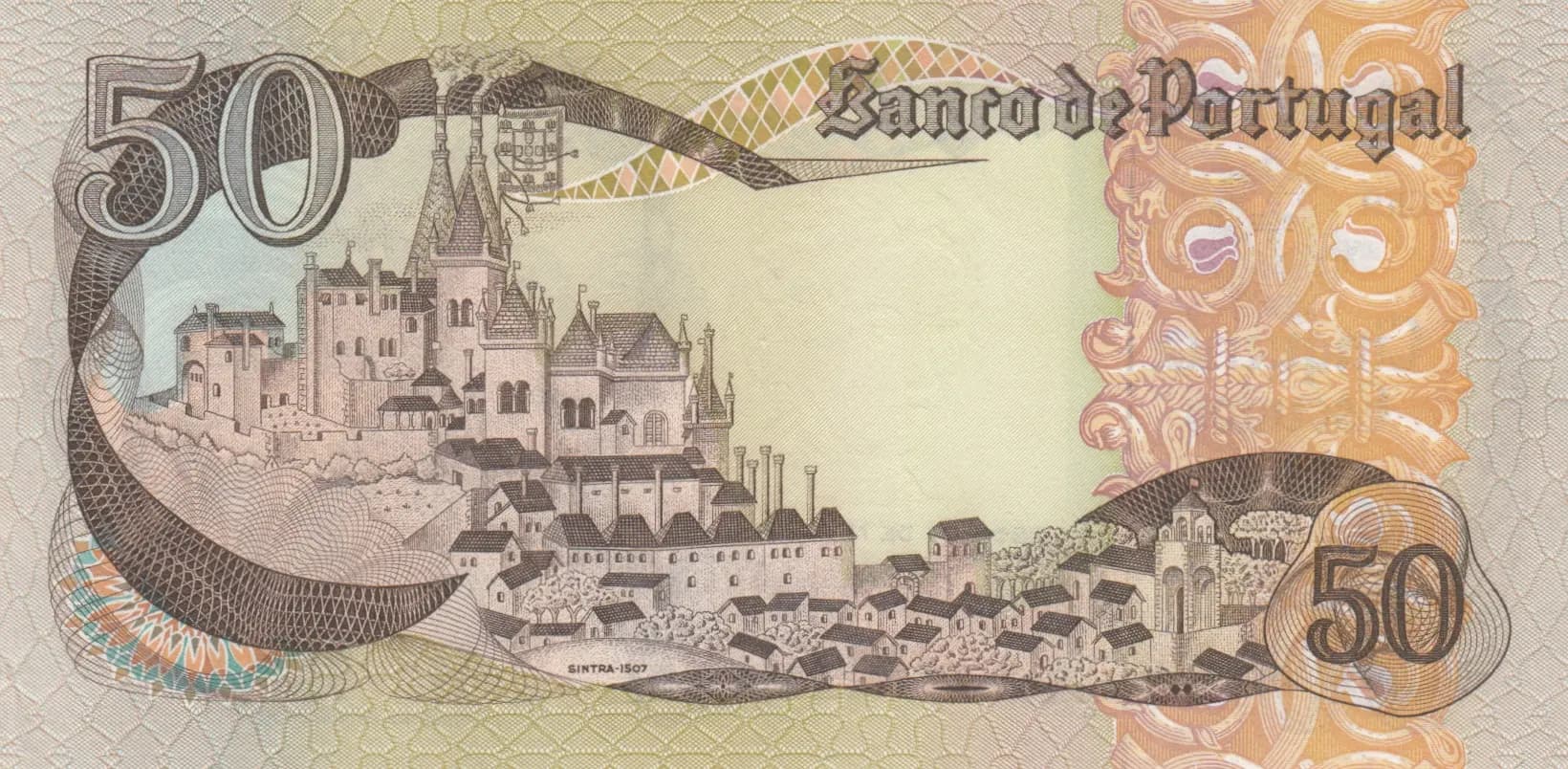
This is an uncirculated 1968 Portuguese 50 Escudos banknote (Pick P-174a) featuring Infanta Dona Maria in Renaissance dress on the obverse and the medieval castle of Sintra on the reverse. The note displays excellent preservation with no visible wear, creases, or damage, showcasing the intricate multicolored security printing with geometric patterns and fine-line engraving characteristic of Banco de Portugal's 1960s issues. Based on recent market data, UNC examples command approximately $18 in catalog value, making this a solid mid-range collectible from Portugal's pre-decimal currency era.
Common. With catalog values of $18 UNC and $5 VF as of 2019, and eBay transaction data showing regular sales throughout the 2014-2021 period at modest prices ($1.80-$6.50 for typical examples, with graded specimens reaching $32-$85), this note is readily available in the collector market. The 1968 issue date represents a standard production run of Banco de Portugal during normal currency circulation. No evidence suggests limited mintage, recall, or short-lived production.
Issued on May 28, 1968, during the final years of Portugal's Estado Novo regime, this banknote commemorates Infanta Dona Maria, a significant historical figure from Portuguese nobility. The reverse features Sintra's iconic fortress castle, reflecting Portugal's medieval heritage and the nation's pride in its historical landmarks during a period of significant political transition in the country.
The obverse features a formal portrait of Infanta Dona Maria, a Renaissance-era Portuguese noblewoman, rendered in profile facing left and adorned with elaborate period dress, pearl necklace, and ornate headdress typical of 16th-century Portuguese court fashion. The left side displays the Portuguese coat of arms with shield design and heraldic emblem. The reverse showcases the medieval Castle of Sintra perched on a hillside, with multiple towers and turrets surrounded by period dwellings, depicting the fortress as it appeared in 1507. Both sides employ ornate decorative borders and frames characteristic of high-quality banknote engraving.
FRONT: 'Banco de Portugal' (Bank of Portugal), 'Cinquenta escudos ouro' (Fifty escudos gold), 'INFANTA D. MARIA' (Infanta D. Maria), 'LISBOA, 28 DE MAIO DE 1968' (Lisbon, May 28, 1968), 'ADMINISTRADOR' (Administrator), 'Ch.9' (Series 9 designation), Serial number 'LH16881', and denomination '50'. BACK: 'Banco de Portugal' (Bank of Portugal), 'SINTRA-1507' (Sintra-1507, referencing the fortress), and denomination '50'.
Intaglio/line engraving with multicolor offset lithography security printing. The note employs fine cross-hatching, geometric mesh patterns, and intricate line-work typical of 1960s European banknote production. The security features include multicolored geometric patterns and ornamental border designs. Based on catalog data indicating 7 signature varieties for this issue, this note represents standard production of Banco de Portugal's 1968 series.
This note is cataloged as Pick P-174a, with a variant P-174b also recorded. The visual analysis confirms this as Ch.9 (Chapter 9 series designation). The catalog indicates 7 signature varieties exist for this denomination and year. The serial number observed (LH16881) with the prefix 'LH' may represent a specific signature variety or print run variant. Without additional comparative examples, the precise signature variety cannot be definitively determined from the visual analysis alone, but the Ch.9 designation and date of May 28, 1968 are confirmed.