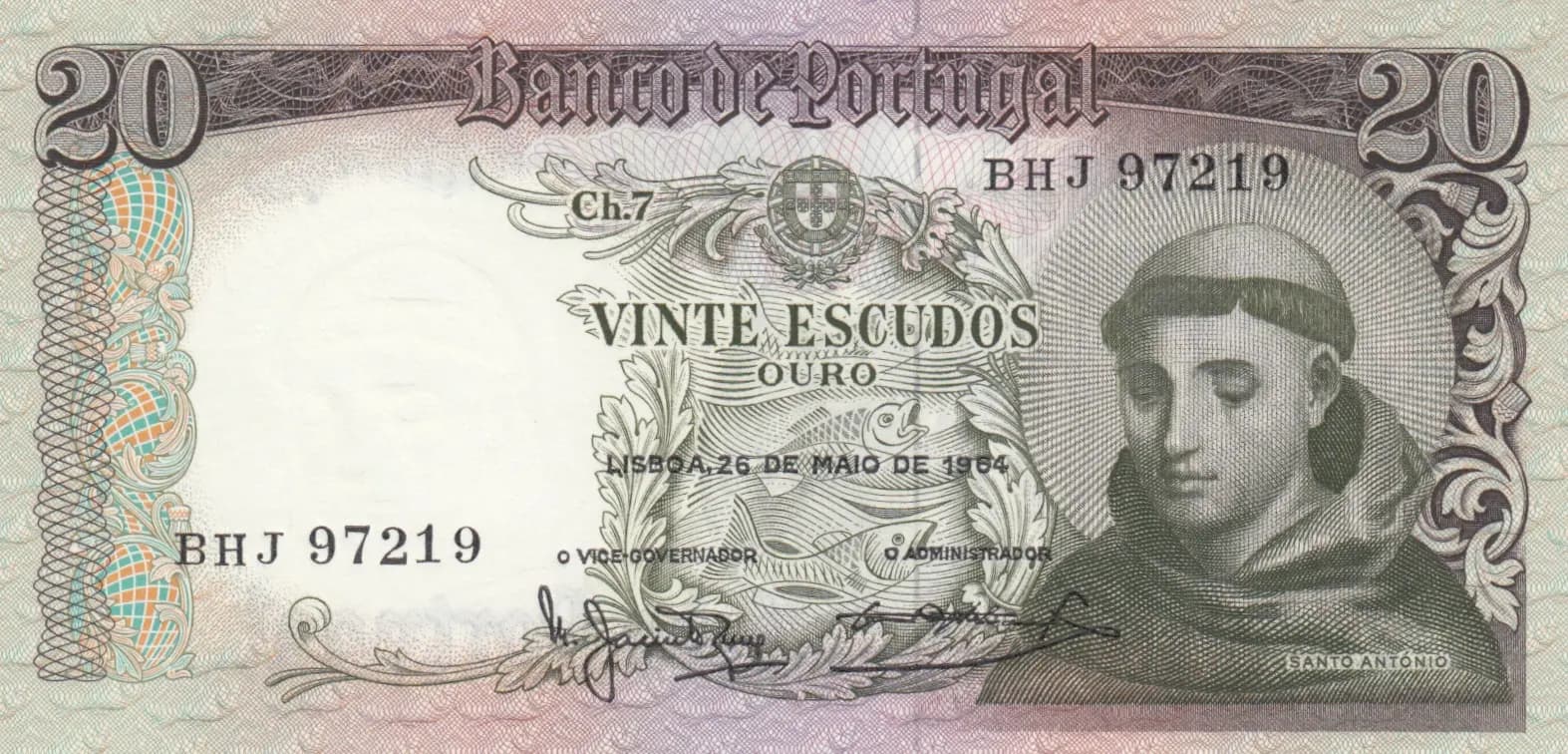
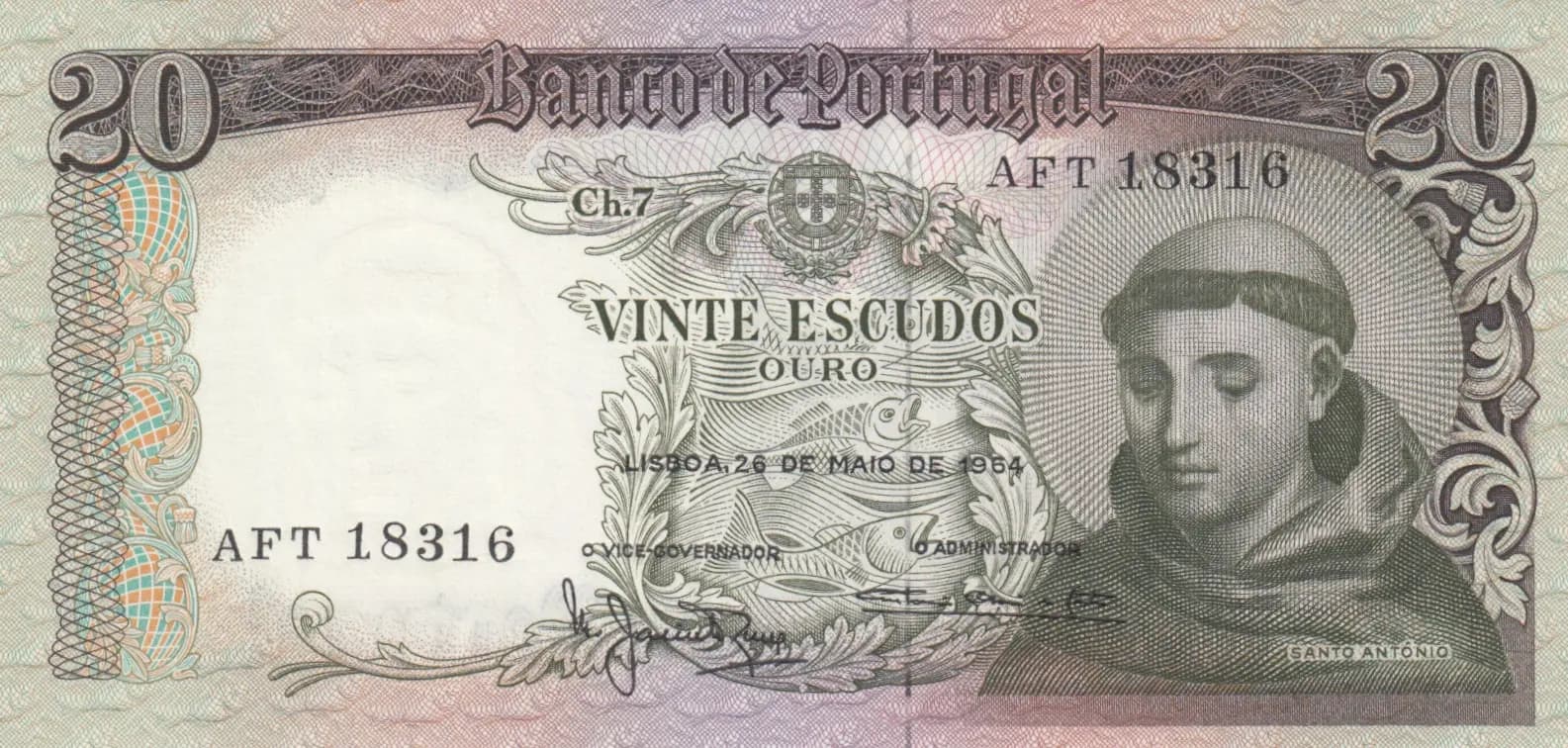
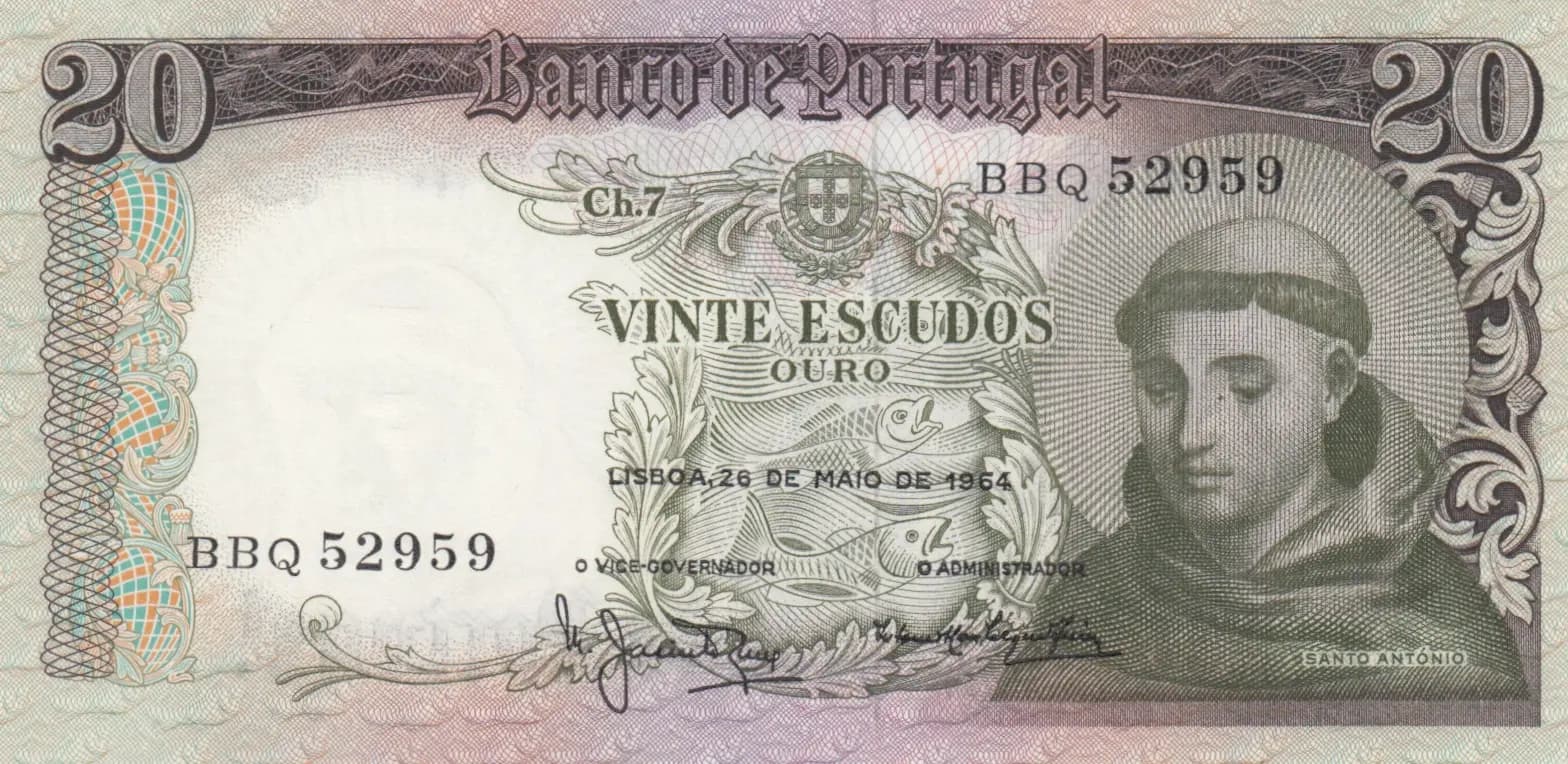
20 escudos 1964
Market Prices
6 salesAbout This Note
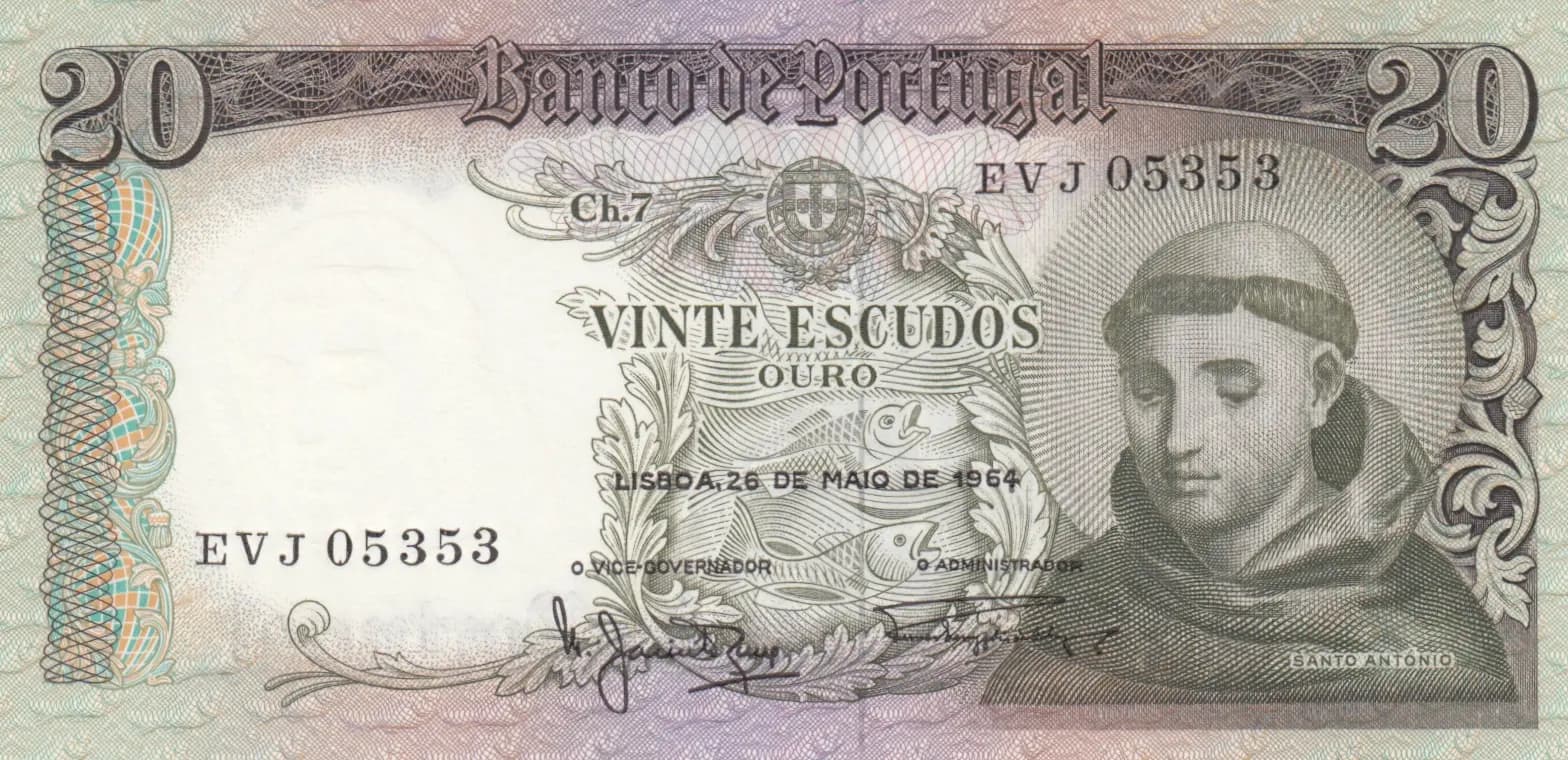
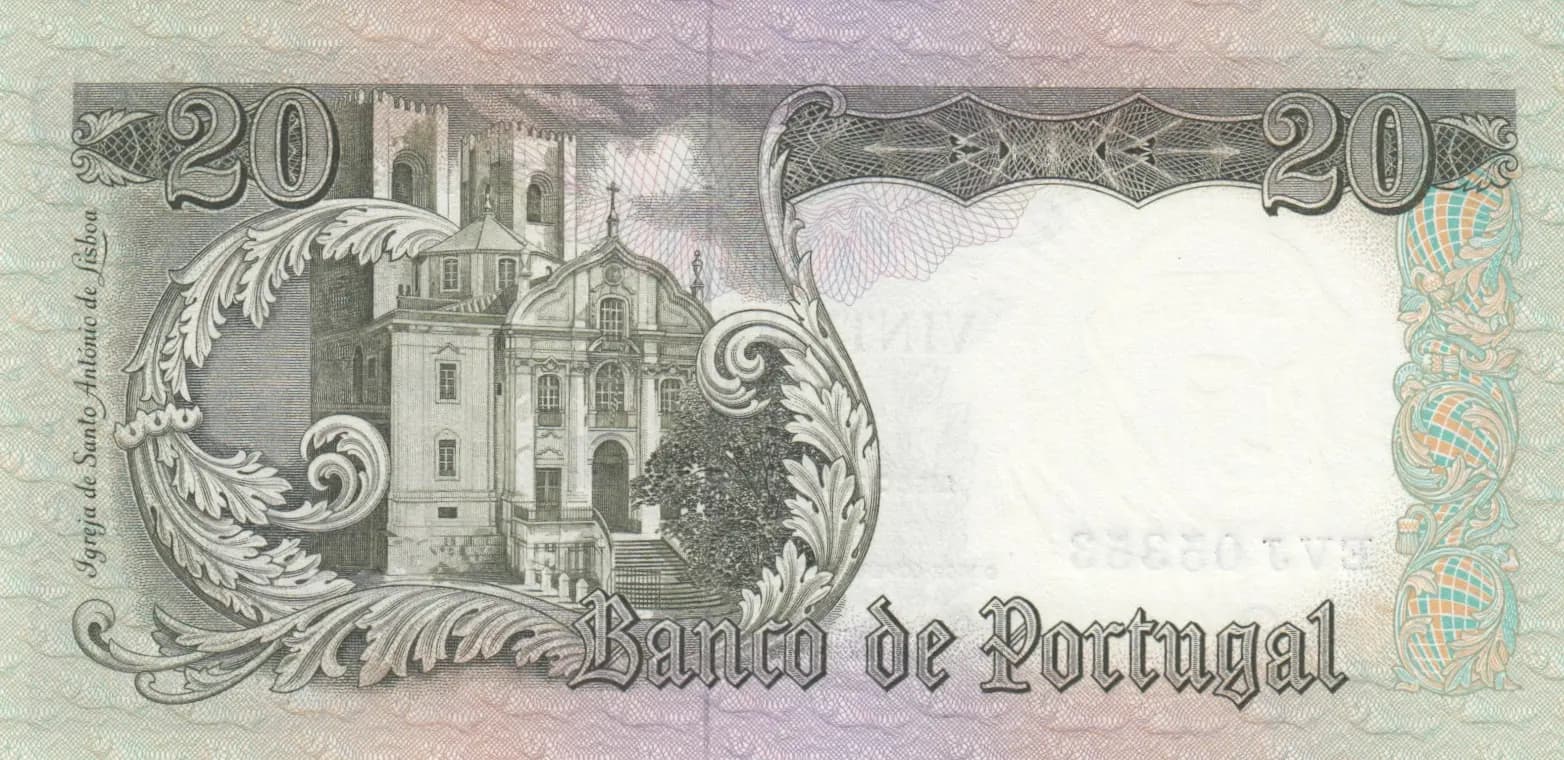
A pristine uncirculated example of the Portugal 20 Escudos from 1964, featuring a striking portrait of Santo António (Saint Anthony of Padua) on the obverse and an ornate baroque architectural rendering of the Igreja de Santo António de Lisboa on the reverse. The note exhibits exceptional condition with sharp, well-defined printing throughout, complex security features including fine-line engraving patterns and geometric micropatterning, and the characteristic multicolor palette of olive-green, purple, brown, orange, and blue that defines this classic Portuguese issue.
Common. The 1964 20 Escudos (P-167a) was a regular-issue banknote with substantial print runs characteristic of a workhorse denomination. Market evidence from eBay sales data shows recent UNC examples selling between $3.50 and $13.77 (with 2019 catalog value listed at $20 UNC), indicating typical pricing for common twentieth-century European banknotes. No evidence of short print runs, recall, or scarcity exists for this Pick number. The availability of multiple signature varieties (noted as 7 varieties) further supports standard circulation levels during the note's period of issue.
Issued on May 26, 1964, during the late Salazar era of Portugal, this banknote commemorates Santo António, a deeply venerated figure in Portuguese Catholic tradition. The Chiesa di Santo António de Lisboa depicted on the reverse represents Portuguese baroque ecclesiastical architecture and the nation's religious heritage during a period when Portugal maintained strong Catholic identity as a cornerstone of national culture. The formal date and administrative signatures reflect the institutional gravitas of the Banco de Portugal during the Estado Novo regime.
The obverse features a left-facing profile portrait of Santo António (Saint Anthony of Padua), positioned at right, rendered in the classical style typical of Portuguese currency iconography. The composition incorporates the heraldic shield and cross emblems of Portugal's coat of arms in the central field, flanked by ornate baroque flourishes and scrollwork. Decorative geometric borders in orange and blue frame the left edge. The reverse showcases a detailed baroque architectural engraving of the Igreja de Santo António de Lisboa (Church of Saint Anthony of Lisbon), depicted with period-accurate details including a domed structure crowned with a cross, arched doorways, windows, and decorative stonework, surrounded by baroque scrollwork embellishments on both sides. The geometric border pattern repeats on the right edge of the reverse. Throughout both sides, fine-line security printing creates complex background patterns in pink and purple tones.
Front side: 'Banco de Portugal' (Bank of Portugal), 'VINTE ESCUDOS' (Twenty Escudos), 'SANTO ANTÓNIO' (Saint Anthony), 'OURO' (Gold), 'LISBOA, 26 DE MAIO DE 1964' (Lisbon, May 26, 1964), 'VICE-GOVERNADOR' (Vice-Governor), 'O ADMINISTRADOR' (The Administrator), 'Ch.7' (Chapter 7, indicating signature variety), and serial number 'BBQ 52959'. Back side: Denomination numerals '20', 'Igreja de Santo António da Ísla' (Church of Saint Anthony of the Island), and 'Banco de Portugal' (Bank of Portugal).
Intaglio engraving (recess printing), the standard security printing method for Portuguese banknotes of this era. The visual evidence of fine-line engraving patterns, geometric micropatterning, and the sharpness of portrait and architectural details all confirm this technique. The printer is likely the Banco de Portugal's in-house printing facilities or contracted Portuguese security printers, consistent with the high quality and security features typical of 1960s Portuguese currency production.
This is a P-167a variety, characterized by watermark of Santo António of Padua. The PMG population data indicates two watermark variants exist (P-167a and P-167b), both with Santo António watermarks but potentially differing in other security features or printing characteristics. The observed note shows 'Ch.7' designation, indicating one of seven known signature varieties for this Pick number. The serial number prefix 'BBQ' and the specific numbering sequence would further identify this within the variety classification system, though without access to comprehensive serial ranges, the exact signature variety cannot be definitively determined from visual inspection alone. Collectors should verify signature varieties against standard Portuguese numismatic references for precise attribution.