20 escudos 1940
Market Prices
17 salesAbout This Note
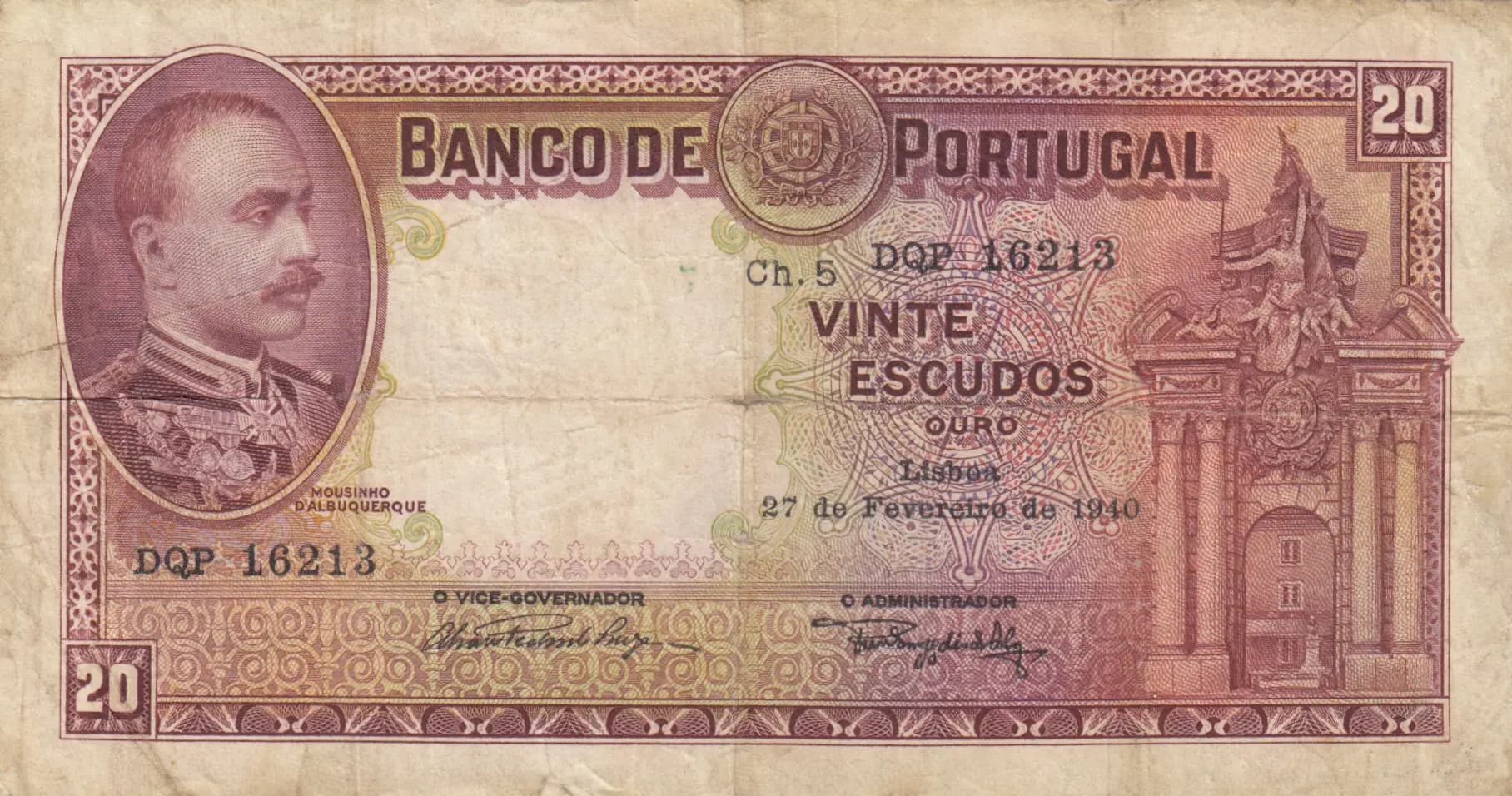
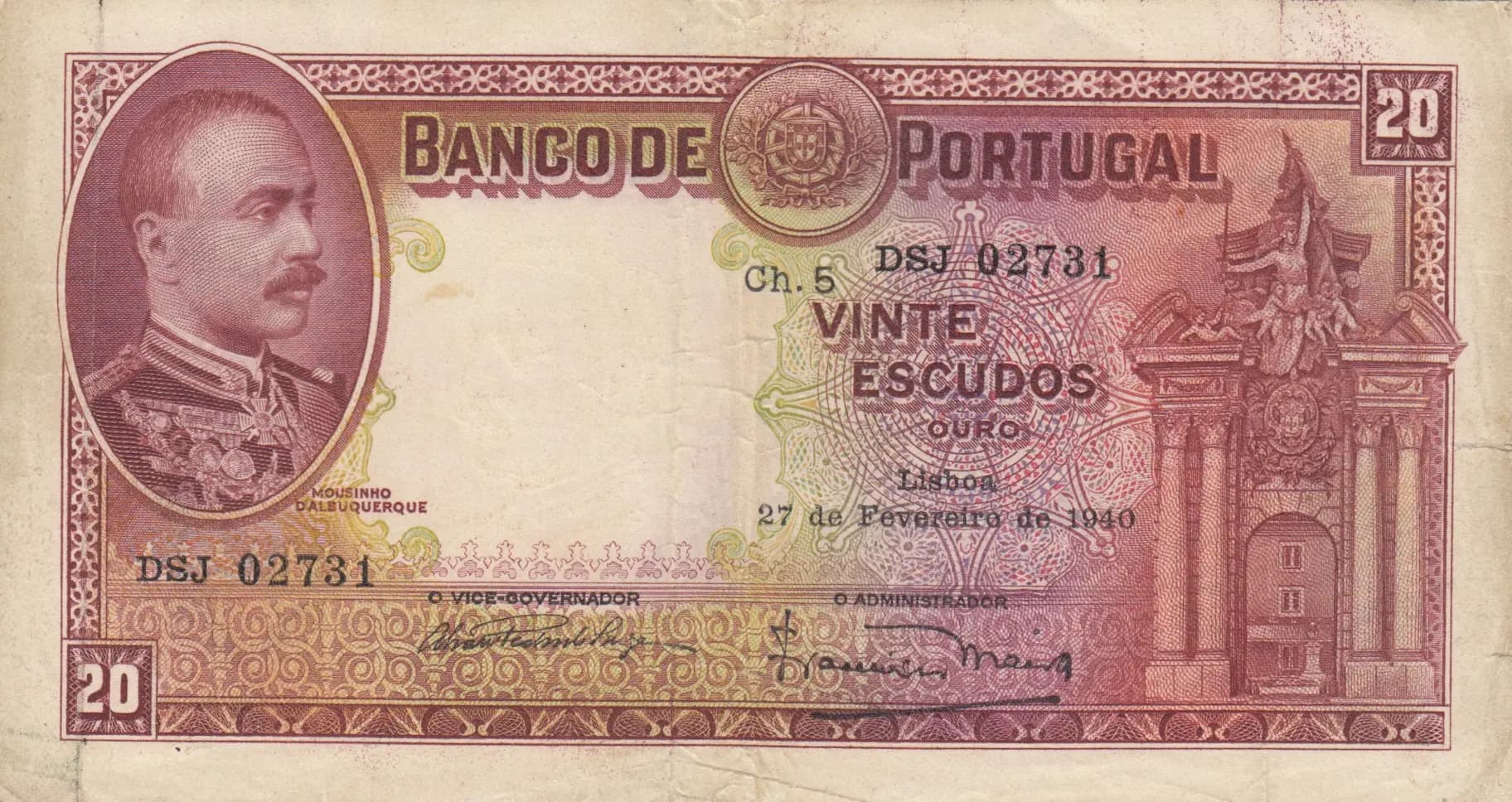
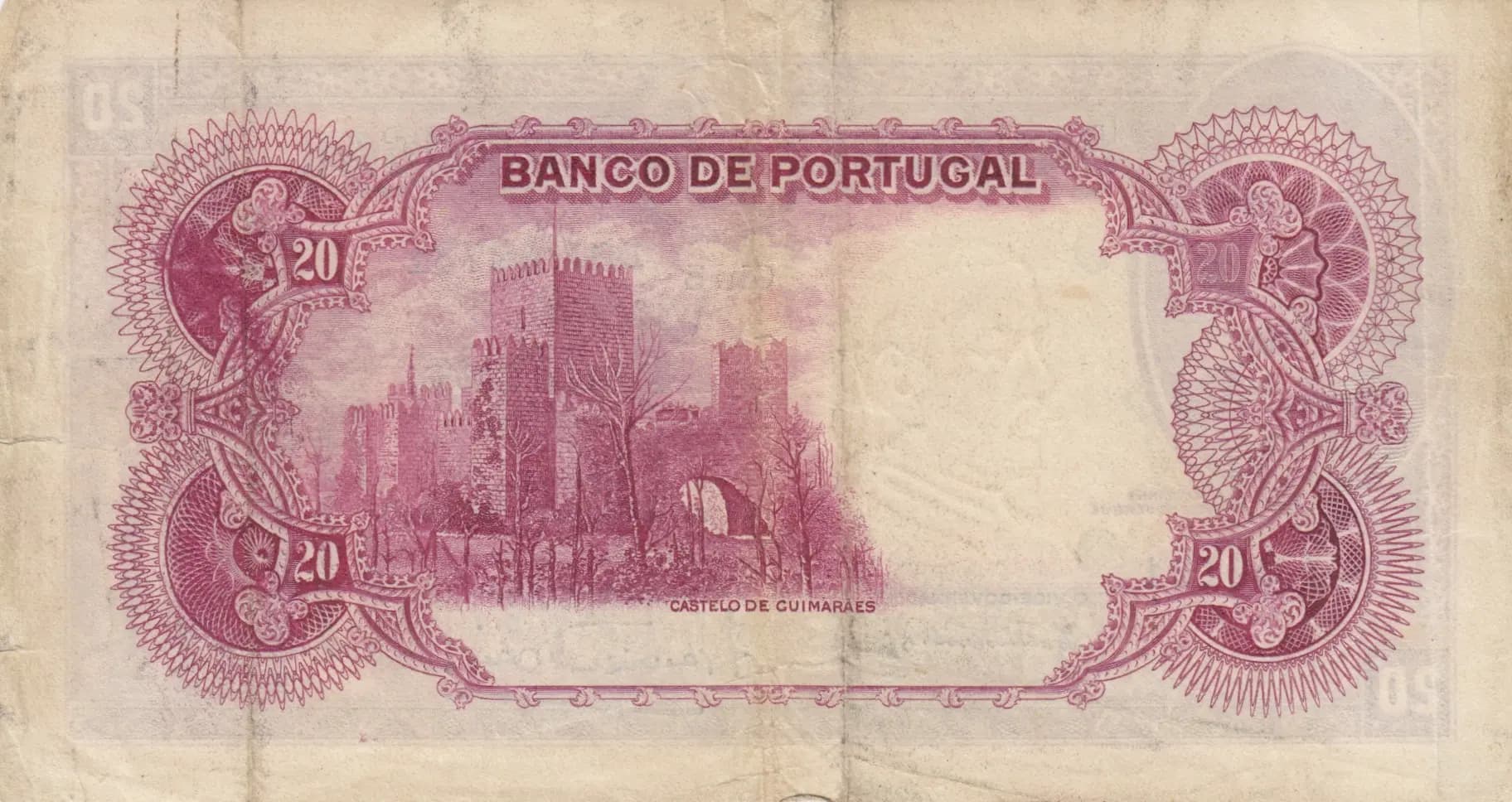
This Portuguese 20 Escudos note from 1940 presents a well-circulated example of Pick P-143, graded in Fine condition with visible age-related wear including creasing, foxing, and yellowing consistent with an 84-year-old banknote. The note features the distinctive mauve-burgundy color scheme characteristic of this issue, with finely detailed engraving showing both the portrait of Mousinho d'Albuquerque on the obverse and the iconic Guimarães Castle on the reverse. This specific example (Chapa 5, serial DSJ 02731) represents the final issue date of 27 February 1940 and demonstrates the sophisticated security features employed by the Banco de Portugal during the Estado Novo period.
Common. While this note is from 1940 and shows authentic age-related wear, it remains common in the secondary market. eBay sales data demonstrates consistent availability with multiple Fine-condition examples selling in the $23-$65 range across 2013-2025, indicating regular market supply. The Banco de Portugal maintained significant print runs for this denomination throughout its 1929-1940 circulation period. Current catalog values (2016) place Fine examples at $100, but actual market transactions consistently underperform catalog estimates, suggesting ample availability. There is no evidence of a limited print run, recall, or short-lived issuance that would justify rarity classification.
Issued during the Estado Novo regime of Portugal under António de Oliveira Salazar, this 1940 note commemorates Mousinho d'Albuquerque, a military figure significant to Portuguese colonial and republican history, while the reverse depicts Guimarães Castle, a medieval fortress symbolizing Portuguese national heritage and the birthplace of the Portuguese nation. The note's issuance in 1940, at the height of Salazar's authoritarian consolidation of power, reflects Portugal's attempt to project historical legitimacy and national identity through its currency design. The 'OURO' (gold) designation on the obverse reflects the theoretical gold-backed nature of Portuguese escudos during this era.
The obverse features a left-facing profile portrait of Mousinho d'Albuquerque, a Portuguese military officer and colonial administrator, rendered in fine detail with characteristic mustache and military uniform. The portrait is positioned on the left side within an ornate circular medallion, with an architectural structure (likely a governmental building) depicted on the right side. The design incorporates elaborate geometric patterns with Islamic-influenced border motifs and ornamental corner medallions, characteristic of early 20th-century Portuguese banknote design. The reverse showcases the Castelo de Guimarães (Guimarães Castle), a prominent medieval fortification featuring multiple towers and crenellated walls, positioned centrally and surrounded by allegorical winged figures in decorated corner cartouches. Both sides feature a coat of arms or national emblem and maintain strict bilateral symmetry with ornate floral and geometric framing elements. The color scheme employs mauve and burgundy tones with cream/off-white paper and gold accents.
FRONT SIDE: 'BANCO DE PORTUGAL' (Bank of Portugal) — top center; 'VINTE ESCUDOS' (Twenty Escudos) — denomination; 'OURO' (Gold) — backing specification; 'MOUSINHO D'ALBUQUERQUE' — portrait identification; 'Lisboa' (Lisbon) — place of issue; '27 de Fevereiro de 1940' (27 February 1940) — official issue date; 'O VICE-GOVERNADOR' (The Vice-Governor) — signature line; 'O ADMINISTRADOR' (The Administrator) — signature line; 'Ch. 5' — chapa/plate marking; Serial number 'DSJ 02731' (appears twice). BACK SIDE: 'BANCO DE PORTUGAL' (Bank of Portugal) — top center; 'CASTELO DE GUIMARÃES' (Guimarães Castle) — landmark identification; Denomination '20' — appears in all four corners.
This note was produced using intaglio (copperplate) engraving, as evidenced by the intricate line-work, fine detail rendering in the portrait, complex geometric border patterns, and the three-dimensional raised impression characteristic of intaglio printing. The printer is identified as BWC (Bradbury, Wilkinson & Company), a renowned British security printer, with no imprint visible on the note itself—a common practice for currency production. The sophisticated security features including geometric repetitive patterns, fine-line shading in the portrait, and complex architectural detailing of the castle all confirm the use of traditional intaglio engraving technology standard for high-security banknotes of the 1940 era.
This specific example represents Chapa (plate) 5, a known variety within the P-143 issue. The note carries the final official issue date of 27 February 1940, making it part of the terminal printing run of this design. The serial number prefix 'DSJ' and the format 'DSJ 02731' are consistent with the documented series for this issue. PMG records confirm P-143 with BWC printer represents a single catalogued variant within the Pick system, though internal varieties by chapa plate and serial number prefix exist. The mauve-burgundy color scheme and the specific architectural rendering on the obverse (showing the ornate building) are consistent with the documented design parameters for Chapa 5 of this Pick number.