2,50 escudos 1925
Market Prices
10 salesAbout This Note
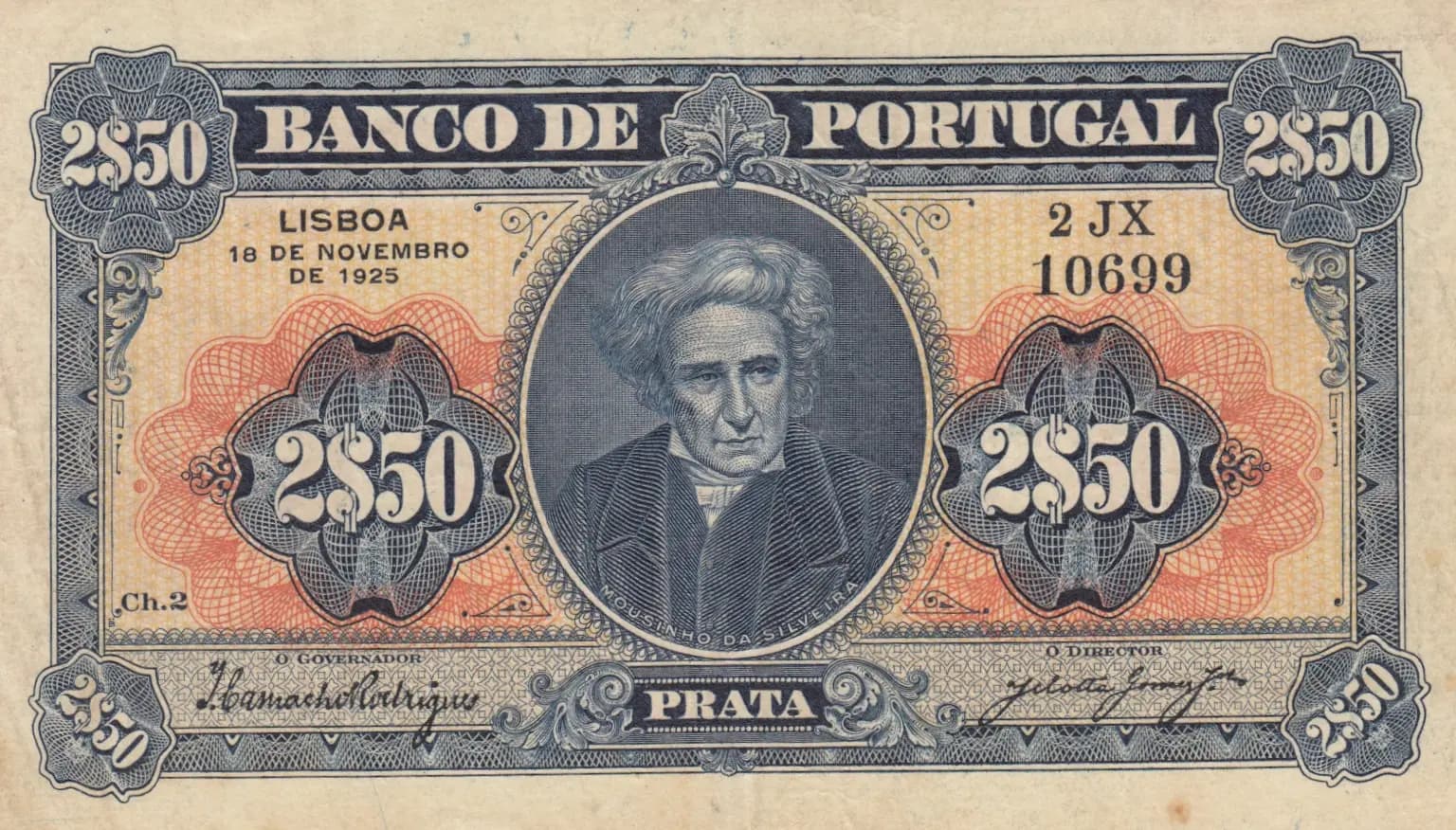
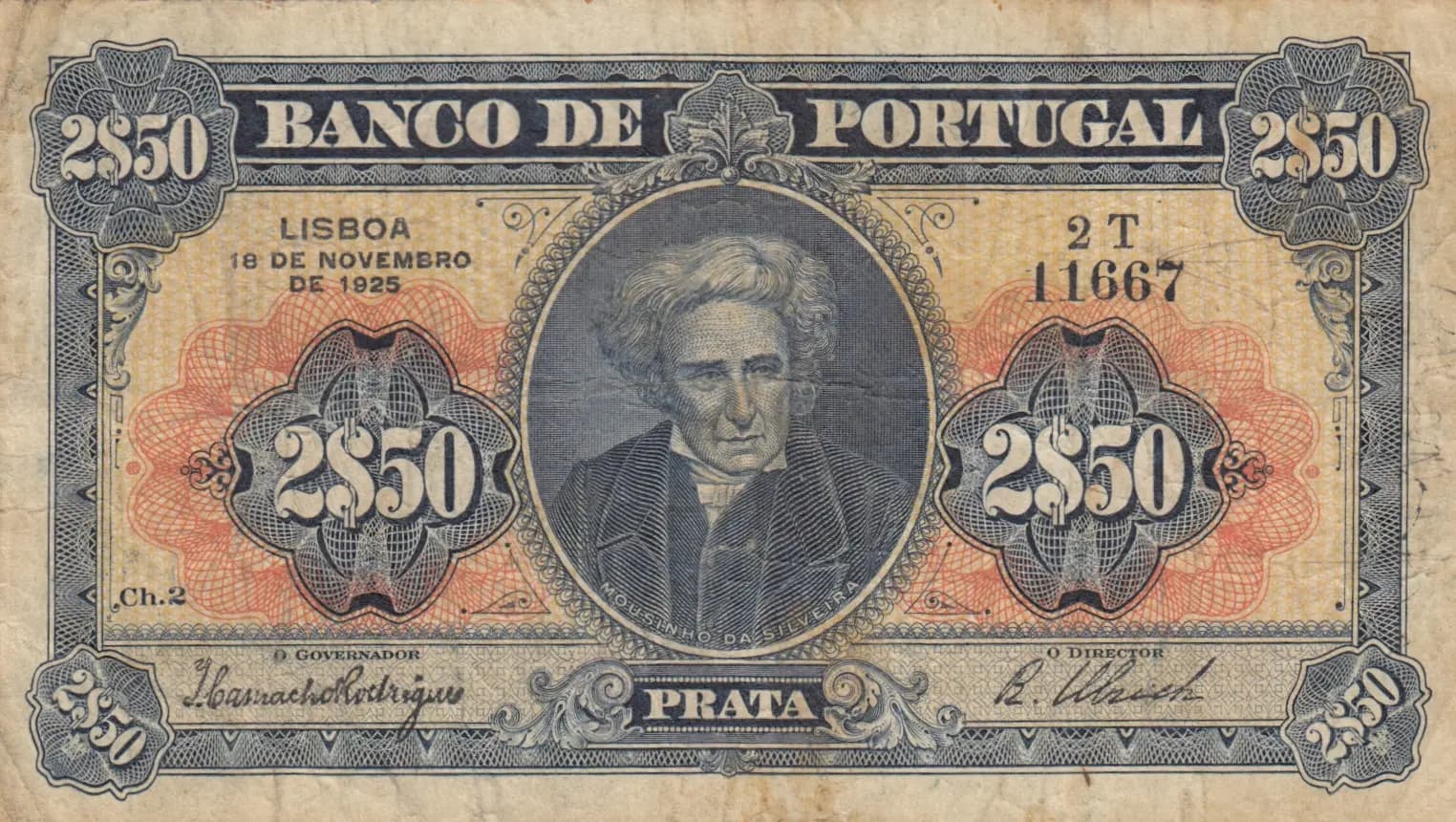
This is a Portuguese 2.50 Escudos banknote from 1925, issued by the Banco de Portugal and cataloged as Pick P-127. The note features a portrait of Mousinho da Silveira on the obverse and the Portuguese coat of arms on the reverse, rendered in the elegant beige and red-orange color scheme typical of this series. In Fair condition, the note exhibits significant aging with visible creasing, foxing, and circulation wear consistent with its nearly century-old age, yet it retains the intricate engraving detail and period charm characteristic of early 20th-century Portuguese numismatics.
Common. This is a standard circulation issue from the 1925-1926 date range with substantial print runs. eBay market data confirms its common status, with Fair-condition examples regularly selling in the $40-90 range historically, and current catalog values placing Fair specimens at $60. Multiple examples have appeared on the market over the past two decades at modest price points, indicating adequate supply in the collector market.
This banknote was issued during a transitional period in Portuguese history, specifically dated November 18, 1925, just one year after the military coup that would reshape the Portuguese state. The prominent depiction of Mousinho da Silveira, a 19th-century Portuguese military and political figure, reflects Portugal's engagement with its own historical legacy during this unstable era. The coat of arms featuring the five shields of Portugal's heraldic tradition underscores the nation's continuity and sovereignty during a period of significant political change.
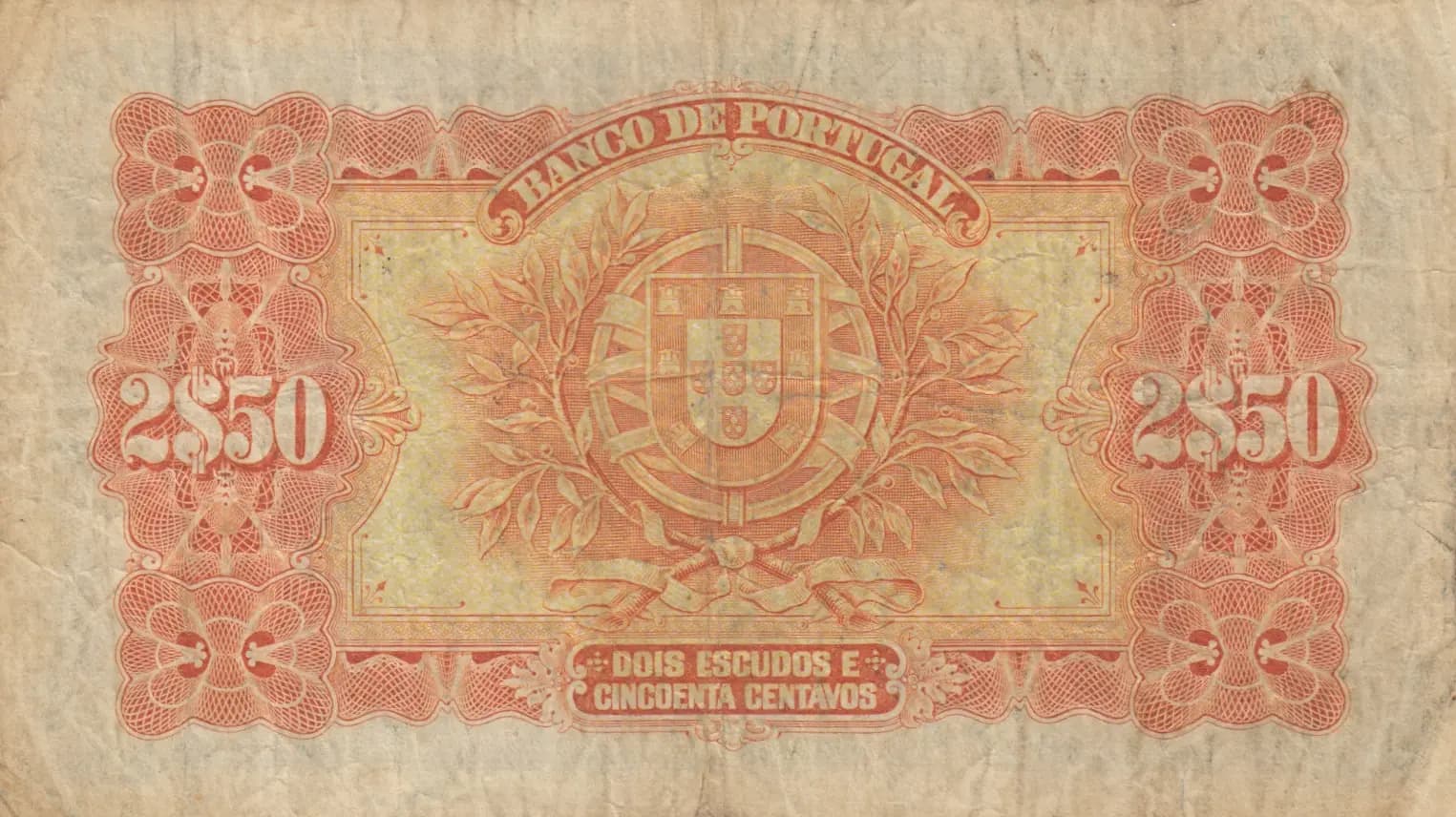
The obverse features a left-facing portrait of Mousinho da Silveira, a prominent 19th-century Portuguese military commander and statesman, positioned within an oval frame at the center of the note. The portrait is rendered in fine engraving with detailed modeling of his formal attire including coat and cravat. The design is framed by an ornate border with decorative rosette patterns in all four corners and ornamental vignettes. The denomination appears in decorative red and black quatrefoil shapes flanking the portrait. The reverse displays the Portuguese national coat of arms at center, consisting of a heraldic shield with five smaller shields arranged in characteristic Portuguese fashion, surrounded by laurel wreaths on the left and palm branches on the right. The coat of arms is enclosed within an ornamental frame, with the denomination again displayed in quatrefoil forms in the upper corners. Both sides feature the matching corner rosette designs and extensive geometric borders demonstrating high-quality engraving work.
Front side: 'BANCO DE PORTUGAL' (Bank of Portugal), '2$50' (2 Escudos 50 Centavos), 'LISBOA' (Lisbon), '18 DE NOVEMBRO DE 1925' (18 November 1925), 'O GOVERNADOR' (The Governor), 'O DIRECTOR' (The Director), 'Ch.2' (Chapter/Chapa 2 - printer's variant marking), '11667' (serial number). Back side: 'BANCO DE PORTUGAL' (Bank of Portugal), '2$50' (2 Escudos 50 Centavos), 'DOIS ESCUDOS E CINCOENTA CENTAVOS' (Two Escudos and Fifty Centavos).
This note was produced using intaglio (engraved steel plate) printing, as evidenced by the fine line work, detailed crosshatching, and dimensional quality visible throughout the design. The printer was W&S (Waterlow & Sons) without imprint notation. The watermark consists of the repeated bank name throughout the paper. The two-color printing on the obverse (blue on orange and yellow underprint) and the orange on yellow underprint of the reverse were achieved through sequential intaglio passes with carefully registered colored paper stock.
This note is identified as Chapa 2 (Ch.2), indicating it is the second printing plate variant for this denomination and date combination. The visual analysis confirms this marking on the obverse. The specific date 18.11.1925 places this within the known date varieties for Pick P-127. The serial number 11667 is recorded. PMG has cataloged two main variants for Pick number P-127 (P-127 and P-127cts), suggesting minor design or specification differences, though this particular specimen appears to be the standard P-127 variety.