500 zlotych 1919
Market Prices
33 salesAbout This Note
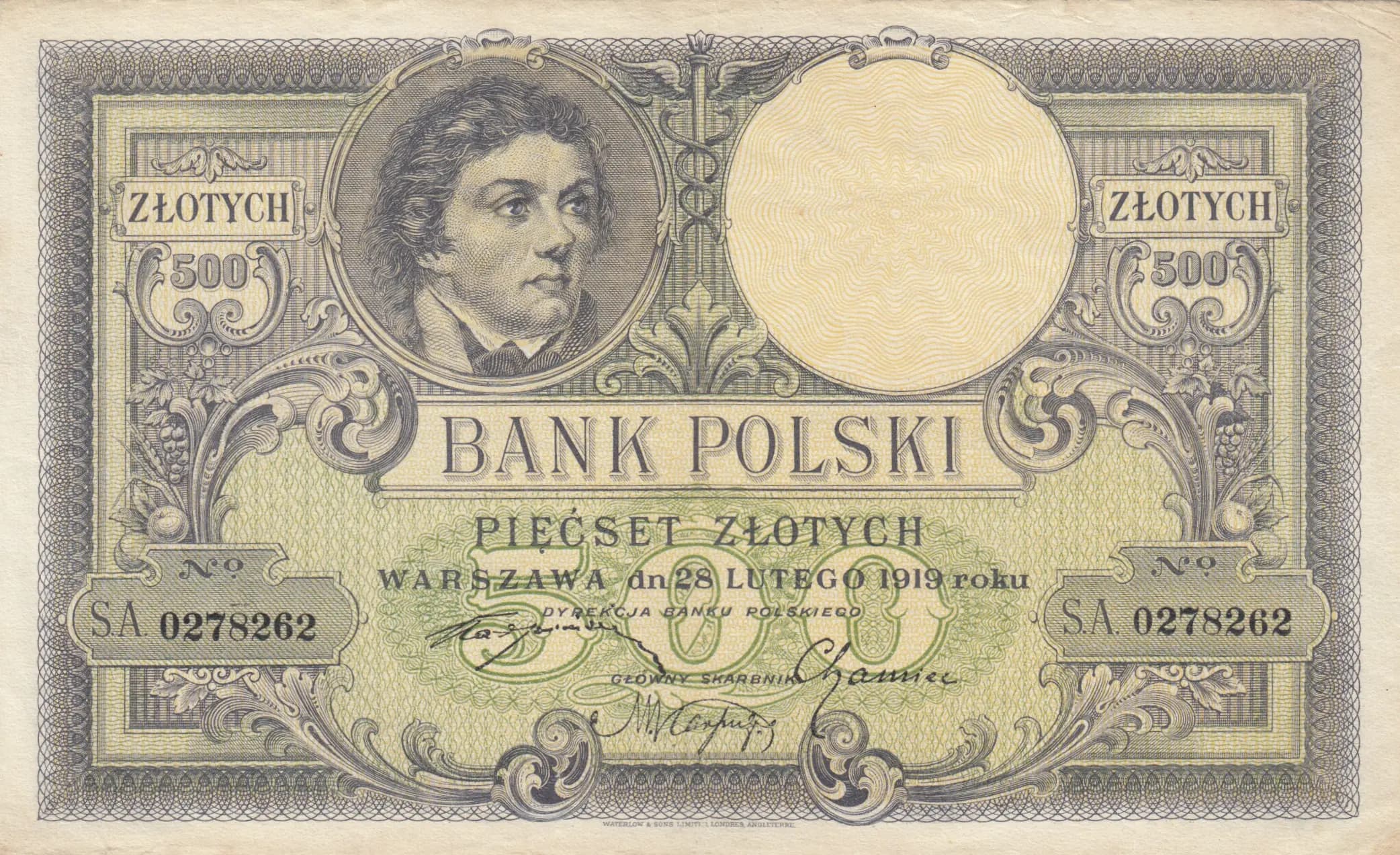
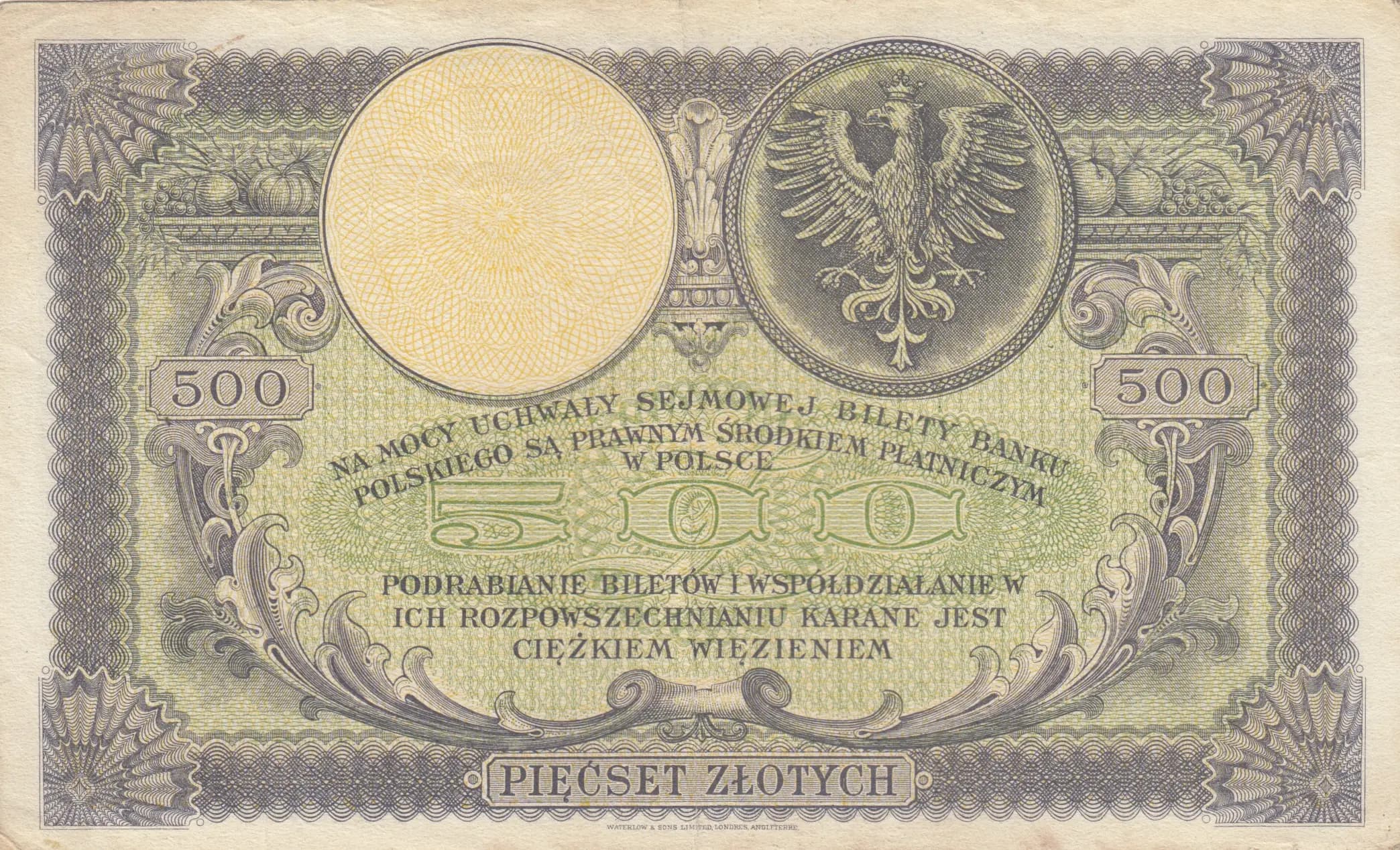
This 500 Złotych note from 1919 presents an excellent example of early Polish currency issued during the nation's restoration following World War I. The note features a portrait of Tadeusz Kościuszko on the obverse and the Polish eagle coat of arms on the reverse, rendered in beige, gray, and black through fine engraved line work. In VF condition, the note exhibits the characteristic aging and slight foxing expected of a 105-year-old banknote, with sharp printing clarity and no significant tears or creases.
Common. eBay market data shows VF-graded examples selling consistently in the $10-13 range as recently as 2016-2021, with F-grade notes regularly available for $7-17. The broad price range and frequent sales indicate substantial surviving circulation, and catalog values (2016: VF=$30) relative to current market prices suggest good availability. This is a standard issue from the early Polish Republic with no indication of low mintage or subsequent rarity.
Issued on February 28, 1919, by Bank Polski just weeks after Poland's independence was formally recognized, this note represents a critical moment in the nation's monetary sovereignty. The portrait of Tadeusz Kościuszko—the 18th-century military leader and national hero—symbolized Polish resistance and independence, while the crowned eagle on the reverse served as the official state symbol of the newly restored Polish Republic. The legal tender declaration printed on the reverse emphasizes the foundational role these banknotes played in establishing economic legitimacy for the fledgling state.
The obverse features a formal portrait of Tadeusz Kościuszko in profile facing left, rendered within an ornate circular frame with elaborate Baroque-style scrollwork and floral border motifs. The reverse displays two large circular medallions: a blank sunburst-pattern circle on the left and the Polish coat of arms (crowned eagle with spread wings) on the right, flanked by extensive geometric radiating line patterns and heraldic design elements. The note's design reflects the neoclassical aesthetic favored for official state currency during the early 20th century, with particular emphasis on patriotic symbolism and fine engraving security details.
FRONT: '500' / 'ZŁOTYCH' / 'PIĘĆSET ZŁOTYCH' (Five Hundred Zlotych) / 'BANK POLSKI' (Polish Bank) / 'WARSZAWA dn[?] LUTEGO 1919 roku' (Warsaw on [day] February 1919) / 'SA 0278262' (Serial Number). BACK: '500' / 'PIĘĆSET ZŁOTYCH' (Five Hundred Zlotych) / 'NA MOCY UCHWAŁY SEJMOWEJ BILETU POLSKIEGO SĄ PRAWNYM ŚRODKIEM PŁATNICZYM W POLSCE' (By virtue of the Sejm resolution, Polish banknotes are legal tender in Poland) / 'PODRABIANIE BILETÓW I WSPÓLDZIAŁANIE W ICH ROZPOWSZECHNIANIU KARANE JEST CIĘŻKIM WIĘZIENIEM' (Counterfeiting banknotes and complicity in their distribution is punishable by hard imprisonment).
Intaglio engraving (line engraving), printed by Waterlow & Sons, London. The visual analysis confirms the characteristic fine line work, intricate scrollwork, and detailed decorative patterns typical of high-security intaglio production. The sharp definition of borders, portraits, and heraldic elements throughout both sides demonstrates the professional execution expected from a premier security printer of the period.
The note observed displays serial number 'SA 0278262', indicating the SA prefix series. Pick catalog lists P-58 as a single variant. The date of issue is confirmed as 28.02.1919 (February 28, 1919). No overprints or unusual signature varieties are evident in the visual analysis. The Waterlow & Sons imprint (W&S) is confirmed as the printer, consistent with catalog references noting 'W&S' notation.