25 kopeek
About This Note
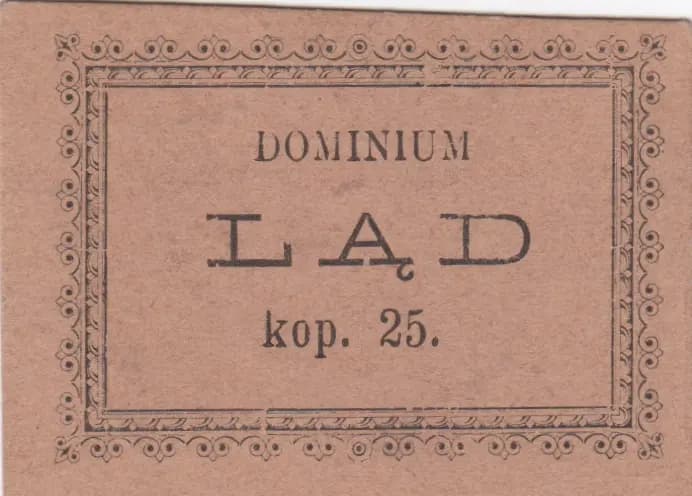
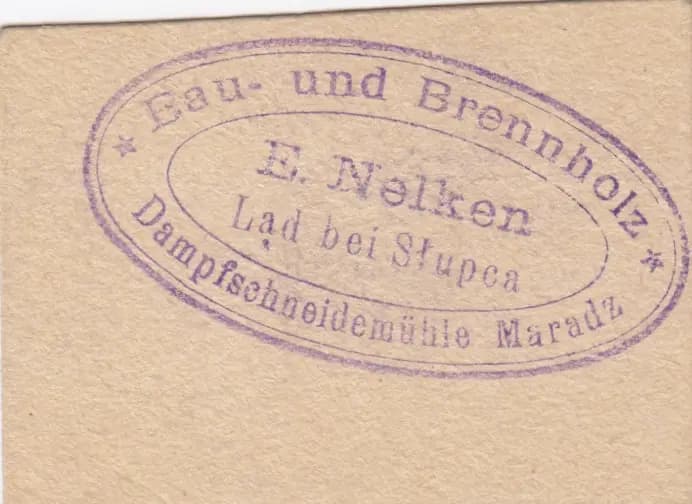
This is a fascinating emergency currency note issued by Dominium LAD, a private enterprise in the Lad/Stupsk region, denominated in 25 kopeks. The note features an ornate tan and beige decorative border with classical floral and geometric patterns, while the reverse displays a purple institutional stamp identifying the issuer as a wood and firewood merchant (E. Neltken, Eau- und Brennholz) operating a steam mill. In UNC condition with age-appropriate patina and visible foxing, this unlisted Pick number represents a rare example of private emergency currency from the early 20th century Baltic/Polish region.
Rare. This note is unl listed in the Pick catalog, indicating it does not appear in the standard philatelic reference works for Polish currency. As a private emergency note issued by a small regional business rather than a government authority, the original print run was likely limited. The survival of a specimen in UNC condition with clear institutional provenance adds to its rarity. Private scrip notes from this region and period are significantly scarcer than official government emissions, and authenticated examples command collector interest.
This note represents private emergency currency issued during a period when small enterprises and regional businesses issued their own scrip to facilitate local commerce, likely during World War I or the interwar period when official currency was scarce or unstable. The German inscriptions combined with the Russian kopek denomination reflect the complex linguistic and political landscape of the former German-controlled territories that became part of Poland after 1918. The issuer, Dominium LAD, operated as a wood merchant and steam mill operator, typical of small regional enterprises that resorted to issuing their own currency to maintain business operations during monetary disruption.
The front side features a symmetrical design with an ornate decorative border composed of repeated floral and geometric motifs in brown and tan inks, framing a central area containing the denomination and issuer information. The color scheme is predominantly tan and beige with brown accents, creating a classical, formal appearance typical of late 19th/early 20th century commercial documents. The reverse displays a purple oval stamp or seal impression, functioning as the institutional mark of the issuing business, with the merchant's name (E. Neltken) and business details (wood merchant and steam mill operator) printed within the oval frame. The cream/off-white paper background and deliberate stamp placement suggest this note was intended to function as official business currency with clear identification of the issuing authority.
FRONT SIDE: 'DOMINIUM' (Latin: domain/dominion); 'LAD' (business designation); 'коп. 25.' (Russian: 25 kopeks). REVERSE SIDE: 'Eau- und Brennholz' (German: wood and firewood); 'E. Neltken' (German: proprietor name); 'Lad bei Stupsk' (German: Lad near Stupsk, geographical location); 'Dampfscheldmühle Maradt' (German: Steam mill Maradt).
This note was produced using letterpress printing, evidenced by the crisp impression of the ornate border patterns and the clear definition of the purple oval stamp on the reverse. The consistent ink application and the quality of the decorative border indicate professional typographic printing rather than manuscript or basic hand-stamping, though the purple stamp on the reverse may have been applied separately as an institutional mark. No security printer is identified in the catalog data; this appears to be a locally-produced emergency note typical of regional German or Baltic printing practices circa 1910-1925.
No varieties are noted in the available data. The specific designation 'Dominium LAD' issued by E. Neltken at Lad near Stupsk appears to be the primary identifying feature. Without additional specimens or catalog research, it is not possible to identify multiple varieties of this note type. The purple stamp impression on the reverse appears to be consistent with the issuing institution's standard marking practice.