4 zlote 1794
Market Prices
3 salesAbout This Note
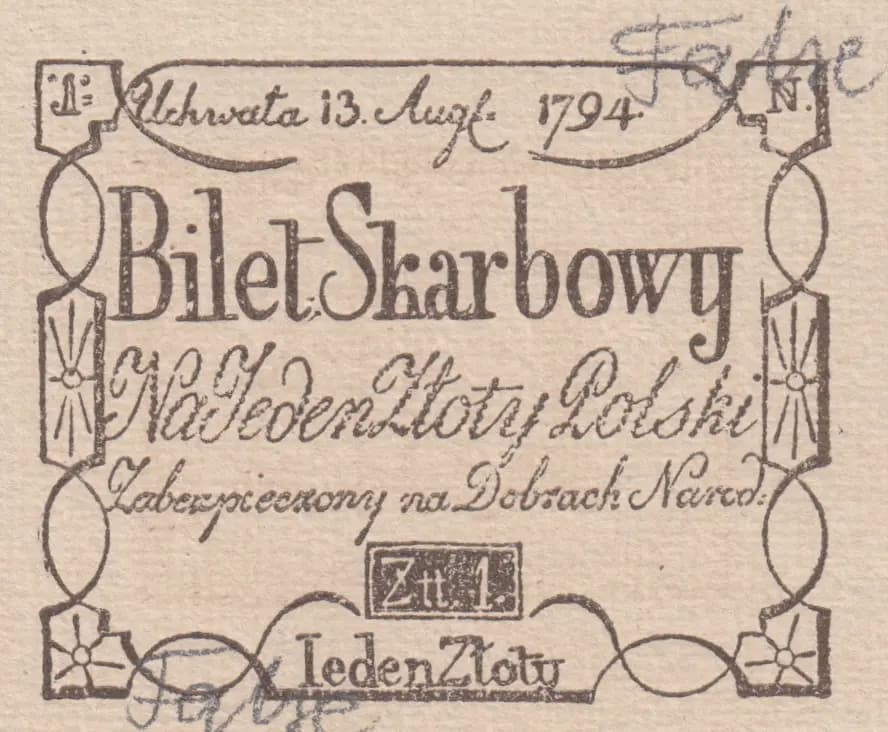
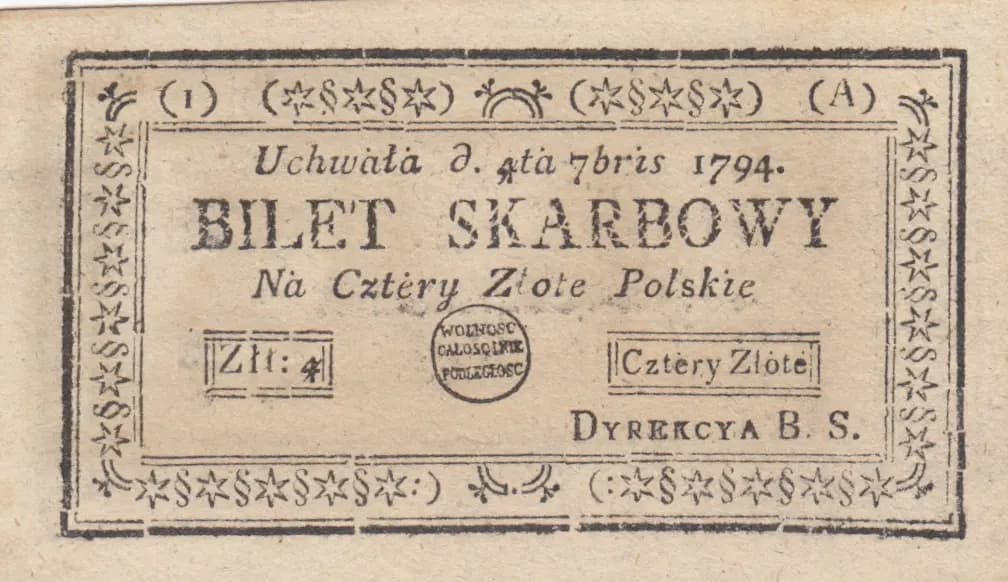
This is a 1794 Polish Bilet Skarbowy (Treasury Ticket) for 4 zlote, issued during a critical period of Polish financial reform. The note features a formal, symmetrical design with decorative star and geometric patterns in the borders and an official central seal, printed on aging cream-colored paper with visible foxing characteristic of late 18th-century documents. In AU condition, the piece retains legible text and clear impressions despite moderate yellowing and age-related discoloration, making it a notable survivor from Poland's early paper currency period.
Common. Despite the historical significance of 1794 Polish currency, Bilet Skarbowy tickets in this denomination appear with reasonable frequency in the marketplace. eBay transaction data shows consistent sales activity across condition grades from F to PMG 35, with catalog values in 2016 ranging from $5 (G) to $25 (EF). The note's age and condition make it valuable to collectors, but the denomination, printing quantity, and surviving examples indicate this is not a scarce issue. The AU condition grade commands modest premiums but does not elevate this to rare status.
The 4 zlote Bilet Skarbowy was issued on July 7, 1794, during the tumultuous final years of the Polish-Lithuanian Commonwealth, shortly before the Third Partition of Poland (October 1794). These treasury tickets represented an attempt by Polish authorities to manage state finances during a period of extreme political and military crisis. The formal typography and official seal imagery reflect the legitimacy efforts of the Warsaw government during this desperate final chapter of independent Polish statehood.
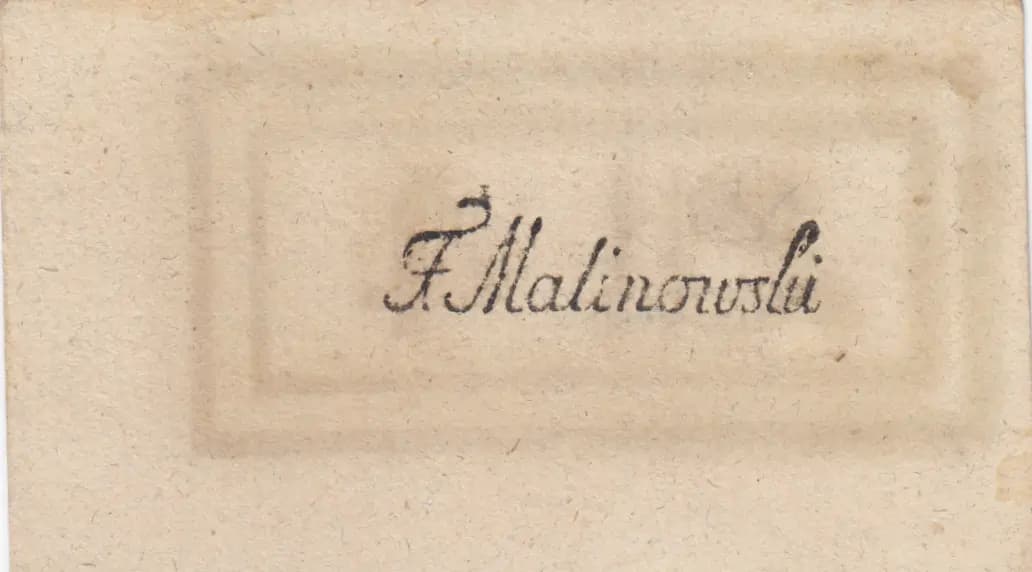
The note employs a classical late-18th-century treasury certificate design with emphasis on formal authority and legitimacy. The front features a symmetrical layout framed by ornamental borders composed of stars and crescent moon geometric patterns in the corners, typical of Polish neoclassical design of the period. A prominent circular seal or stamp occupies the center, serving as the issuing authority's mark. The denomination appears in multiple locations (text and numerals) to prevent counterfeiting. No portraits or specific landmarks are depicted; instead, the design relies on geometric ornamentation and typography to convey official status. The verso contains only a handwritten signature, suggesting these were issued with personalized authentication by treasury officials. The overall aesthetic reflects contemporary European financial document standards rather than decorative banknote design.
FRONT SIDE: 'Uchwała d. gta 7bris 1794' (Resolution dated July 7, 1794) | 'BILET SKARBOWY' (Treasury Ticket) | 'Na Cztery Złote Polskie' (For Four Polish Zlotes) | 'Zlt: 4' (Zlotes: 4) | 'Cztery Złote' (Four Zlotes) | 'DYREKCYA B. S.' (Direction of Treasury/B.S.) | 'WIADOMOŚĆ CAŁOŚCIOWIE PUBLICZNOŚĆ' (Notice to the General Public). BACK SIDE: 'F. Malinowski' (handwritten signature or name).
Letterpress printing (typography) on laid paper, with the primary text, border ornaments, and seal impression created through inked metal type and engraved blocks. The clarity of the geometric patterns and consistent ink impression across the note indicate professional printing press production rather than manuscript issuance. The handwritten signature on the verso was added post-printing as an authentication measure. No evidence of security printing techniques such as color printing or sophisticated anti-counterfeiting measures typical of later issues; the security relied on the official seal, formal typography, and manuscript signatures.
The handwritten signature 'F. Malinowski' on the verso may represent an authentication signature by a treasury official, and different signatures could constitute minor varieties. The resolution date of July 7, 1794 (noted as 'gta 7bris 1794' in abbreviated form) is consistent with the official issue date. No serial numbers, overprints, or other distinguishing variety markers are visible in the visual analysis. This appears to be a standard example of the Pick P-A11 type without notable varieties.