1 rubel 1916
About This Note
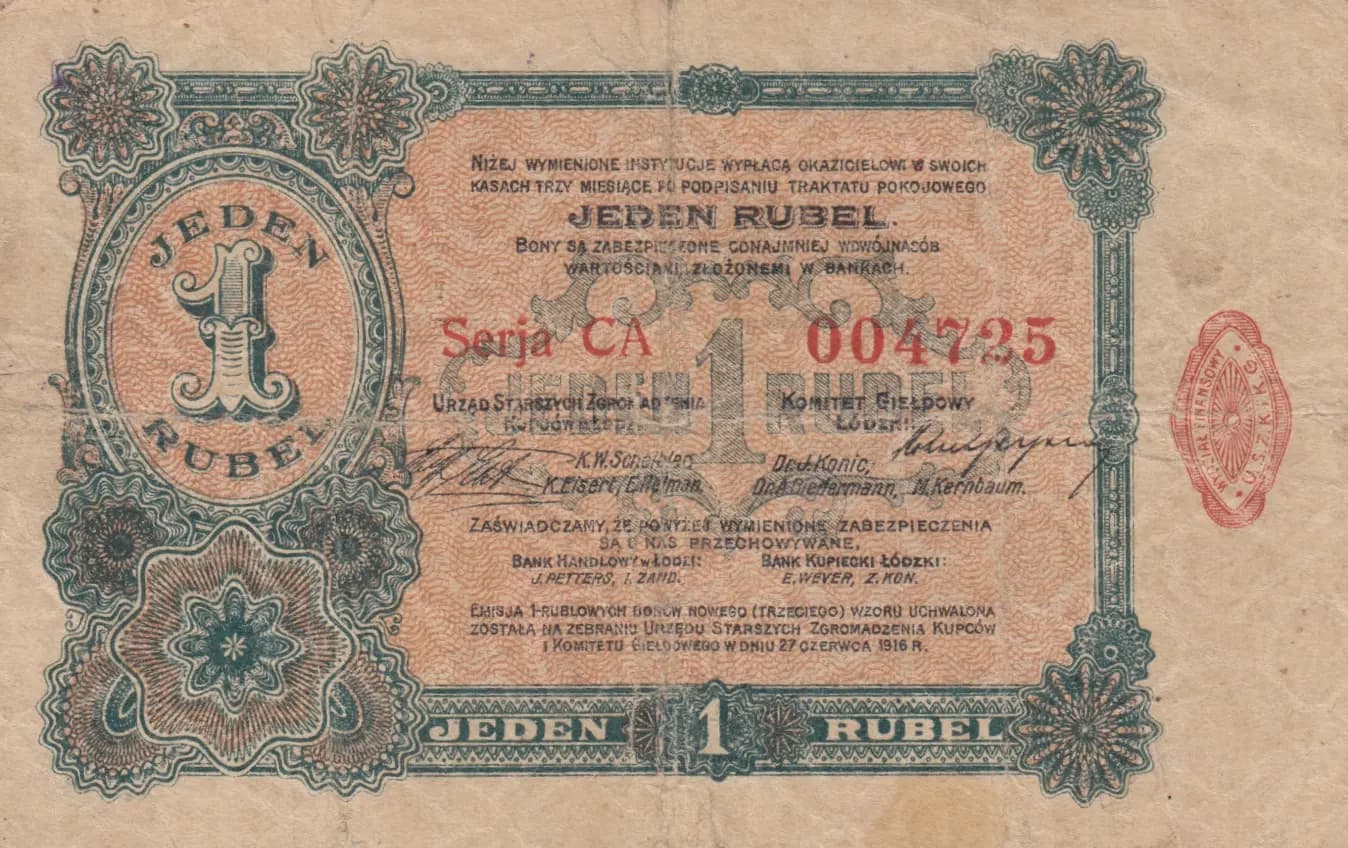
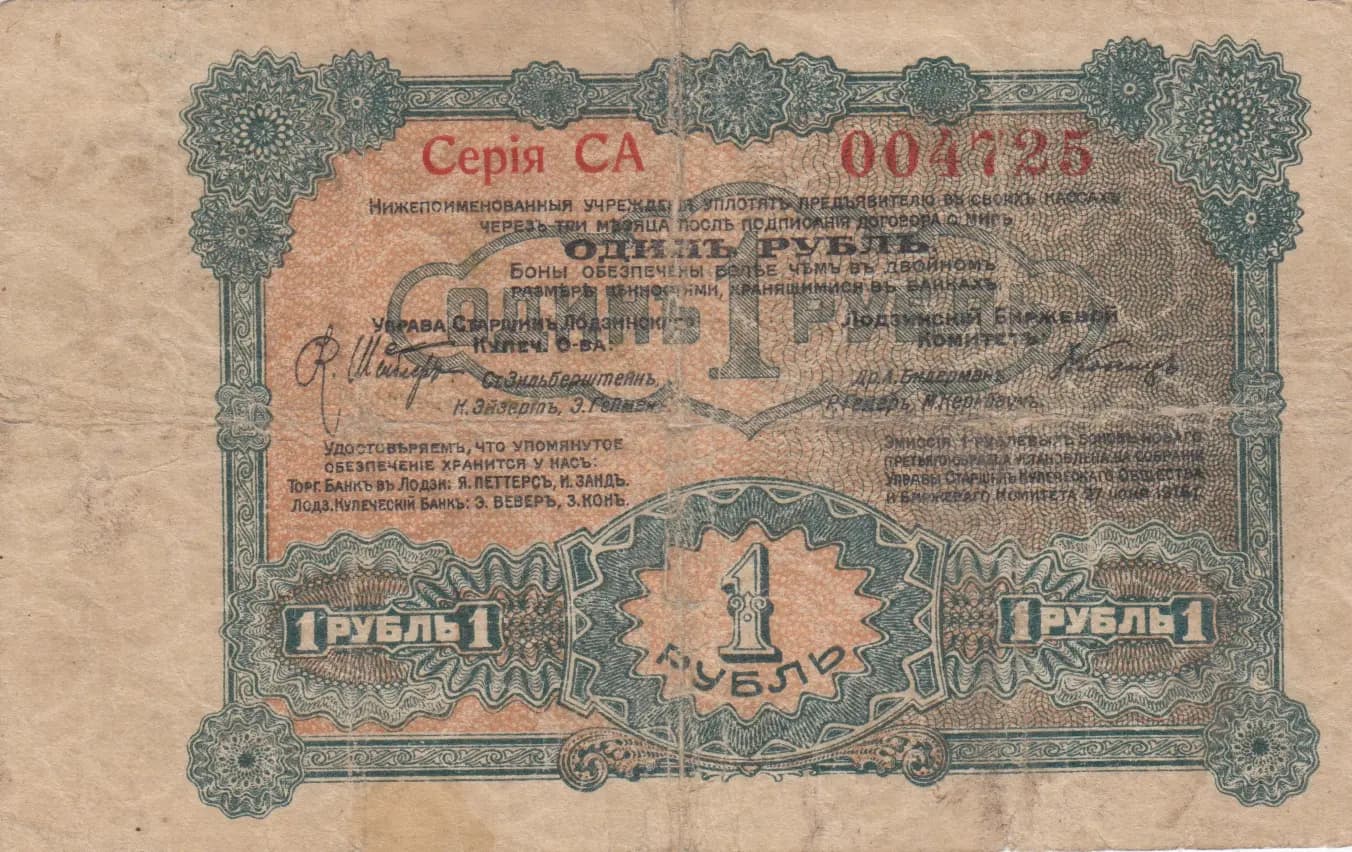
This is a bilingual Polish-Russian 1 Rubel bond certificate from 1916, issued during World War I by Łódź financial institutions. The note displays excellent period detail with ornate green/teal borders, Roman numeral denomination, and dual-language text reflecting the complex political status of Poland under Russian partition. In Fair condition, the note shows appropriate wear with creases, foxing, and aged paper consistent with a century-old circulated specimen.
Common. This is a 1 Rubel denomination bond from 1916 issued by multiple financial institutions in Łódź during the final years of Imperial Russian rule in Poland. Such bonds were issued in substantial quantities for wartime financing and circulation among regional banking institutions. The lack of Pick catalog listing (P-unlisted status) does not necessarily indicate rarity—rather, it suggests this particular variant or issuer has not been formally catalogued in standard philatelic references, which is common for regional bond certificates. Fair condition examples like this specimen are readily encountered in the market.
This 1916 Łódź bond represents a fascinating artifact of Polish-Russian relations during the final years of Imperial Russia. The bilingual Polish-Russian inscriptions reflect the fact that Poland was under Russian control during this period, with Łódź serving as a major financial center. The June 27, 1916 authorization date places this issue during World War I, when such bonds were used to finance wartime operations through multiple regional banking institutions including the Bank Handlowy and Bank Kupiecki.
This bilingual bond certificate features a symmetrical layout with ornate decorative borders in green/teal ink forming geometric and floral patterns throughout. The central design element on both sides is a large Roman numeral 'I' enclosed in an elaborate circular frame—on the front it appears in an ornate oval medallion, while on the back it is set within a star-burst or scalloped circular frame. Corner rosettes with floral motifs appear in all four corners on both sides. The tan/beige paper background provides contrast to the multi-colored printing in green/teal (for borders and ornaments) and red (for serial numbers, series designations, and certain text elements). The layout reflects dual-language requirements with Polish on the front and Russian (Cyrillic) on the back, both presenting identical financial information and signatures from the issuing institutions in Łódź.
FRONT SIDE - Polish Text: 'JEDEN RUBEL' (One Ruble); 'Seria CA' (Series CA); Serial number '004725'; 'The institutions listed below will pay interest in their offices of the Council being a signatory to the peace treaty'; 'Bonds are secured by at least double the value deposited in banks'; Banking institutions listed: 'Bank Handlowy Łódzi: J.PETTERRO, Z.ZAND' and 'Bank Kupiecki Łódski: E.WEVER, Z.KON'; 'We certify that the securities mentioned below are stored with us'; Authorization date and legislative information from June 27, 1916. BACK SIDE - Russian (Cyrillic) Text: 'ГРУБЛЬ' (Ruble); 'ГРУБЛЬ 1' (1 Ruble); 'Серия СА' (Series CA); Serial number '004725'; 'The institutions mentioned below will pay interest in their offices after signing the agreement'; 'Bonds are secured by double the value deposited in banks'; 'We certify that the aforementioned securities are stored with us'; Russian banking institution names corresponding to the Polish versions on the front.
This note was produced using letterpress/typographic printing combined with ornamental border and pattern engraving. The ornate borders, corner rosettes, and decorative frames characteristic of the design were clearly produced through engraved printing plates, while text and serial numbers appear to have been added through moveable type composition. The multi-color effect (green/teal and red) indicates separate print runs or overlays. This was a standard high-security printing technique for bonds and official financial documents of the 1916 period. The printer is not identified in the visual analysis, though the quality suggests work by an established European security printer serving the Russian Empire's Polish territories.
Series CA, Serial number 004725. This specimen represents the standard bilingual Polish-Russian variant issued for Łódź institutions. The dual-language format with matching serial numbers on both sides is the characteristic design of this issue. Varieties would be identified by different series designations or serial number prefixes, institutional issuer variations, or signature differences. The signatures visible (K.M.Schorlake, Dr.Reonio, Dr.Kuederbaum, Dr.Aiedersann, Ld.Kernbaum on front; corresponding Russian transliterations on back) represent the authorizing officials and would vary by institutional variant.