50 000 marek 1922
Market Prices
21 salesAbout This Note
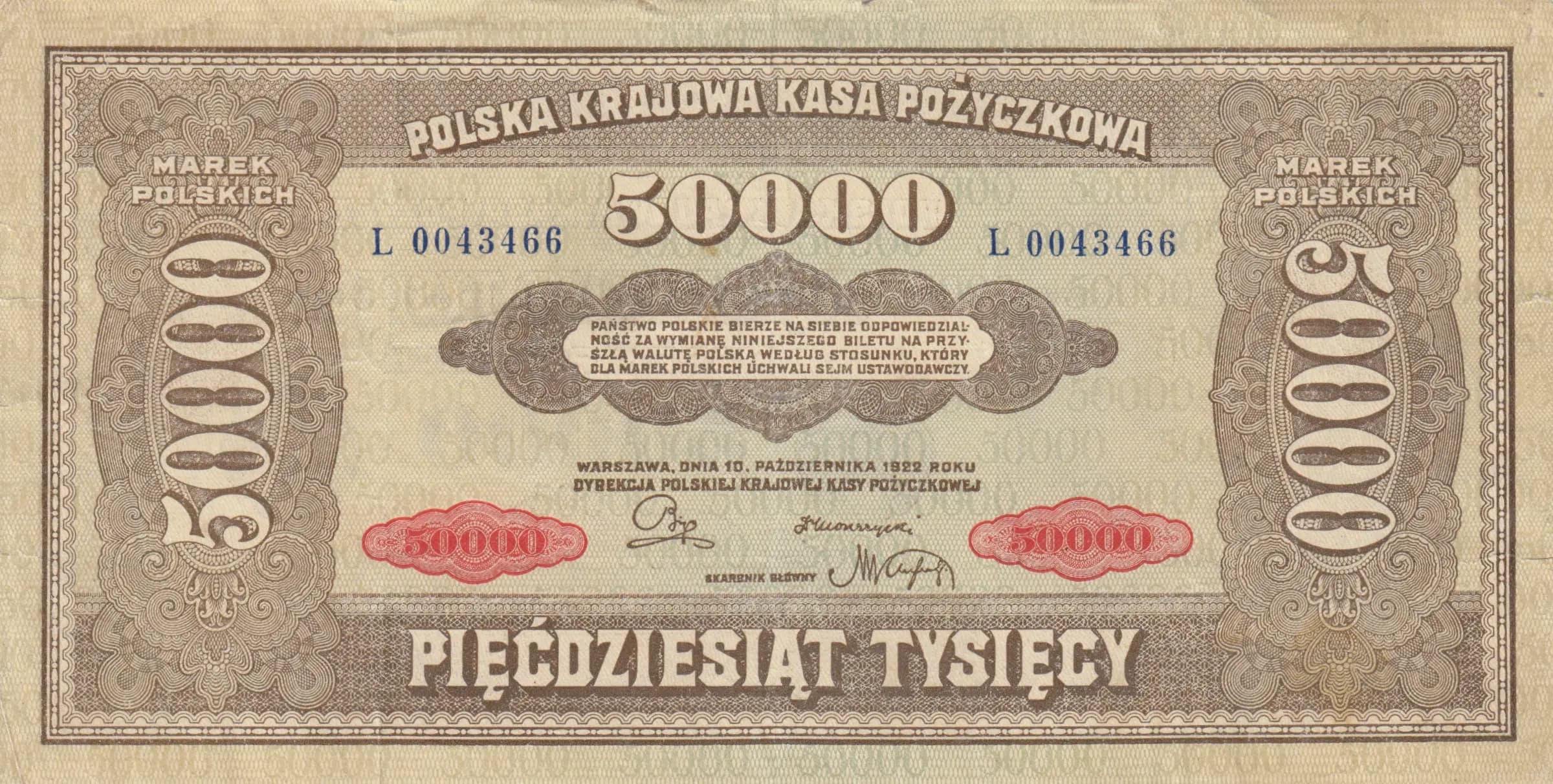
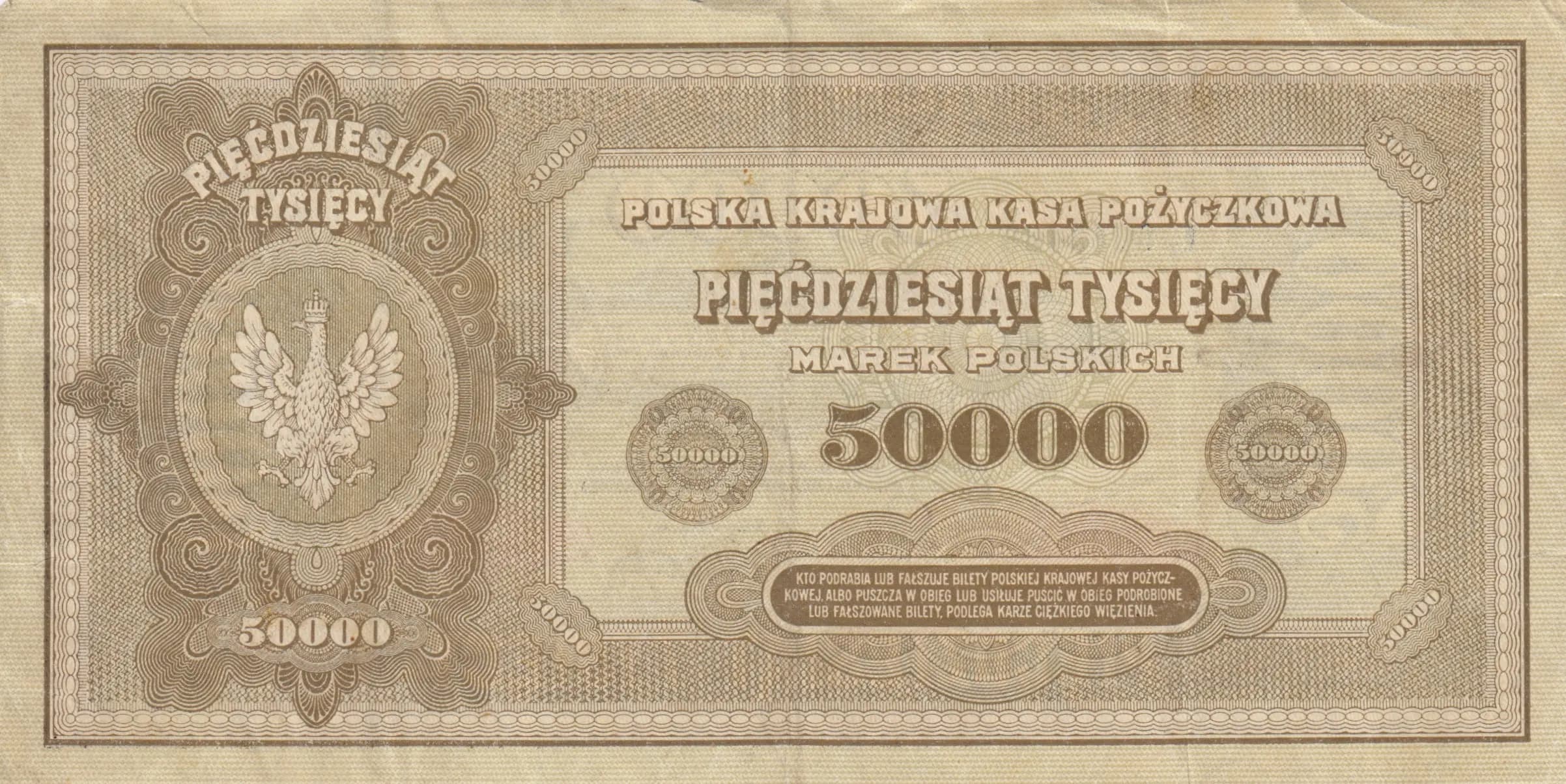
This Polish 50,000 Mark note from 1922 issued by Polska Krajowa Kasa Pożyczkowa exemplifies the high-denomination hyperinflation currency of post-WWI Poland. The note displays exceptional condition with crisp, clean margins, consistent coloring, and no visible wear—characteristics suggesting an uncirculated or near-uncirculated specimen. The elaborate brown and tan engraving with red security elements and ornate geometric patterns reflects the sophisticated security printing of the era, making it a notable example of interwar Polish currency design.
common
This note was issued on October 10, 1922, during Poland's severe post-World War I hyperinflation crisis, when the Polish mark collapsed in value necessitating denominations in the hundreds of thousands. The issuer, Polska Krajowa Kasa Pożyczkowa (Polish National Loan Bank), was a state institution tasked with stabilizing currency during this tumultuous economic period. The note's prominent Polish eagle symbol on the reverse and formal governmental language emphasizing state responsibility for currency exchange reflect the Polish state's attempts to maintain confidence in its transitional currency during a period that would ultimately lead to the adoption of the złoty in 1924.
The note features the Polish National Loan Bank's characteristic high-denomination design with elaborate Art Nouveau-inspired engraving. The obverse displays a formal layout with the denomination '50,000' prominently centered with red ornamental frames, flanked by intricate geometric and floral borders in brown and tan. Signature lines indicate authorization by the Chief Treasurer. The reverse showcases the Polish State Eagle (Orzel Biały)—the national symbol—depicted in a crowned, heraldic style with outstretched wings within an ornate circular medallion, surrounded by decorative scrollwork. The eagle appears on the left with denomination elements and institutional text arranged on the right within a geometric rectangular frame. The color palette of brown, cream, and tan with strategic use of red creates a visually formal and authoritative impression consistent with emergency government currency of the period.
{"front":{"issuer":"POLSKA KRAJOWA KASA POŻYCZKOWA = Polish National Loan Bank","denomination_words":"PIĘĆDZIESIĄT TYSIĘCY MAREK POLSKICH = Fifty Thousand Polish Marks","denomination_numerals":"50000","date":"WARSZAWA, DNIA 10. PAŹDZIERNIKA 1922 ROKU = Warsaw, 10th October 1922","authority":"DYREKCJA POLSKIEJ KRAJOWEJ KASY POŻYCZKOWEJ = Direction of the Polish National Loan Bank","state_guarantee":"PAŃSTWO POLSKIE BIERZE NA SIEBIE ODPOWIEDZIALNOŚĆ ZA WYMIANĘ NINIEJSZEGO BILETU NA PRZYSZŁĄ WALUTĘ POLSKĄ WEDŁUG STOSUNKU, KTÓRY DLA MAREK POLSKICH UCHWALI SEJM USTAWODAWCZY = The Polish State assumes responsibility for the exchange of this bill for future Polish currency according to the ratio that the Legislative Sejm will adopt for Polish marks","signature_authority":"SKARBNIK GŁÓWNY = Chief Treasurer","serial_number":"L 0043466"},"back":{"denomination_words":"PIĘĆDZIESIĄT TYSIĘCY MAREK POLSKICH = Fifty Thousand Polish Marks","issuer":"POLSKA KRAJOWA KASA POŻYCZKOWA = Polish National Loan Bank","denomination_numerals":"50000 (appears multiple times)","counterfeiting_warning":"KTO PODRABIA LUB FAŁSZUJE BILETY POLSKIEJ KRAJOWEJ KASY POŻYCZKOWEJ ALBO PUSZCA W OBIEG LUB USUWA PUSZCIĆ W OBIEG PODROBIONE LUB FAŁSZOWANE BILETY, PODLEGA KARZE CIEŻKIEGO WIĘZIENIA = Whoever counterfeits or forges bills of the Polish National Loan Bank or puts into circulation or causes to be put into circulation counterfeit or forged bills is subject to heavy imprisonment"}}
Intaglio engraving (line engraving/copperplate printing), evidenced by the crisp, fine detail of the geometric patterns, floral ornaments, the intricately rendered Polish eagle, and the sharp definition of all text elements and borders. The multiple layers of decorative borders and the complexity of the security features suggest professional production by a state security printer. The precise registration visible between color areas and the uniform ink saturation indicate high-quality presses typical of official government banknote production facilities of the 1920s.
This specific specimen is identified by serial number L 0043466 with an 'L' prefix, indicating a particular print series. The date of 10.10.1922 is standard for Pick-33. No major known varieties (overprints, color variations, or signature combinations) are evident from the visual analysis. However, collectors should note that Polish hyperinflation notes from this period sometimes appear with varying signature combinations and occasional printer's marks. The relatively low serial number (0043466) suggests this note is from an early printing run of the series.