5 marek 1919
Market Prices
19 salesAbout This Note
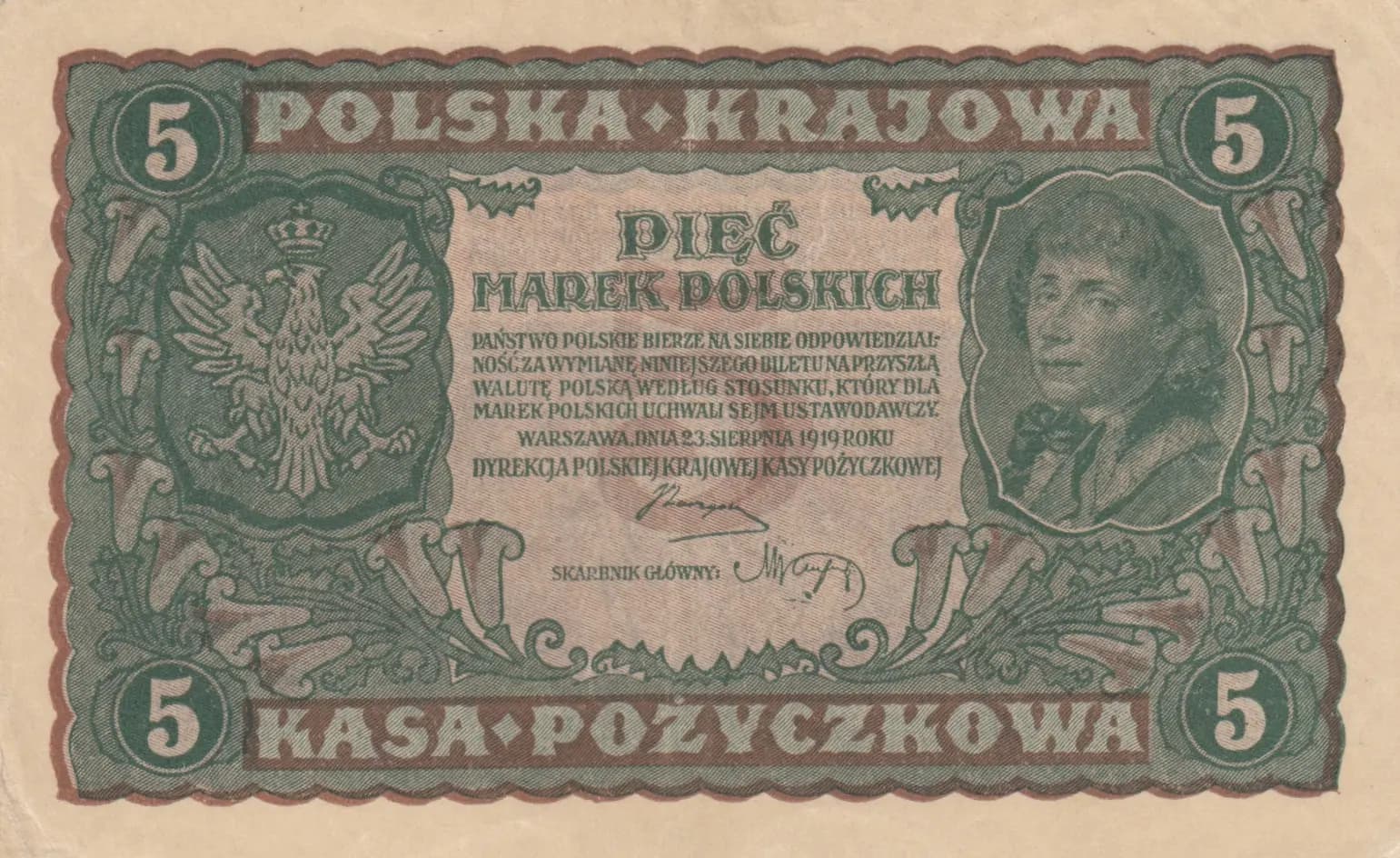
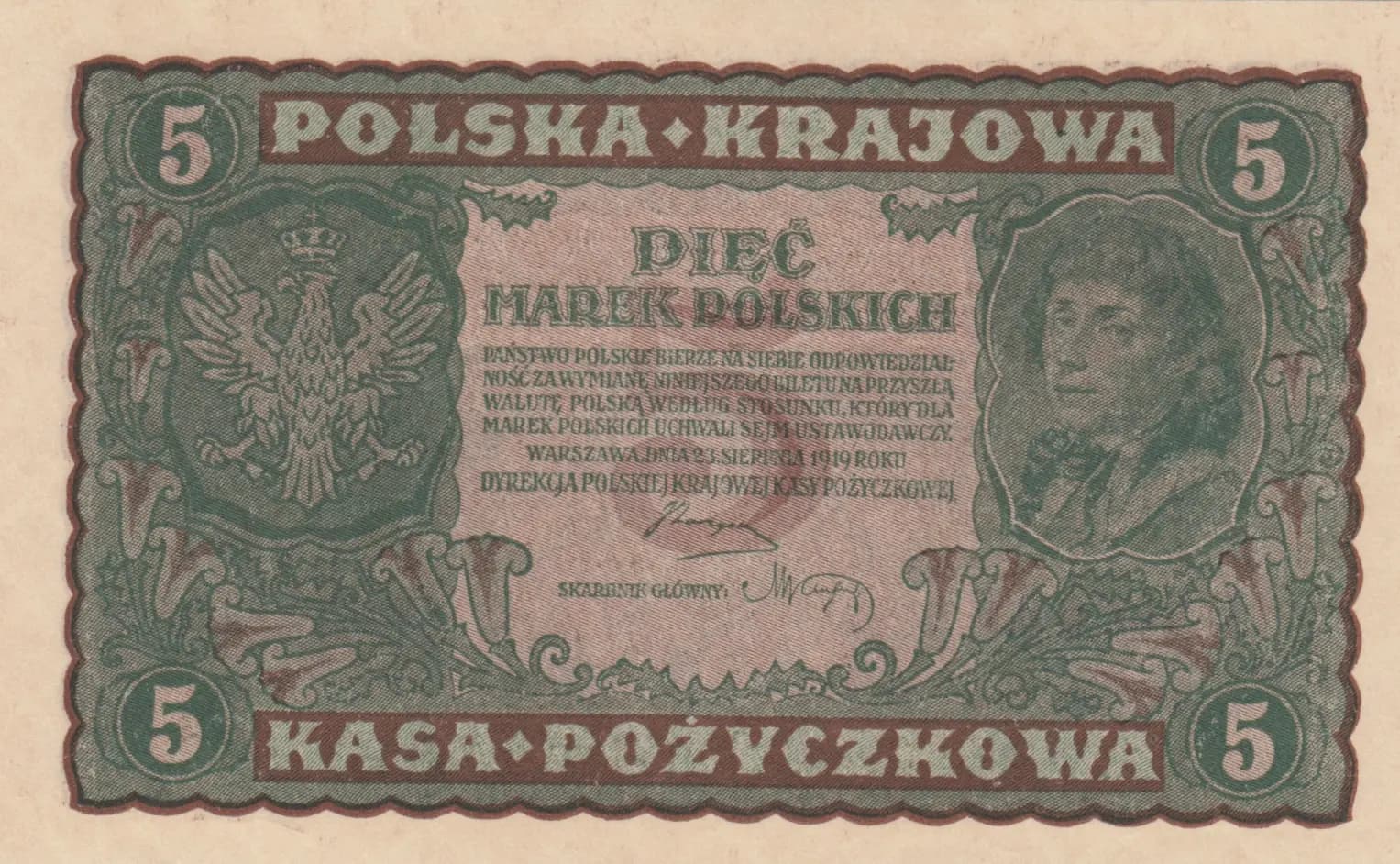
This is a Polish 5 Marek note from 1919, issued by the Polska Krajowa Kasa Pożyczkowa (Polish National Loan Bank) on August 23, 1919. The note displays beautiful Art Nouveau design with green and brown coloring, featuring Polish eagles and ornamental scrollwork, with denomination numerals in all four corners. In UNC condition, this note exhibits minimal wear with only age-appropriate foxing and discoloration consistent with its 105-year history, making it an attractive example of early Polish currency from the post-WWI period.
Common. This note is readily available in the collector market, as evidenced by consistent eBay sales data showing multiple transactions per year across various condition grades (ranging from $1.50 to $54 for graded examples), with UNC examples cataloged at $15 according to 2016 catalog values. The note was issued in substantial quantities by the Polish National Loan Bank during 1919, and examples have survived in reasonable numbers. The consistent market activity and affordable pricing across all grades indicate this is a standard early Polish note without scarcity characteristics.
This note represents Poland's early monetary sovereignty following the country's independence restoration in 1918 after 123 years of partition. The Polska Krajowa Kasa Pożyczkowa (Polish National Loan Bank) was established to manage Poland's financial recovery during the transition from occupation to statehood. The prominent double-headed Polish eagle on both sides symbolizes the restored nation's independence, while the August 23, 1919 date reflects the government's effort to stabilize the new Polish economy during the chaotic post-war period.
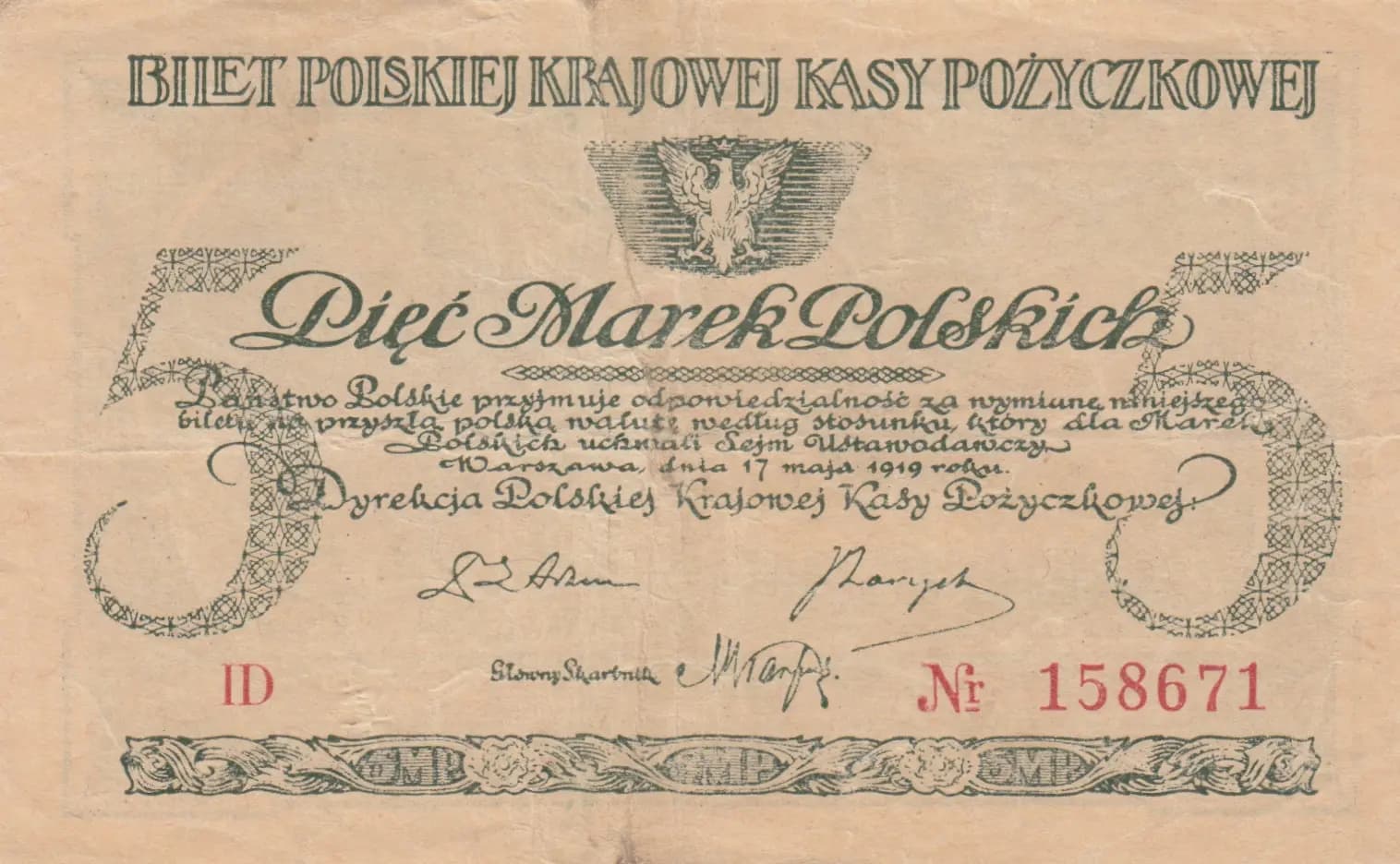
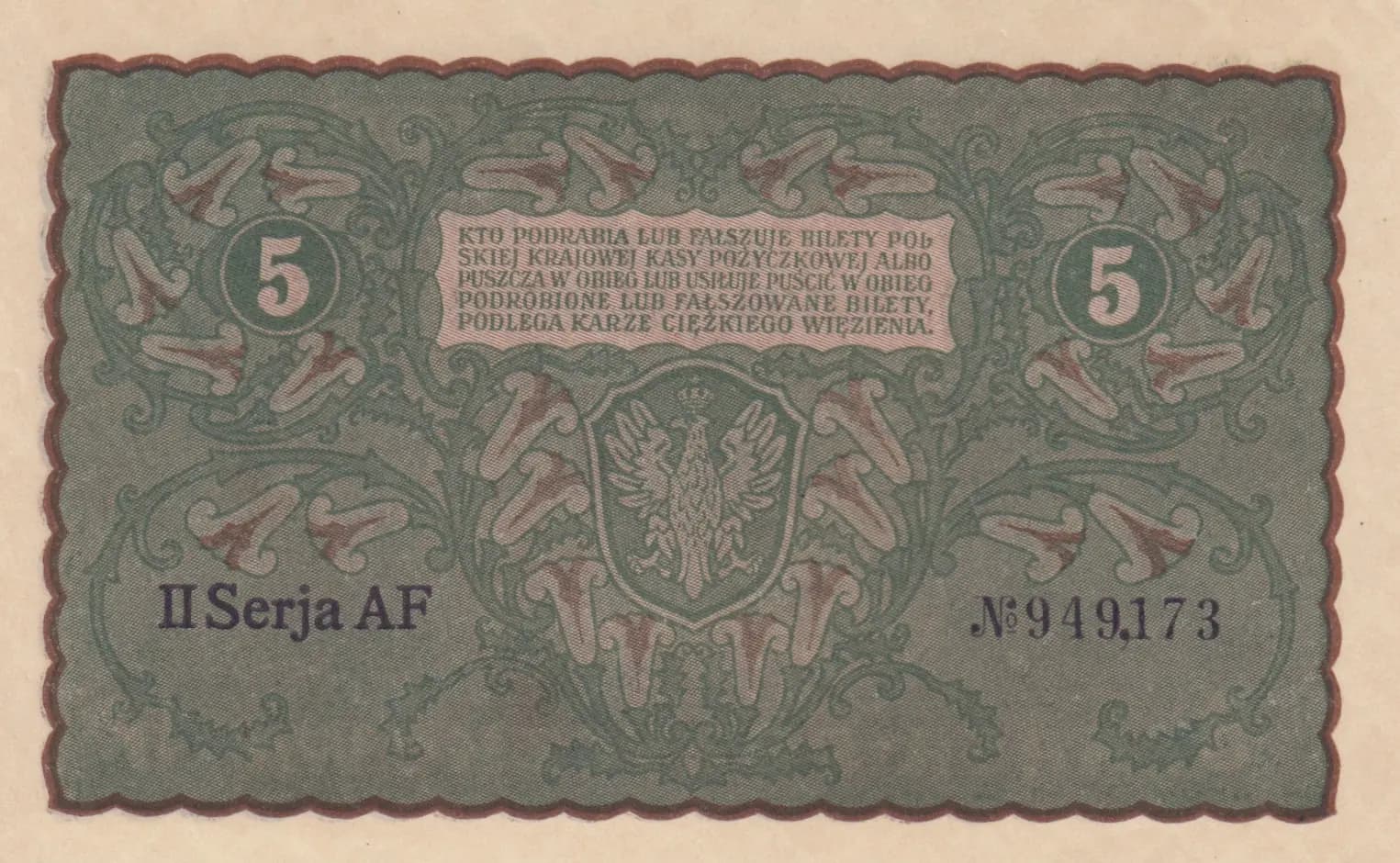
The obverse features an ornate Art Nouveau border with scalloped burgundy/brown edges. The note is dominated by green coloring with tan/beige central panels. Two oval portrait frames are positioned on the left and right sides; based on catalog data, the right side depicts Tadeusz Kościuszko, the renowned Polish military leader and national hero. The left side features a Polish double-headed eagle coat of arms within a decorative frame. Extensive ornamental floral and scrollwork patterns fill the background, with the denomination '5' displayed in circles at all four corners. The reverse displays a prominent crowned double-headed Polish eagle in a central shield, surrounded by similar ornamental patterns and additional decorative eagles in corner elements. Both sides showcase the heraldic symbols of Polish national identity during the reconstruction period.
FRONT SIDE: 'POLSKA KRAJOWA KASA POŻYCZKOWA' (Polish National Loan Bank) / 'PIĘĆ MAREK POLSKICH' (Five Polish Marks) / Main text: 'The Polish State assumes responsibility for the exchange of this note in full value, in Polish marks at the rate which was established by law for Polish marks by the Legislator. Warsaw, August 23, 1919. Director of the Polish National Loan Bank' / 'SKARB GŁÓWNY: KASA POŻYCZKOWA' (Main Treasury: Loan Bank). BACK SIDE: Counterfeiting warning: 'Whoever counterfeits or forges tickets under the National Loan Bank or puts into circulation or removes such notes from circulation is subject to severe imprisonment.' / Series and serial number designation: 'II Serja AF' (Series II AF) / Serial number: 'No. 949173'
This note was produced using intaglio (engraved) printing, evidenced by the fine detailed line work, intricate ornamental patterns, and sharp definition visible in both the portraits and decorative elements. The multi-color printing (green, brown, tan, gray) was applied through traditional banknote engraving methods typical of early 20th-century European currency production. The precision of the security features, including the fine scrollwork and anti-counterfeiting ornamental patterns, is characteristic of professional security printing used by central banking institutions of this era.
This example represents Series II AF (Serja II AF) with serial number 949173, as observed on the reverse. According to catalog data, this Pick number (P-24) has two known serial number varieties. The series designation system (Roman numerals followed by letter combinations) was used by the Polish National Loan Bank to track production batches. The specific series and serial number combination observed here is consistent with standard production variants for this denomination and issuer, with no unusual overprints, signatures, or other distinguishing features noted that would indicate a significant variety or error.