5 marek 1919
Market Prices
10 salesAbout This Note
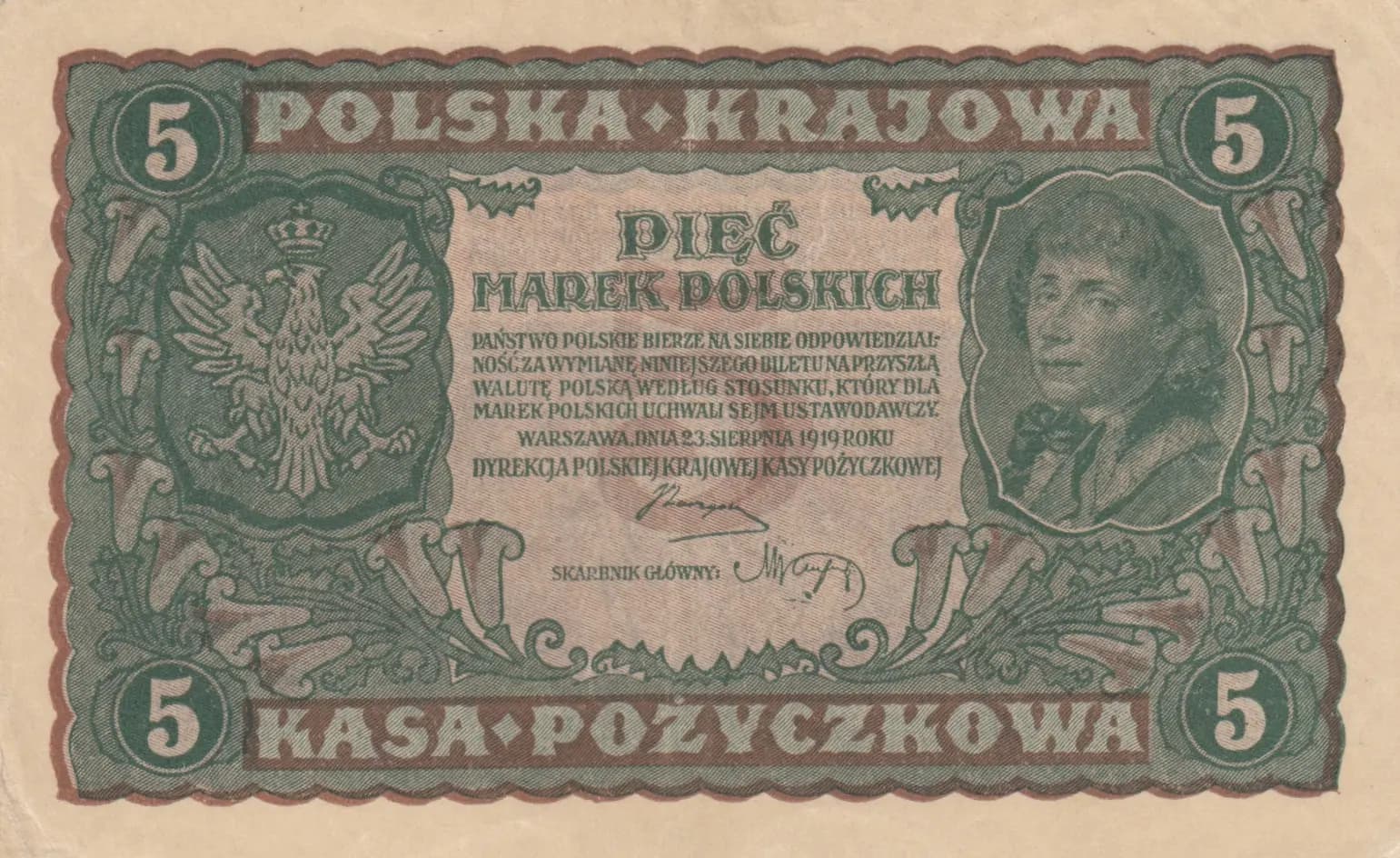
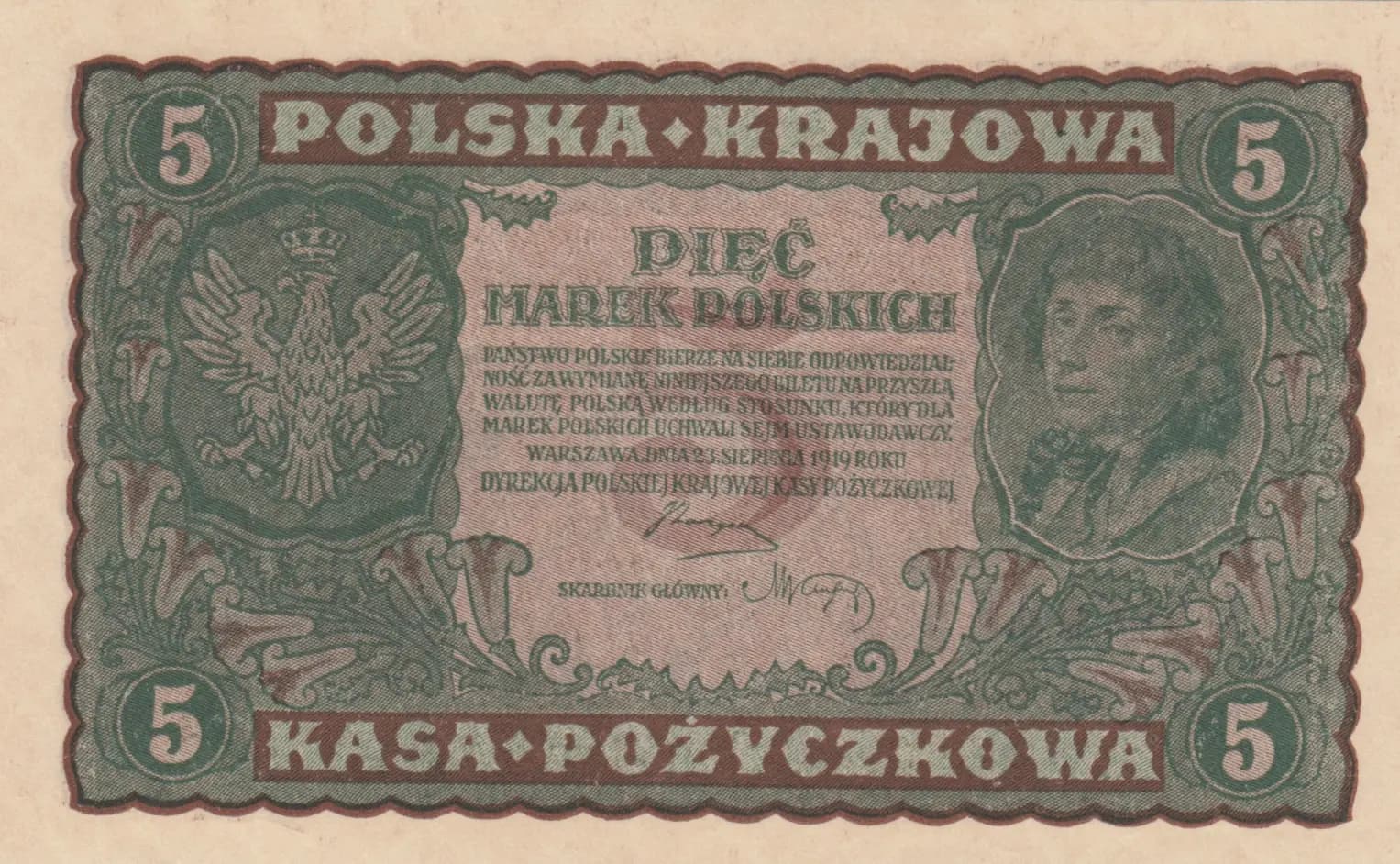
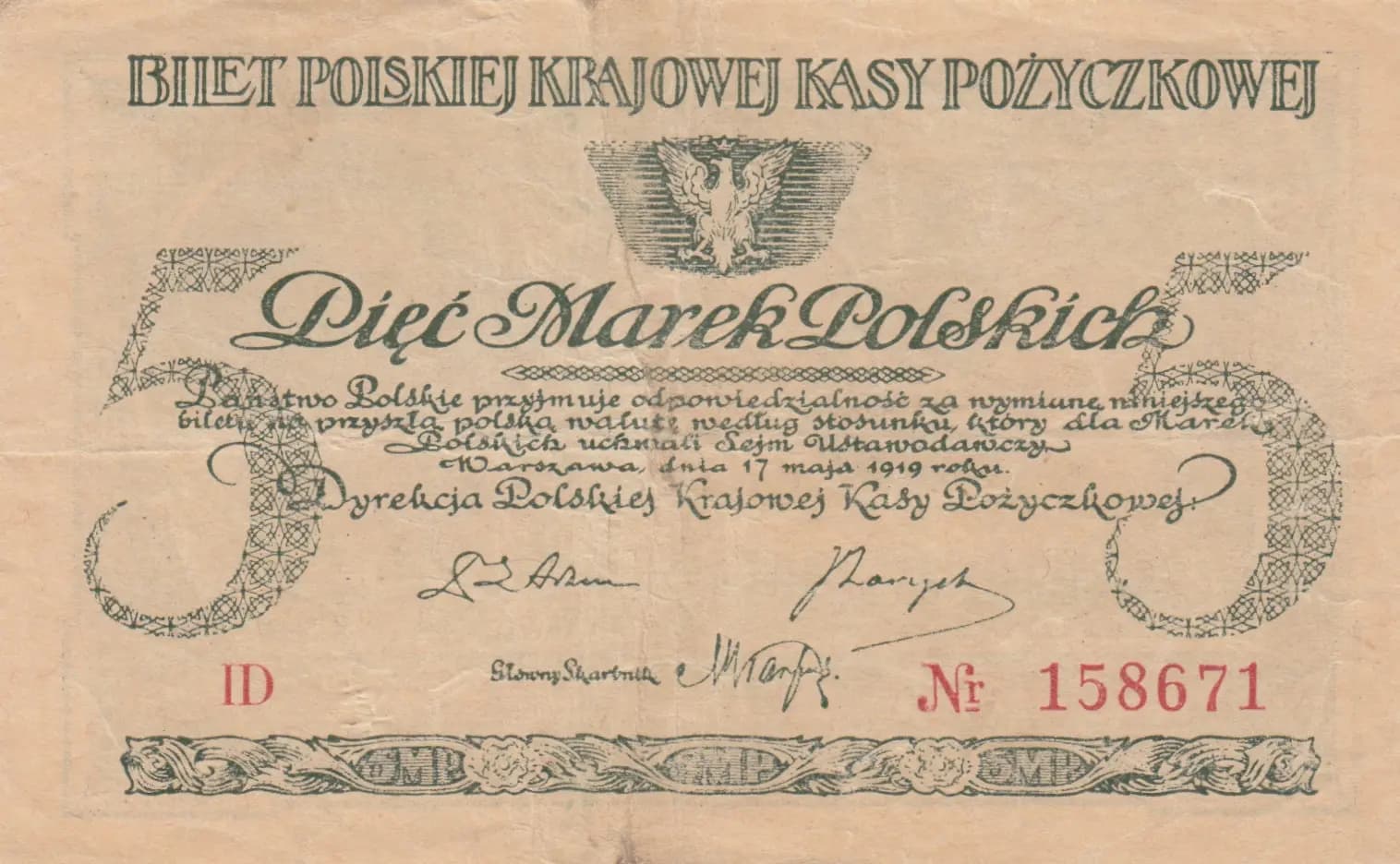
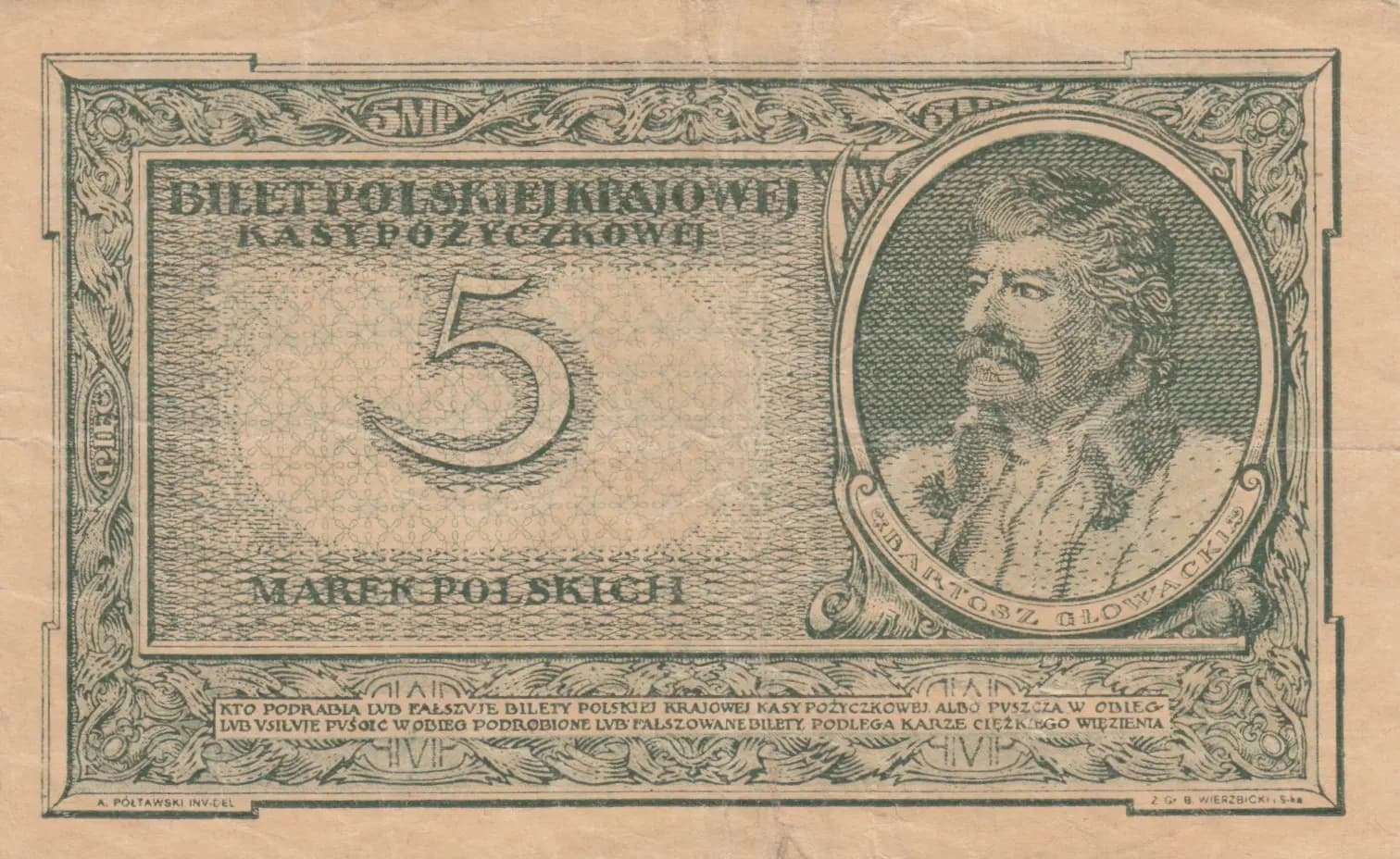
This is a Polish 5 Marek banknote issued on May 17, 1919 by the Polska Krajowa Kasa Pożyczkowa (Polish National Loan Bank), graded VF by catalog standards. The note exhibits typical aging characteristics for a 104-year-old circulated note, including visible creasing, foxing, and tan discoloration, but maintains clear legibility of all engraved details. The obverse features the Polish White Eagle emblem with ornate borders and handwritten signatures, while the reverse displays a portrait of Bartosz Głowacki in profile within a circular frame alongside the denomination numeral '5'.
Common. The eBay price history provided shows consistent sales in the $5–$37 range across multiple condition grades (VG to EF) over a 7-year period, with catalog values for VF grade at $15 (2016). This pricing pattern and frequency of sales indicates this is a readily available note in the numismatic market. While the Polska Krajowa Kasa Pożyczkowa was a short-lived issuing authority (operating only in the immediate post-WWI period), this particular denomination and issue date appears to have had sufficient circulation and survival to remain common today. No evidence of low print runs, recalls, or extreme scarcity applies to this Pick-20 note.
This note represents an important transitional period in Polish monetary history, issued just weeks after Poland's independence was formally recognized following World War I. The Polska Krajowa Kasa Pożyczkowa (Polish National Loan Bank) served as an early financial institution for the newly reconstituted Polish state, with this ticket serving as a medium of exchange during the chaotic early years of Polish sovereignty. The prominent Polish White Eagle and inscriptions addressing 'Polish Children' (Dzieci Marek Polskich) reflect nationalist sentiment and the populist appeal of Poland's new currency to its citizens.
The obverse presents a formal, text-heavy design typical of early Polish state currency, dominated by the double-headed Polish White Eagle (Orzel Biały) at the top center, serving as the heraldic symbol of state authority. The design incorporates elaborate geometric ornamental borders with scrollwork and flourishes on both sides. Three handwritten signatures appear on the obverse, indicating authorization by multiple officials of the Polska Krajowa Kasa Pożyczkowa. The reverse features a portrait of Bartosz Głowacki, a historical Polish figure, depicted in profile facing left with wavy hair and period clothing, enclosed within a circular ornamental frame. The large numeral '5' dominates the left portion of the reverse. The portrait identification (Bartosz Głowacki) is confirmed by external catalog references, though the visual analysis describes only a bearded man—this likely represents a notable Polish historical or political figure from the independence period. The overall aesthetic reflects early 20th-century European banknote design with emphasis on engraved fine-line work and ornamental security features.
OBVERSE: 'BILET POLSKIEJ KRAJOWEJ KASY POŻYCZKOWEJ' (Ticket of the Polish National Loan Bank); 'Dzieci Marek Polskich' (Polish Children); Long inscription beginning 'Państwo Polskie przyjmuje odpowiedzialność...' translating to 'The Polish State assumes responsibility for the exchange of this ticket according to Polish currency at the established rate for Polish marks, issued in Warsaw on May 17, 1919'; 'Dyrekcja Polskiej Krajowej Kasy Pożyczkowej' (Direction of the Polish National Loan Bank); 'Starszy Skarbnik w Warszawie' (Senior Treasurer in Warsaw); Serial number 'Nr 158671'. REVERSE: 'BILET POLSKIEJ KRAJOWEJ KASY POŻYCZKOWEJ' (Ticket of the Polish National Loan Bank); '5 MAREK POLSKICH' (5 Polish Marks); Anti-counterfeiting warning: 'KTO PODRABIA LUB FAŁSZUJE BILETY...PODLEGA KARZE PODLE KODEKSU' (Whoever counterfeits or forges these tickets or puts them into circulation is subject to punishment according to law); 'A. PÓŁTAWSKI INV. CEL' (Designer/Inventor A. Półtawski); 'Z.G.B. WIERZBICKI, S-ka' (Printer Z.G.B. Wierzbicki Company).
This note was produced using intaglio engraving (line engraving and steel plate printing), the standard technique for banknote production of the era. The fine detail visible in the ornamental borders, portrait, and text inscription indicates multiple engraved printing plates. The printer was Z.G.B. Wierzbicki, S-ka (Wierzbicki Company), as credited on the reverse, with design by A. Półtawski. The color application—tan/cream paper with green and red inks—suggests letterpress or lithographic overprinting of the base engraved design. The visible handwritten signatures were added post-printing, as was customary for official banknotes of this period requiring authorization marks.
The specific variety of this note is determined by its serial number (Nr 158671), which falls within the documented range for the May 17, 1919 issue. No overprints, error varieties, or significant printing variants are noted in the visual analysis. The three signatures on the obverse are consistent with standard authorization marks for this issuing institution and do not constitute a distinct variety. The Pick catalog lists this as P-20, indicating a single main variety for the 5 Marek 1919 denomination from the Polska Krajowa Kasa Pożyczkowa. Serial number prefixes and specific signature combinations may create sub-varieties of interest to specialized collectors, but the present specimen represents a standard circulation example of the main type.