20 zlotych 1931
Market Prices
15 salesAbout This Note
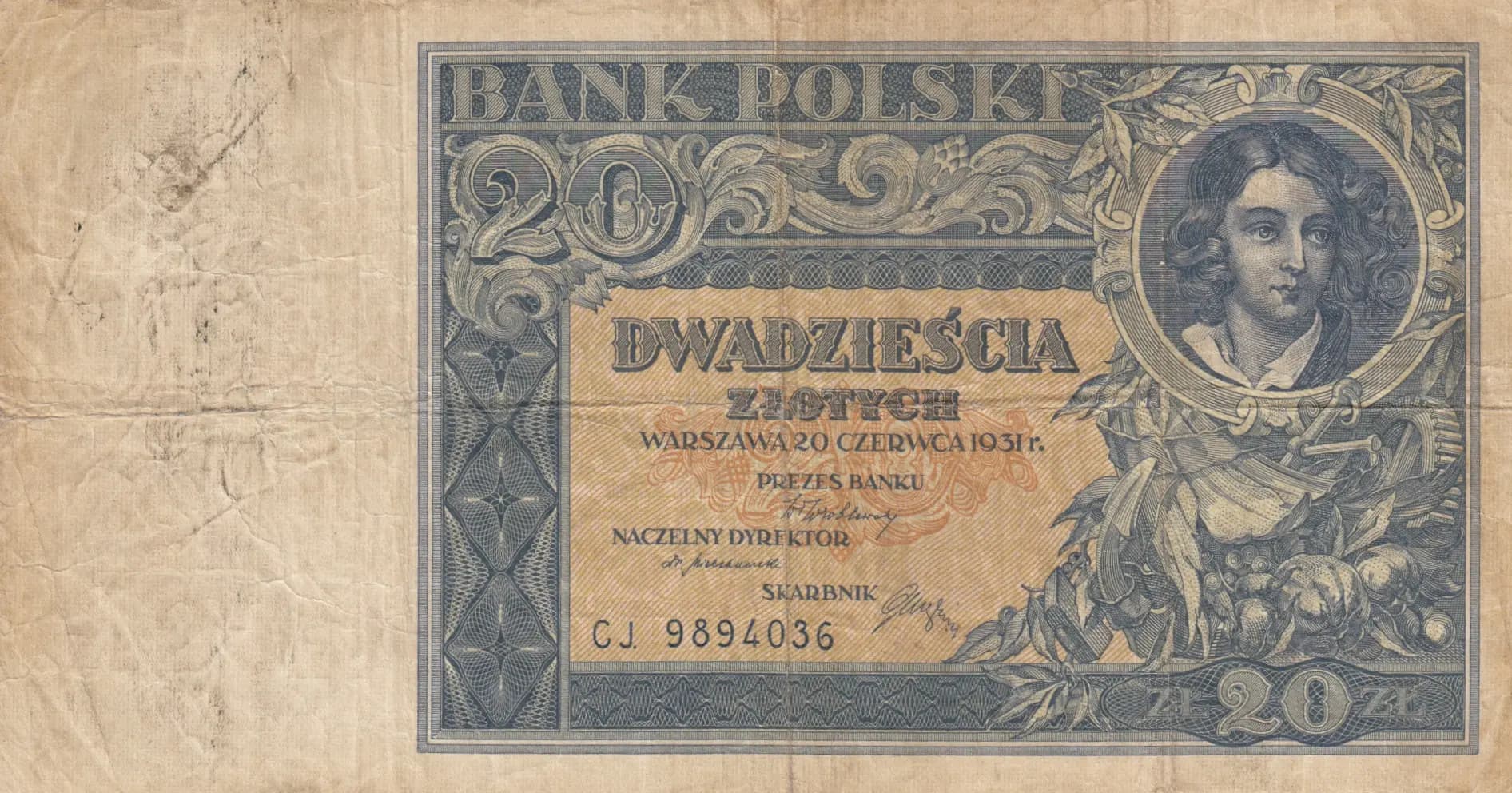
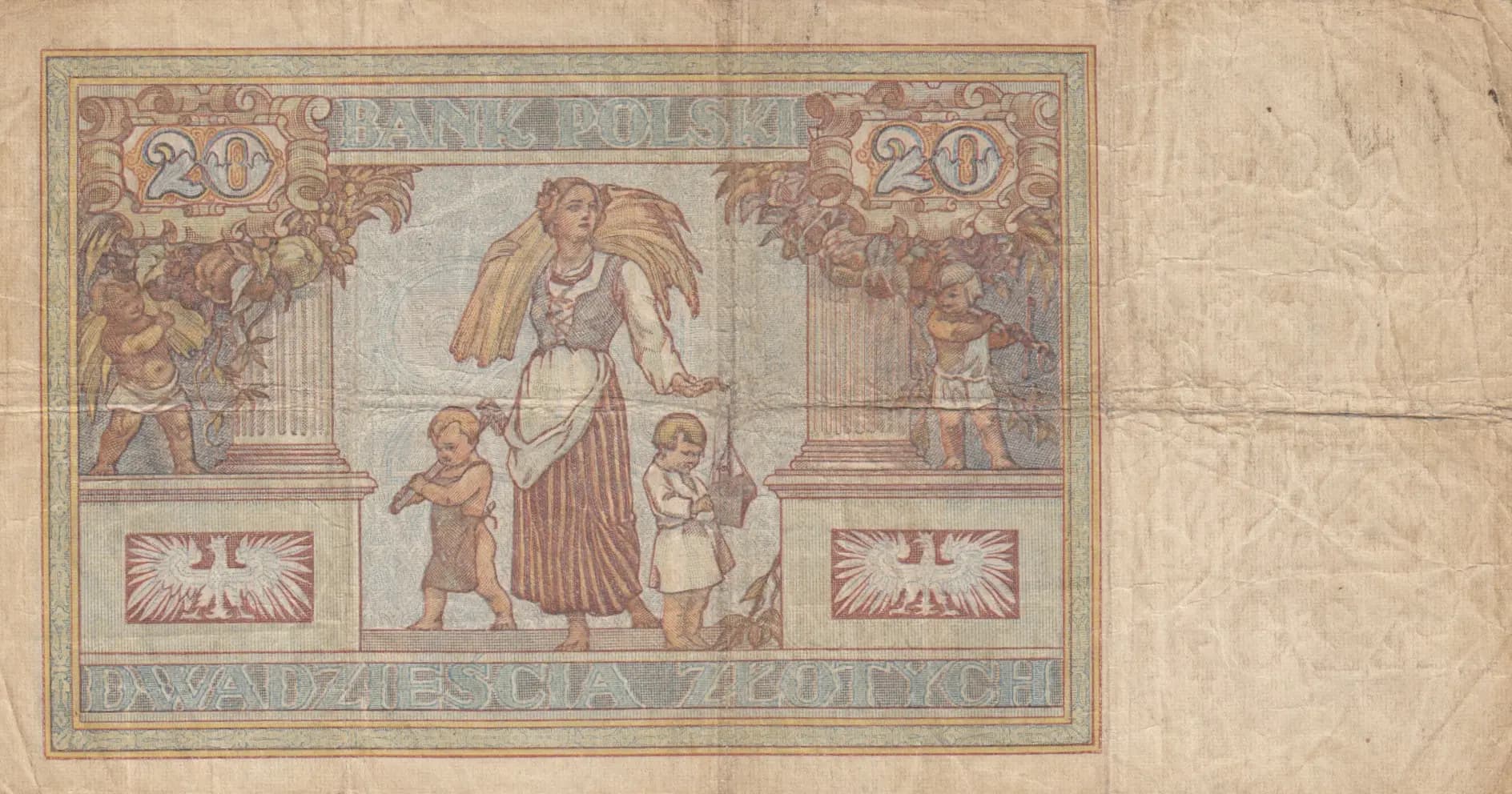
This is a Polish 20 Złotych banknote from 1931, issued by Bank Polski on June 20, 1931, graded in Fair (F) condition. The note features a portrait of Emilie Plater on the obverse and an allegorical winged female figure with two children on the reverse, both rendered in fine engraved detail. Despite visible creasing, fold marks, foxing, and age staining consistent with F-grade condition, the note retains good structural integrity and displays the characteristic blue-gray and brown color palette of this issue.
Common. The eBay market data provided shows consistent sales in the $3.52 to $8.16 range for notes in F condition over the past decade, with catalogue values for F-grade at approximately $3-5 USD. The presence of multiple PMG-graded variants in the population report indicates regular commercial circulation and professional grading activity. Print runs for this standard issue were substantial, and the denomination (20 Złotych) was widely circulated. No evidence of rarity or limited issuance is supported by either the catalog data or secondary market pricing.
This banknote was issued during the interwar period of the Second Polish Republic, a time of monetary and economic stabilization following World War I. The obverse features Emilie Plater, a 19th-century Polish patriot and freedom fighter, reflecting the nation's emphasis on historical figures of resistance and national identity. The reverse's allegorical winged female figure with children represents Poland's prosperity and future, a common iconographic choice for nations rebuilding their independence and economic stability in the post-WWI era.
The obverse features a formal portrait of Emilie Plater, a Polish-Lithuanian noblewoman and military commander (1806-1831), depicted in an oval decorative frame on the upper right side of the note. Her profile faces left, rendered with fine engraved detail showing her curled period hairstyle. The background employs ornamental borders in blue-gray tones with intricate scrollwork and floral motifs. The reverse depicts an allegorical personification of Poland as a classical winged female figure in flowing robes, standing centrally with two putti (cherubic children) flanking her sides. She is positioned within a classical architectural framework with columns on both sides. White eagle emblems (the Polish national symbol) appear in small rectangular cartouches at the lower left and right of the central composition. The color scheme combines reddish-brown and green tones on the reverse with the blue-gray and tan palette of the obverse.
OBVERSE: 'BANK POLSKI' (Bank of Poland); '20' (denomination); 'DWADZIEŚCIA ZŁOTYCH' (Twenty Zlotych); 'WARSZAWA 20 CZERWCA 1931 r.' (Warsaw June 20, 1931); 'PREZES BANKU' (President of the Bank); 'NACZELNY DYREKTOR' (Chief Director); 'SKARBNIK' (Treasurer); Serial number 'CJ 9894036'. REVERSE: 'BANK POLSKI' (Bank of Poland); '20' (denomination); 'DWADZIEŚCIA ZŁOTYCH' (Twenty Zlotych).
This banknote was produced using intaglio engraving (steel plate engraving), the standard security printing technique for Bank Polski during this period. The fine line work, intricate geometric patterns, detailed portraiture, and security features visible throughout the note exemplify the high-quality engraving characteristic of interwar Polish currency production. The note displays the hallmark sharpness and detail possible only through intaglio printing, with no evidence of lithographic or other alternative printing methods.
The PMG population report indicates two catalogued variants for Pick 73: P-73pp (perforated pair) and P-73s (specimen). The serial number visible on the example ('CJ 9894036') with the 'CJ' prefix is consistent with regular production notes. No unusual varieties, overprints, or significant printing errors are evident from the visual analysis. This appears to be a standard example of the base P-73 type.