20 zlotych 1946
Market Prices
11 salesAbout This Note
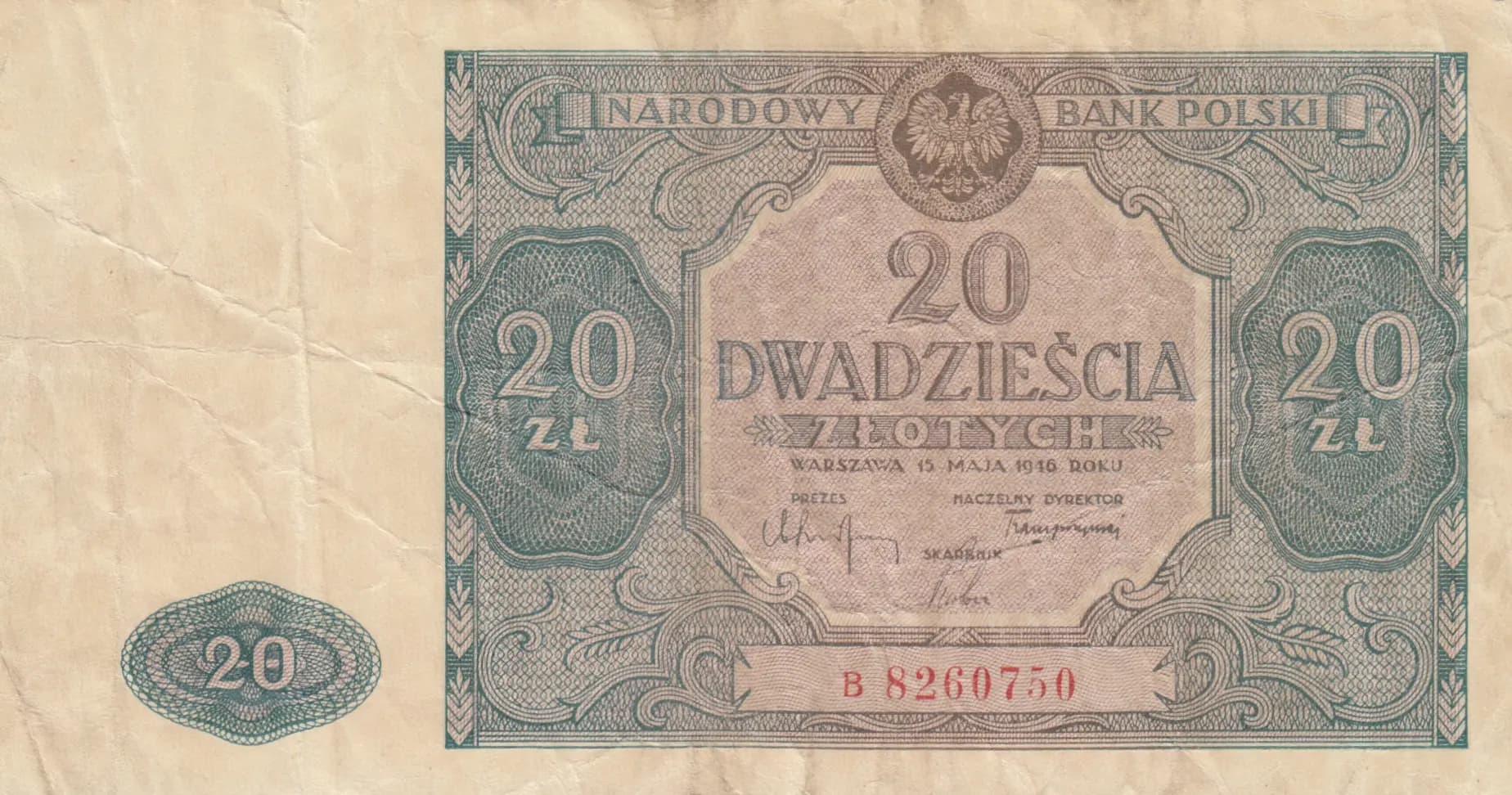
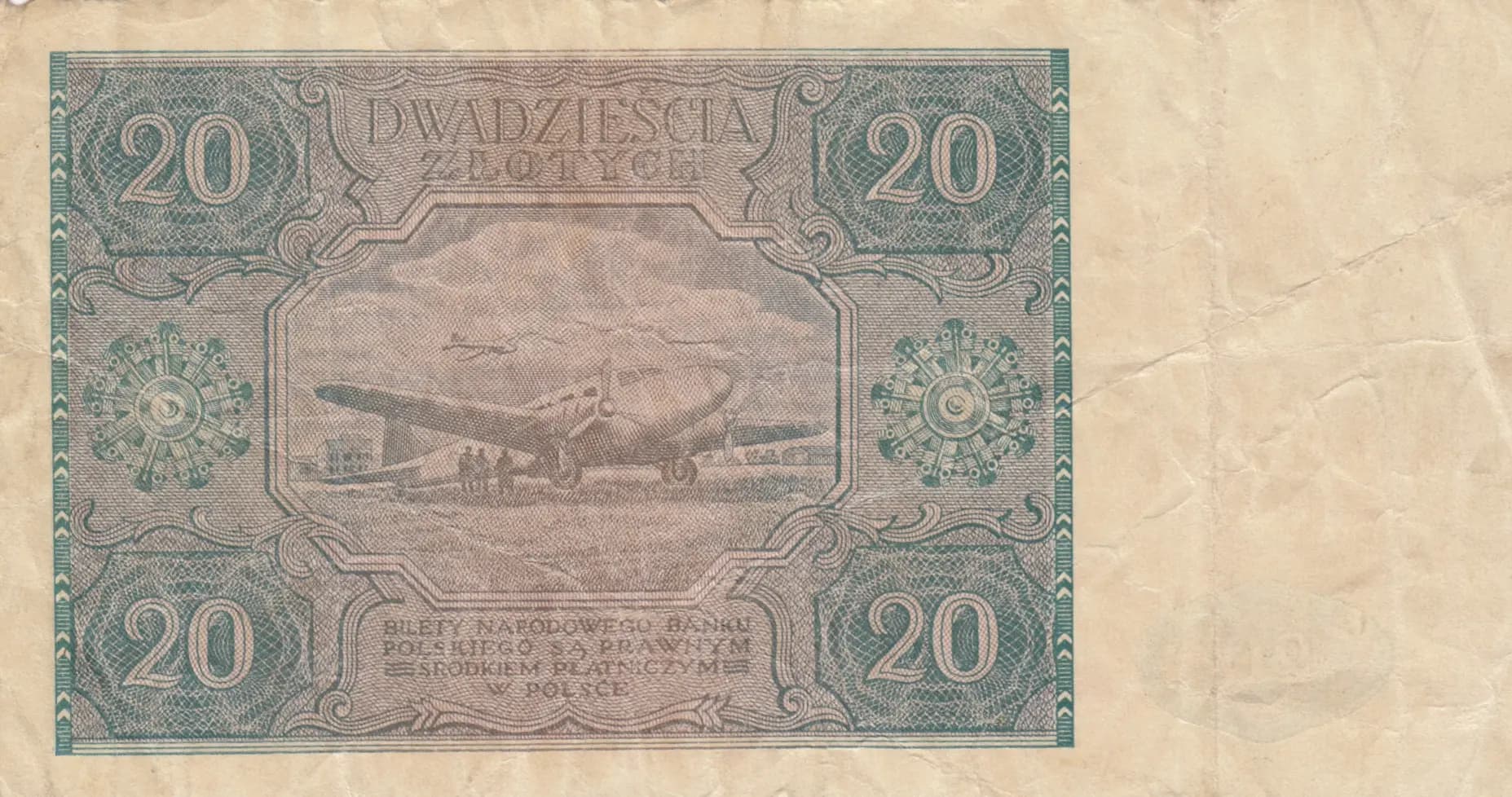
This Polish 20 złotych banknote from 1946 (Pick-127) features the distinctive design elements of the early post-WWII Polish currency, with the Polish eagle emblem prominently displayed on the obverse and a locomotive scene on the reverse. The note exhibits excellent condition with minimal wear consistent with age, displaying the intricate engraving work and ornamental borders characteristic of mid-20th century security printing. The May 15, 1946 date marks this as part of the immediate post-war reconstruction currency issued by the newly reconstituted Narodowy Bank Polski.
Common. eBay auction data shows notes in F condition selling consistently in the $7-$29.50 range across multiple sales from 2013-2023, with typical realized prices around $12-$15 for Fair condition examples. The 2016 catalog valuation places F grade at approximately $10-$15. The regular issue status and consistent market availability indicate this was a standard denomination with substantial print run. Only premium grades (PMG 67 noted at $549) command significantly higher prices.
This note was issued just one year after the liberation of Poland from Nazi occupation, representing the monetary reconstruction of the devastated nation under Soviet influence. The inclusion of the Polish eagle (Orzeł Biały) on the obverse reasserted Polish national sovereignty and identity, while the locomotive depicted on the reverse symbolized Poland's industrial recovery and modernization ambitions during the post-war reconstruction period. The design reflects the nationalist and progressive themes of Poland's immediate post-war government.
The obverse features the Orzeł Biały (White Eagle), Poland's national emblem, positioned prominently in a circular medallion at the top center. The design employs elaborate ornamental borders in teal/green and beige tones with extensive rosettes, scrollwork, and geometric filigree patterns throughout. The denomination appears in multiple locations—as numerals '20' in four corners within oval cartouches and spelled out as 'DWADZIEŚCIA ZŁOTYCH' in the center. The reverse depicts a detailed locomotive scene in landscape setting, representing Poland's industrial heritage and post-war reconstruction. The same ornamental corner medallions appear on both sides, with sophisticated decorative borders framing the entire note.
FRONT: 'NARODOWY BANK POLSKI' (National Bank of Poland), '20' and 'DWADZIEŚCIA ZŁOTYCH' (Twenty zlotych - denomination), 'WARSZAWA 15 MAJA 1946 ROKU' (Warsaw, May 15, 1946), 'PREZES' (President - signature line), 'NACZELNY DYREKTOR' (Chief Director - signature line), 'ZŁ' (currency abbreviation for złotych), Serial number 'B 8260750'. BACK: '20' and 'DWADZIEŚCIA ZŁOTYCH' (Twenty zlotych), 'BILET NARODOWEGO BANKU POLSKIEGO' (Ticket of the National Bank of Poland), 'KRAJOWA KASA POŻYCZEK NA WEKSELE' (National Loan Bank for Bills of Exchange).
Intaglio (engraved) printing, characteristic of high-security banknote production of the 1940s. The fine line work, cross-hatching, and intricate filigree patterns visible throughout serve both aesthetic and anti-counterfeiting purposes. The detailed locomotive engraving and ornamental borders demonstrate the sophisticated craftsmanship typical of professional security printers of this era. The precision of the border work and portrait medallions indicates production by a skilled security printing facility, likely either Polish or produced under Soviet supervision given the post-war context.
This is the base P-127s variety as catalogued by Pick. The observed serial number prefix 'B' with number '8260750' appears consistent with standard issue production. The note is dated 15 May 1946 from Warsaw as per the inscription 'WARSZAWA 15 MAJA 1946 ROKU'. Two signature lines are present (PREZES and NACZELNY DYREKTOR positions), though specific signatory names are not legible in the visual analysis. No overprints, replacement markings, or other varieties are observed. This represents a standard circulation issue of the first Polish post-war banknote series.