2 zlote 1946
Market Prices
13 salesAbout This Note
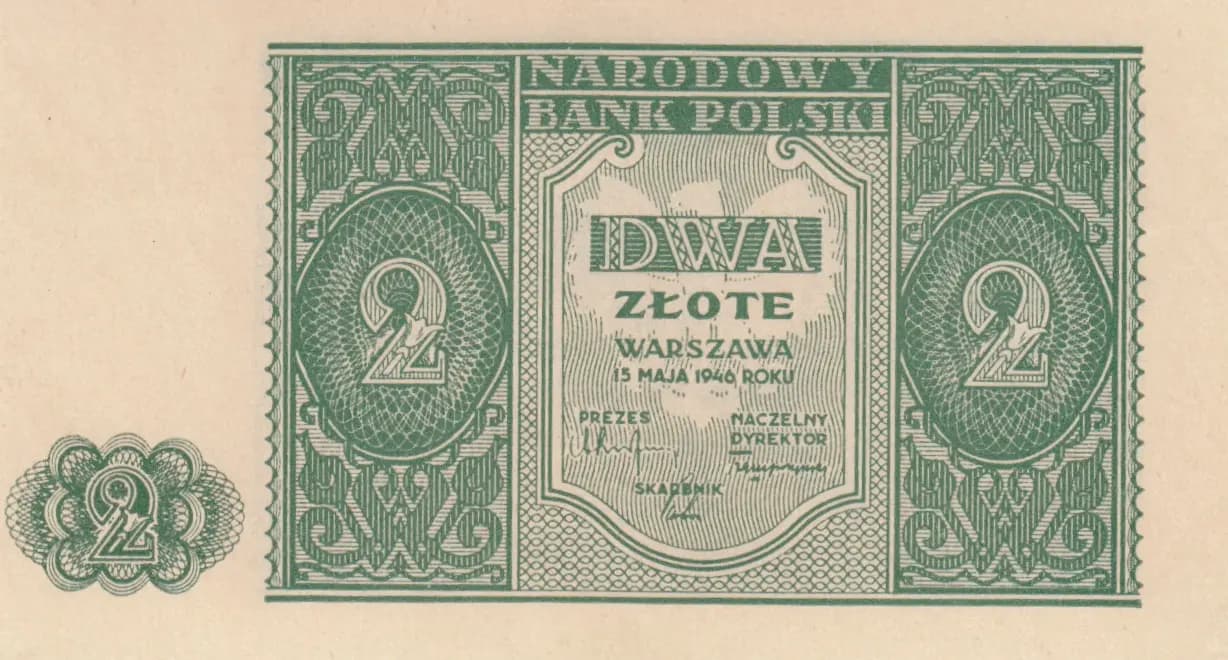
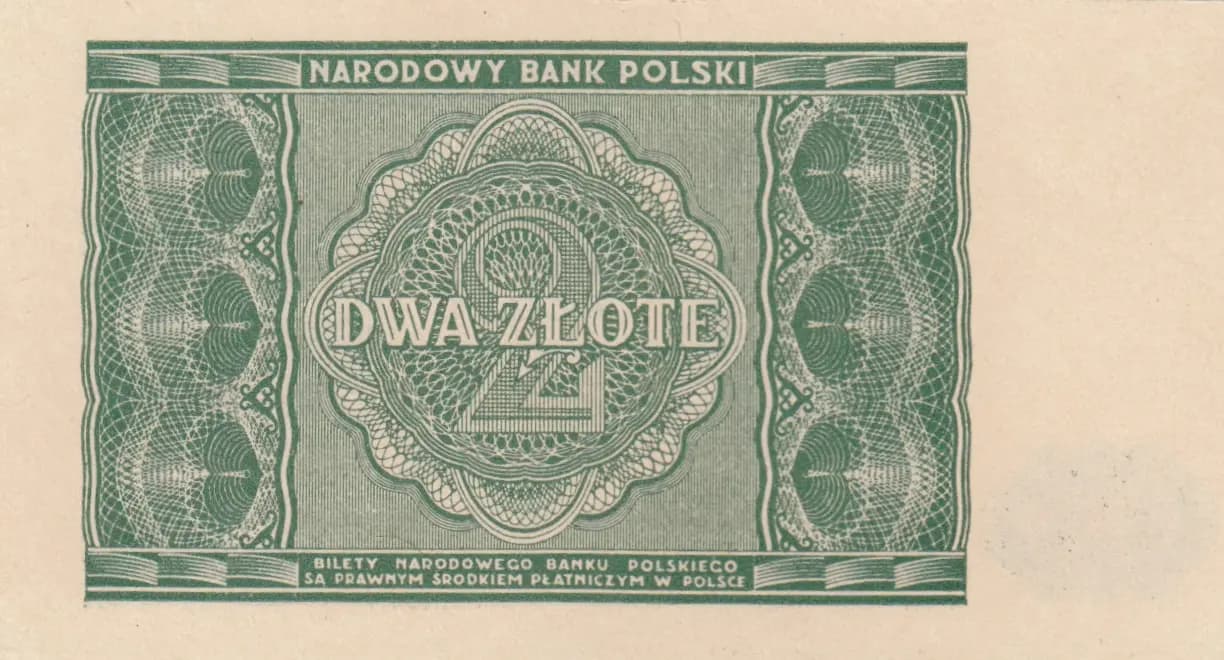
This is a pristine, uncirculated example of the Polish 2 Złote note from 1946, featuring elegant green and cream coloring with intricate ornamental borders and decorative medallions. The note exhibits exceptional condition with sharp impressions, clean margins, and no visible wear, making it an attractive example of early postwar Polish currency. The sophisticated engraved design and commemorative date of 15 May 1946 reflect the National Bank of Poland's efforts to establish monetary stability following World War II.
Common. The eBay price tracking data shows consistent sales activity with UNC specimens selling in the $12.50-$15.50 range (2012-2016), and lower-grade examples (F, VF, AUNC) regularly appearing at auction with moderate bid counts (4-12 bids per lot). The 2016 catalog value of $8 for UNC specimens combined with regular circulation in the collector market indicates this is a standard, widely available postwar Polish note. No specific print run restrictions or rarity indicators are documented in the PMG population data.
This 2 Złote note was issued on 15 May 1946 by the Narodowy Bank Polski (National Bank of Poland) during the immediate postwar period as the nation rebuilt its economy and financial institutions under Soviet influence. The Warsaw reference and 1946 date inscribed on the obverse commemorate the note's issuance in the capital city, which had been devastated during WWII and was undergoing reconstruction. The absence of portraits in favor of purely ornamental and symbolic design reflects the transitional nature of Polish monetary policy during this period of Soviet domination.
The obverse features an elaborate symmetrical design with ornamental numerals '2' displayed prominently within circular medallions on both left and right margins, framed by decorative floral and geometric border patterns. The center cartouche contains the issuing bank name, denomination, location (Warsaw), and the specific issue date (15 May 1946), along with signature lines for the Chief Director and Cashier. The reverse displays a large central circular medallion with scalloped/petal-like decorative edges containing the denomination 'DWA ZŁOTE' and numeral '2', flanked by repetitive geometric and ornamental patterns. The entire note employs fine line engraving with complex cross-hatching and mesh patterns as security features, typical of the engraving standards employed by the National Bank of Poland during this period.
Front side: 'NARODOWY BANK POLSKI' (National Bank of Poland), 'DWA ZŁOTE' (Two Zlote), 'WARSZAWA' (Warsaw), '15 MAJA 1946 ROKU' (15 May 1946), 'PORT' (Port), 'NACZELNY DYREKTOR' (Chief Director), 'KASJER' (Cashier). Reverse side: 'NARODOWY BANK POLSKI' (National Bank of Poland), 'DWA ZŁOTE' (Two Zlote), 'BILETY NARODOWEGO BANKU POLSKIEGO SĄ PRAWNYM ŚRODKIEM PŁATNICZYM W POLSCE' (Banknotes of the National Bank of Poland are legal tender in Poland).
Intaglio engraving (line engraving), evidenced by the fine detail work, intricate cross-hatching, mesh patterns, and complex ornamental designs visible throughout both sides. The sophisticated border work and medallion designs are characteristic of professional security printing standards employed by European central banks in the mid-20th century. No specific printer attribution is available from the catalog data, though the technical execution suggests work by a skilled security printer contracted by the Polish central bank.
Pick catalog number P-124. The visual analysis identifies this as a standard obverse/reverse design with no overprints or unusual markings observed. The note bears the signature lines for 'NACZELNY DYREKTOR' (Chief Director) and 'KASJER' (Cashier), which remain unfilled as printed, consistent with many notes from this issuing period. No distinct varieties (such as signature variations or serial number prefix differences) are apparent from the visual examination. The single PMG variant catalogued as P-124s corresponds to this standard issue type.