100 marek 1916
Market Prices
3 salesAbout This Note
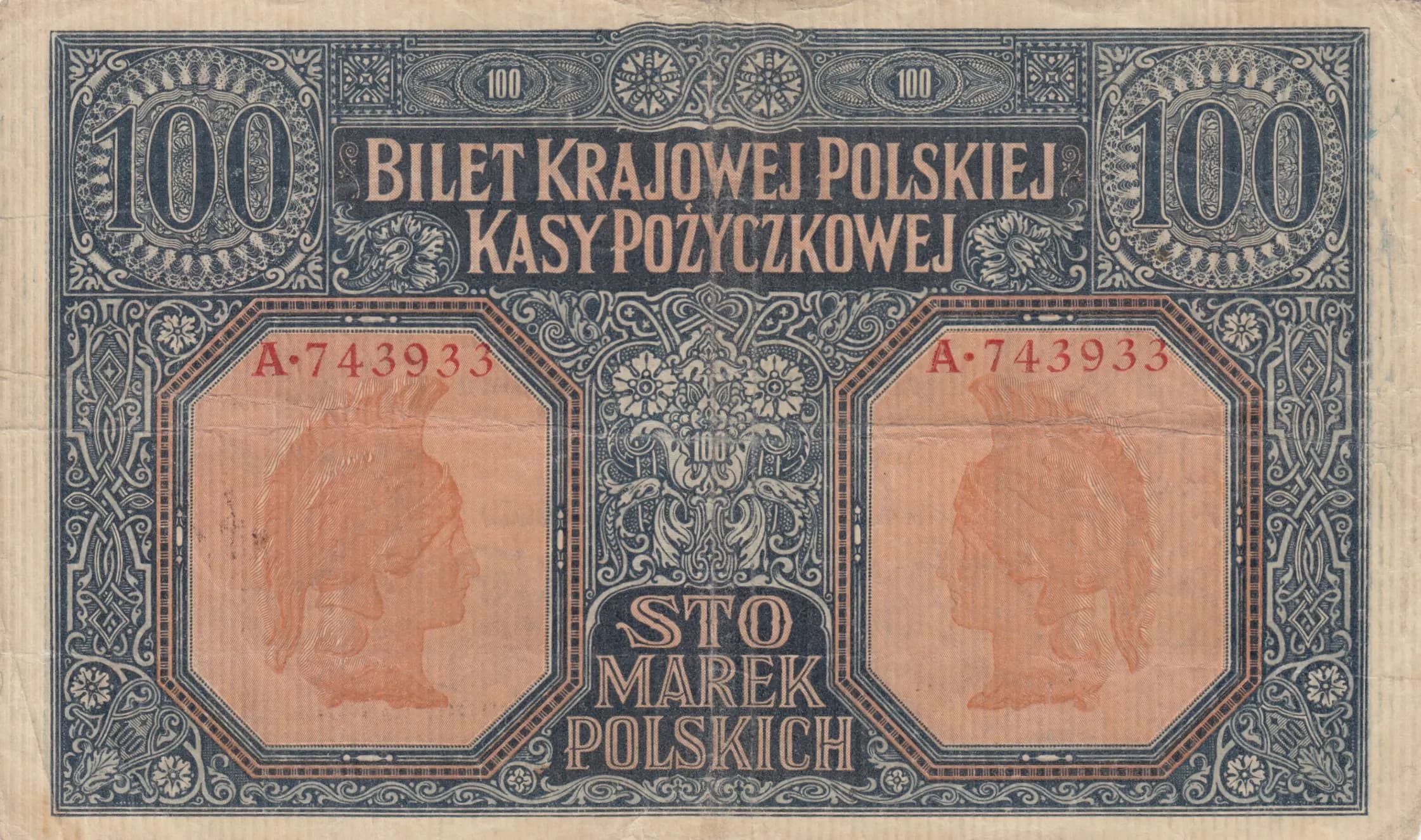
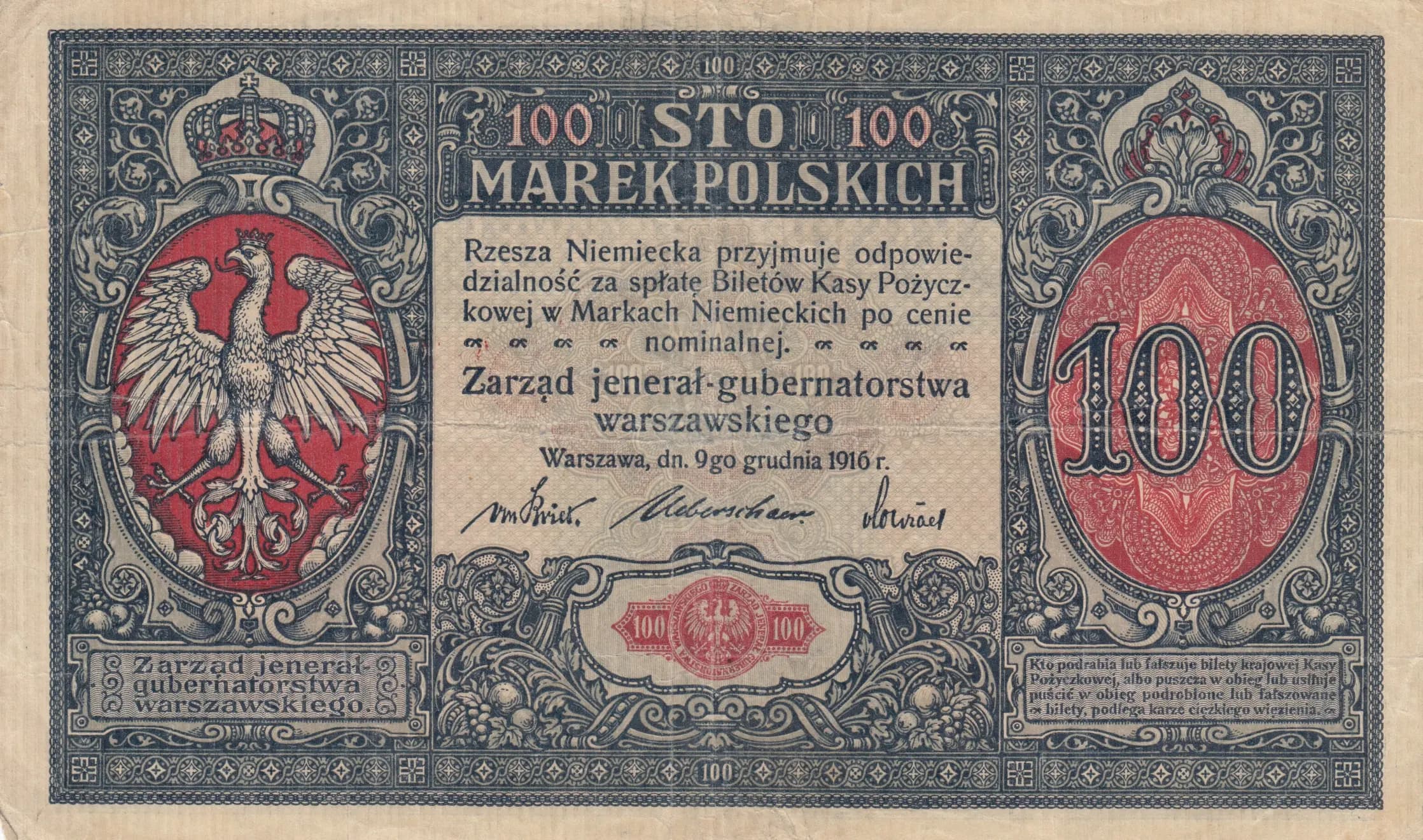
This is a VF-graded 100 Marek Polskich banknote issued by Krajowa Polska Kasa Pożyczkowa on December 9, 1916, during the German occupation of Poland. The note displays the characteristic two-color design with ornate blue and peach toning, featuring symmetric portrait medallions on the obverse and the iconic Polish white eagle on a red shield on the reverse. Despite visible foxing, creasing, and age-related discoloration consistent with circulation over a century ago, the note maintains excellent structural integrity and retains the fine engraved details that define this early Polish occupation-period currency.
Common. The eBay price data indicates consistent availability in the market, with examples in F grade selling in the $15–$100 range historically, and VG examples trading at under $10. The catalog valuation of $100 for F grade and $500 for EF confirms this note is not scarce—it represents standard circulation currency from a major denomination issued during a well-documented historical period. PMG population reports show this base Pick number has multiple variants cataloged, further indicating substantial print runs. The VF example here, though attractive, falls squarely within the common range for this issue.
This banknote was issued under German military administration of Warsaw (Zarząd jenerał-gubernatorstwa warszawskiego) during World War I, when Poland remained partitioned and under foreign control. The explicit inscription stating that the German Empire assumes responsibility for redemption in German Marks reflects the financial and political reality of the occupation. The prominent Polish white eagle and patriotic imagery represent early nationalist symbolism during a period when Poland was working toward independence, which would be achieved in 1918.
The obverse features a formal, symmetrical design with two profile portrait medallions in peach/salmon color positioned left and right of center, separated by an ornamental text panel. The portraits appear to be allegorical or semi-historical figures rather than specific named individuals, consistent with Polish occupation-era currency design conventions. Large denomination numerals '100' in ornate circular frames occupy the top corners. The reverse displays the Polish national coat of arms—a white eagle with spread wings mounted on a red shield with an ornate crown—as the dominant central element, flanked by the denomination '100' in a red oval cartouche. Both sides are enclosed within intricate multi-layered decorative borders featuring geometric and floral patterns in blue/dark teal. The color palette of blue, peach, red, and cream with gold accents creates a dignified yet accessible appearance appropriate for wartime occupation currency.
{"front":{"title":"BILET KRAJOWEJ POLSKIEJ KASY POŻYCZKOWEJ (Bond of the National Polish Loan Bank)","denomination":"STO MAREK POLSKICH (One Hundred Polish Marks)","serialNumber":"A·743933","numerals":"100"},"back":{"denomination":"STO MAREK POLSKICH (One Hundred Polish Marks)","issuer":"Zarząd jenerał-gubernatorstwa warszawskiego (Administration of the Governor-General of Warsaw)","date":"Warszawa, dn. 9go grudnia 1916 r. (Warsaw, December 9, 1916)","germanyStatement":"Rzesza Niemiecka przyjmuje odpowiedzialność za spłatę Biletów Kasy Pożyczkowej w Markach Niemieckich po cenie nominalnej. (The German Empire assumes responsibility for the repayment of Loan Bank Notes in German Marks at nominal value.)","counterfeiting":"Kto podrabia lub fałszuje bilety krajowej Kasy Pożyczkowej, sibo puszcza w obieg lub usiluje uchodzić w obieg podrobione lub fałszowane na śmierć, podlega karze więzienia. (Whoever counterfeits or forges bonds of the National Loan Bank or puts them into circulation or attempts to pass counterfeit or forged notes shall be subject to imprisonment.)"}}
This note was produced using intaglio engraving and multi-color letterpress printing, typical of early 20th-century banknote production. The fine line work, detailed border patterns, and sharp denomination numerals visible in the images are characteristic of steel engraving. The two-color printing scheme (blue and peach on obverse, blue, red, and gold on reverse) required separate printing passes. While specific printer attribution is not documented in available sources, Polish occupation-era notes of this period were typically produced by the German occupation authorities' printing facilities in Warsaw.
This specific note is identified as Pick P-6 from the December 9, 1916 issue with the text 'Zarząd jenerał-gubernatorstwa...' (General-Gubernatorial Administration variant). The catalog reference notes that a related note with 'Zarząd General-Gubernatorstwa...' and differing back text ('Bilet Polskiej Krajowej Kasy Pożyczkowej') exists and is cataloged separately as P-15. This specimen displays serial number A·743933, indicating it is from the 'A' series. No other distinguishing overprints, date variations, or signature variants are visible in the visual analysis.