10 zlotych 1929
Market Prices
16 salesAbout This Note
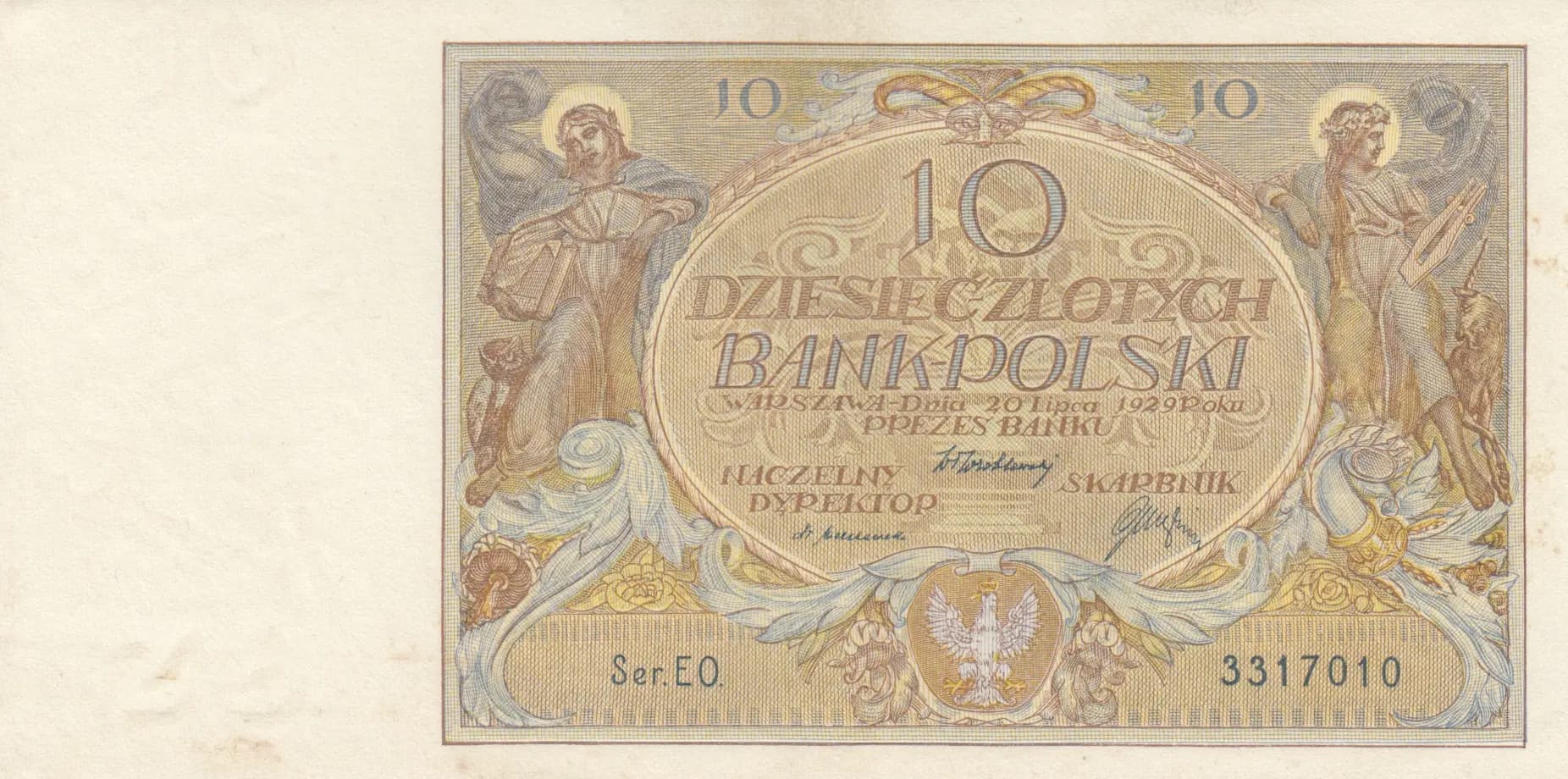
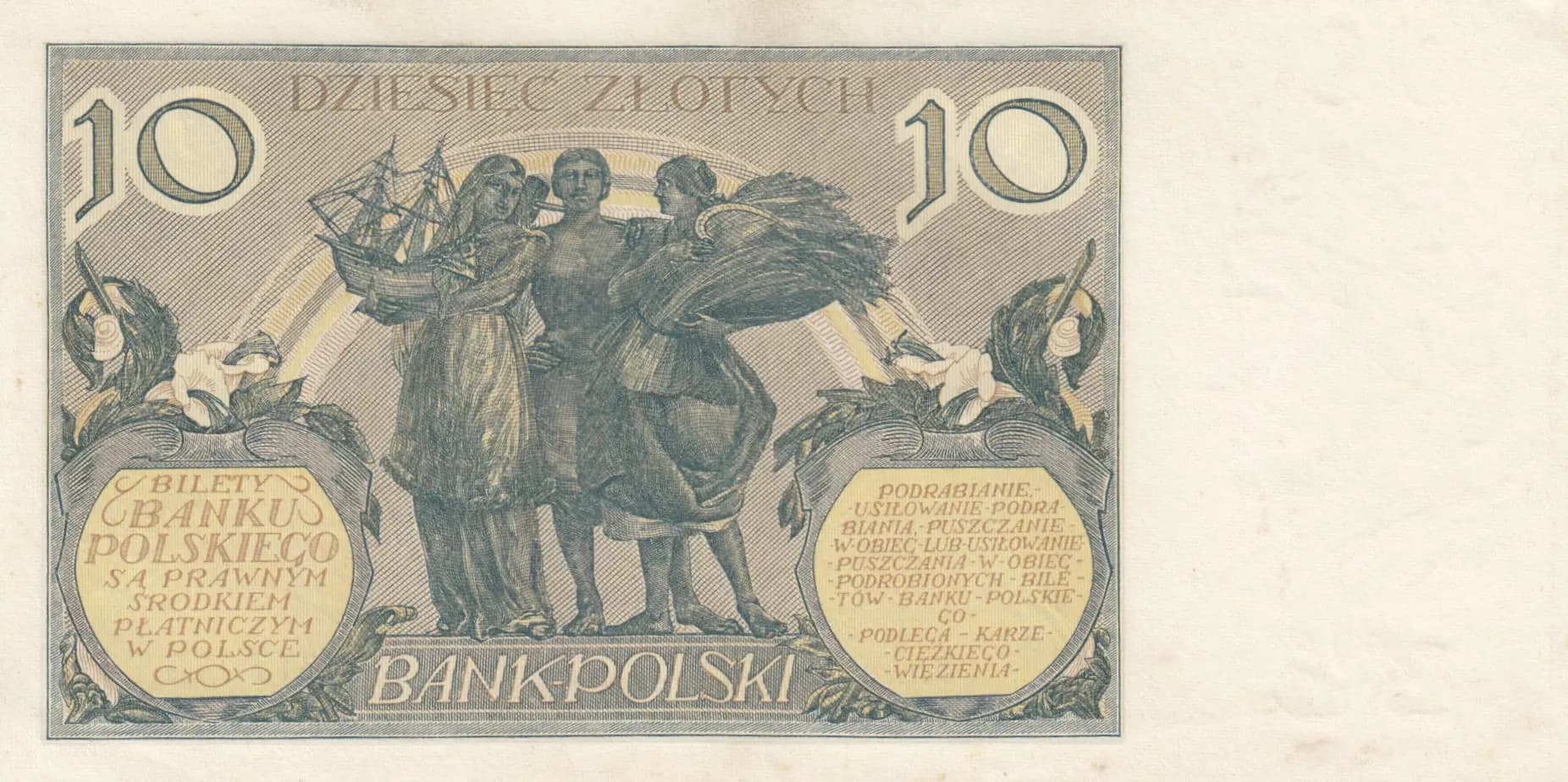
An exceptionally well-preserved example of Poland's 10 zlotych banknote from 1929, issued by Bank Polski in Warsaw. The note displays the characteristic beige and blue color scheme with ornate allegorical imagery on both sides—allegorical female figures with halos on the obverse and classical figures representing commerce and industry on the reverse. In UNC condition, this note exhibits crisp paper, sharp engraving detail, and the kind of pristine appearance that makes it highly desirable to collectors of interwar Polish currency.
Common. While the 10 zlotych 1929 is a desirable interwar Polish note, eBay market data demonstrates consistent availability at modest prices across all grades. A PMG 64 specimen sold for $56.55 in 2025 (notable but not exceptional), and catalog values list UNC examples at approximately $20. The regular issue designation, sustained supply on the secondary market over many years, and the absence of any documented print run restrictions or recalled batches all indicate this is a commonly encountered note among collectors. UNC specimens command reasonable premiums over circulated examples but remain within the affordable range for most collectors.
Issued during Poland's interwar period, this 1929 banknote reflects the newly stabilized Polish zloty following the monetary reform of 1924. The allegorical figures representing commerce, industry, and agriculture on the reverse symbolize Poland's post-independence economic aspirations, while the Polish eagle emblem anchors the note's nationalist symbolism. The July 29, 1925 date on the obverse (contrasting with the 1929 catalog date) indicates this was an authorized design template used for multiple print runs during the late 1920s.
The obverse features an ornate central oval frame in beige and cream tones, flanked by two allegorical female figures (muses or virtues) with halos and classical drapery—the left figure holds a palm frond (symbolizing victory or achievement) while the right holds a sword or laurel implement (representing strength or justice). The design is framed by elaborate decorative scrollwork and floral borders typical of 1920s banknote aesthetics. The Polish eagle in a heraldic shield appears at the bottom center as the state symbol. The reverse depicts three classical allegorical figures in blue-green tones—representing Commerce, Industry, and Agriculture according to catalog references—with a model sailing ship visible in the composition, symbolizing Poland's maritime and economic interests. Fine diagonal line shading creates background texture throughout both sides. The serial number appears in the lower left (Series EO, number 3317010).
FRONT: '10 DZIESIĘCIU' (Ten zlotych); 'BANK POLSKI' (Bank of Poland); 'WARSZAWA Dnia 29 lipca 1925 Roku' (Warsaw, July 29, 1925); 'OPIEZES BANKU' (Director of the Bank); signature area marked 'UCZELINY' and 'DYREKTOR' (Director); 'Ser.EO' (Series EO); serial number '3317010'. BACK: '10 DZIESIĘCIU' (Ten zlotych); 'BANK POLSKI' (Bank of Poland); 'BILETY BANKU POLSKIEGO S PRAWNYM ŚRODKIEM PŁATNICZYM W POLSCE' (Bank of Poland notes are a legally recognized means of payment in Poland); counterfeiting warning: 'PODRRABIANIE, USLOWANIE, PODRABIANIA PUSZCZANIE W OBIOC LUB USILOWANIE PUSZCZANIA W OBIOC PODROBIONVYCH HILE TOW BANKU POLSKIEGO DO PODLECA KARZE CIEZKIEGO WIEZIENIA' (Counterfeiting, attempting to counterfeit, or attempting to circulate counterfeit Bank of Poland notes is subject to severe imprisonment).
Intaglio engraving, the standard security printing method for banknotes of this era. The fine line work, intricate scrollwork, complex allegorical compositions, and the characteristic depth visible in the image are all hallmarks of the intaglio process. Multiple color printing was achieved through successive passes of different colored inks. The printer for Bank Polski issues of this period is not definitively identified from the visual analysis alone, though Polish State Printing Works (Polska Drukarnia Państwowa) was the primary issuer.
This specimen is identified as Series EO with serial number 3317010. The 10 zlotych 1929 (Pick 69) exists in multiple series and serial number ranges reflecting different print runs. The obverse date of July 29, 1925 represents the original authorization date for the design template, which remained in use for several years. Varieties of this note include different letter series (such as EO noted here) and corresponding serial number ranges. Watermark noted in reference material as 'King, 10Z1' (portrait watermark with denomination), typical of Bank Polski issues from this period.