100 marek 1919
“serie AE”
Market Prices
6 salesAbout This Note
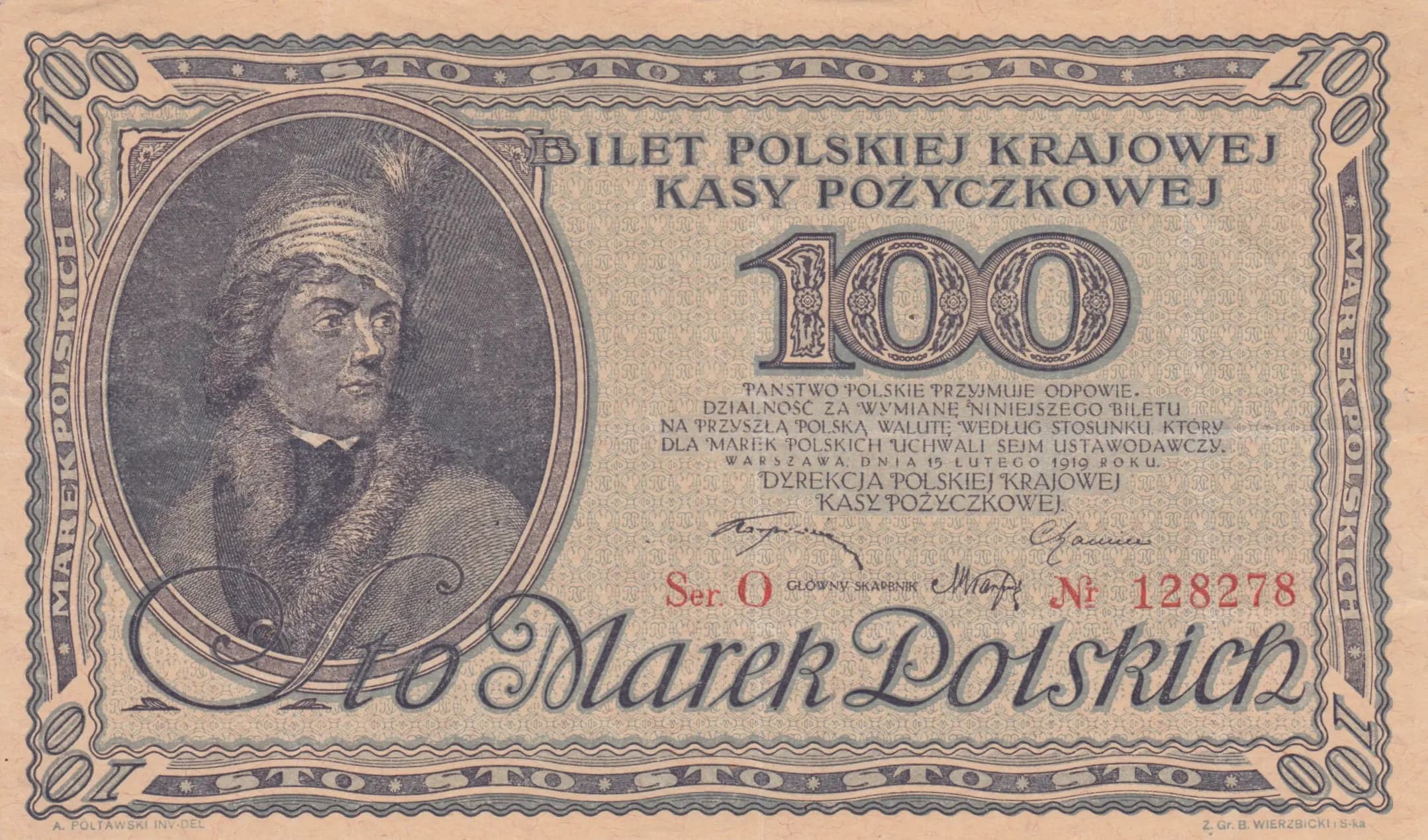
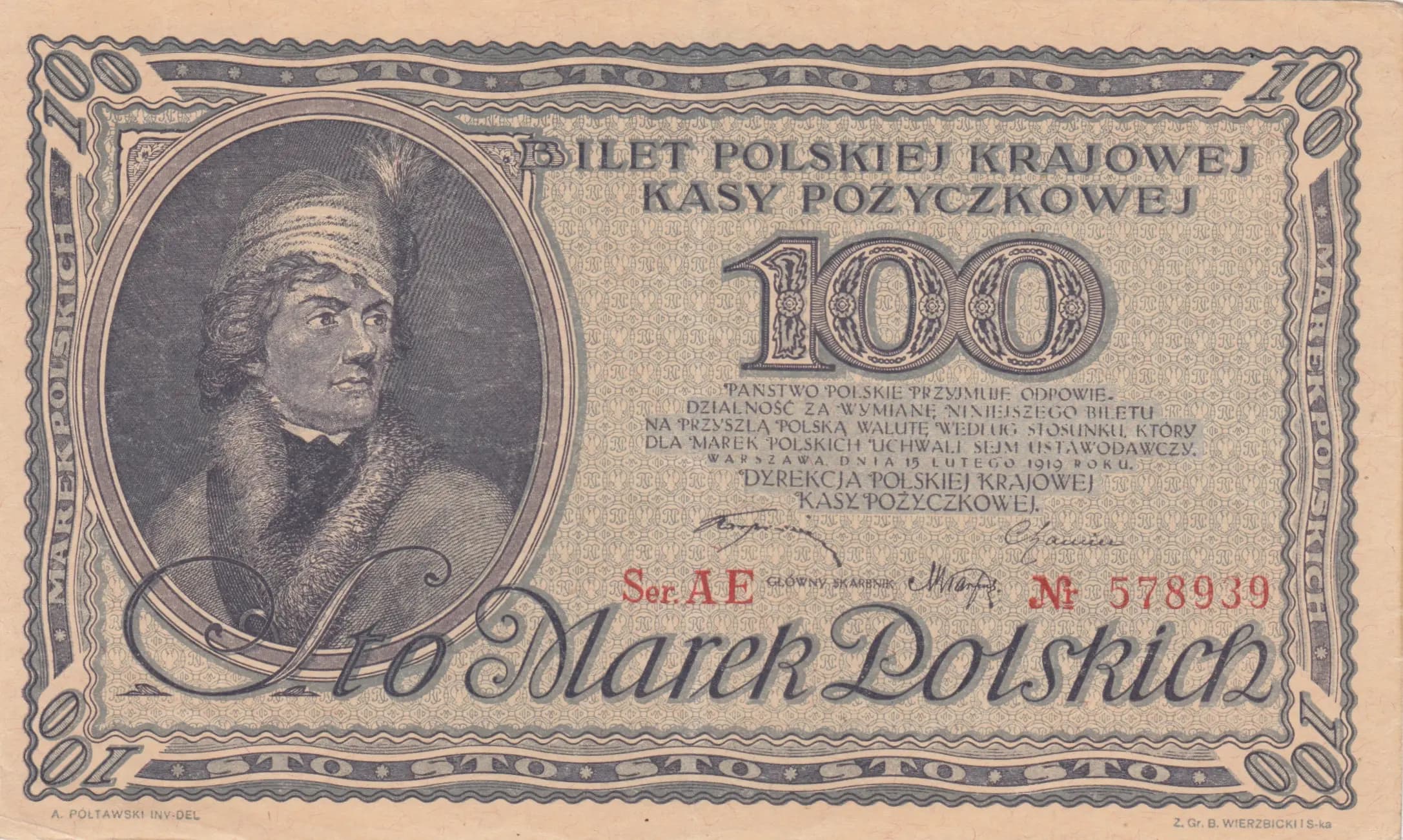
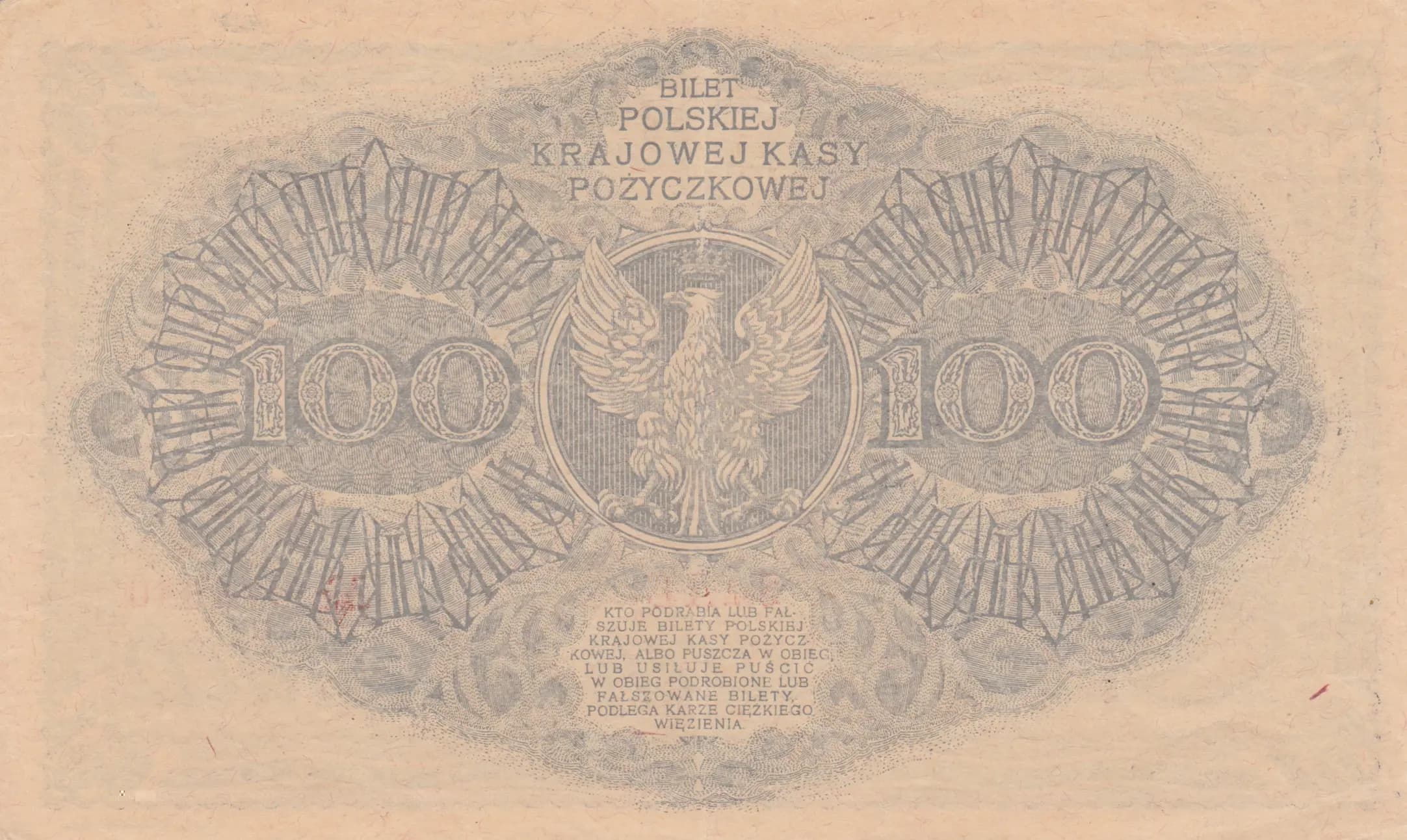
This is a VF-graded 100 Marek note from the Polska Krajowa Kasa Pozyczkowa (Polish National Loan Bank), issued February 15, 1919, in series AE. The note displays the characteristic tan/beige and gray coloring typical of early Polish currency, with a dignified portrait of Tadeusz Kościuszko in an ornate oval frame on the obverse and the Polish White Eagle on the reverse. Despite visible aging and light foxing consistent with a century-old note, the engraving detail remains sharp and the inscriptions are fully legible, making this an attractive example of early Polish monetary history.
Common. The eBay price tracking data provided shows this note type selling consistently in the $7–$35 range across multiple years and condition grades, with catalog 2016 valuations of $7 for VF grade. Multiple sales records indicate regular market availability. This was a regular issue from a major Polish state issuing authority during the early independence period, suggesting substantial print runs. The series AE example presented here aligns with typical market pricing for VF-grade specimens.
This banknote was issued during the critical early weeks of Poland's independence following World War I, when the newly reconstituted Polish state needed to establish monetary authority. The Polska Krajowa Kasa Pozyczkowa (Polish National Loan Bank) served as a temporary issuing institution before the establishment of the Bank of Poland. The choice to feature Tadeusz Kościuszko—the legendary 18th-century military leader and national hero—alongside the Polish White Eagle symbolized the nation's continuity with its historical past and its aspirations for the future.
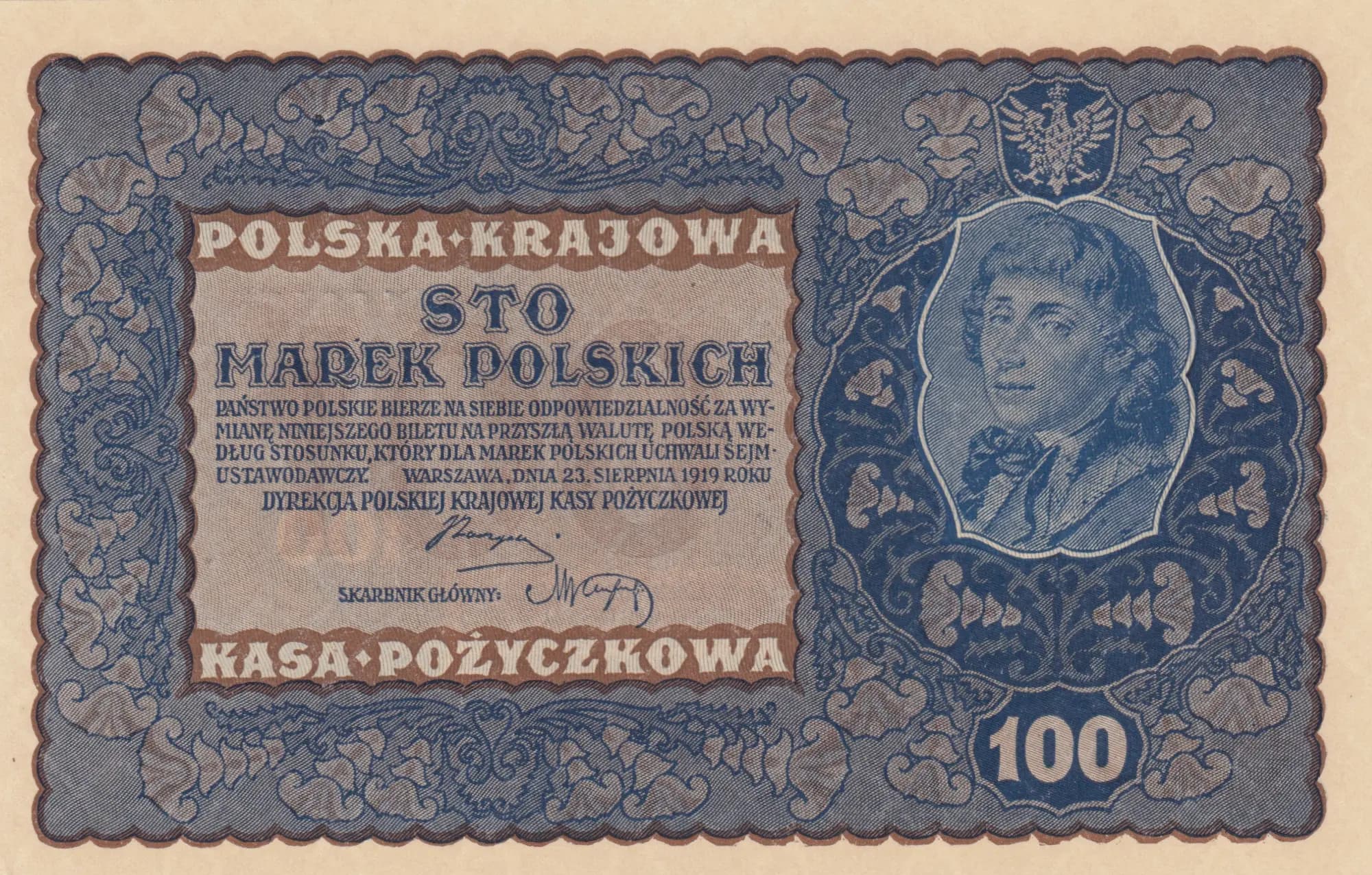
The obverse features a left-facing profile portrait of Tadeusz Kościuszko (1746–1817), the revered Polish general and statesman, depicted wearing historical military headwear and rendered in fine engraving within an ornate oval frame. The portrait is positioned at the left side of the note, with the large denomination numerals '100' prominently displayed in the center-right. The design incorporates elaborate security elements including a decorative wavy outer border, geometric corner ornaments, and fine repeating pattern work throughout the background. The reverse displays the Polish White Eagle (Orzeł Biały) as the central heraldic emblem within a circular frame, flanked symmetrically by two decorative fan or palm-like motifs. Large denomination numerals '100' appear symmetrically on either side of the eagle. The entire reverse background features radiating line patterns designed both for aesthetic appeal and anti-counterfeiting purposes. The paper is described as brownish with a honeycomb watermark.
FRONT: 'BILET POLSKIEJ KRAJOWEJ KASY POZYCZKOWEJ' (Ticket of the Polish National Loan Bank); '100 / Sto Marek Polskich' (One Hundred Polish Marks); 'PAŃSTWO POLSKIE PRZYJMUJE ODPOWIEDZI DZIAŁNOŚĆ ZA WYMIANĘ NINIEJSZEGO BILETU NA PRZYSZŁA POLSKĄ WALUTĘ WEDŁUG STOSUNKI, KTÓRE DLA MAREK POLSKICH UCHWALI SEJM USTAWODAWCZY' (The Polish State assumes responsibility for exchanging this ticket for future Polish currency according to the rate which the legislative Sejm will adopt for Polish marks); 'WARSZAWA, DNA 15 LUTEGO 1919 ROKU' (Warsaw, February 15, 1919); 'DYREKCJA POLSKIEJ KRAJOWEJ KASY POZYCZKOWEJ' (Direction of the Polish National Loan Bank); 'Ser. AE N° 578939' (Series AE Number 578939); 'A. POLTAWSKI INV. DEL' (A. Poltawski inventor/designer); 'Z. Gr. B. WIERZBICKI i S-ka' (Z. Gr. B. Wierzbicki and Co. [printer]). BACK: 'BILET POLSKIEJ KRAJOWEJ KASY POZYCZKOWEJ' (Ticket of the Polish National Loan Bank); '100' (denomination, appears twice); 'KTO PODROBIA LUB FAŁSZUJE BILETY POLSKIEJ KRAJOWEJ KASY POZYCZKOWEJ, ALBO PUSZCZA W OBIEG FAŁSZYWIE PUSCIĆ W OBIEG PODROBIONE LUB FAŁSZOWANE BILETY PODLEGA KARZE CIĘZKIEGO WIĘZIENIA' (Whoever counterfeits or falsifies tickets of the Polish National Loan Bank, or puts into circulation falsified or counterfeited tickets, is subject to the penalty of hard imprisonment).
This note was produced using traditional intaglio engraving, evidenced by the fine line work, complex geometric patterns, and the depth of detail visible throughout both obverse and reverse. The printer was B. Wierzbicki i S-ka (B. Wierzbicki and Co.), a Warsaw-based printing house. The honeycomb watermark and the brownish paper stock are consistent with premium security printing practices of the period. The engraver credited on the note is A. Poltawski.
This example is identified as Pick P-17a, series AE, serial number 578939. The 'a' designation in the Pick catalog suggests this is one of multiple varieties of the 100 Marek 1919 issue, likely distinguishing it from other versions by printer, series letter, or other distinguishing feature. The series AE designation is noted in the collector notes and is visible on the note itself. The PMG population report indicates P-17s as an alternative catalog variant designation for the 100 Marek type, suggesting some cataloging variation exists for this denomination across different authorities.