10 zlotych 1946
Market Prices
12 salesAbout This Note
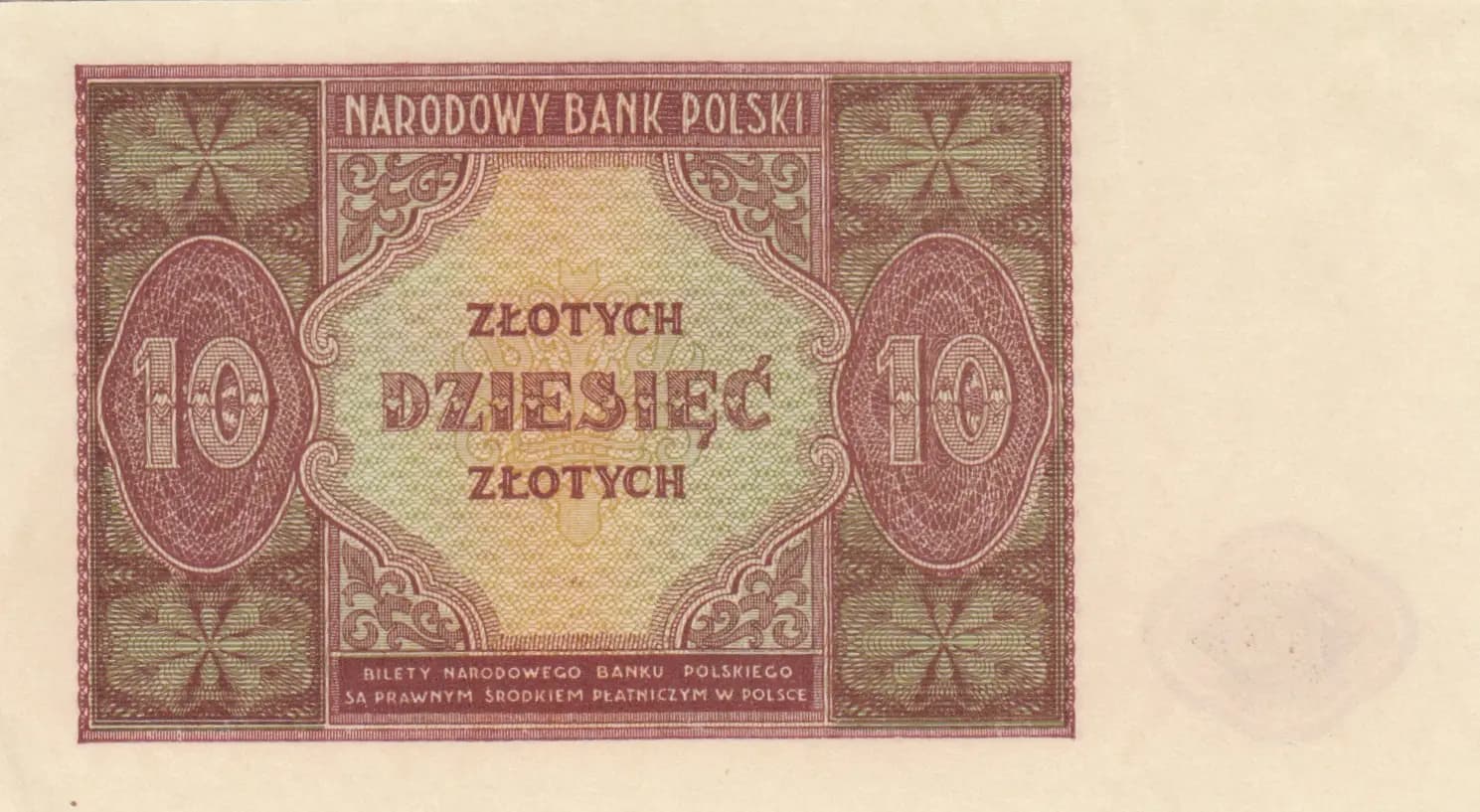
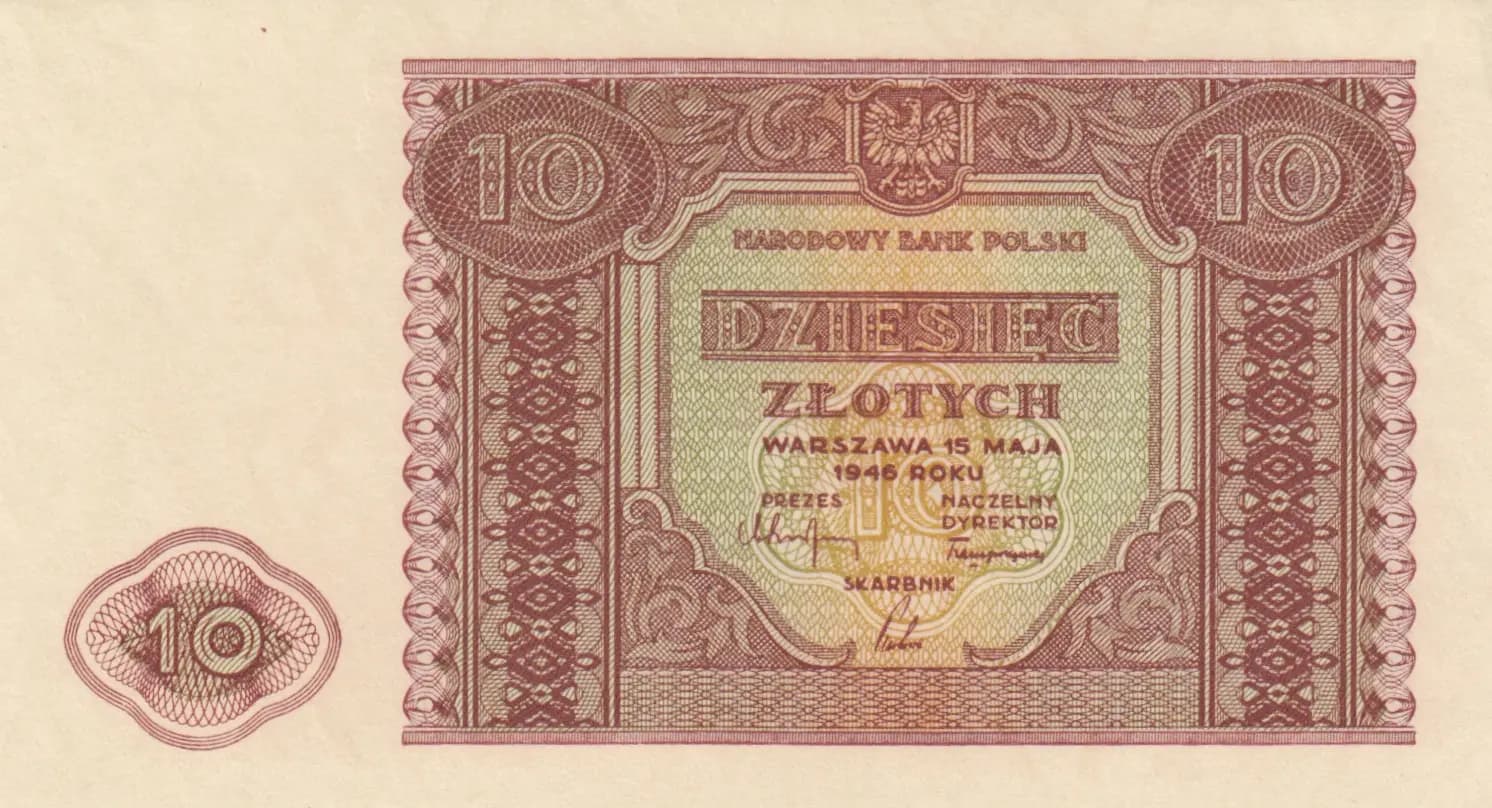
This is a pristine, uncirculated example of the Polish 10 Złotych note from 1946, issued by Narodowy Bank Polski on May 15th. The note displays the characteristic red-brown and green color scheme with intricate cross-hatching and geometric security patterns throughout both sides. As an early post-WWII Polish banknote in UNC condition, it represents an important transitional currency from the immediate post-war period and remains highly collectible in this exceptional state of preservation.
Common. This is a regular issue banknote from a major European central bank with a substantial print run. eBay auction data confirms typical selling prices ranging from $4–$28 depending on condition grade, with UNC examples catalogued at approximately $10 as of 2016. The consistent availability and modest pricing across multiple sales over many years indicates this is a commonly available note in the collector market.
Issued on May 15, 1946, this banknote represents Poland's monetary stabilization efforts in the immediate aftermath of World War II. The prominent Polish national eagle emblem depicted on the reverse symbolizes national sovereignty and reconstruction following the war. The Narodowy Bank Polski (National Bank of Poland) reasserted its authority to issue currency as part of the country's post-war recovery and re-establishment of independent banking institutions.
The 1946 10 Złotych note features a symmetrical, formal design characteristic of early post-war Polish currency. The obverse presents large oval medallions containing the denomination '10' on both left and right sides, with ornamental cross patterns in the corners and decorative scrollwork throughout. The reverse is dominated by the Polish national eagle emblem at the top center, serving as the primary symbolic element representing national authority. Large denomination numerals appear in all four corners, with an ornamental oval vignette positioned in the lower left. Decorative columns frame the central cartouche containing the date and place of issue (Warsaw, May 15, 1946), along with signature lines for the President, Director, and Treasurer. The entire composition employs intricate cross-hatching and geometric patterns as both aesthetic and security elements.
Front side: 'NARODOWY BANK POLSKI' (National Bank of Poland), 'DZIESIĘĆ ZŁOTYCH' (Ten Zloty), 'BILETY NARODOWEGO BANKU POLSKIEGO SĄ PRAWNYM ŚRODKIEM PŁATNICZYM W POLSCE' (Banknotes of the National Bank of Poland are legal tender in Poland). Reverse side: 'NARODOWY BANK POLSKI' (National Bank of Poland), 'DZIESIĘĆ ZŁOTYCH' (Ten Zloty), 'WARSZAWA 15 MAJA 1946 ROKU' (Warsaw, May 15, 1946), 'PREZES' (President), 'NACZELNIK' (Director/Chief), 'SKARBNIK' (Treasurer).
This note was produced using intaglio (engraved) printing, the standard security printing method for banknotes of this era. The deep cross-hatching patterns, fine line work, and detailed geometric designs visible throughout both sides are characteristic of high-quality intaglio engraving. The complex background patterns and security elements would have been engraved into steel plates, providing both visual appeal and counterfeit resistance through the difficulty of reproducing such intricate work.
Pick number P-126 represents the standard 1946 issue. The visual analysis shows the reverse is dated 'WARSZAWA 15 MAJA 1946 ROKU' with signature lines for three officials (President, Director, Treasurer). No overprints, serial number prefixes, or other variants are noted in the image. PMG has catalogued one primary variant for this Pick number. The specific signatures and any minor printing variations would constitute sub-varieties, though the present specimen appears to be the standard variety with no distinctive markings beyond the standard issue characteristics.