10 zlotych 1944

Market Prices
6 salesAbout This Note
This Polish 10 złotych note from 1944 (Pick P-110) is a mid-grade circulated example displaying the characteristic blue-on-cream color scheme and ornate baroque design typical of Narodowy Bank Polski's wartime emissions. The note shows honest wear consistent with Fair condition—visible creasing, aged paper, and general circulation marks—yet retains good legibility of its decorative elements and inscriptions. This particular note is notable for the printer error 'OBOWIAZKOWYM' at the bottom, distinguishing it from the corrected P-111 variety and making it an interesting item for Polish banknote specialists.
Common. The eBay market data shows consistent pricing in the $5-$22 range across various grades from 2015-2017, with Fair-grade examples selling for $4.75-$9.15. These price points indicate a readily available note with modest collector demand. The 1944 Polish 10 złotych is not a short-run issue, and no documentation suggests it was recalled or is otherwise scarce. While it is a genuine historical artifact from a significant wartime period, it represents standard currency production rather than a limited emission.
Issued during the tumultuous final year of World War II, this banknote represents Poland's monetary system under Soviet-influenced administration, with printing executed by the Russian state printer Goznak in Moscow. The elaborate baroque-style ornamentation and eagle/shield symbolism reflect traditional Polish heraldic imagery, serving to assert national identity during a period of foreign occupation and administrative uncertainty. This 1944 emission predates the major Polish monetary reforms of the post-war period, making it a transitional artifact of Poland's complex wartime and early occupation history.
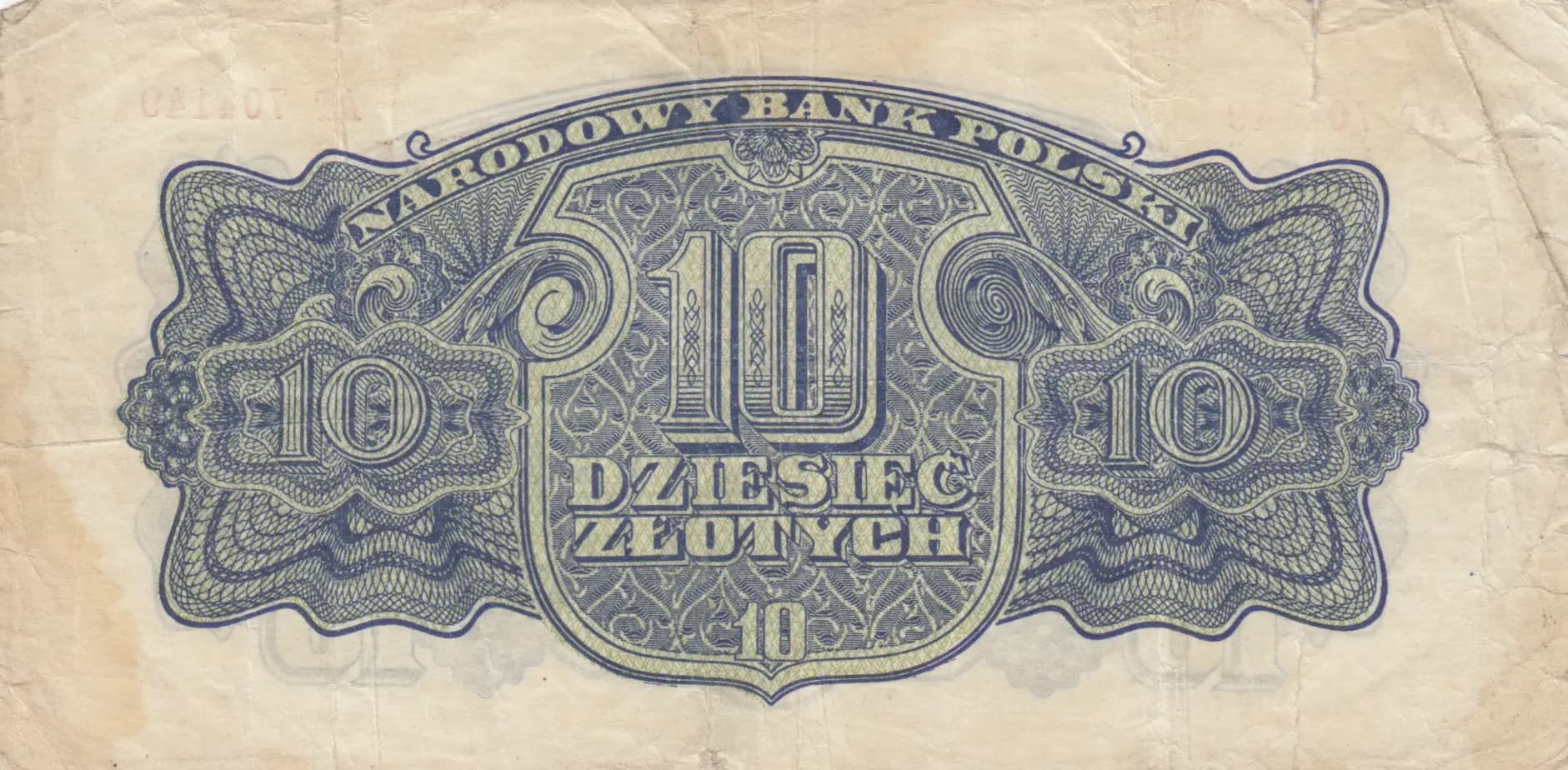
The reverse displays a highly symmetrical baroque design dominated by ornate scrollwork, floral patterns, and heraldic elements characteristic of early-to-mid 20th century Polish currency design. The central shield-shaped cartouche houses the denomination and currency information. Eagle or bird motifs (likely representing the Polish eagle, Poland's national symbol) appear symmetrically on the left and right sides within decorative frames. Elaborate corner flourishes and fine engraved line work throughout create a classical, formal appearance intended to convey governmental authority and prevent counterfeiting. The color palette of blue/navy ink on cream paper stock with subtle gold/yellow undertones in the design creates visual distinction and period-appropriate aesthetics.
Reverse side inscriptions: 'NARODOWY BANK POLSKI' (National Bank of Poland), '10' (denomination numeral), 'DZIESIĘC' (Ten in Polish), 'ZŁOTYCH' (Zlotych currency). The note features the printer error 'OBOWIAZKOWYM' (incorrect spelling) at the bottom, which in corrected form should read 'OBOWIAZKOWE.' All inscriptions appear in Polish language with numerals rendered in elaborate decorative cartouches on left and right sides.
Intaglio engraving, characteristic of banknote production of this era. The note was printed by Goznak (the Russian state security printer) in Moscow, as evidenced by the documented printing attribution and the specific spelling error introduced during their production run. The intricate crosshatching, fine line work, and detailed baroque ornamentation are hallmarks of high-security intaglio engraving. The multi-color effect (blue on cream with gold undertones) suggests careful registration of separate engraved plates.
This is the P-110 variety characterized by the printer error 'OBOWIAZKOWYM' (incorrect spelling) on the reverse. The corrected spelling 'OBOWIAZKOWE' appears on the related P-111 variety, which was printed by Narodowy Bank Polski domestically rather than by Goznak. This orthographic distinction is the primary variety marker for this Pick number and should be noted in catalog documentation. Serial number prefixes and signatures, if visible on the obverse (not analyzed in provided images), may indicate additional sub-varieties within the P-110 classification.