10 000 marek 1922
Market Prices
29 salesAbout This Note
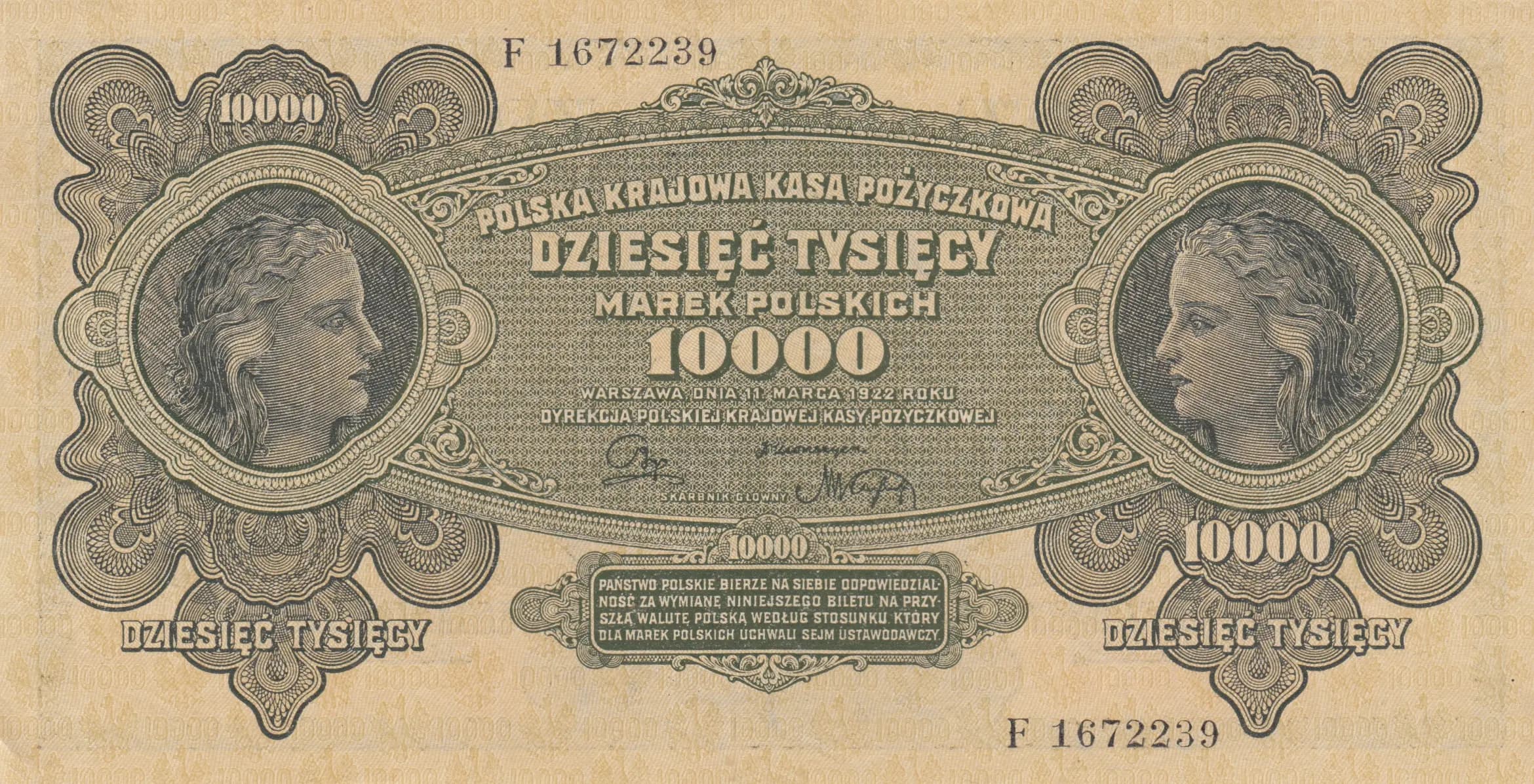
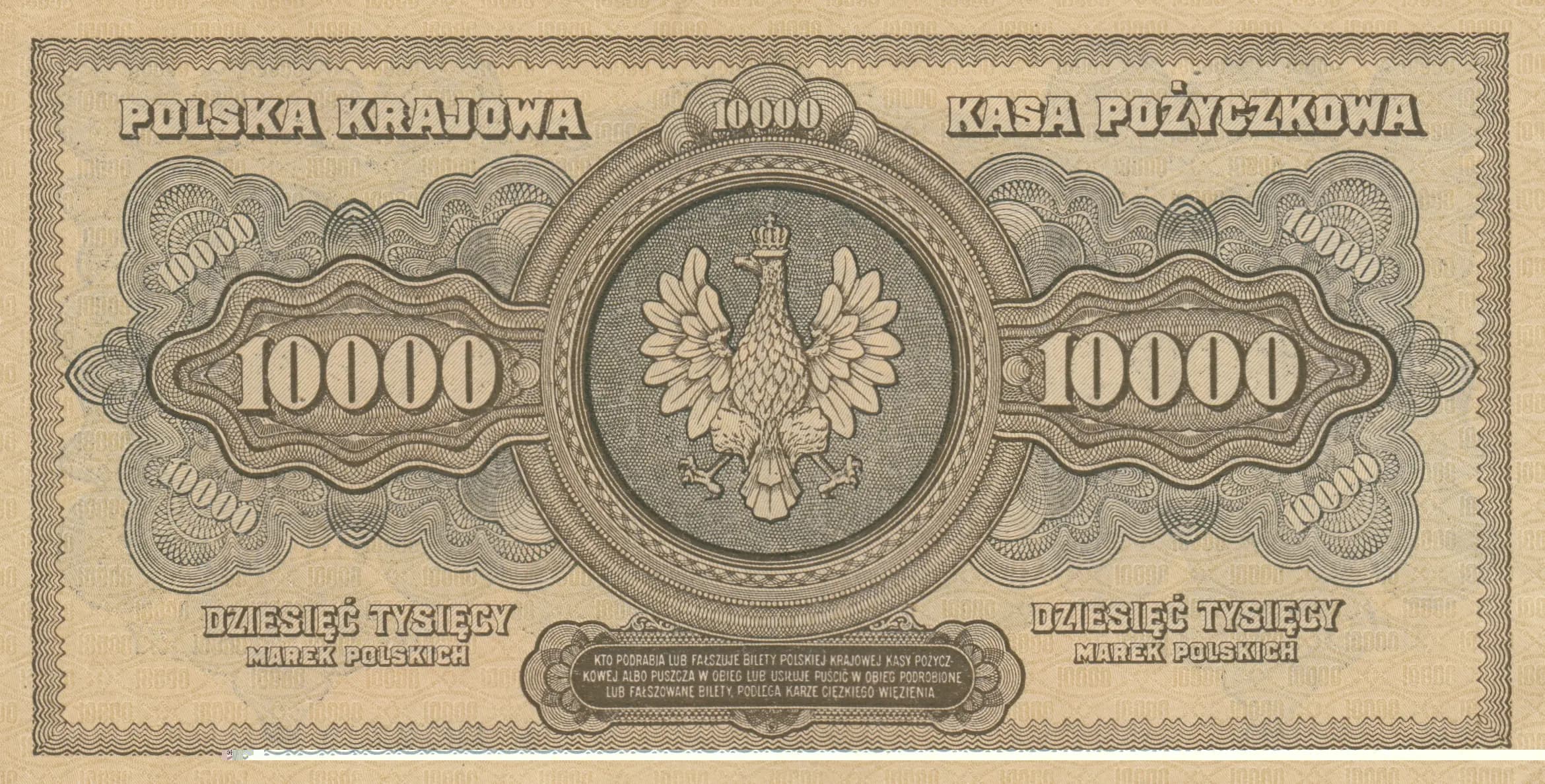
This 10,000 Polish Marek banknote from 1922 is a stunning example of early interwar Polish currency design, presented in AU (About Uncirculated) condition with crisp printing and no visible wear. The note features symmetrical Art Nouveau styling with dual female portrait medallions flanking an ornate center design on the obverse, while the reverse showcases a crowned Polish Eagle in a decorative circular frame. The exceptional condition and artistic merit make this an attractive piece for collectors of Eastern European currency or interwar period banknotes.
Common. While this is an early Polish interwar note with historical significance, the eBay price data shows consistent sales ranging from $3 to $105 depending on condition, with VF and F grades regularly trading for $8-25 and AU/AUNC examples for $50-105. The 2016 catalogue values of $10-50 across grades G-EF, combined with regular auction activity over more than a decade, indicate this is a readily available note in the collector market. The Polska Krajowa Kasa Pożyczkowa issued substantial quantities of this denomination during 1922, and surviving examples are not scarce.
Issued by the Polska Krajowa Kasa Pożyczkowa (Polish National Loan Bank) on March 11, 1922, this note represents Poland's early post-independence monetary system during a period of significant inflation and currency stabilization. The prominent display of the Polish Eagle and patriotic inscriptions reflecting Polish sovereignty reflect the nation's recent independence from partition powers, while the high denomination (10,000 marks) indicates the currency's rapid depreciation during this volatile economic period. The note's Art Nouveau aesthetic represents the artistic standards of Central European financial design in the early 1920s.
The obverse features a classical Art Nouveau composition with bilateral symmetry. Two female portrait medallions, each showing a woman's head in profile with wavy hair facing inward toward the center, occupy the upper left and right portions. These allegorical female figures likely represent Poland or Liberty, typical of interwar Polish iconography. The center displays large denomination text 'DZIESIĘĆ TYSIĘCY MAREK POLSKICH' with ornate circular rosette patterns in all four corners and elaborate scrollwork framing the entire design in a beige/tan and black color scheme. The reverse presents the crowned Polish Eagle (Białyorzeł) as the dominant central symbol, positioned within an ornate circular medallion frame surrounded by decorative wave-pattern borders and scrollwork. The eagle's spread wings and crown emphasize national sovereignty. Large denomination numerals '10000' appear symmetrically on both left and right sides, with text bands above and below the eagle containing the issuer name and denomination text. The overall design demonstrates high engraving standards with fine line geometric patterns and intricate cross-hatching throughout.
FRONT: 'Polska Krajowa Kasa Pożyczkowa' (Polish National Loan Bank) | 'Dziesięć Tysięcy Marek Polskich' (Ten Thousand Polish Marks) | '10000' (numerical denomination) | 'Warszawa Dnia 11 Marca 1922 Roku' (Warsaw, March 11, 1922) | 'Dyrektor Polskiej Krajowej Kasy Pożyczkowej' (Director of Polish National Loan Bank) | 'Państwo Polskie bierze na siebie odpowiedzialność za wymianę niniejszego biletu na przyszłą walutę polską według stosunku, który dla marek polskich ustalony będzie' (The Polish State assumes responsibility for exchanging this note for future Polish currency at the rate which will be established for Polish Marks) | Serial number: F 1672239. BACK: 'Polska Krajowa Kasa Pożyczkowa' (Polish National Loan Bank) | 'Dziesięć Tysięcy Marek Polskich' (Ten Thousand Polish Marks) | '10000' (numerical denomination) | 'Kto podrabia lub fałszuje bilety Polskiej Krajowej Kasy Pożyczkowej albo pusza w obieg lub świadomie posiada podrobionych lub fałszowanych biletów podlega karze ciężkiego więzienia' (Whoever counterfeits or forges notes of the Polish National Loan Bank or puts into circulation or knowingly possesses counterfeit or forged notes is subject to severe imprisonment).
Intaglio engraving (line engraving), the standard security printing method for banknotes of this era. The crisp, clear impression of fine lines, ornamental patterns, and portrait details visible in the AU condition specimen indicates skilled engraving work. The detailed circular medallion frames, scrollwork, and security background patterns are characteristic of intaglio production. The specific printer for this Polska Krajowa Kasa Pożyczkowa issue is not definitively documented in standard references, though major Polish banknote printing during this period was conducted by several European security printers including Polish state printing works.
Pick P-32 represents a single catalogued variety for the 10,000 Marek 1922 issue. This specific specimen carries serial number F 1672239, indicating it is from a standard circulation batch. The 'F' prefix likely denotes a particular printing series. No known overprints, signatures variants, or major design varieties are documented for this Pick number, though signature varieties may exist between different directors' terms. The consistent design and printing across known examples of P-32 suggest minimal varieties within this issue.