1/2 marki 1920
Market Prices
18 salesAbout This Note
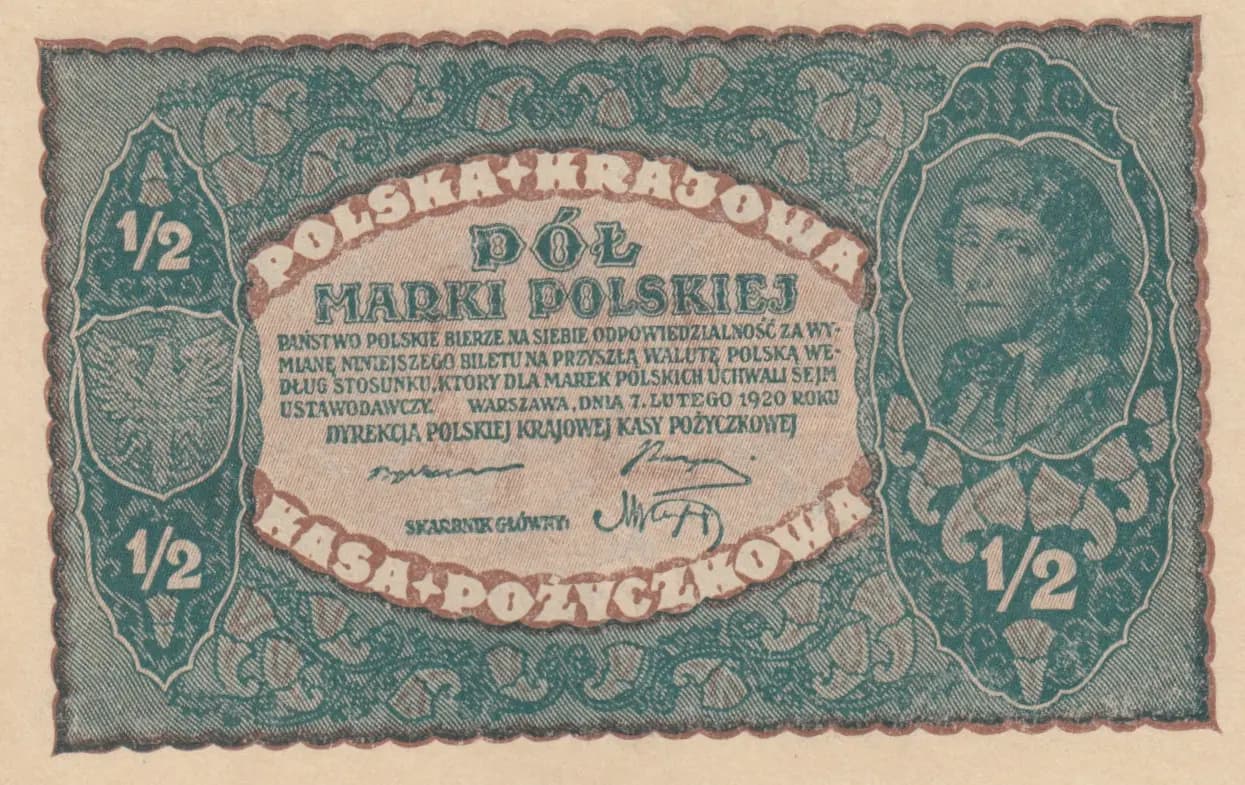
This Polish 1/2 Marki from 1920 is an attractive example of early interwar Polish currency issued by the Polska Krajowa Kasa Pożyczkowa (Polish National Loan Fund). The note displays vibrant green ink on cream paper with an ornate decorative border featuring intricate scrollwork and floral patterns, centering on an oval cartouche containing official text and a heraldic eagle on the reverse. In AU condition, this example shows minimal wear with slight age-related yellowing typical of notes from this period, with no visible tears, folds, or significant damage, making it an appealing piece of Polish monetary history.
Common. This note is a regular issue from the Polish National Loan Fund's 1920 emissions and remains readily available in the collector market. eBay historical price data shows consistent sales ranging from $2–$12 for ungraded examples in various grades (F through UNC), with only professionally graded examples (PMG 66–67) commanding higher prices ($59–$90). The relatively modest pricing across numerous transactions over a decade indicates substantial surviving population. While not worthless, this denomination and issuer's notes were produced in sufficient quantities to remain accessible to collectors at modest cost.
This note was issued on February 7, 1920, during a pivotal period following Poland's restoration of independence after World War I and the collapse of the Central Powers. The Polska Krajowa Kasa Pożyczkowa served as the temporary monetary authority before the establishment of the Polish State Bank (Bank Polski), issuing emergency currency to stabilize the newly reconstituted Polish economy. The heraldic eagle featured on the reverse is Poland's national emblem, symbolizing sovereignty and the restoration of the Polish state during this transformative period.
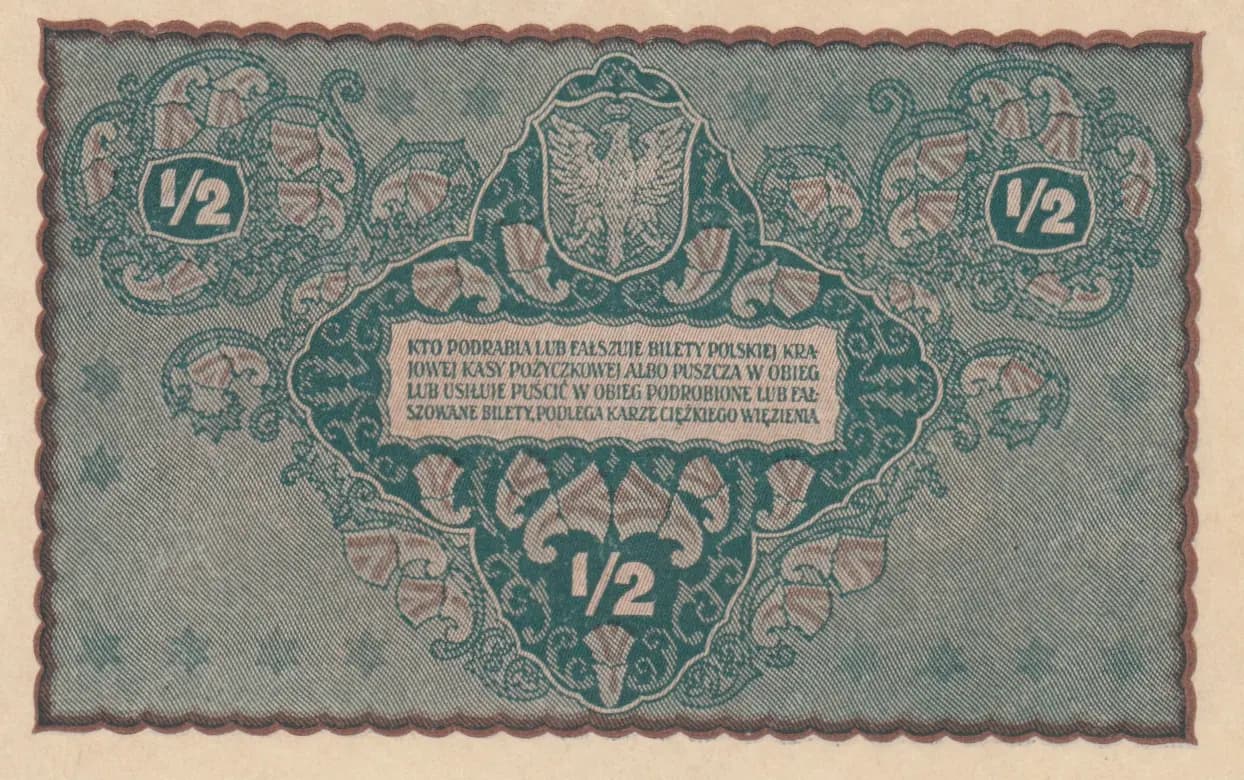
The obverse features a formal baroque-influenced design with a prominent ornate green border incorporating intricate scrollwork and floral patterns in the corners marked with shield-shaped denomination cartouches displaying '1/2'. The central design comprises a pale pink/beige oval cartouche containing the official issuing text and authority declarations of the Polish National Loan Fund. The reverse displays a similar ornate green border with matching decorative elements, centered on a heraldic coat of arms featuring Poland's crowned eagle—the national emblem—set within an ornamental shield. Below this heraldic centerpiece is another rectangular cartouche containing the counterfeiting penalty clause. The color scheme of green on cream/beige paper with brown/rust border accents was typical of Central European currency design of this era.
FRONT SIDE: 'Pożyczki Krajowej' (Domestic Loan) and 'Dół Marki Polskiej' (Half Polish Mark) appear in the denomination markers. The central text reads: 'The Polish State assumes responsibility, having the following office responsible for Polish currency on the date of study for which Polish marks were adopted by His Imperial Majesty's legislative body. Warsaw, February 7, 1920. Direction of the Polish National Loan Fund.' The signature line indicates 'Skarbnik Główny' (Chief Treasurer). BACK SIDE: The denomination '1/2' (Half) appears in multiple corners. The warning text states: 'Whoever counterfeits or falsifies notes of the Polish National Loan Fund or puts into circulation or attempts to put into circulation counterfeit or falsified notes shall be subject to imprisonment.'
This note was produced using intaglio (engraved) printing, evidenced by the fine-line cross-hatching patterns visible throughout the intricate border designs, the complex ornamental engraving in the scrollwork, and the sharp definition of the heraldic eagle and decorative elements. The multi-color printing (green ink on cream paper with brown borders) required separate plates or careful registration. The printer for Polish National Loan Fund notes of this period is typically attributed to security printers in Warsaw or contracted European security printing houses experienced in government currency production.
The PMG population report indicates a single cataloged variant (P-30s) for this base Pick number. Within this emission, varieties may exist based on signature combinations (Skarbnik Główny/Chief Treasurer signatures), serial number prefixes, and minor design elements, though the visual analysis of this particular example does not reveal sufficient detail to definitively identify specific signature varieties. The February 7, 1920 date is consistent with the primary emission recorded in standard catalogs. No overprints or significant design variations are evident in this specimen.