1/2 marek 1916
Market Prices
13 salesAbout This Note
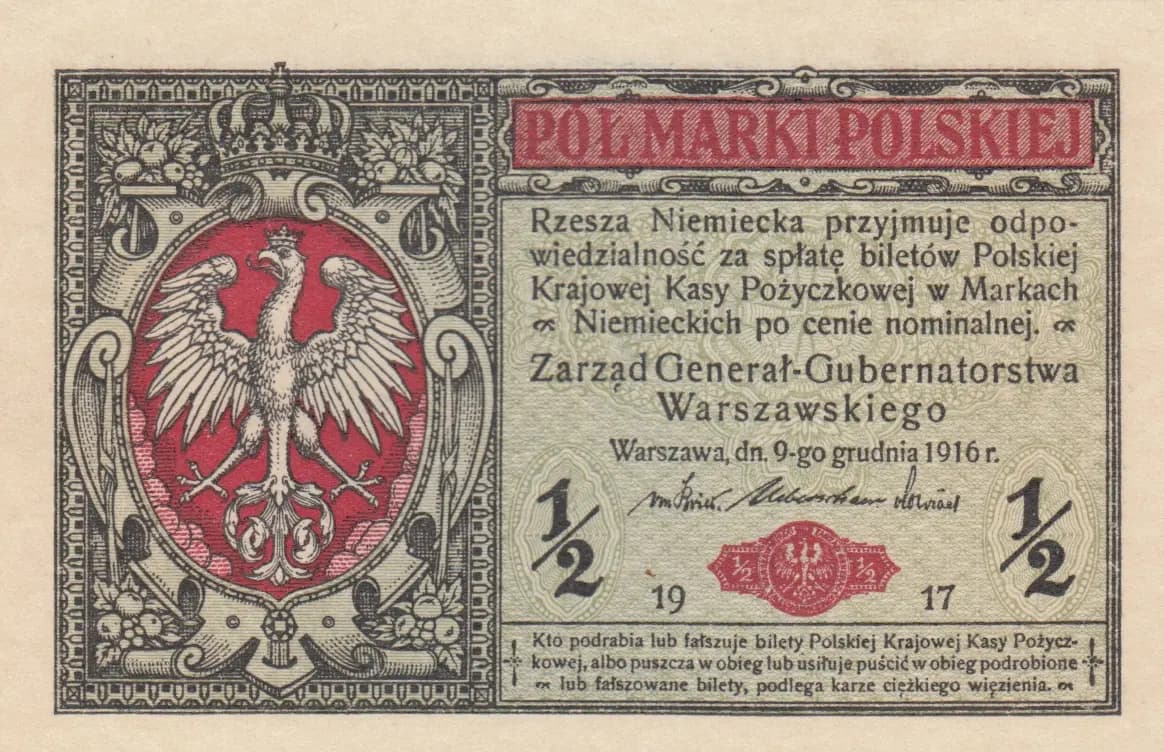
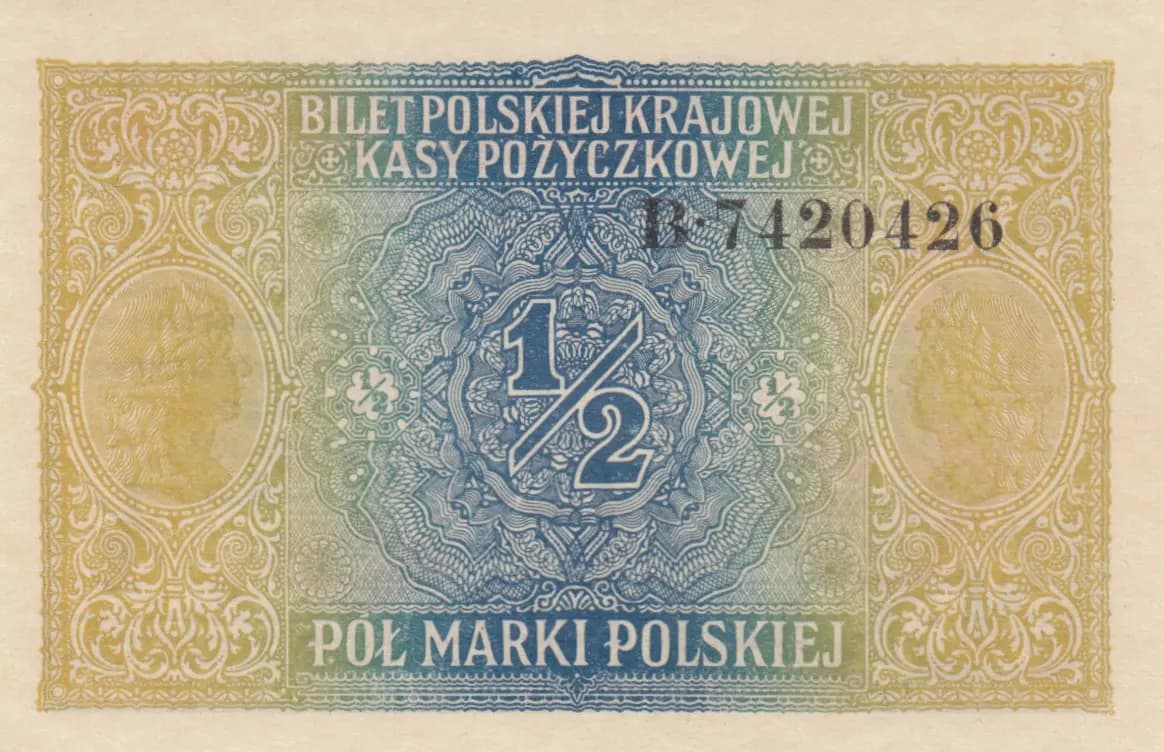
This Polish 1/2 Marki from 1916 is an attractive example of early 20th century Polish monetary history, issued by the Polska Krajowa Kasa Pożyczkowa (Polish National Loan Bank) under German occupation. The note displays excellent preservation in AU condition with crisp, well-defined printing throughout, vibrant color retention on both obverse and reverse, and minimal wear consistent with the grade. The ornate baroque-style design featuring the crowned Polish eagle (Orzeł Biały) on the front and classical female portrait medallions on the back exemplifies the artistic standards of German-occupation-era Polish currency.
Common. eBay market data shows consistent sales in the $8–$31 range for various condition grades (VG through VF), with even high-grade examples (EF/AUNC) trading in the $23–$30 range historically. The 2016 catalogue values of $10 (VG), $20 (VF), and $40 (UNC) further support common status. This denomination from the 1916/1917 issue appears to have been produced in substantial quantity, indicating no significant scarcity. The AU condition grade assigned does not materially increase rarity, as similar grades appear regularly in market sales.
Issued on December 9, 1916, during Poland's partition under German occupation in World War I, this note represents a critical moment when Polish national identity was reasserting itself through financial instruments. The issuing authority, the Zarząd Generalnego Gubernatorstwa (Administration of the General Governorship), reflects the complex political situation of the German occupation zone in the Russian partition. The prominent crowned eagle with crossed swords beneath it on the obverse symbolizes Polish sovereignty and national pride during a period when Poland had no independent state, while the German Reich's guarantee of payment printed on the note underscores the economic realities of wartime occupation.
The obverse features the Orzeł Biały (White Eagle), the crowned Polish coat of arms, centered within an ornamental red shield medallion on the left side, with spread wings displaying heraldic precision and a crown surmounting the eagle's head. Beneath the eagle are crossed swords, traditional Polish national symbols of sovereignty. The reverse showcases two classical female portrait medallions in profile, positioned symmetrically on either side of a large blue decorative badge containing the denomination '1/2'. The female portraits likely represent allegorical figures of Poland or Liberty, consistent with early 20th century banknote iconography. Both sides employ elaborate baroque-style decorative borders, scrollwork, and floral motifs in cream, gold, green, and blue tones, with the overall design intended to project both national dignity and security against counterfeiting.
FRONT SIDE: 'POLSKA MARKI POLSKIEJ' (Polish Mark of Poland) — Main denomination and currency identifier. 'Zarząd Generalnego Gubernatorstwa Warszawskiego' (Administration of the General Governorship of Warsaw) — Issuing authority. 'Warszawa, dn. 9-go grudnia 1916 r.' (Warsaw, December 9, 1916) — Issue date. 'Rzesza Niemiecka przyjmuje odpowiedzialność za spłatę biletów Polskiej Krajowej Kasy Pożyczkowej w Markach Niemieckich po cenie nominalnej.' (The German Reich accepts responsibility for payment of Polish National Loan Bank tickets in German Marks at nominal price.) — Redemption guarantee. '1/2' and '19[17]' — Denomination and year overprint. 'Kto podrabia lub fałszuje bilety Polskiej Krajowej Kasy Pożyczkowej, albo puszczy w obieg lub użytuje puscił w obieg podrobione lub fałszowane bilety, podlegnie karze cieżkiego więzienia.' (Whoever forges or counterfeits tickets of the Polish National Loan Bank, or puts into circulation or uses counterfeit or forged tickets, shall be subject to hard imprisonment.) — Anti-counterfeiting warning. BACK SIDE: 'BILET POLSKIEJ KRAJOWEJ KASY POŻYCZKOWEJ' (Polish National Loan Bank Ticket) — Institution identification. '1/2 PÓŁMARKI POLSKIEJ' (Half Polish Mark) — Denomination statement. '774204026' — Serial number.
The note exhibits characteristics of steel-plate engraving, the standard security printing technique of the period, evidenced by the fine-line precision visible in the ornamental borders, the crisp definition of the eagle's feathers and heraldic details, and the clearly rendered portrait medallions. The elaborate decorative patterns function as inherent anti-counterfeiting measures, as the complexity of the engraved artwork would be prohibitively difficult to reproduce. The color printing, combining black line work with colored elements (red shields, blue badges, gold and green accents), suggests multi-plate color lithography or chromolithography technique executed in coordination with the engraved primary design.
This specific note shows the standard variety of P-7 with the date 'Warszawa, dn. 9-go grudnia 1916 r.' (December 9, 1916) on the obverse and an overprinted year designation of 1917. The serial number '774204026' is consistent with the series produced during this emission. The PMG population report indicates P-7s (specimen note) exists as a variant, suggesting that non-specimen examples like this circulation note represent the primary variety of this Pick number. No additional overprints, signatures, or alterations are evident from the visual analysis that would distinguish this as a rare sub-variety.