50 pisos 1978
Market Prices
7 salesAbout This Note
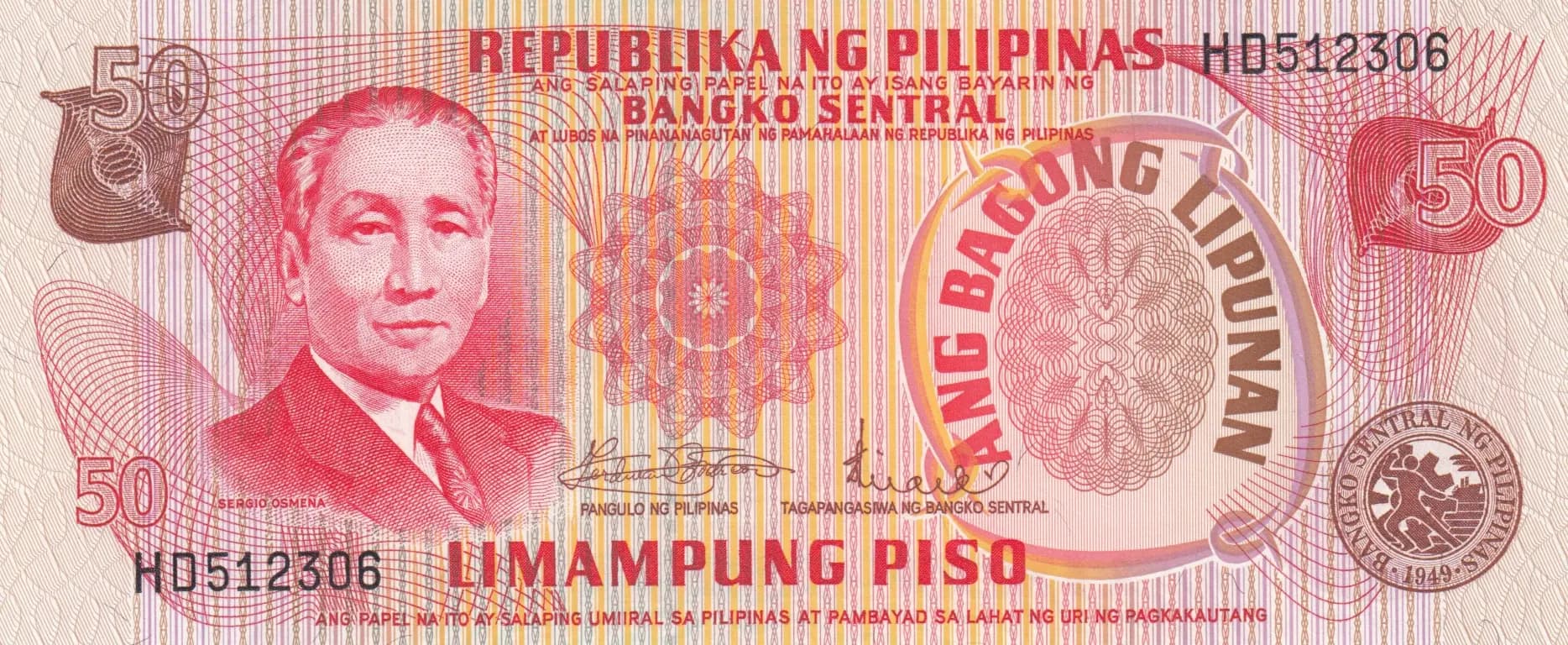
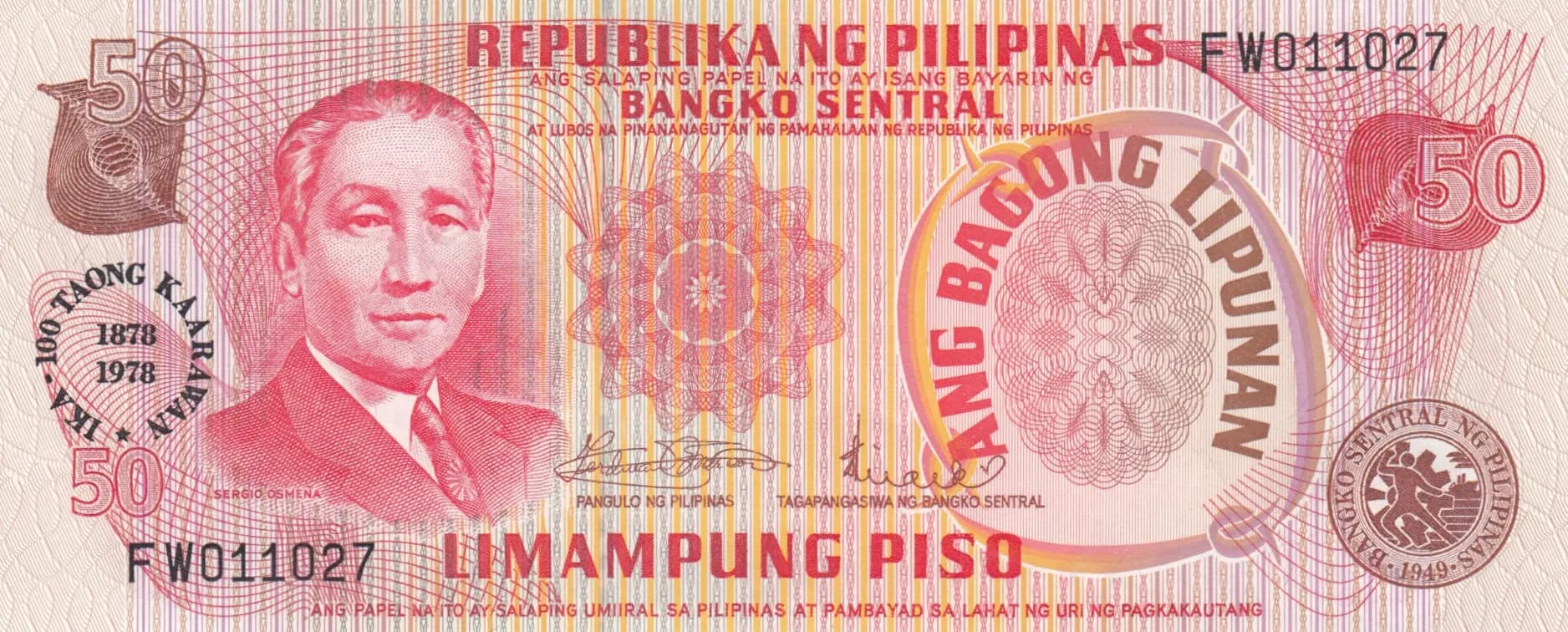
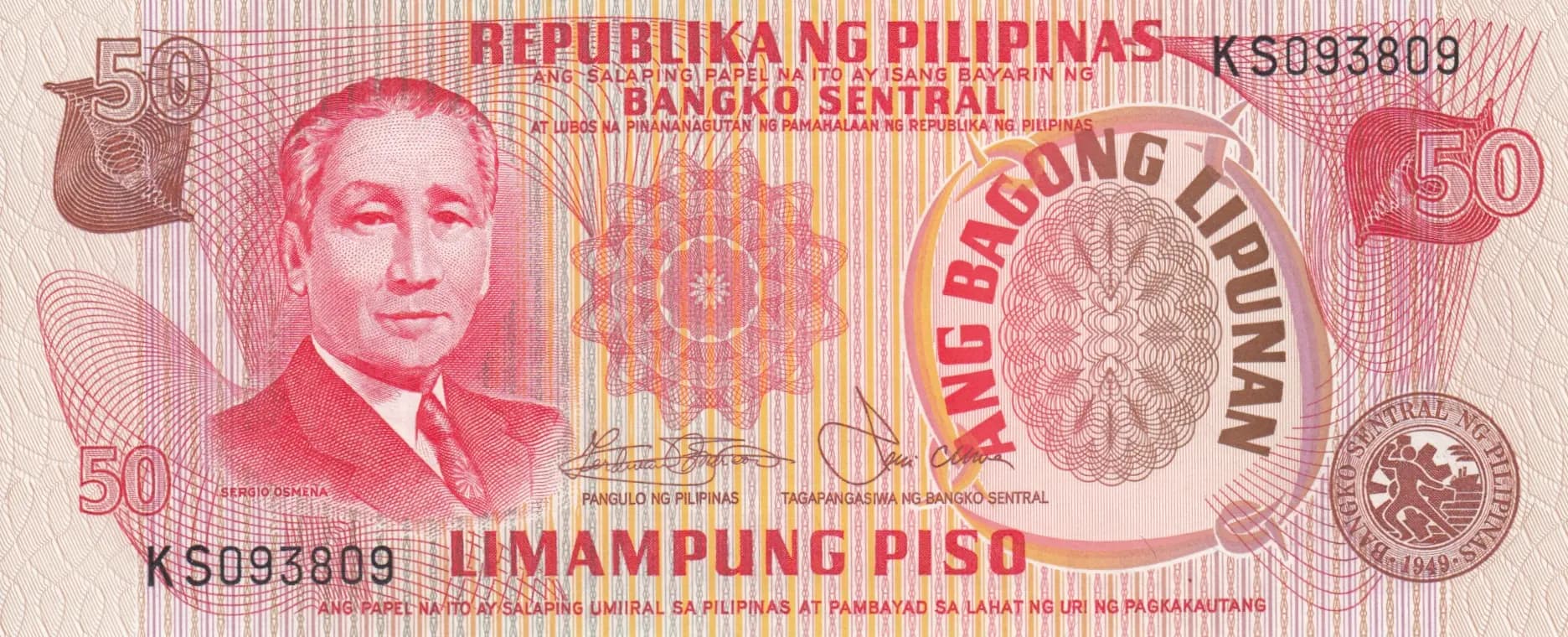
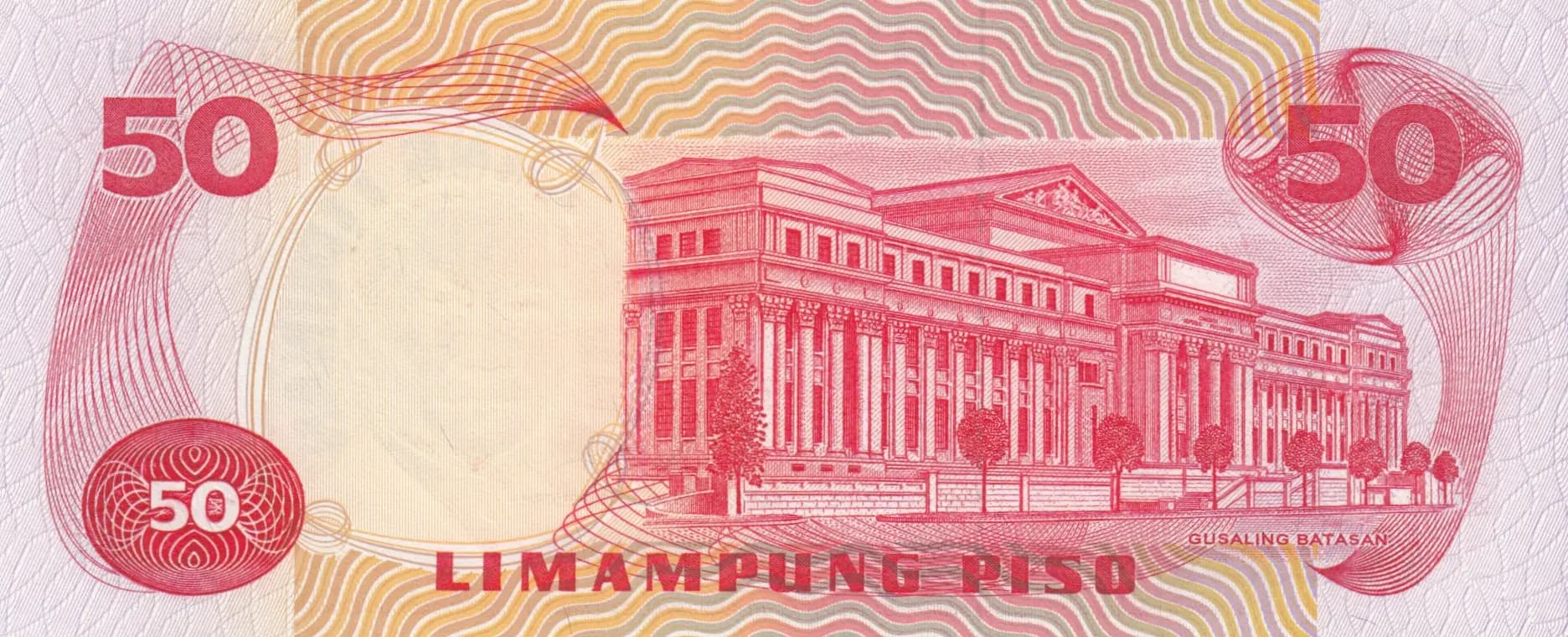
A pristine UNC example of the 1978 Philippine 50 pesos (Pick P-163b) featuring Sergio Osmeña in formal portrait on the obverse and the Legislative Building on the reverse. The note displays the characteristic pink-red and tan color scheme with intricate security line patterns and a prominent circular security medallion, all rendered with crisp, clean printing typical of uncirculated specimens. This Central Bank Type 4 seal variant represents a desirable mid-range denomination from the New Society era of Philippine currency.
Common. The 50 pesos P-163b from 1978 is a regular issue from a major currency series with substantial print run. Market evidence from eBay sales data shows consistent circulation of this note across multiple condition grades, with UNC examples averaging $2-3 in value (2014-2020 price history). These modest catalog and market values are characteristic of common, non-rare banknotes. No information suggests limited print runs, recalls, or scarcity for this specific Pick number.
Issued in 1978 during Ferdinand Marcos's 'New Society' (Bagong Lipunan) period, this note honors Sergio Osmeña, a pre-war Philippine president and statesman who died in 1961. The reverse depicts the Gusaling Batasan (Legislative Building) in Manila, now the National Museum, symbolizing the government institutions of the Republic. This denomination and design series reflects the Central Bank of the Philippines' modernization of the currency system during the late 1970s.
The obverse features a three-quarter portrait of Sergio Osmeña, the second President of the Philippines (1944-1946), rendered in formal business attire with suit and tie, positioned on the left side in classical banknote style. The right side incorporates a large circular security medallion with concentric brain-like or spiral patterns serving as both a security device and design element. The Philippine national coat of arms seal appears in the bottom right corner. The reverse displays a detailed architectural rendering of the Gusaling Batasan (Legislative Building), a neoclassical structure with prominent colonnaded portico and pediment, centered within an ornamental composition. Both sides employ a consistent color palette of pink, red, tan, brown, and yellow with intricate linework backgrounds creating a complex anti-counterfeiting pattern. Denomination numerals '50' and text 'LIMAMPUNG PISO' appear prominently on both sides.
{"front":{"REPUBLIKA NG PILIPINAS":"Republic of the Philippines","ANG SALAPING PAPEL NA ITO AY ISANG BAYARIN NG BANGKO SENTRAL AT LUBOS NA PINANAGUTUAN NG PAMAHALAAN NG REPUBLIKA NG PILIPINAS":"This paper money is a liability of the Central Bank and is fully guaranteed by the Government of the Republic of the Philippines","PANGULONG PILIPINAS":"President of the Philippines","TAGAPANGASIWA NG BANGKO CENTRAL":"Governor of the Central Bank","LIMAMPUNG PISO":"Fifty Pesos","SERGIO OSMEÑA":"Sergio Osmeña [portrait identification]","ANG PAPEL NA SALAPING UMIRAL SA PILIPINAS AT PAMBAYAD SA LAHAT NG URI NG PAGKAKAUTANG":"The paper money that circulates in the Philippines and is used for payment of all kinds of debts"},"back":{"LIMAMPUNG PISO":"Fifty Pesos","GUSALING BATASAN":"Legislative Building"}}
Intaglio (recess) printing combined with multicolor offset lithography. The note was printed by Giesecke & Devrient (G&D), a leading security printer, as indicated in catalog references. The intricate line patterns, security medallion, and detailed portraiture are characteristic of the intaglio process, while the multicolor background was likely applied via offset lithography. No printer imprint appears on the note itself, which is typical for Central Bank of the Philippines notes of this era.
This is cataloged as P-163b, indicating it is variant 'b' of the 50 pesos series (distinguishing it from P-163a and potentially other variants). The note features Central Bank Seal Type 4 as specified in catalog references. Replacement notes, if any, would be identified by a '+' prefix in the serial number. The visual serial number 'KS093809' shown on this specimen is consistent with regular issue serial numbering. No visible evidence of the '+' replacement prefix is observed on this example.