20 pesos 1941
“Cebu”
Market Prices
About This Note
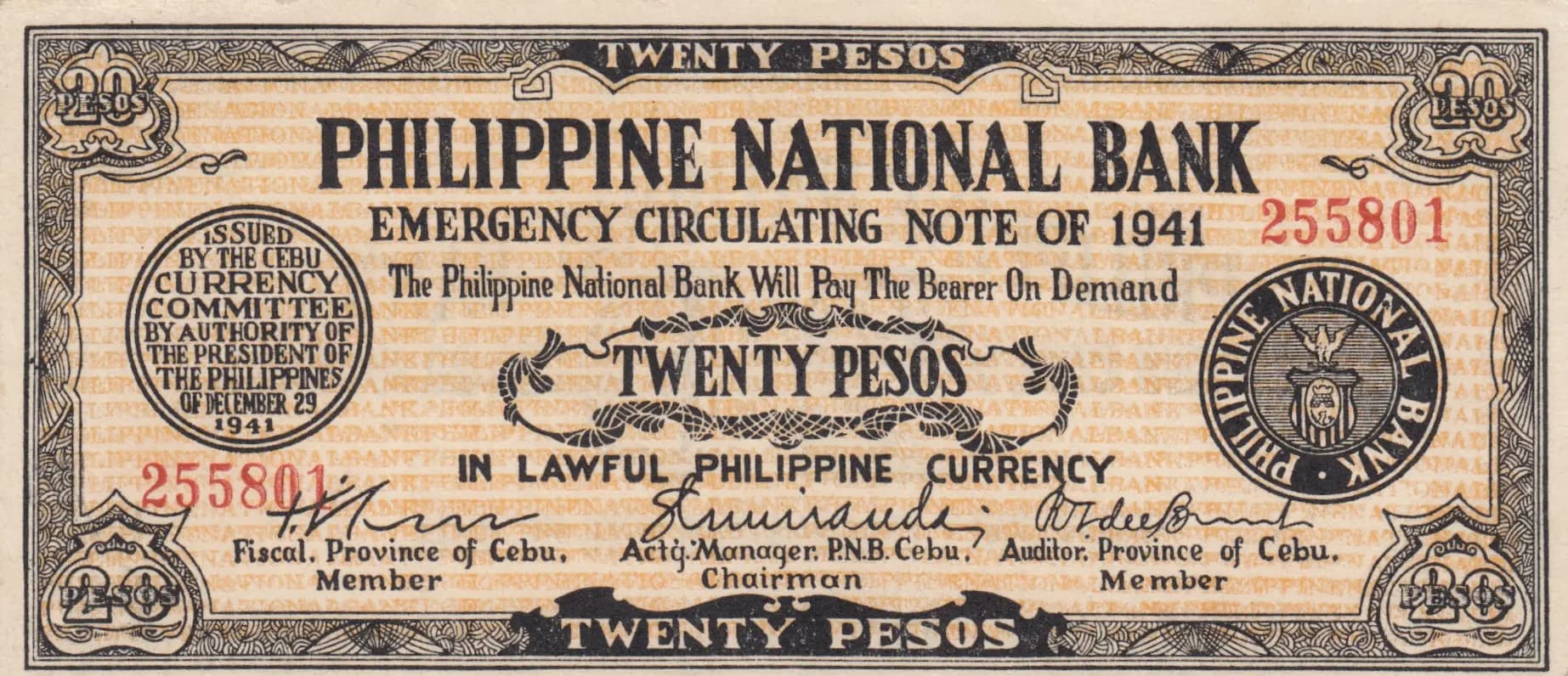
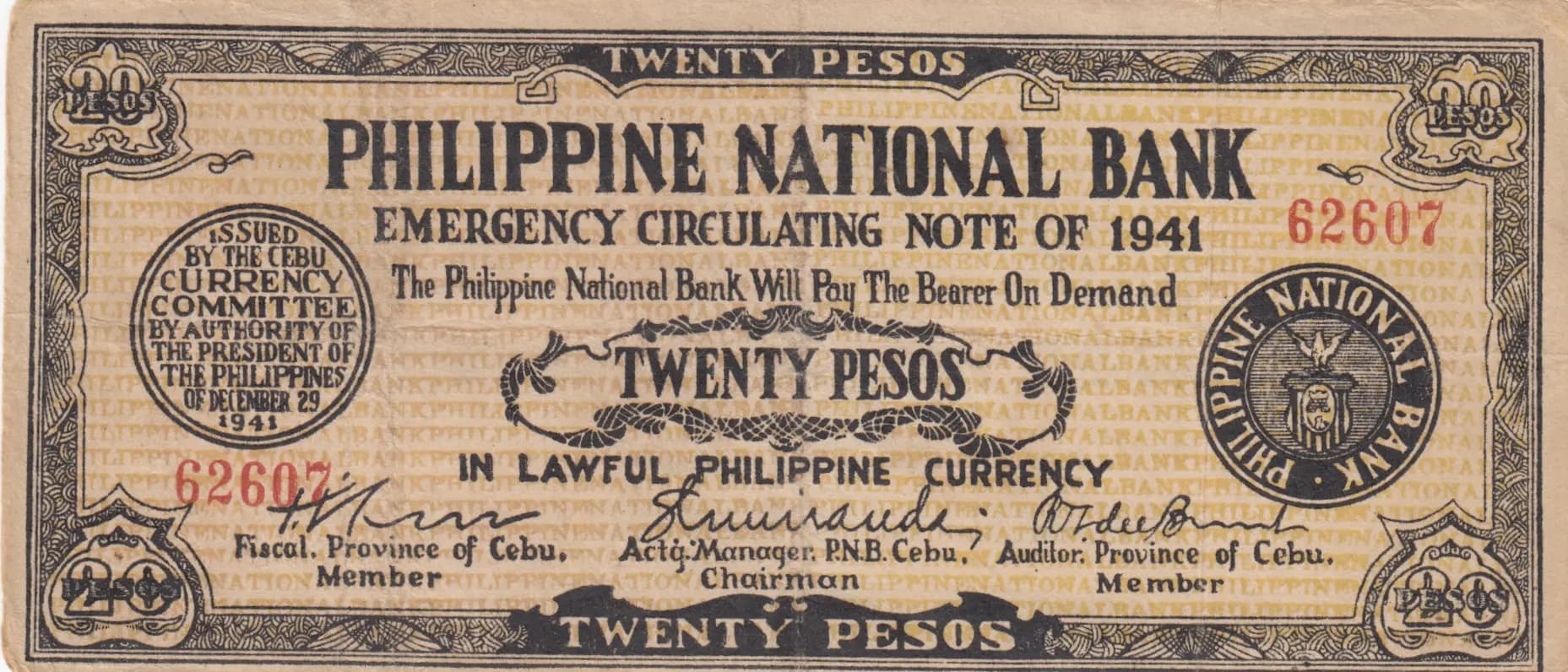
This is a Philippine National Bank 20 pesos emergency circulating note from December 29, 1941, issued by the Cebu Currency Committee during the Japanese occupation of the Philippines. The note displays tan/beige coloring with black and red printing, featuring ornate decorative borders and official seals from both the Cebu Currency Committee and the Philippine National Bank. In VF condition, it shows moderate aging with visible creasing and foxing consistent with wartime emergency currency that saw actual circulation.
Common. The catalog data indicates a substantial print run with serial numbers ranging from 1 to 302,500, suggesting at least hundreds of thousands of these notes were issued. eBay pricing data confirms this assessment, with prices ranging from $7.99 to $129.95 USD depending on condition, with VF examples (matching this note's grade) typically selling around $129.95. The wide availability of comparable examples in the secondary market and the large original emission firmly establish this as a common issue despite its historical interest.
This emergency note was issued on December 29, 1941, just days after the Japanese attack on Pearl Harbor and the rapid Japanese invasion of the Philippines. The Cebu Currency Committee's seal and authorization from the President of the Philippines indicate this was part of the emergency measures taken by the Philippine Commonwealth government during the military crisis. The note represents a critical period when normal currency supplies were disrupted and emergency circulating notes were authorized to maintain the money supply in provincial areas like Cebu.
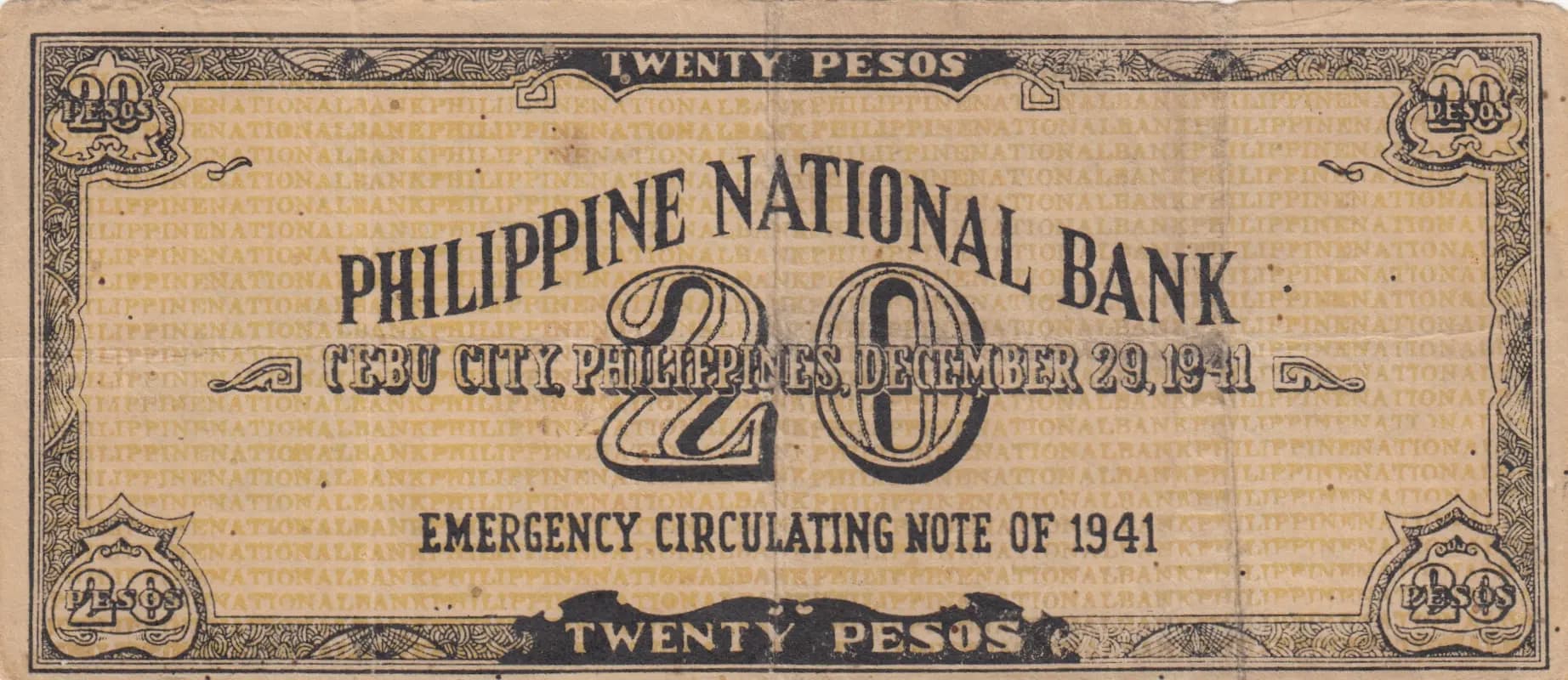
The note features a symmetrical design with ornate geometric and floral decorative borders on both front and back. The front is dominated by two circular seals—one on the left bearing the Cebu Currency Committee's authorization and date, and one on the right identifying the Philippine National Bank as issuer. The denomination '20' appears in all four corners as decorative markers. The center lower portion contains three signature lines identifying the officials of the Cebu Currency Committee (Fiscal, Acting Manager/Chairman, and Auditor). The back is more minimal, presenting the denomination and issuing information prominently with the same decorative border treatment. The serial number appears in red (62607), a standard security feature distinguishing individual notes within the 1 to 302,500 series. No portraits or named landmarks are depicted; the design emphasizes official authority and institutional legitimacy through seals and formal inscriptions.
FRONT: 'TWENTY PESOS' / 'PHILIPPINE NATIONAL BANK' / 'EMERGENCY CIRCULATING NOTE OF 1941' / 'The Philippine National Bank Will Pay The Bearer On Demand' / 'IN LAWFUL PHILIPPINE CURRENCY' / 'ISSUED BY THE CEBU CURRENCY COMMITTEE BY AUTHORITY OF THE PRESIDENT OF THE PHILIPPINES OF DECEMBER 29 1941' / Serial number: '62607' / Committee positions: 'Fiscal, Province of Cebu, Member' / 'Act. Manager PNB Cebu, Chairman' / 'Auditor, Province of Cebu, Member' — BACK: 'TWENTY PESOS' / 'PHILIPPINE NATIONAL BANK' / 'CEBU CITY, PHILIPPINES, DECEMBER 29, 1941' / 'EMERGENCY CIRCULATING NOTE OF 1941' / Denomination marker: '20'
This note was produced using letterpress printing, evidenced by the sharp, crisp line work of the decorative borders, the clear registration of the circular seals, and the precise typography throughout. The red serial number was applied in a separate pass, a standard technique for emergency notes of this period. The black on tan/orange underprint color scheme and the overall printing quality are consistent with the security printing capabilities available to the Philippine National Bank in 1941.
This specific example is identified as variety with serial number 62607, placing it well within the documented series range (1-302,500). The note is from the Cebu City emission, as confirmed by the committee seal and back inscription specifying 'CEBU CITY, PHILIPPINES, DECEMBER 29, 1941.' The catalog designation P-S218 classifies this as a standard Cebu variety of the 1941 emergency issue. No overprints or unusual signature variations are evident in this example.