20 pesos 1949
Market Prices
5 salesAbout This Note
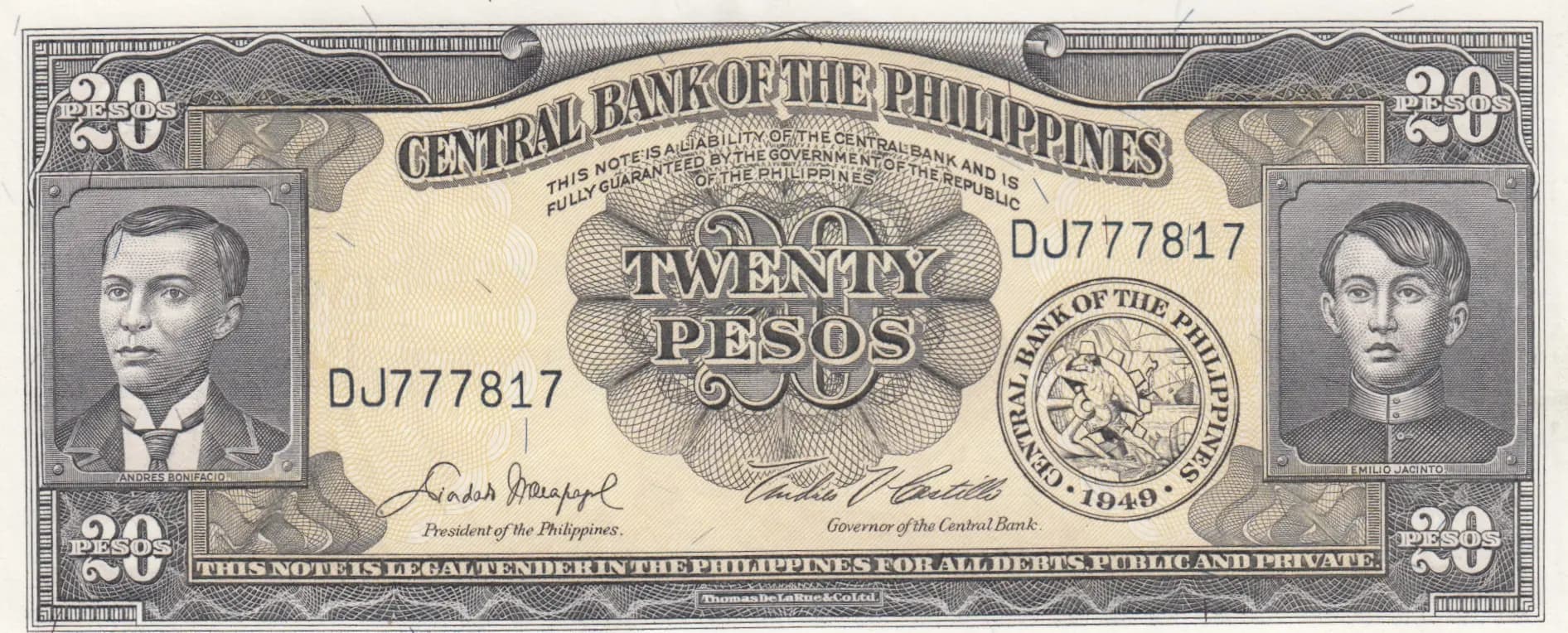
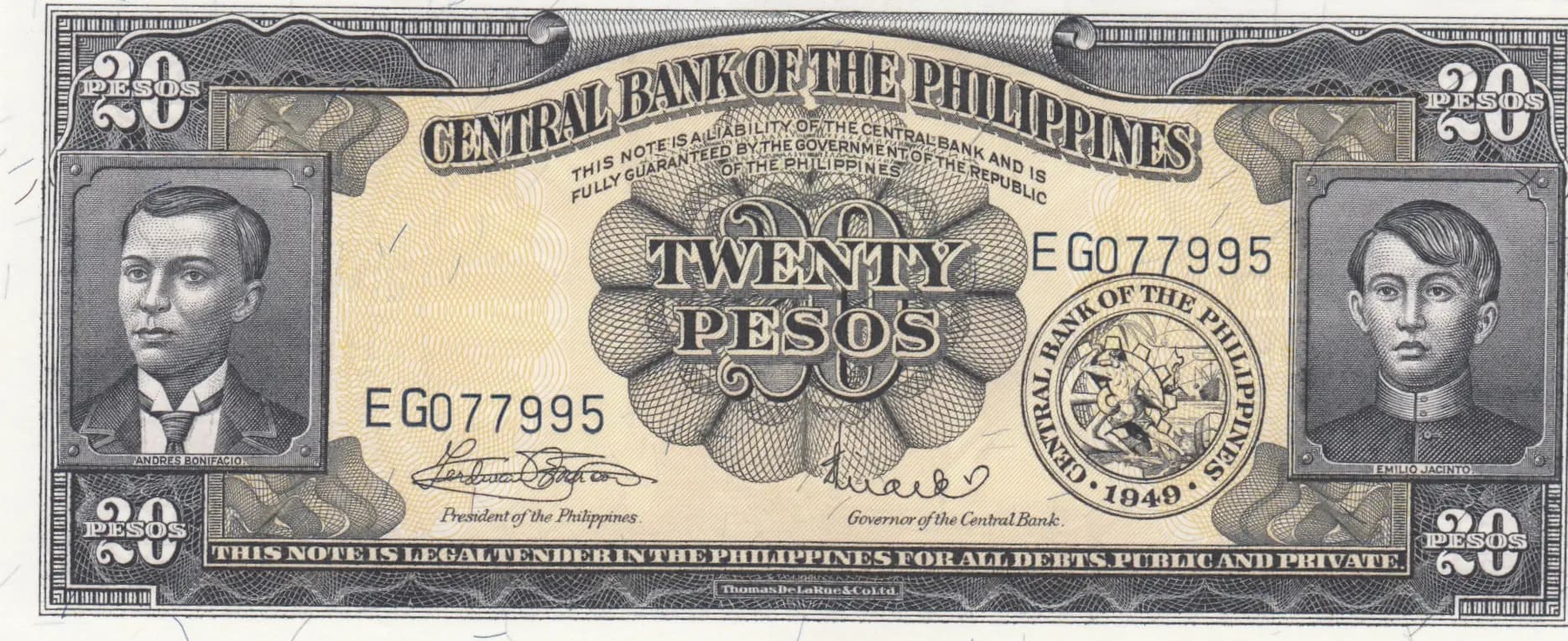
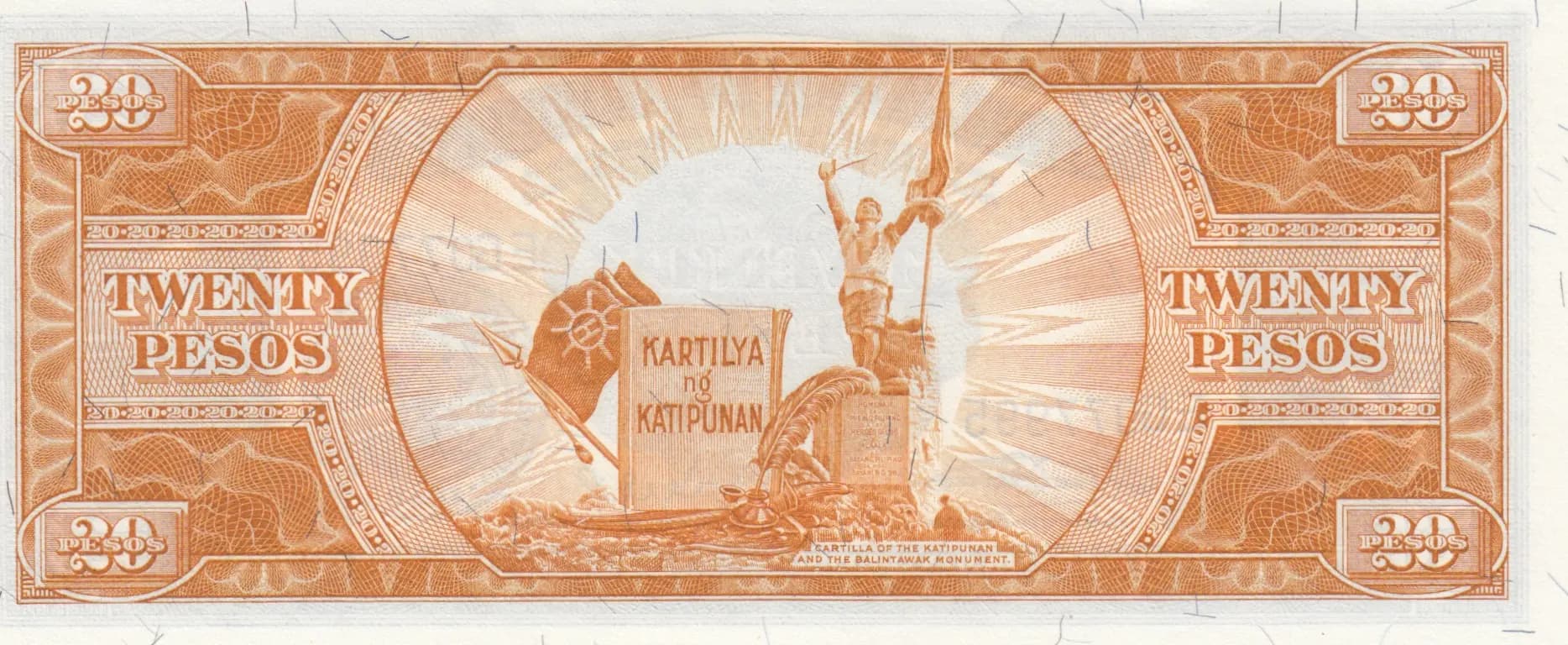
This is a 1949 Central Bank of the Philippines 20 pesos note (Pick P-137e) printed by Thomas de la Rue in London, featuring dual portraits of Filipino revolutionary heroes Andres Bonifacio and Emilio Jacinto. The note displays characteristic cream and beige coloring on the obverse with ornate black and gray decorative borders, while the reverse showcases an orange-tan allegorical design depicting Liberty with the Kartilya ng Katipunan and Balintawak Monument. Despite being graded UNC, the visual analysis indicates visible wear including fold lines and creasing consistent with circulation, suggesting the actual condition may be overstated or the grading reflects different standards.
Common. eBay market pricing data shows comparable examples (PMG 64, UNC, AUNC grades) selling in the $3.25-$26 range from 2014-2021, with catalog values as low as $2.50 for UNC specimens (2019). The regular issue status, long circulation period (1949-1969 per banknote.ws), substantial print run typical of a major denomination from a national central bank, and current affordable pricing all indicate this is a common banknote in the numismatic market. The stated UNC grade appears inconsistent with observed wear marks, but even allowing for grading variation, this remains an inexpensive, readily available note.
Issued in 1949, shortly after the Philippines' independence from American colonial rule in 1946, this note commemorates the nation's revolutionary heroes and foundational documents. The depiction of Andres Bonifacio and Emilio Jacinto honors the leaders of the Katipunan, the secret revolutionary society that initiated armed resistance against Spanish rule, while the reverse features the Kartilya ng Katipunan (the Katipunan's code of conduct) and the Balintawak Monument, symbolizing the nation's struggle for freedom and self-determination during this formative period of the Philippine Republic.
The obverse features a sophisticated dual-portrait composition with Andres Bonifacio (left) and Emilio Jacinto (right), the intellectual architects of Philippine revolutionary resistance. The center displays the denomination 'TWENTY PESOS' within an ornamental frame flanked by serial numbers. The Central Bank of the Philippines seal dated 1949 appears at lower right. The reverse presents an allegorical female figure representing Liberty or Victory, rendered in classical style, holding aloft a banner inscribed with 'Kartilya ng Katipunan' and a torch, symbolizing enlightenment and national aspiration. Adjacent to this figure stands the Balintawak Monument, an architectural memorial to the revolution. A radiating sunburst pattern behind the figure emphasizes the illuminating power of the nation's foundational principles. The entire design is framed by ornamental corner rosettes containing the denomination.
FRONT: 'CENTRAL BANK OF THE PHILIPPINES' (issuing authority); 'TWENTY PESOS' (denomination); 'THIS NOTE IS A LIABILITY OF THE CENTRAL BANK AND IS FULLY GUARANTEED BY THE GOVERNMENT OF THE PHILIPPINES REPUBLIC' (legal guarantee); 'ANDRES BONIFACIO' and 'EMILIO JACINTO' (portrait identifications); 'CENTRAL BANK OF THE PHILIPPINES 1949' (issuer and date); 'THIS NOTE IS LEGAL TENDER IN THE PHILIPPINES FOR ALL DEBTS PUBLIC AND PRIVATE' (legal tender declaration); 'Thomas De La Rue & Co Ltd' (printer); Serial number 'E G077995'. BACK: 'TWENTY PESOS' (denomination, repeated); 'KARTILYA NG KATIPUNAN' (Tagalog: 'Code of the Katipunan'); 'CARTILLA OF THE KATIPUNAN AND THE BALINTAWAK MONUMENT' (English description of reverse design); '20' (denomination numeral).
This note was produced by Thomas de la Rue and Company, London, using advanced intaglio engraving techniques characteristic of early 20th-century security currency production. The visual analysis reveals intricate engraved patterns, fine-line cross-hatching, complex background textures, and detailed decorative border work throughout both sides. The multi-color printing (cream/beige and black on obverse; orange/tan and cream on reverse) was achieved through sequential intaglio printing passes, a technique that provided both aesthetic appeal and security against counterfeiting through the difficulty of reproducing the fine engraved detail.
This note represents Pick P-137e, indicating it is the fifth cataloged variety of the 1949-1969 series 20 pesos denomination. The specific variety designation 'e' likely reflects differences in security features, signature combinations, or seal designs across the production run. The observed Central Bank seal dated 1949 and the serial number prefix 'E G' are consistent with the described Type 1 Central Bank Seal variant. The note's specific variety within the P-137 family would be confirmed by examining signature blocks and comparing seal and border design characteristics against other cataloged varieties (P-137a through P-137d), which may represent different signature combinations or slight design modifications made during the 20-year circulation period.