20 pesos 1949
Market Prices
33 salesAbout This Note
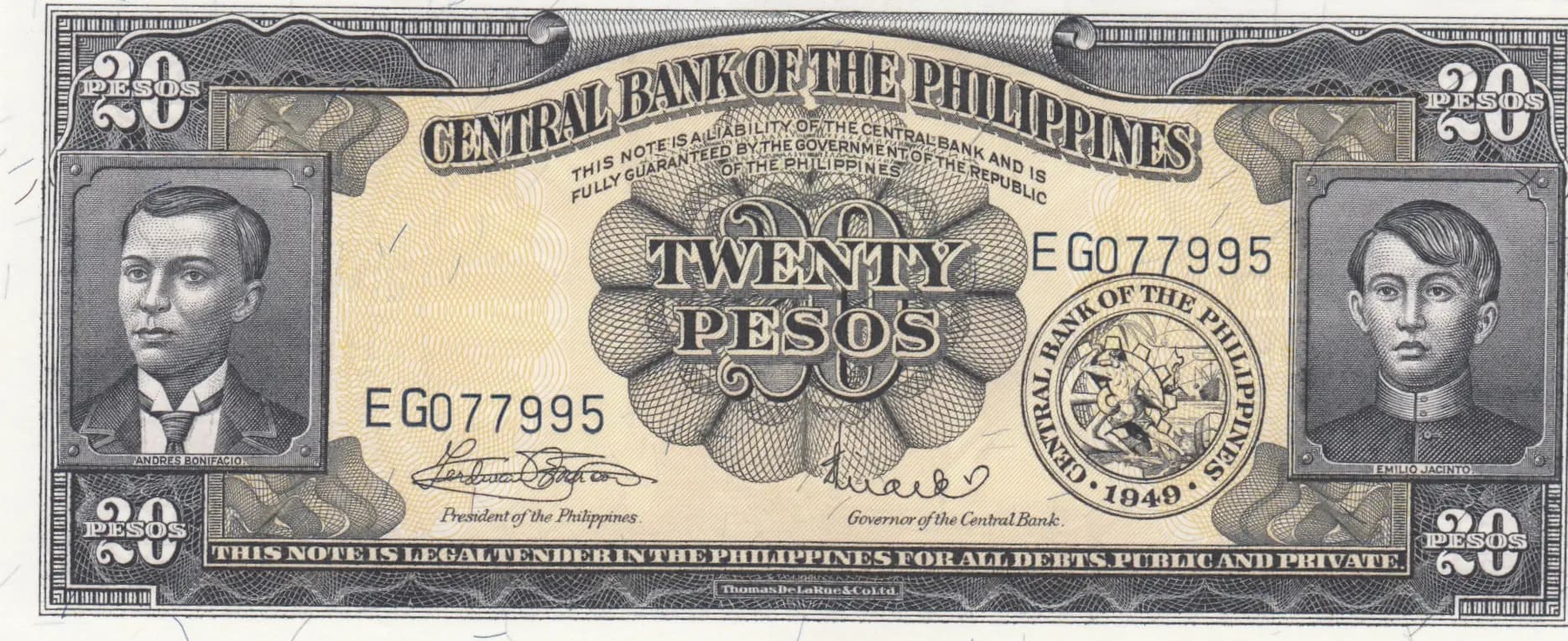
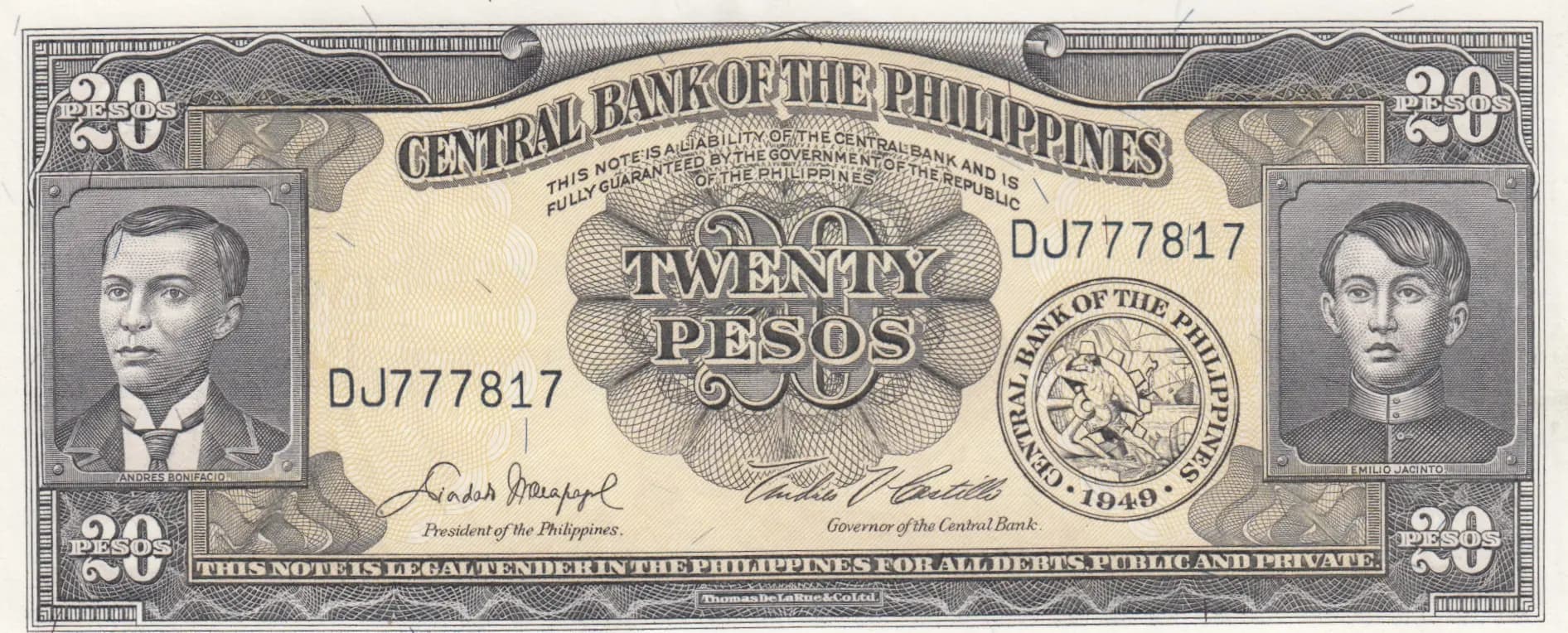
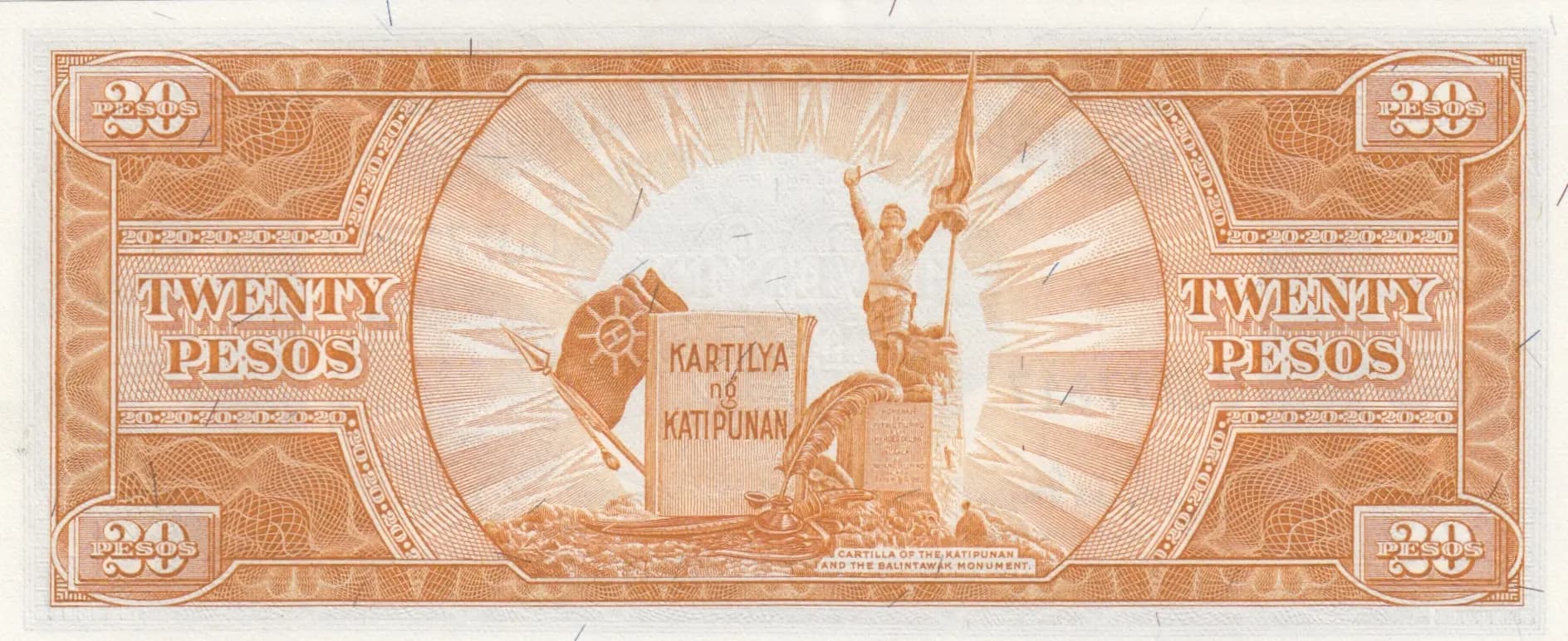
A superb example of the 1949 Central Bank of the Philippines 20 Pesos banknote (Pick P-137d) in uncirculated condition. The note exhibits the hallmark design of this period with portraits of revolutionary heroes Andres Bonifacio and Emilio Jacinto flanking an ornate central cartouche on the obverse, rendered in black and cream tones. The reverse depicts the Balinawak Monument with the Cartilla of the Katipunan in warm orange-tan hues, representing a significant moment in Philippine nationalist history. The note displays pristine condition with sharp printing detail and no evidence of circulation.
Common. Market data from realbanknotes.com shows consistent auction activity at modest price points, with recent UNC examples selling for $15-15.50 (March 2025) and historical prices predominantly ranging $2-17. The eBay price history demonstrates active collector demand but at levels indicative of plentiful supply. While certified examples (PMG 64-66) command premiums ($30-70 in 2018-2021), the base UNC notes remain affordable. The denomination and 20-year issue span (1949-1969 per banknote.ws) suggest a substantial print run, consistent with common status.
Issued in 1949, shortly after Philippine independence from the United States (1946), this banknote commemorates the leaders of the Philippine Revolution against Spanish colonial rule. Andres Bonifacio and Emilio Jacinto, depicted on the obverse, were key figures in the Katipunan movement of the 1890s. The reverse's Balinawak Monument scene reinforces the revolutionary narrative central to post-independence Philippine nationalism, with the Cartilla of the Katipunan—the society's constitution—serving as a symbol of the struggle for independence and democratic ideals.
The obverse features a symmetrical dual-portrait design with Andres Bonifacio (left) and Emilio Jacinto (right), both rendered as formal bust-length portraits in period attire. These are separated by an ornate central cartouche containing 'TWENTY PESOS' text with elaborate geometric and floral border ornamentation. The Central Bank of the Philippines seal, dated 1949, appears at lower right. The note employs a sophisticated palette of black intaglio printing on cream/yellow underprint. The reverse showcases the Balinawak Monument—a commemorative memorial with a standing figure holding the Philippine flag against a radiating sunburst background, representing the pivotal 'Cry of Balintawak' (1896). The Cartilla of the Katipunan appears as a tablet or document in the composition. Denomination numerals '20' appear in decorative corner cartouches. The entire design is executed in warm orange-tan hues with fine line work and intricate background patterning.
FRONT SIDE: 'CENTRAL BANK OF THE PHILIPPINES' (issuing authority), 'TWENTY PESOS' (denomination), 'THIS NOTE IS A LIABILITY OF THE CENTRAL BANK AND IS FULLY GUARANTEED BY THE GOVERNMENT OF THE REPUBLIC OF THE PHILIPPINES' (legal guarantee), 'THIS NOTE IS LEGAL TENDER IN THE PHILIPPINES FOR ALL DEBTS PUBLIC AND PRIVATE' (legal tender declaration), 'ANDRES BONIFACIO' (portrait identification), 'EMILIO JACINTO' (portrait identification), 'President of the Philippines' and 'Governor of the Central Bank' (signature blocks), '1949' (issue year), 'DJ777817' (serial number). BACK SIDE: 'TWENTY PESOS' (denomination), 'KARTILYA ng KATIPUNAN' (Tagalog: 'Cartilla of the Katipunan'), 'CARTILLA OF THE KATIPUNAN AND THE BALINAWAK MONUMENT' (monument description).
Intaglio engraving (recess printing), executed by Thomas de la Rue & Company, London, a world-renowned security printer. The visual evidence of fine cross-hatching, intricate line work, geometric border patterns, and the sunburst radiating lines on the reverse are all characteristic of high-quality intaglio engraving. The crisp detail and security-line complexity visible in the uncirculated specimen confirm professional security-print standards of the period.
This specimen exhibits the Type 1 Central Bank Seal (large format) as identified on realbanknotes.com. The note is from the series bearing serial prefix 'DJ' and shows the 1949 date designation. Varieties of this Pick number may exist based on signature combinations (President and Governor), seal variations (Type 1 vs. other types noted in catalog references), or overprints, though the standard 1949 regular issue variant is most commonly encountered. The ND (No Date) cataloging in some references contrasts with the visible '1949' on the note itself, reflecting the Central Bank's dating convention of printing the year rather than issuing it as a specific release date.