2 pesos 1949
Market Prices
About This Note
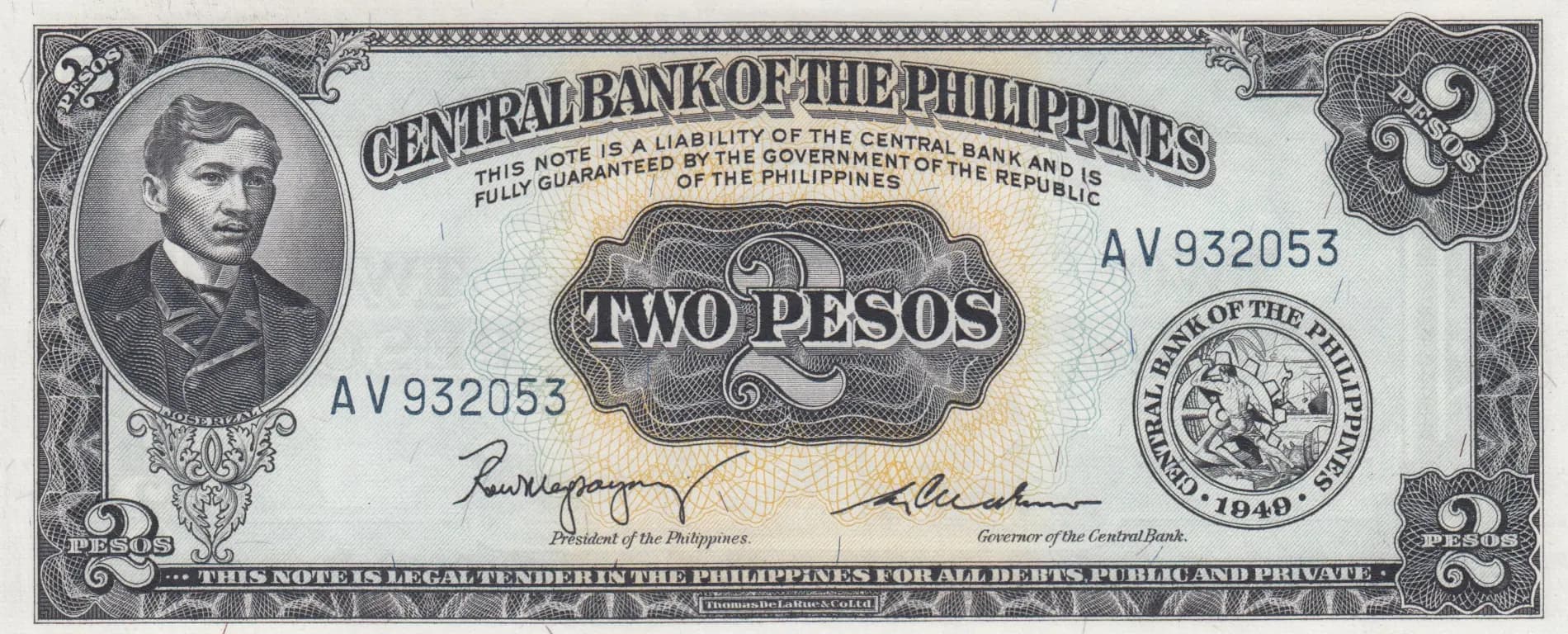
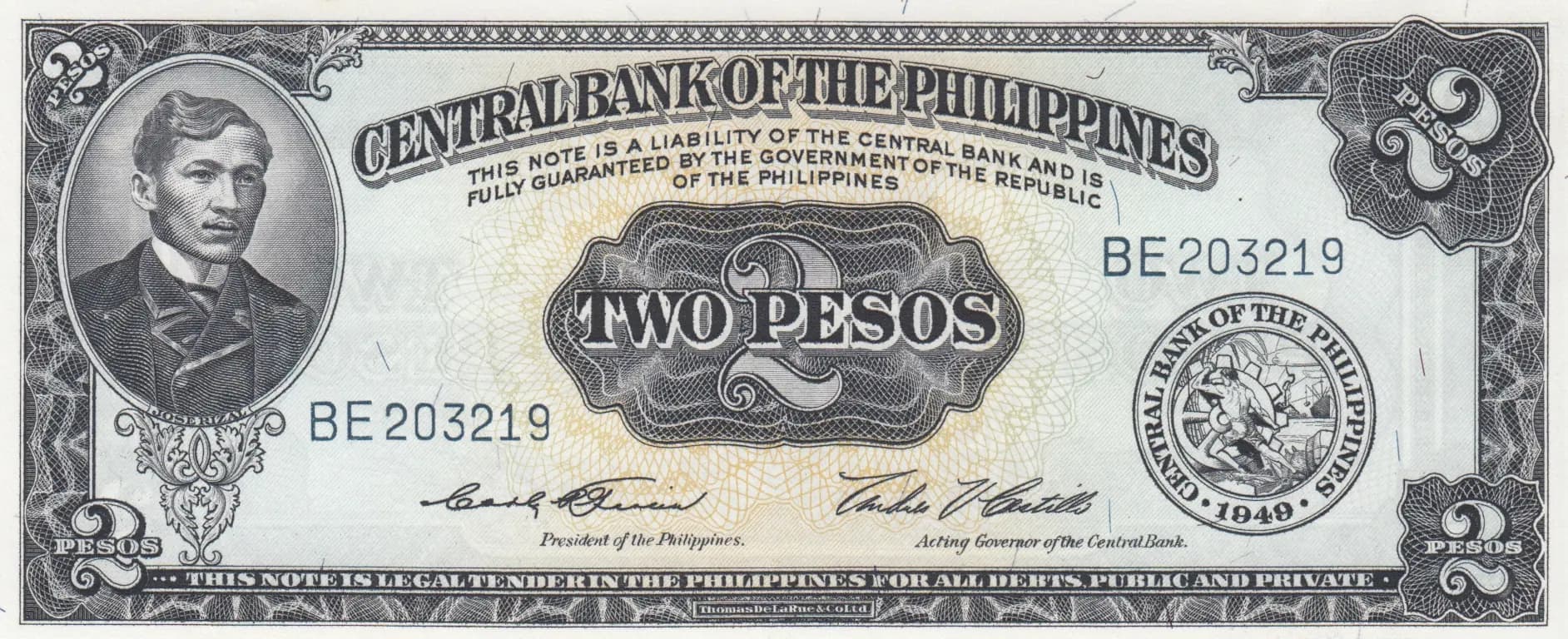
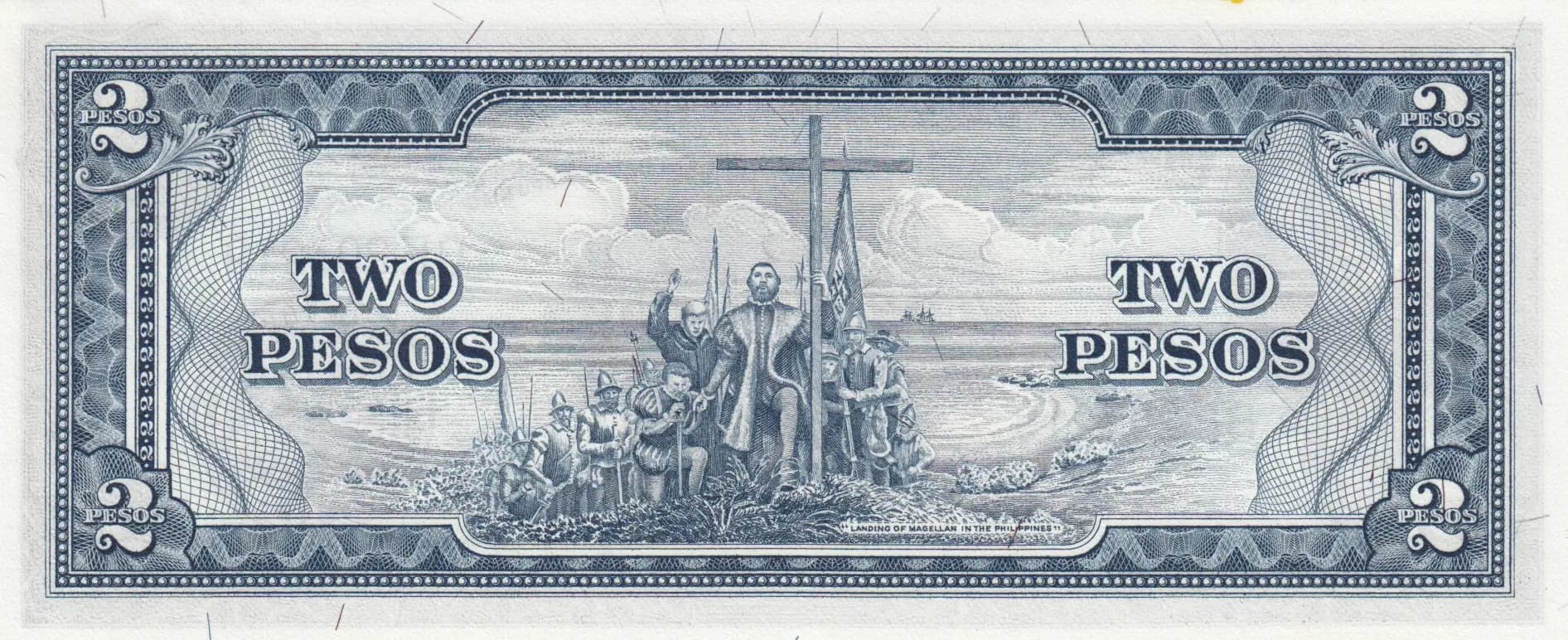
This Philippine 2 Pesos banknote from 1949 (Pick P-134c) features a striking portrait of national hero Jose Rizal on the obverse and a historically significant scene of Magellan's landing on the reverse. The note displays the characteristic fine line engraving work typical of Thomas de la Rue's printing, with ornate decorative borders and security features throughout. Despite appearing in UNC grade, the note exhibits visible creasing and age-related wear marks, suggesting it may be a high-grade circulated example rather than a pristine uncirculated specimen.
Common. The 1949 Philippine 2 Pesos circulates widely among collectors and in numismatic markets. eBay pricing data shows UNC examples trading in the range of $17.95–$249.00 USD with considerable variance, and 2019 catalogue values of approximately $10 UNC. The wide price range suggests market variation rather than genuine scarcity, indicating this is a readily available note. Large print runs by the Central Bank of the Philippines and the absence of specific recall or short-issue designation support a common classification.
Issued in 1949, this note commemorates the early years of the Central Bank of the Philippines following independence. The front features Jose Rizal, the Philippine national hero and symbol of the independence movement, while the reverse depicts Ferdinand Magellan's 1521 landing in the Philippines—the pivotal moment of European contact with the archipelago. The dual imagery reflects the nation's complex historical narrative, bridging pre-colonial resistance and colonial legacy during a formative period of nation-building.
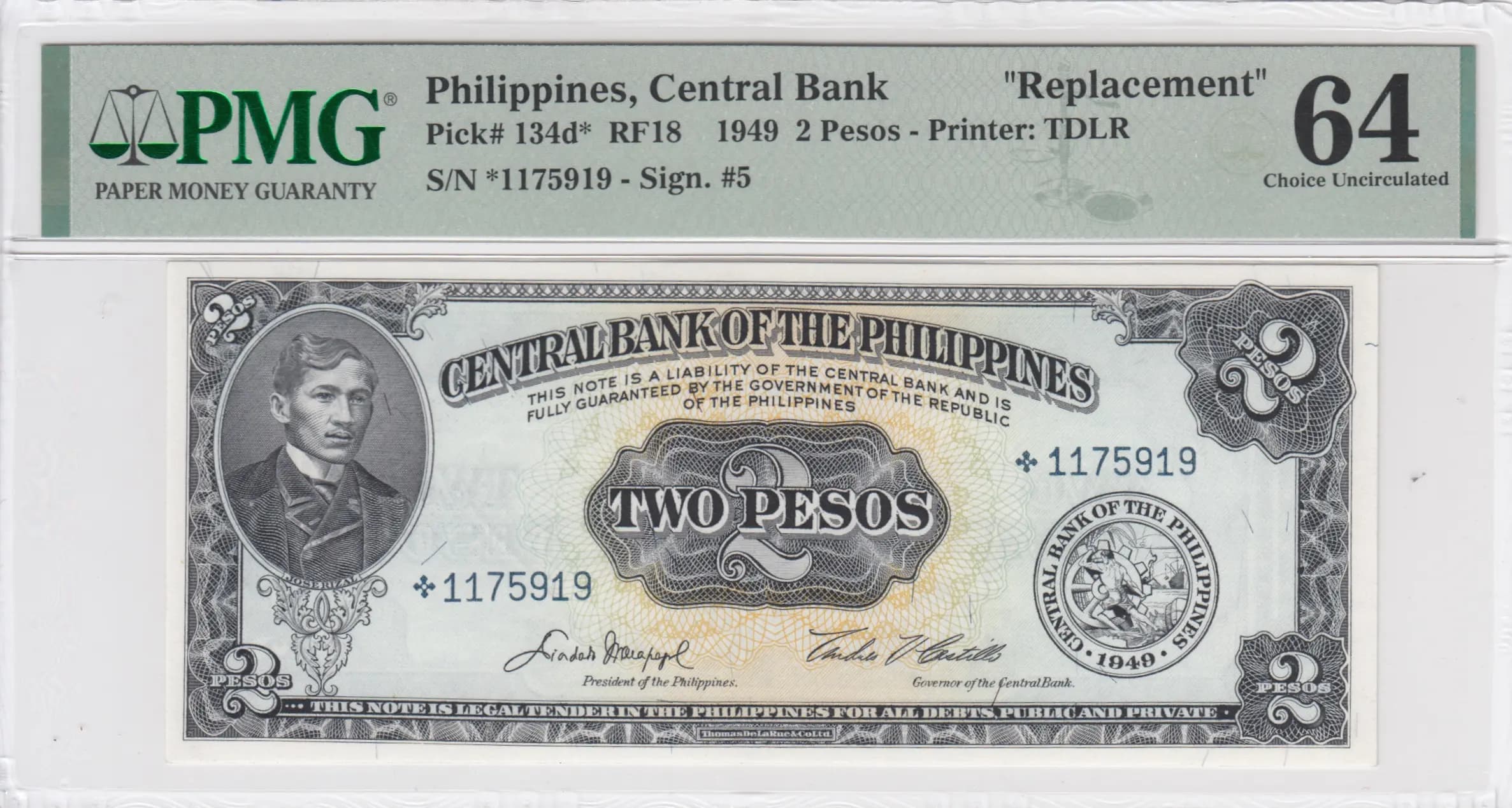
The obverse features a formal profile portrait of Jose Rizal, the Philippine independence movement's most revered intellectual and martyr, positioned at the left in three-quarter profile wearing a late 19th-century suit and tie. The Central Bank of the Philippines seal, dated 1949 and labeled 'BANGKO SENTRAL NG PILIPINAS,' appears prominently at the lower right with 'Central Bank Seal Type 1' design. The denomination appears in ornamental cartouches at the top and bottom center, with the numerals '2' and text 'TWO PESOS' framed in elaborate scrollwork. The reverse presents a meticulously engraved historical scene titled 'Landing of Magellan in the Philippines,' depicting multiple figures gathered around a large Christian cross on elevated terrain, with a coastal landscape, water, and distant ships visible in the background—symbolizing the first Christian presence in the islands. Ornamental corner frames with the numeral '2' appear at all four corners.
FRONT: 'CENTRAL BANK OF THE PHILIPPINES' / 'BANGKO SENTRAL NG PILIPINAS' (Tagalog: Central Bank of the Philippines) / 'TWO PESOS' / 'THIS NOTE IS A LIABILITY OF THE CENTRAL BANK AND IS FULLY GUARANTEED BY THE GOVERNMENT OF THE REPUBLIC OF THE PHILIPPINES' / 'THIS NOTE IS LEGAL TENDER IN THE PHILIPPINES FOR ALL DEBTS, PUBLIC AND PRIVATE' / 'President of the Philippines' / 'Acting Governor of the Central Bank' / '1949' (year and seal date). BACK: 'TWO PESOS' (appears twice) / 'LANDING OF MAGELLAN IN THE PHILIPPINES' / 'PESOS' (appears twice on ornamental frames).
Intaglio engraving (line engraving) with fine detail work throughout, printed by Thomas de la Rue, London (TDLR). The security design elements include fine line engraving, intricate crosshatching, geometric patterns, and stippling, particularly evident in the landscape backgrounds and border designs. A beaded border pattern is visible around the note's perimeter for additional anti-counterfeiting security.
This specimen is catalogued as Pick P-134c, with known variants including P-134d* and P-134s2 in the PMG population report, all printed by Thomas de la Rue. The serial number visible on this note is 'BE203219' in blue. The specific variety may be determined by signature variants (President and Acting Governor of the Central Bank signatures appear on the note) and seal type designations. The 'Type 1' Central Bank Seal noted in the obverse description may distinguish this from later reissues (P-134d, P-134e variants issued through the 1960s).