10 centavos 1949
Market Prices
8 salesAbout This Note
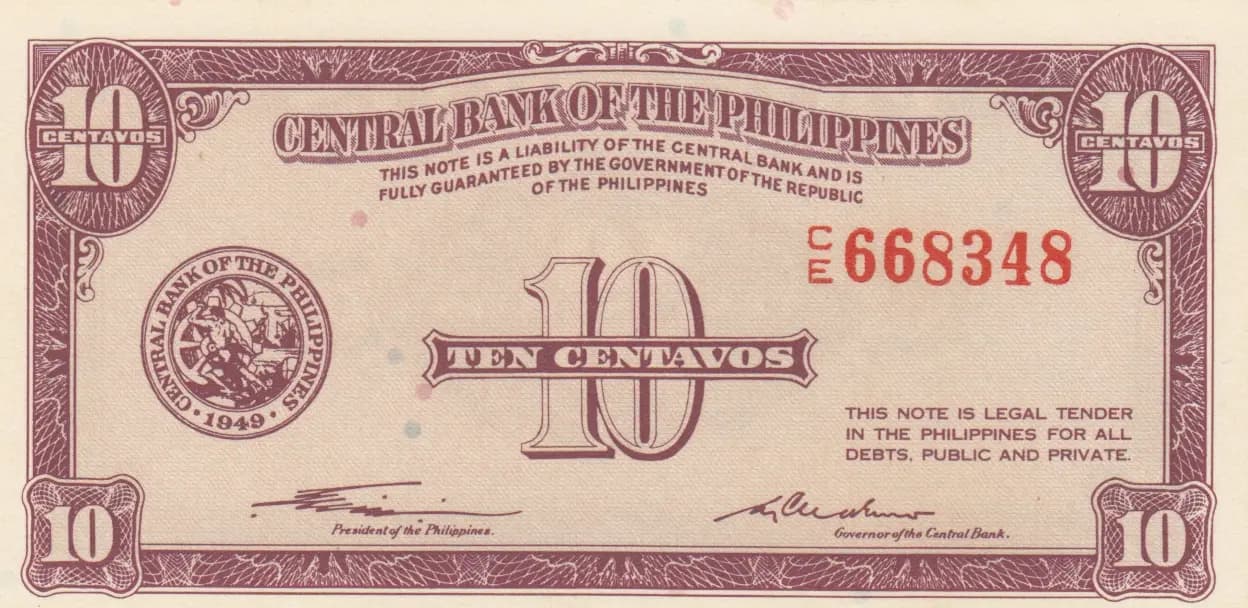
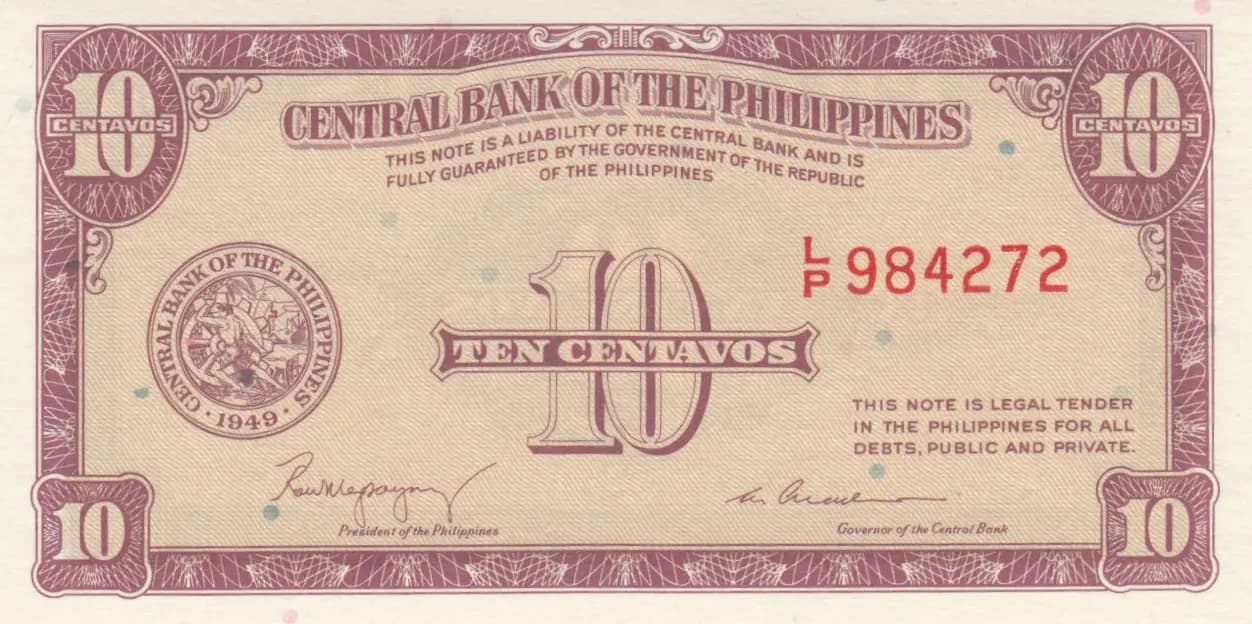
This is a remarkable example of a Philippines 10 centavos note from 1949, the first issue under the newly independent Central Bank of the Philippines. The note is presented in uncirculated condition with crisp, sharp printing throughout, displaying no visible wear, creases, or foxing. The purple/mauve color scheme and intricate ornamental design featuring fine-line engraving and guilloche patterns exemplifies the high security standards of early Central Bank currency production.
Common. While the 1949 date is historically significant as the Central Bank's first issue, the eBay market data provided demonstrates consistent sales in the $1.26 to $19.50 range across multiple condition grades over an eight-year period, with UNC examples selling for approximately $6.80. The 2019 catalog valuation of $1.75 for UNC further confirms this is an abundant note. The PMG population report lists only one recorded variant for P-128, suggesting straightforward identification without multiple scarce varieties. Print runs for early Philippine centavo denominations were substantial, and these notes remain readily available in the collector market.
Issued in 1949, this note represents the early period of the Central Bank of the Philippines following the country's independence in 1946. The circular seal dated 1949 and the guaranteed backing statement reflect the new republic's commitment to establishing a credible, internationally-recognized currency. The English-language inscriptions and formal legal tender declaration demonstrate the Philippines' institutional modernization during this pivotal post-war period.
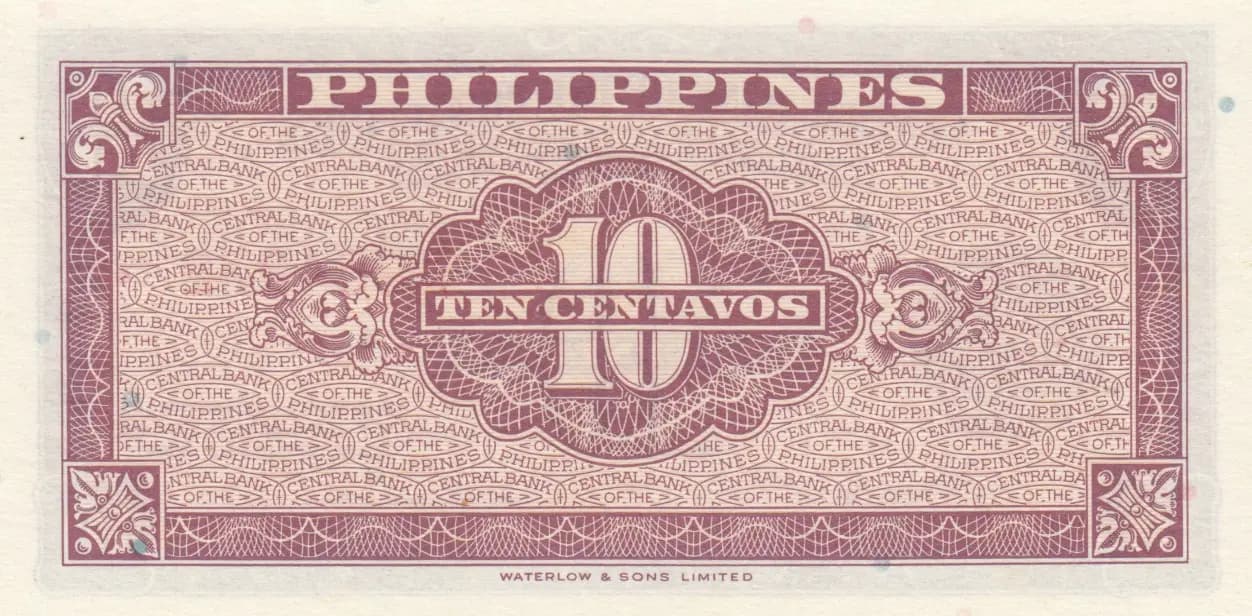
The obverse features a formal, classical design centered on the denomination 'TEN CENTAVOS' within an ornate cartouche. The Central Bank of the Philippines seal appears at the left side, dated 1949, establishing the note's official provenance. Two signature lines occupy the lower portion: the President of the Philippines (left) and the Governor of the Central Bank (right), representing the dual authority over the currency. Corner medallions display the numeral '10' in decorative frames. The reverse maintains the same purple/mauve palette with extensive guilloche and scrollwork patterns filling the background as a security measure, with the denomination and issuer information repeated in the center within another ornate cartouche. The printer credit 'WATERLOW & SONS LIMITED' is clearly visible, confirming production by this renowned British security printer.
Front side: 'CENTRAL BANK OF THE PHILIPPINES' (main issuer identification); 'THIS NOTE IS A LIABILITY OF THE CENTRAL BANK AND IS FULLY GUARANTEED BY THE GOVERNMENT OF THE REPUBLIC OF THE PHILIPPINES' (legal guarantee); 'TEN CENTAVOS' (denomination); 'THIS NOTE IS LEGAL TENDER IN THE PHILIPPINES FOR ALL DEBTS, PUBLIC AND PRIVATE' (legal tender declaration); 'President of the Philippines' and 'Governor of the Central Bank' (signature labels); serial number '₱984272'. Back side: 'CENTRAL BANK OF THE PHILIPPINES', 'OF THE' (part of institution name display); 'TEN CENTAVOS' (denomination); 'WATERLOW & SONS LIMITED' (printer credit/security printer identification).
This note was produced using intaglio (engraved) printing, the standard security printing method for high-value currency. The fine-line engraving visible throughout—including the intricate rosette designs, scrollwork, and guilloche patterns—is characteristic of intaglio production. The printer, Waterlow & Sons Limited (also referenced as W&S in secondary sources), was one of the world's most prestigious currency printers and employed advanced security engraving techniques. The sharp, crisp impression of all design elements confirms professional-grade intaglio production with careful registration.
This note is P-128 (Pick catalog designation), featuring Signature Type 2 as noted in the realbanknotes.com reference. The visual analysis confirms the Central Bank Seal Type 1 at the left. The printer is identified as Waterlow & Sons Limited (W&S). The serial number observed (₱984272) represents a single example; serial number ranges and signature combinations are the primary variety markers for this issue. The 1949 date is consistent across the issue type, with no date varieties reported for P-128.