1 centavo 1942
Market Prices
2 salesAbout This Note
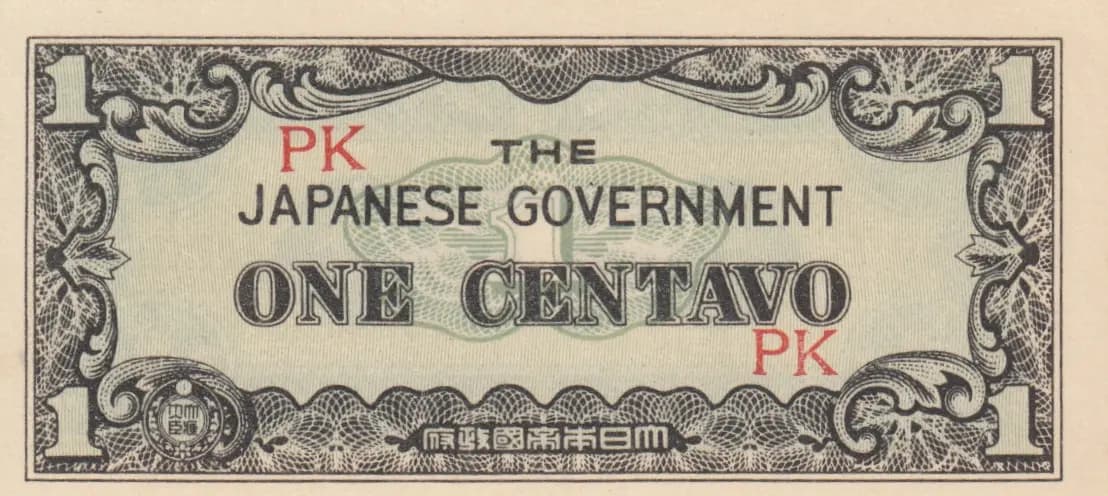
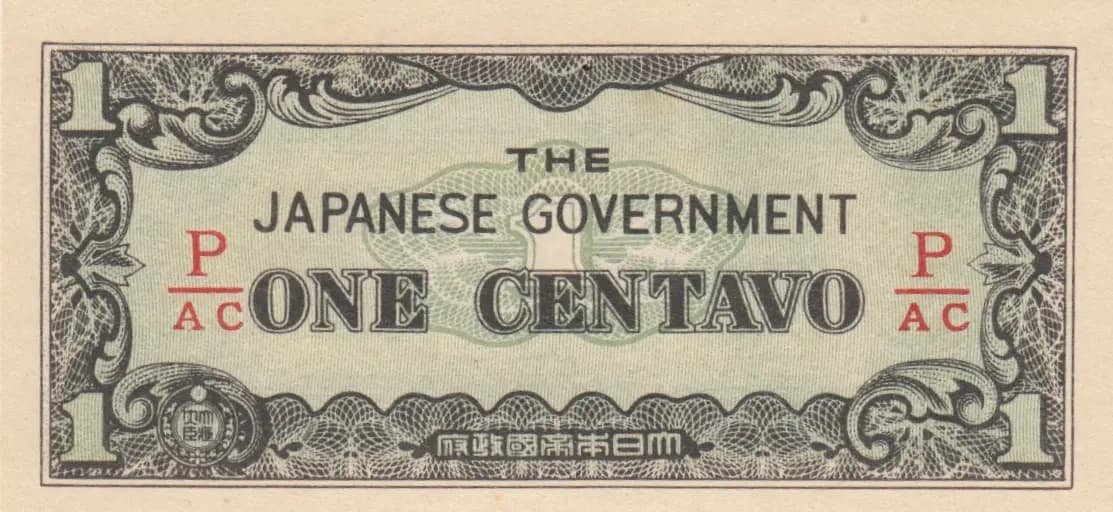
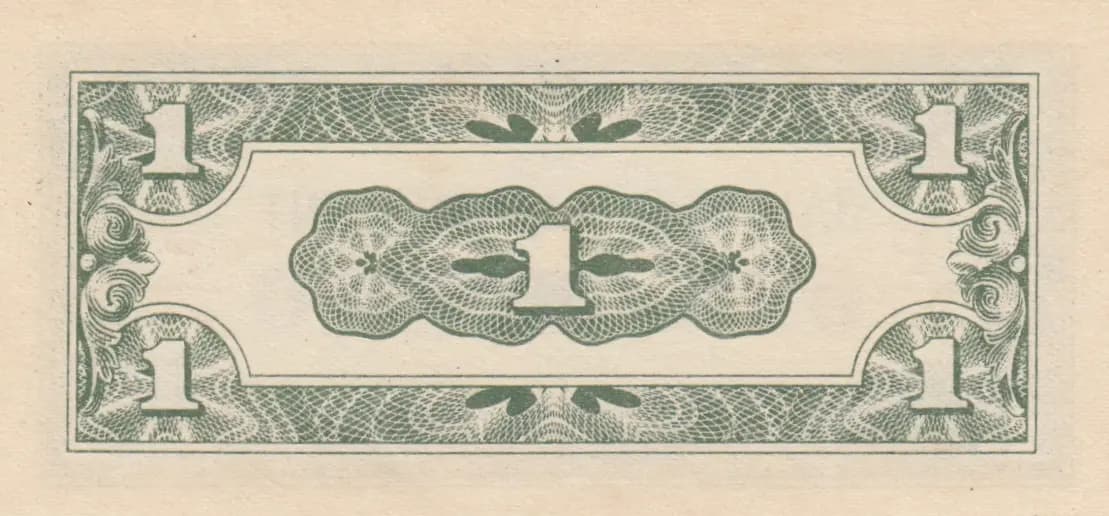
This is a 1 Centavo note issued by the Japanese Government for use in the occupied Philippines during 1942, presented here in uncirculated condition. The note features an elegant design with ornate black decorative borders and scrollwork on the obverse, paired with a minimalist reverse displaying a large central numeral '1' in green ink within an intricate geometric frame. The crisp, bright paper and absence of wear, creases, or foxing are consistent with an uncirculated specimen, making this an excellent example of Japanese occupation currency from World War II.
Common. The eBay market data shows recent sales in the $1.55–$1.60 range for UNC specimens, with catalog values (2016) placing UNC condition at $1.25. These low market prices and modest catalog valuations, combined with the straightforward fractional denomination and standard design without special overprints or varieties, indicate this is a commonly encountered note among Japanese occupation currency collectors. Japanese occupation centavos were issued in large quantities and remain readily available in uncirculated condition, explaining the minimal collector premium.
This fractional centavo note was issued during the Japanese occupation of the Philippines (1942-1945) as part of efforts to establish Japanese-controlled currency in occupied territories. The bilingual English and Japanese inscriptions—particularly the prominent 'JAPANESE GOVERNMENT' text and the Japanese characters '日本占領下' (Under Japanese Occupation) observed on the obverse—reflect the occupying power's assertion of administrative authority. The minimal denominations and simple, austere design contrasted sharply with pre-war Philippine currency, underscoring the economic disruption and resource constraints of the occupation period.
The obverse presents a formal, symmetrical design dominated by an elaborate border of black scrollwork and geometric flourishes emanating from all four corners on a cream-beige background. The central text block identifies the issuer and denomination in clear English capitals, with Japanese characters below indicating occupation authority. Two circular seals or emblems are positioned in the lower left and right, typical of Japanese Government currency of the period. The reverse employs a more minimalist aesthetic, featuring a prominent large numeral '1' centered within an ornate oval or rounded rectangular frame composed of intricate geometric line work and floral patterns in green ink. The frame is flanked by smaller corner numerals (all '1') positioned in classical currency security format. The overall design reflects Japanese administrative efficiency paired with traditional decorative elements characteristic of occupation-era currency.
FRONT: 'THE JAPANESE GOVERNMENT' (English, centered); 'ONE CENTAVO' (English, denomination); 'P' and 'AC' (red fractional block letters, left and right sides respectively); '日本占領下' (Japanese, translates to 'Under Japanese Occupation'). BACK: Large central numeral '1' (denomination marker); corner numerals '1' positioned in all four corners (standard denomination security feature). All inscriptions are in English or Japanese, with the fractional block letters 'P' and 'AC' in red serving as a security and control mechanism.
This note was produced using intaglio (recess) printing, evidenced by the crisp, fine-line detail visible in the elaborate border scrollwork, geometric mesh patterns, and the sharp definition of all inscriptions and numerals in both black and green inks. The multi-color printing (black on cream obverse with green on reverse) suggests sequential passes through the press, a standard intaglio practice. The Japanese Government typically contracted with established security printers for occupation currency; this series was likely printed in Japan or by Japanese-controlled facilities. The precision and uniformity of the design elements are consistent with government-level security printing standards of the 1940s.
This note is catalogued as Pick P-102b, indicating it is the 'b' variety of the 1 Centavo issue. The 'b' designation typically denotes a specific printing or state variant; without access to detailed Pick catalog descriptions, the distinction between P-102a and P-102b likely relates to printer identification, watermark variants, or subtle design changes in the security features or fractional block letters. The presence of the red 'P' and 'AC' fractional block letters on both sides, as observed in the visual analysis, may be the defining characteristic of this particular variety. No date variations are noted, as Japanese occupation currency of 1942 was typically printed without specific issue dates (marked 'ND' in catalogs).