5 rupees 1966
Market Prices
16 salesAbout This Note
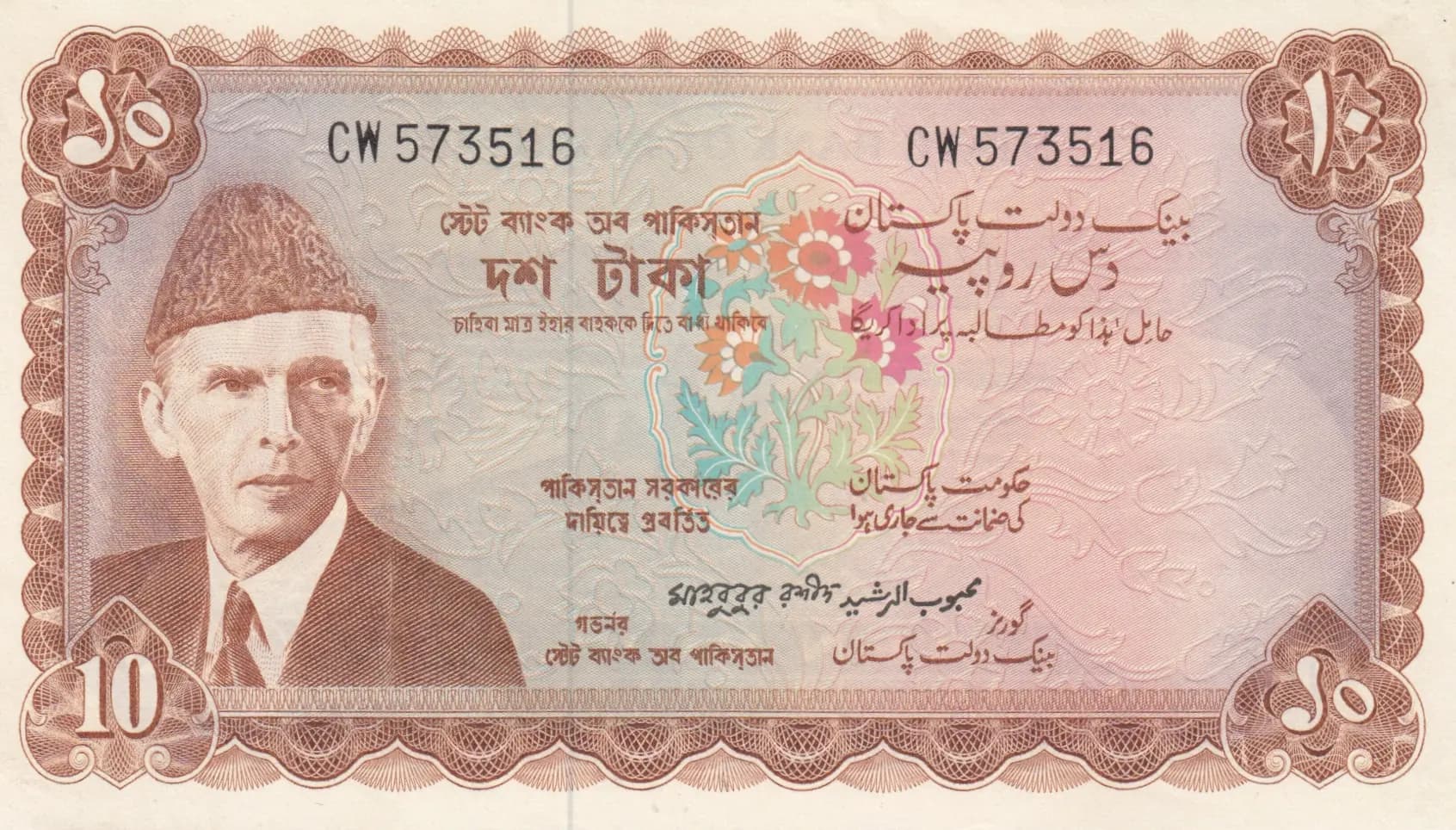
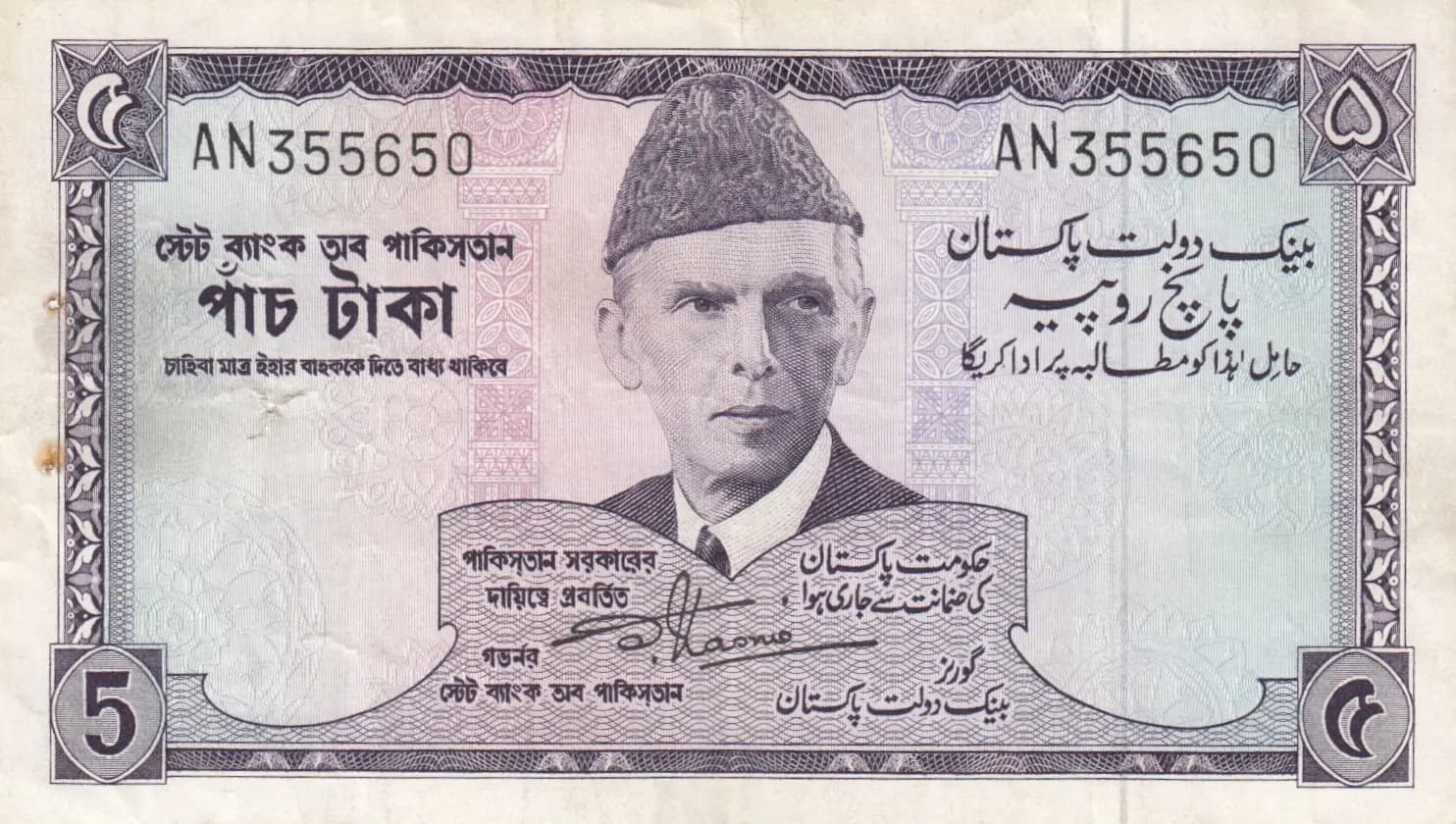
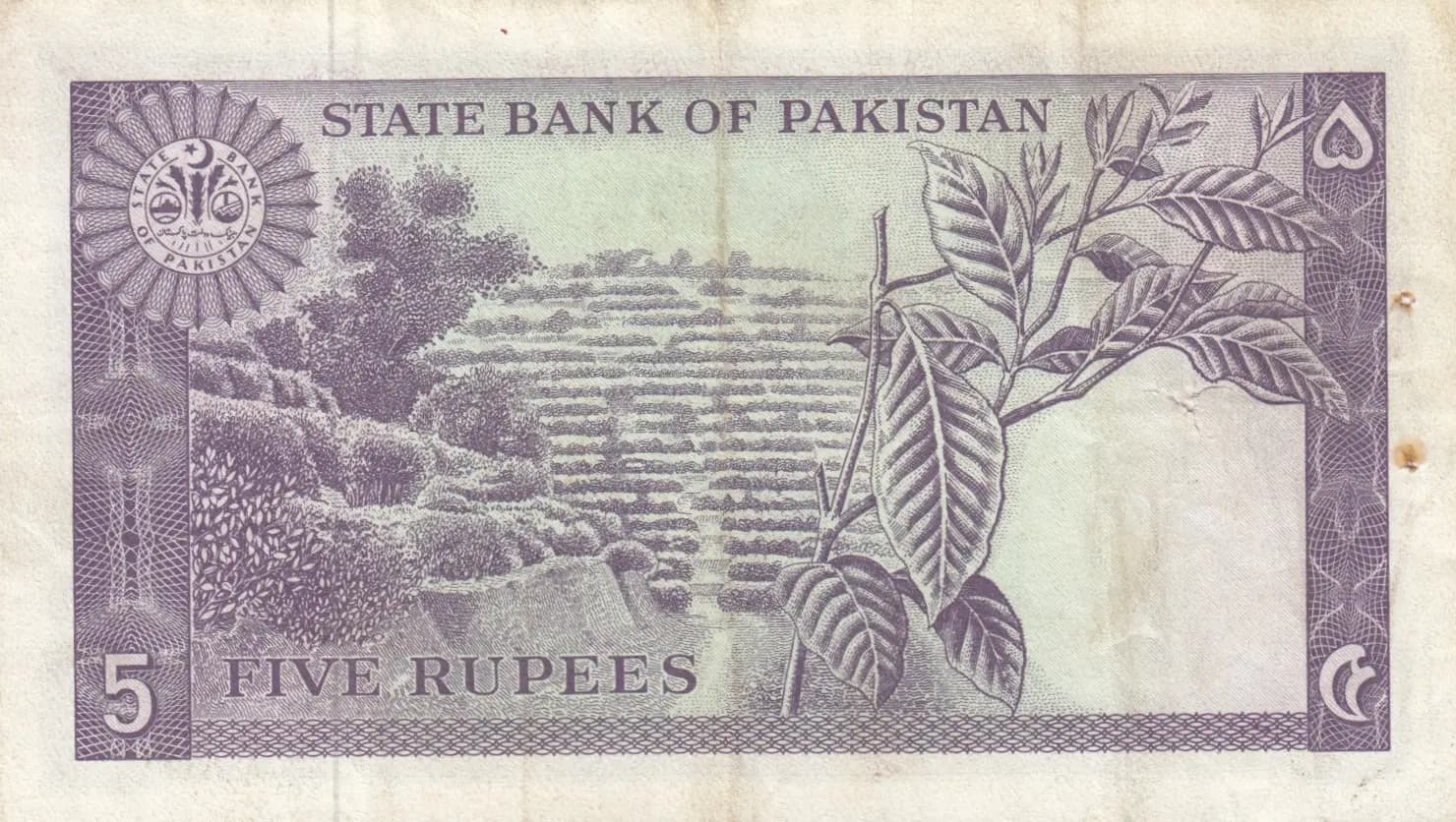
This 1966 Pakistani 5 Rupee note (Pick P-15) features a striking portrait of Muhammad Ali Jinnah in formal dress with traditional Pakistani cap on the obverse, set against a mauve and pink color scheme with ornate Islamic geometric borders. The reverse displays terraced agricultural fields and botanical imagery, reflecting Pakistan's agrarian heritage. The note exhibits visible wear consistent with VF condition, including creasing, foxing, and edge discoloration from circulation, with fine line engraving throughout.
Common. The eBay price history demonstrates consistent and frequent sales across all condition grades from 2013-2021, with VF specimens typically selling in the $2-$7 range, and even high-grade examples (PMG 35, UNC) rarely exceeding $72. The 2019 catalog valuation of $3.50 for VF confirms this is a widely circulated issue with substantial surviving examples. The 1966-1971 date range for this Pick number indicates a multi-year production run.
Issued in 1966 during the early decades of independent Pakistan's monetary system, this note commemorates Muhammad Ali Jinnah, the nation's founder and first Governor-General. The agricultural landscape on the reverse symbolizes Pakistan's economic foundation in the 1960s, while the bilingual inscriptions in Urdu and Bengali reflect the note's circulation across both West and East Pakistan (present-day Bangladesh) during this period before the 1971 separation.
The obverse features a central bust-length portrait of Muhammad Ali Jinnah, founder of Pakistan, depicted wearing a formal Western-style suit jacket and the traditional Jinnah Cap (Karakul). The portrait is surrounded by ornate circular emblems in all four corners containing crescent moon symbols, reflecting Islamic design elements. Fine Islamic geometric and floral patterns frame the entire note with heart and spade-shaped decorative elements in the top corners. The reverse depicts a pastoral landscape of terraced agricultural fields (likely tea gardens or rice paddies) with vegetation and trees, accompanied by a detailed botanical plant illustration on the right side. The State Bank of Pakistan seal appears on the left side of the reverse.
Front: Serial number 'AN355650' (top left and right); 'پانچ روپے' (Urdu: Five Rupees); 'পাঁচ টাকা' (Bengali: Five Rupees); 'سٹیٹ بینک آف پاکستان' (Urdu: State Bank of Pakistan); 'State Bank of Pakistan' (English); Governor designation and Government of Pakistan references. Back: 'STATE BANK OF PAKISTAN' (English header); 'FIVE RUPEES' (English denomination); matching circular denomination indicators of '5' in all four corners.
Intaglio (line engraving) throughout, evidenced by the fine detailed work visible in the portrait, landscape imagery, and ornamental borders. The multiple layers of intricate geometric patterns and the sharp detail in the botanical illustration are characteristic of high-quality engraved banknote production. The State Bank of Pakistan employed established British security printing techniques for this series, with fine line work serving as an anti-counterfeiting measure.
The PMG population report identifies two catalogued varieties for P-15: the standard P-15 and P-15s (specimen). The observed serial number 'AN355650' suggests this is from the standard circulation issue. The note appears to be from one of three known signature varieties documented for this denomination, though the specific signature variant is not clearly discernible in the provided images. No overprints or unusual variants are evident from the visual analysis.