10 rupees 1951
About This Note
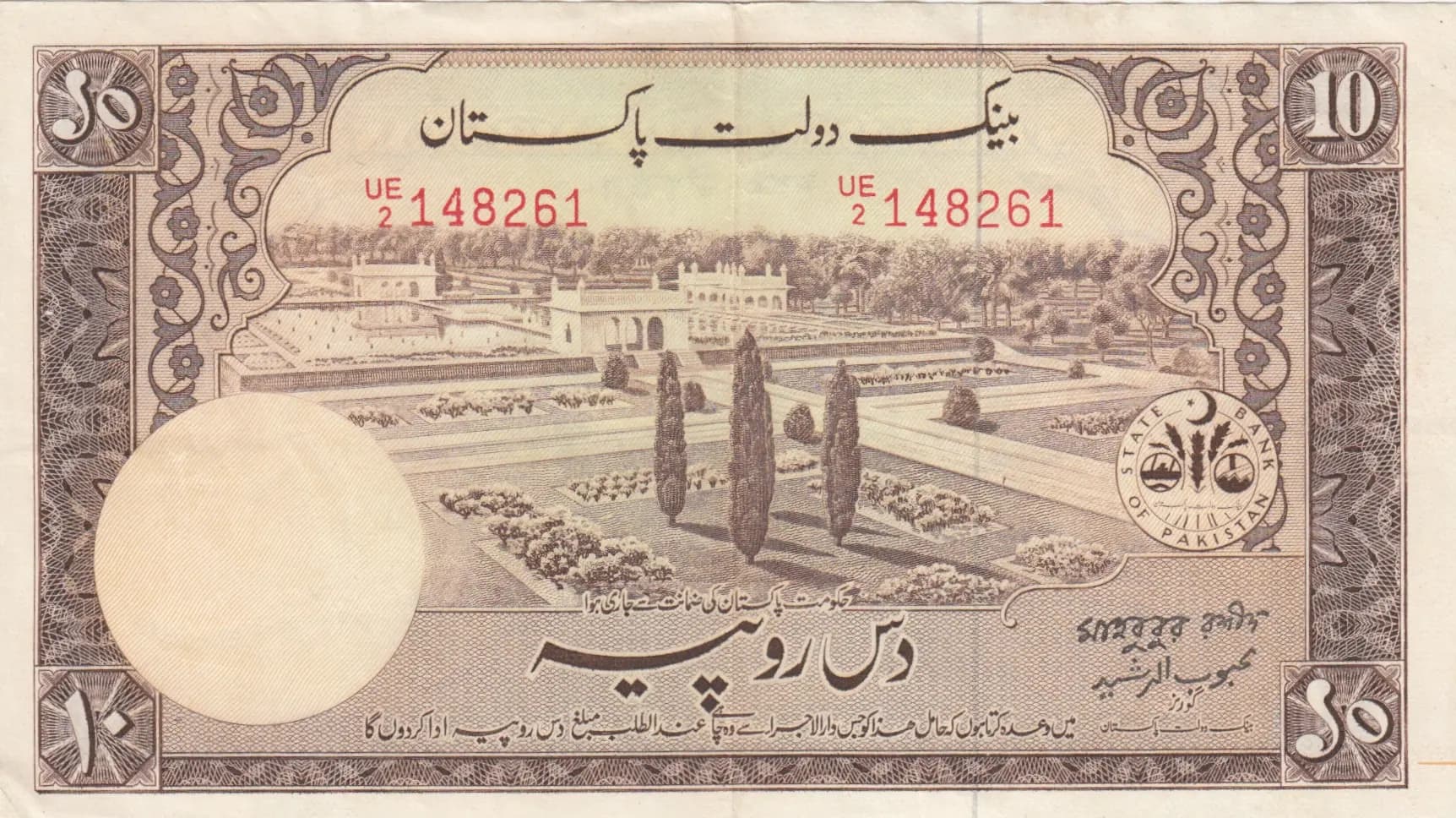
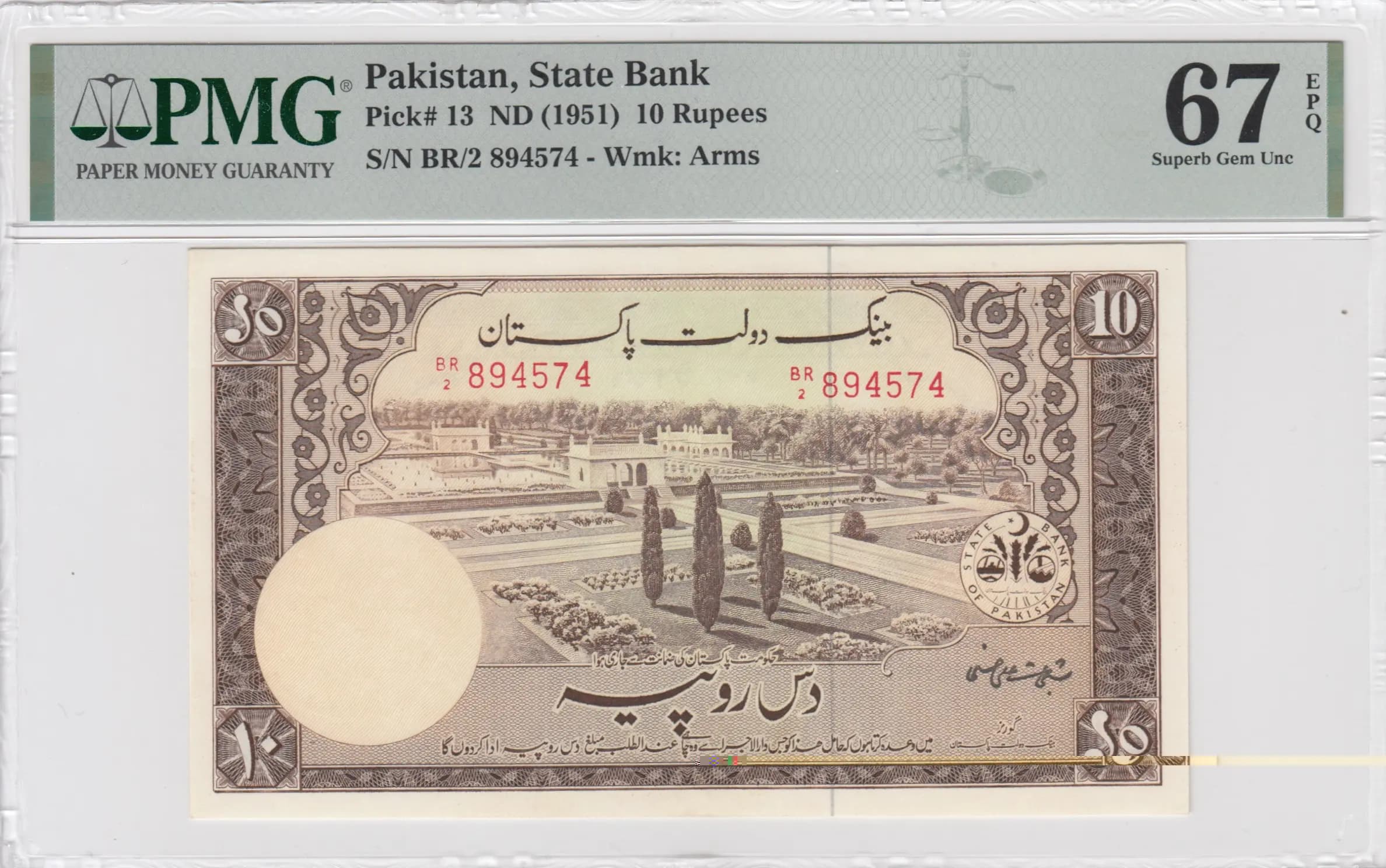
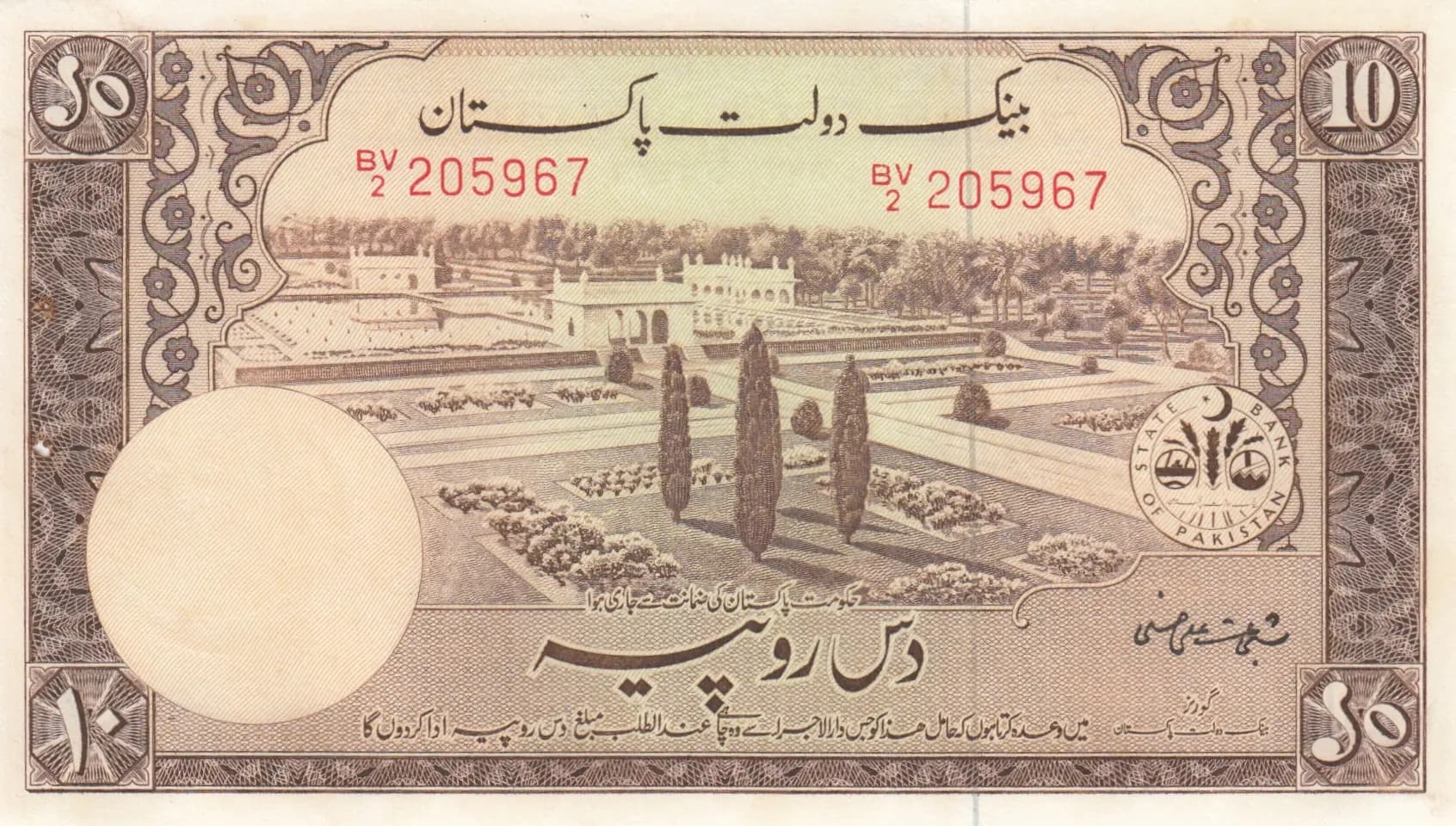
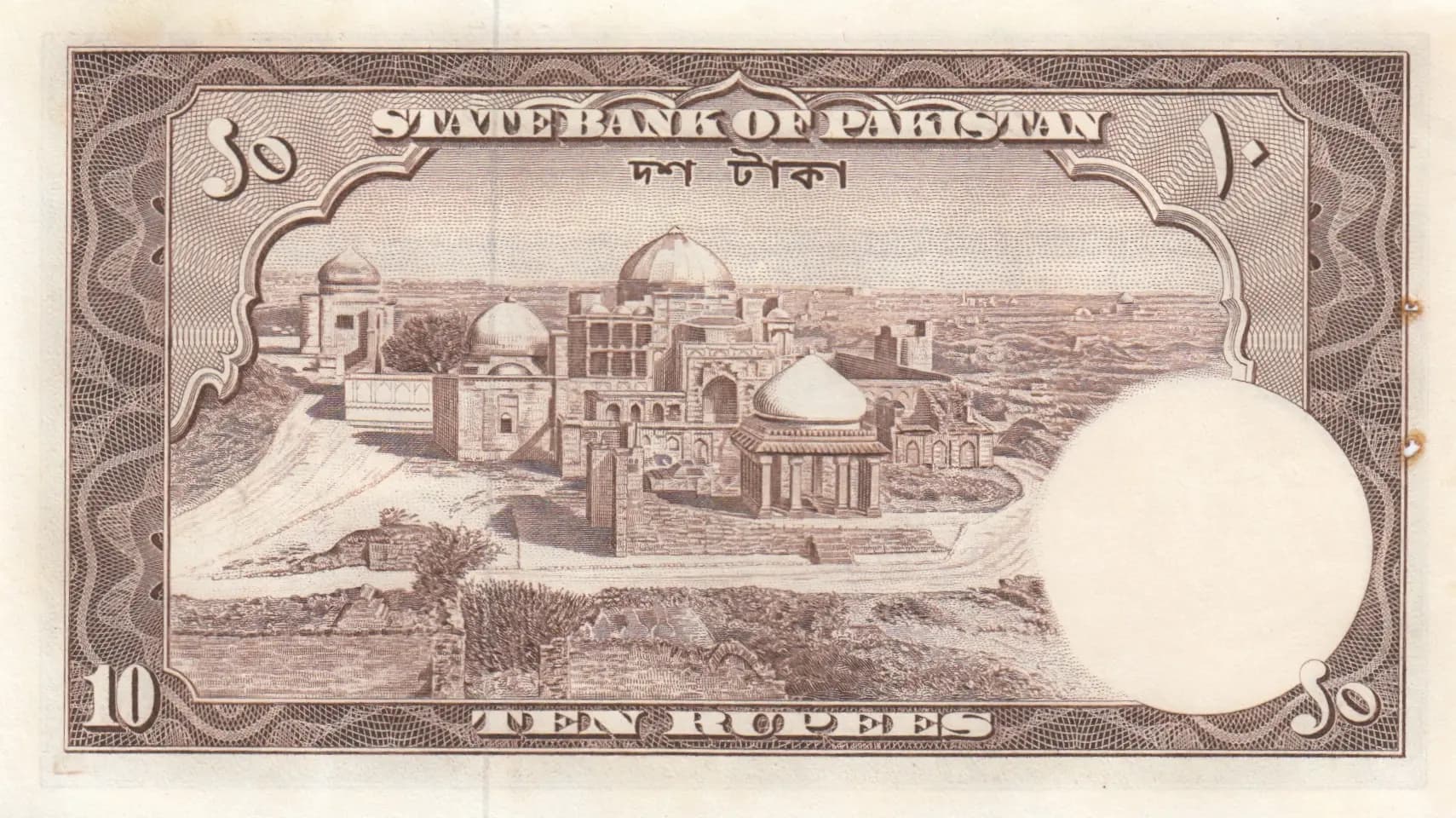
This is a Pakistani 10 Rupees banknote from 1951, the first series issued by the State Bank of Pakistan in its newly independent nation. The note presents in Very Fine condition with attractive sepia-toned engravings depicting Shalimar Gardens on the obverse and Islamic architectural structures (likely the tombs near Thatta) on the reverse. The banknote exhibits the fine craftsmanship typical of early Pakistani currency with ornate decorative borders, clear serial numbers, and well-preserved paper showing only minor age-related foxing—an excellent example of Pakistan's foundational monetary issue.
Common. The 10 Rupees Pick-13(6) from the 1951-1967 series is a foundational issue of the State Bank of Pakistan with substantial print runs during a 16-year circulation period. No historical evidence of short print runs, recalls, or significant scarcity exists for this denomination and series. Contemporary market activity shows these notes trading at modest premiums ($15-40 in VF condition depending on serial number desirability and signature varieties), well within the range typical of common circulating issues. The VF grade observed here is standard and does not enhance rarity significantly.
Issued in 1951, this banknote commemorates Pakistan's early years as an independent nation following partition from India in 1947. The obverse depicts the Shalimar Gardens of Lahore, a Mughal-era monument symbolizing the region's cultural heritage, while the reverse showcases Islamic architectural splendor through the domed structures near Thatta in Sindh. These imagery choices reflect the new nation's emphasis on its Islamic identity and rich historical legacy during the formative years of the State Bank of Pakistan.
The obverse features a panoramic landscape engraving of the Shalimar Gardens in Lahore, showcasing cypress trees, cultivated agricultural fields with irrigation channels, and palatial buildings characteristic of Mughal garden architecture. The reverse depicts an Islamic architectural complex featuring multiple domed structures and fortification walls, representing the historic tombs and monuments near Thatta, Sindh. Both sides are framed by ornate guillochéd borders with elaborate scrollwork and floral patterns in the corners. The State emblem—a crescent and star design—appears on the obverse, while denomination numerals '10' are positioned in all four corners. Large circular watermark areas are present on both sides (left obverse, right reverse). The color scheme throughout is warm sepia tones with brown and tan hues, typical of the intaglio printing era.
OBVERSE: 'بیالیس دولت پاکستان' (Urdu) = 'State of Pakistan'; 'دس روپیہ' (Urdu) = 'Ten Rupees'; Serial number 'BV 2 205967' (English); Denomination '10' (numeral). REVERSE: 'STATE BANK OF PAKISTAN' (English); 'দশ টাকা' (Bengali) = 'Ten Rupees'; 'TEN RUPEES' (English); Denomination '10' (numeral). Note: The presence of Bengali text reflects Pakistan's political union with East Pakistan (present-day Bangladesh) during this period.
This banknote was produced using intaglio engraving (line engraving), as evidenced by the fine detail work visible in the architectural elements, the sharp clarity of the guilloché border patterns, and the overall crisp quality of the impressions. The watermark areas and fine line work are characteristic of security printing from this period. For Pakistani notes of this era (Pick-13 series), the State Bank of Pakistan employed the British American Bank Note Company (BABN) for production of early rupee denominations, though definitive attribution for this specific printing requires additional research.
The serial number prefix 'BV 2' suggests this is from a specific printing batch. The note displays English-Urdu-Bengali trilingual inscriptions, consistent with the 1951-1967 series reflecting the united dominion of Pakistan (including East Pakistan/Bengal). Specific signature varieties may exist within the Pick-13(6) designation based on State Bank governors, but detailed cataloging would require comparison to specialized references. The observed watermark style and border design are consistent with the standard 1951-era issue; no overprints or anomalies are evident in the visual analysis provided.