100 rupees 1972
Market Prices
12 salesAbout This Note
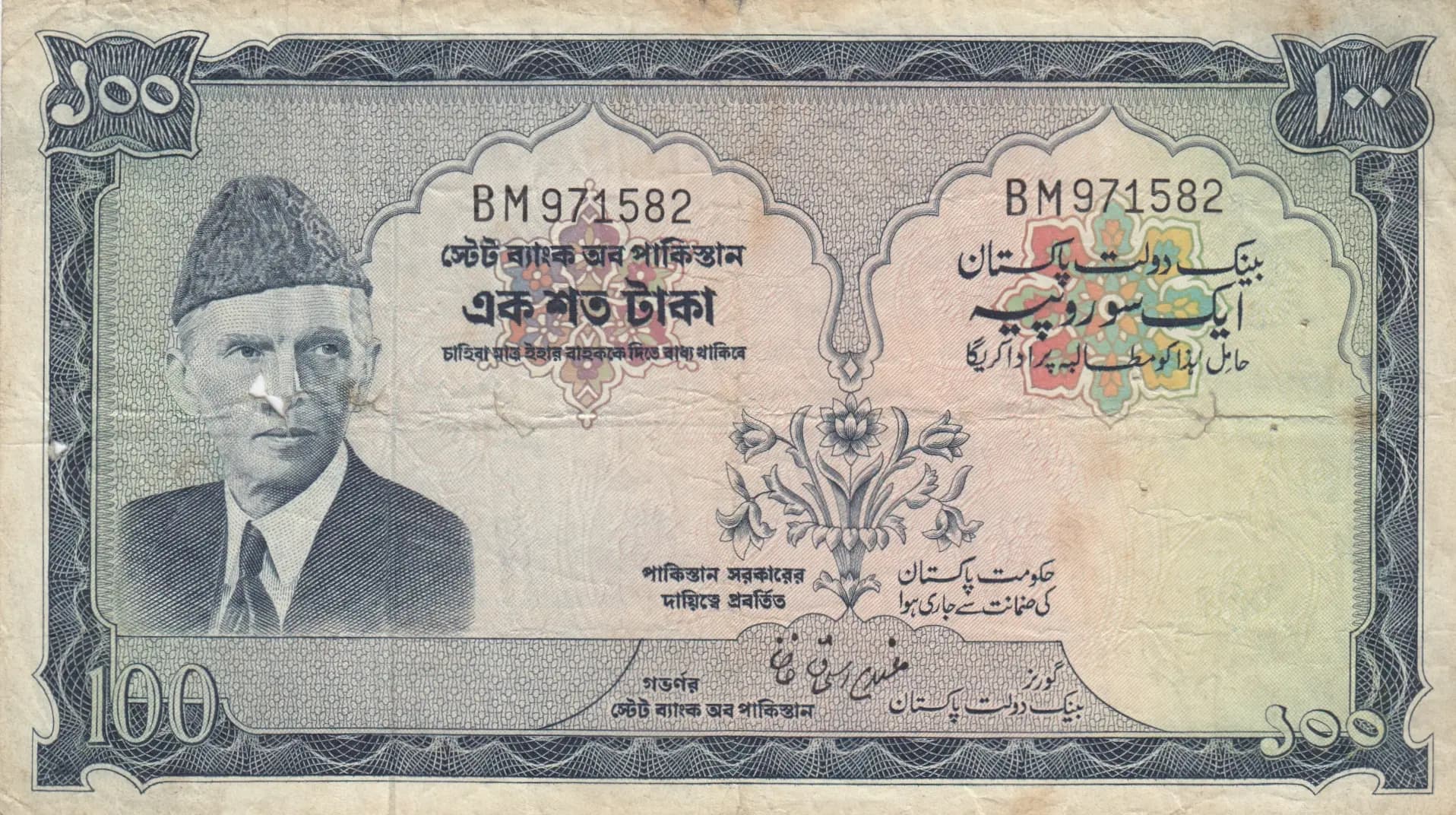
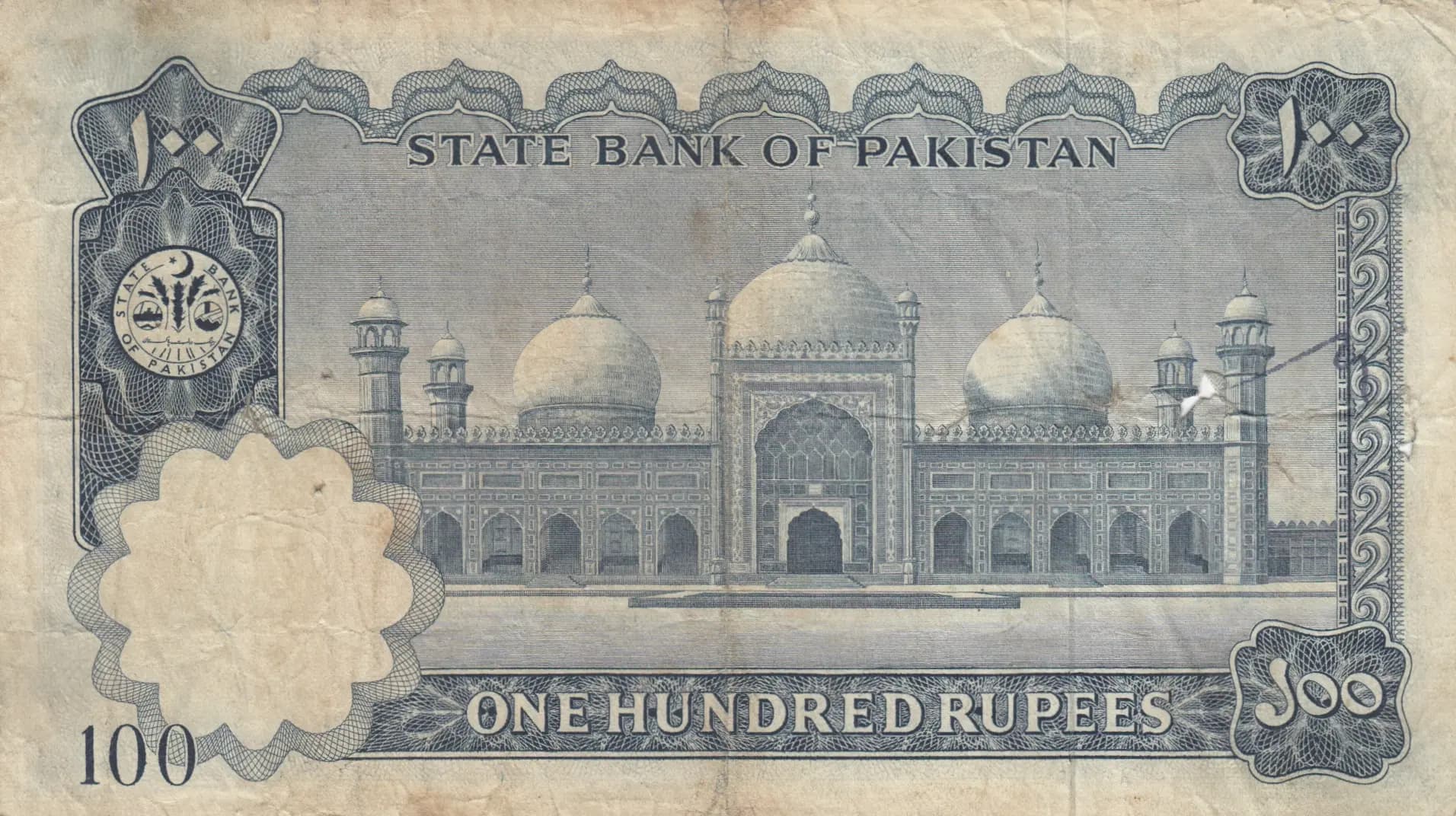
This is a Pakistan 100 Rupees note from the 1972-1975 series, depicting Muhammad Ali Jinnah on the obverse and the iconic Badshahi Mosque in Lahore on the reverse. The note displays Fair (F) condition with visible creasing, foxing, age spots, and yellowing throughout, consistent with extended circulation and age. Despite moderate wear, the fine engraving details and multilingual inscriptions remain discernible, making this a historically significant example of early Pakistani currency.
Common. eBay market data shows consistent sales in the $5-$22 range for Fair to EF condition specimens over the past decade, with catalogue values (2019) listing VF at $20 and UNC at $55. The series was issued 1972-1975 with substantial print runs. Fair condition notes regularly appear on the market at modest prices ($6-$17), indicating this is a standard circulation issue without scarcity.
Issued during the early post-independence period of Pakistan's monetary history, this note commemorates Muhammad Ali Jinnah, the founding father of Pakistan, whose portrait appears on the obverse wearing the traditional Jinnah cap and Western formal attire. The reverse features the Badshahi Mosque in Lahore, one of Pakistan's most significant architectural monuments completed in 1673, symbolizing the nation's Islamic heritage and cultural identity during a formative period of state-building.
The obverse features Muhammad Ali Jinnah, the founder of Pakistan, positioned at the left in profile facing right, depicted in formal Western attire (suit and tie) with a traditional Jinnah cap, a symbol of Islamic Pakistani identity. The center contains ornate decorative cartouches with text in Urdu, Bengali, and English, accompanied by fine floral motifs including lotus-like flowers at the bottom center. The reverse presents an architectural elevation view of the Badshahi Mosque in Lahore, showing its characteristic central dome with flanking structures and multiple minarets, rendered in detailed monochromatic engraving. A circular seal with Islamic geometric patterns appears on the left side of the reverse, with diamond-shaped ornamental patterns in the corners. The overall design employs light greenish-beige and cream backgrounds with dark blue-gray printing.
Front Side: Bengali text 'এক শত টাকা' (One hundred rupees); Urdu text 'پاکستان دولت روپیہ' (State of Pakistan rupees); Bengali text 'স্টেট ব্যাংক অফ পাকিস্তান' (State Bank of Pakistan); Urdu text 'حکومتِ پاکستان' (Government of Pakistan); Serial number 'BM971582' in English; Arabic numerals '100'. Back Side: English text 'STATE BANK OF PAKISTAN'; English text 'ONE HUNDRED RUPEES'; Arabic numerals '100'.
Intaglio engraving (line engraving) with fine guilloche border patterns and security features typical of State Bank of Pakistan currency production from this era. The detailed architectural rendering of the Badshahi Mosque and the portrait engraving are consistent with high-quality intaglio process. The watermark area is incorporated into the ornate cartouches on the obverse. Pakistan's banknotes from this period were typically produced by Thomas De La Rue or similar British security printers, though specific printer attribution for Pick 23 would require additional documentation.
The visual analysis shows serial number 'BM971582', indicating a specific print run identifiable by prefix. The catalog reference notes two signature varieties exist for this Pick number. The note shows the multilingual design characteristic of early Pakistani currency reflecting the linguistic diversity of East and West Pakistan during this period. No overprints or unusual security features are evident in this specimen that would distinguish it as a major variety.