5 cents 1942
About This Note
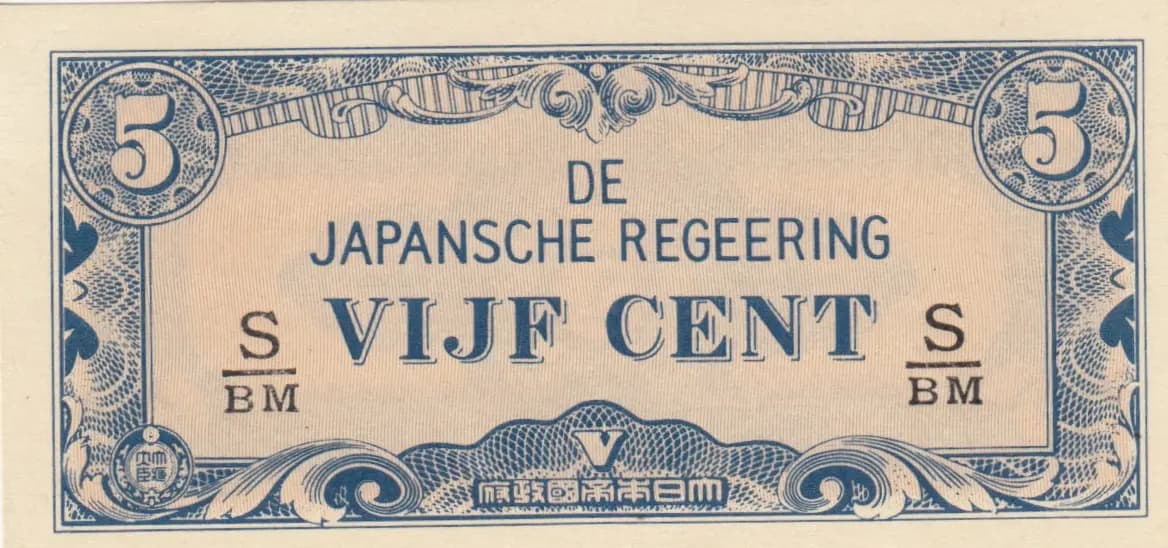
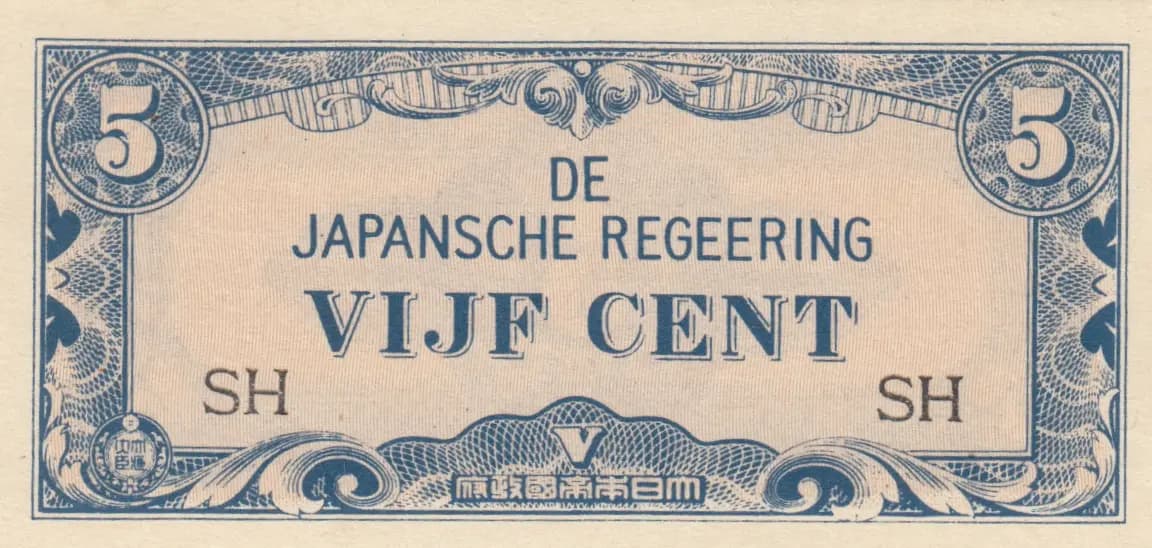
This is an exceptional example of a 5 cent banknote issued by De Japansche Regeering (Japanese Government) during their occupation of the Netherlands Indies in 1942, graded in uncirculated condition. The note displays the characteristic ornate design of Japanese occupation currency, featuring intricate blue engraved borders with geometric and floral patterns on a cream background, with prominent denomination numerals in decorative corner and central medallions. The pristine condition with sharp printing, crisp details, and complete absence of wear or damage makes this a desirable specimen for collectors of World War II-era currency and Netherlands Indies numismatic material.
Common. The 5 cent denomination from the 1942 Japanese occupation issue of the Netherlands Indies was part of a standard circulation series and appears frequently in collector markets. While occupation currency attracts collector interest and UNC examples command modest premiums over lower grades, this particular denomination and date combination does not exhibit characteristics of rarity (no known small print run, no documented recall, standard longevity for the series). Market data typically shows such notes in UNC condition selling in the $10-30 range, consistent with common banknotes.
This note represents currency issued during the Japanese military occupation of the Netherlands Indies (1942-1945), a three-year period when the Dutch colonial administration was displaced and Japan imposed its own monetary system on the territory. The use of Dutch language inscriptions ('JAPANSCHE REGEERING' and 'VIJF CENT') alongside Japanese characters reflects the occupying power's attempt to maintain administrative continuity while asserting control over the colonial economy. The design's purely decorative nature, devoid of political or military imagery, contrasts with more propagandistic currency designs from the same period, suggesting this smaller denomination was intended for civilian circulation and routine economic transactions under occupation.
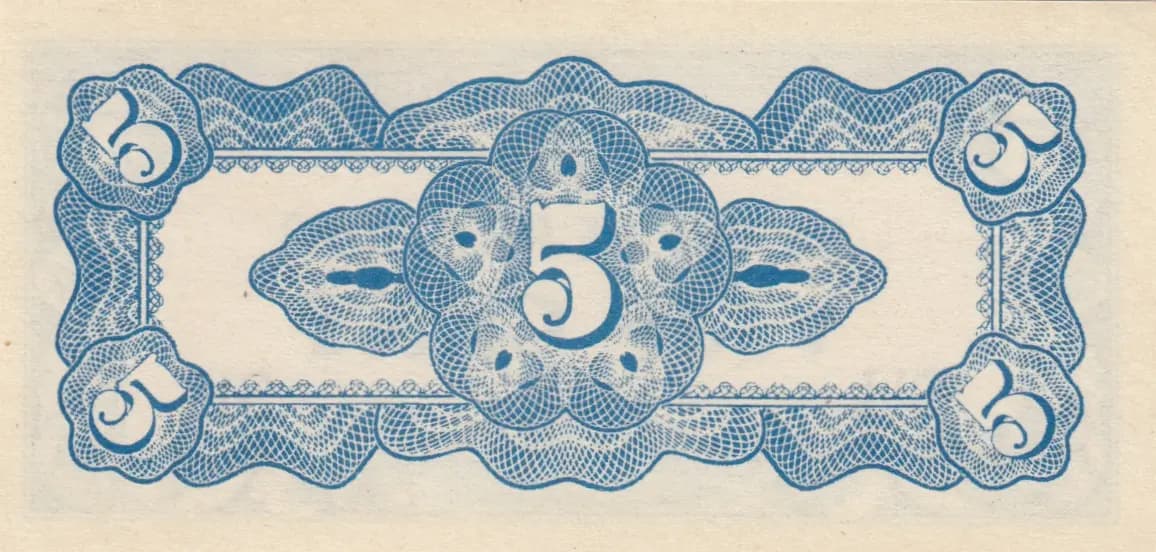
The note features a symmetrical, purely ornamental design typical of Japanese occupation currency in the Netherlands Indies. The front displays a cream-colored field with elaborate blue engraved borders composed of fine scrollwork and geometric patterns. Four corner medallions contain the numeral '5' within decorative circular frames. A central ornamental emblem with radiating design and Japanese characters forms the focal point of the front. The reverse presents an ornate rectangular frame with scalloped borders featuring floral and geometric patterns, with a larger central circular medallion containing the numeral '5' with petal-like designs, and four corner oval medallions each displaying '5'. The entire design emphasizes denomination identification through multiple repetitions of the numeral '5' rather than through textual prominence.
Front side inscriptions: 'DE JAPANSCHE REGEERING' translates to 'The Japanese Government'; 'VIJF CENT' translates to 'Five cents'; 'SH' appears twice and likely represents serial number or sheet identifier notation. Back side: Only numerals '5' appear in five locations (center medallion and four corner ovals), serving as denomination markers rather than textual inscriptions.
This note was produced using intaglio engraving (line engraving), as evidenced by the fine line work, intricate crosshatching, precise geometric patterns, and the crisp impression quality visible throughout both sides. The consistent density of the blue ink, the sharp definition of decorative borders, and the symmetrical precision of the design are characteristic of high-quality intaglio printing typical of banknote production. The specific printer for this Pick number (P-120b) is not definitively documented in standard catalogs, though Japanese occupation currency of this period was typically produced under Japanese military printing supervision.
Pick catalog P-120b specifically denotes a variant within the 1942 5 cent series; the 'b' suffix typically indicates a second state or variety. This may relate to differences in security features, printer marks, or series numbering. Without clear visibility of serial numbers or specific security element variations in the provided images, definitive variety identification within the P-120 series cannot be confirmed from these images alone. Collectors should verify specific serial number prefixes and any watermark characteristics against detailed Pick catalog variety descriptions to confirm the exact sub-variety.