1 cent 1942
About This Note
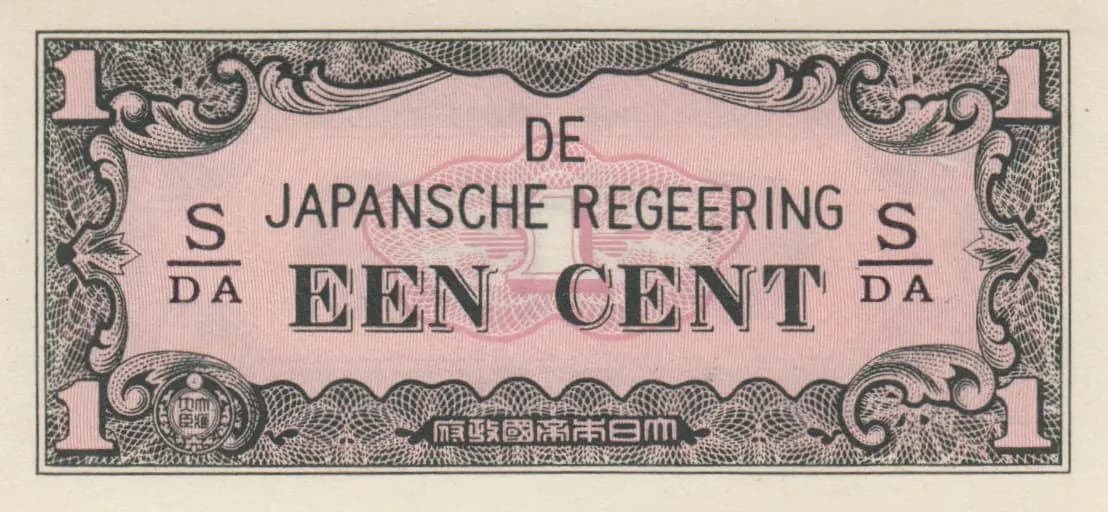
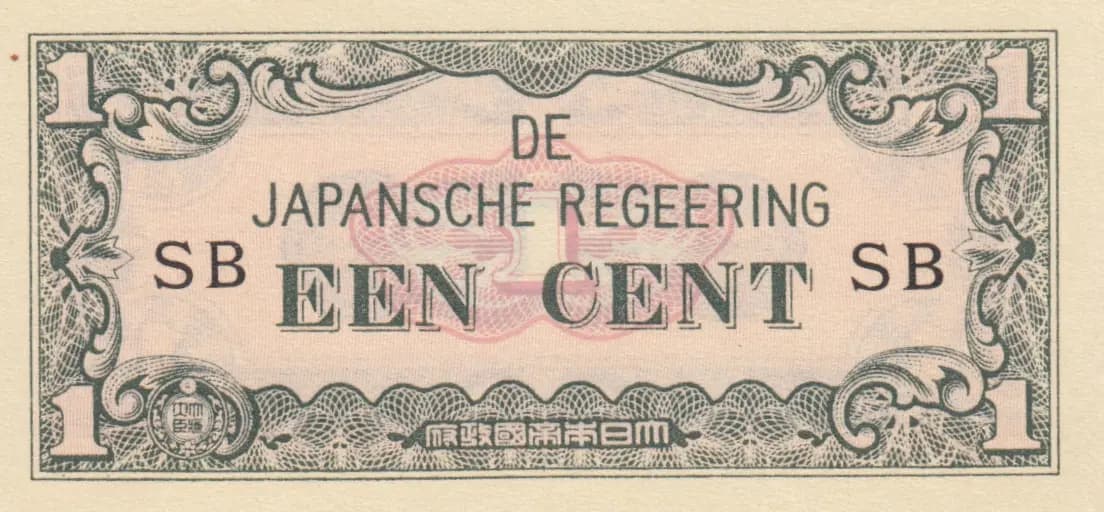
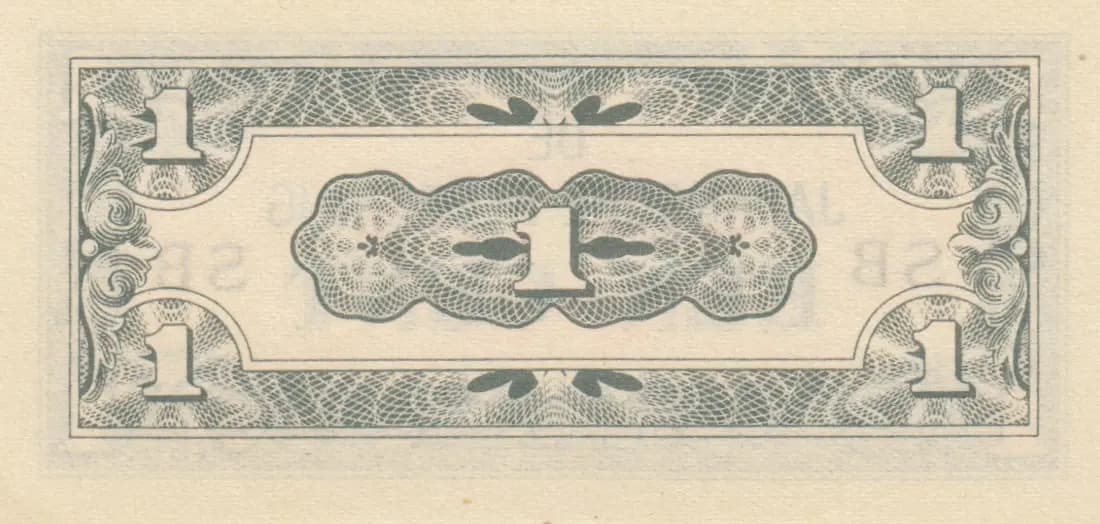
This is a well-preserved example of a 1 cent banknote issued by De Japansche Regeering during the Japanese occupation of the Netherlands Indies in 1942 (Pick P-119a). The note displays crisp, uncirculated condition with vibrant green/teal ink on a cream background, featuring ornate decorative borders with scrollwork and fine crosshatch security patterns on both sides. The front showcases the issuing authority text in Dutch alongside Japanese characters, while the reverse presents a simpler design with denomination numerals in an ornamental frame—a characteristic design approach for occupation currency of this period.
Common. The 1 cent denomination from this occupation issue was produced in large quantities to facilitate everyday transactions during the occupation period. While occupation currencies have collector interest, this particular denomination and Pick number were not part of a limited release and saw substantial circulation. The abundance of surviving examples in the numismatic market confirms widespread availability, and UNC examples, though desirable, are not exceptionally scarce.
This banknote represents currency issued during Japan's occupation of the Dutch East Indies (1942-1945) following the fall of the Netherlands to Axis powers. The dual-language inscriptions in Dutch and Japanese reflect the occupation authority's administrative approach, while the Japanese imperial seal and script visible on the front underscore Japan's assertion of governmental control over the territory. The modest 1 cent denomination and utilitarian design were typical of occupation currencies designed for everyday commerce in the conquered territories.
The front of the note features a formal, symmetrical layout characteristic of government currency, with the denomination and issuer information prominently displayed in the center area. Ornate corner flourishes and scrollwork frame the design, while fine crosshatch and mesh patterns serve as background security elements. A Japanese imperial seal or crest is positioned in the lower center, asserting authority. The reverse simplifies the design, presenting large numeral '1' values in the four corners and a larger '1' enclosed within an ornamental scalloped frame in the center. The color palette of dark green/teal ink on cream/beige paper creates strong contrast and legibility. No portraits or specific landmarks are depicted; instead, the design relies on geometric patterns and official insignia to convey authority and prevent counterfeiting.
Front side: 'DE JAPANSCHE REGEERING' (Dutch) = 'The Japanese Government'; 'EEN CENT' (Dutch) = 'One Cent'; 'SB' appears on left and right sides (designation unclear, possibly a series or control marking); '昭和國南方發行銀行' (Japanese) = Japanese text related to currency issuance authority. Back side: '1' appears in all four corners and centrally within an ornamental frame, indicating the denomination value.
The note employs intaglio engraving (also known as steel plate printing), evidenced by the fine crosshatch backgrounds, precise line work, intricate decorative borders, and sharp detail reproduction visible throughout both sides. The security patterns and ornamental elements show the characteristic depth and precision of intaglio printing. The printer for this occupation currency issue was likely a Japanese government printing bureau or contracted security printer, consistent with Japanese occupation currency production in Southeast Asia during 1942-1945.
Pick P-119a is the standard variety for the 1942 Dutch East Indies 1 cent Japanese occupation note. Potential varieties may exist in the 'SB' designations visible on both sides, which could represent different series or printing batches, though without additional comparative examples or catalog documentation, confirmation of distinct varieties is not possible from this specimen alone. The consistently observed features across both sides suggest this is a standard printing of the type.