5 gulden 1967
Market Prices
14 salesAbout This Note
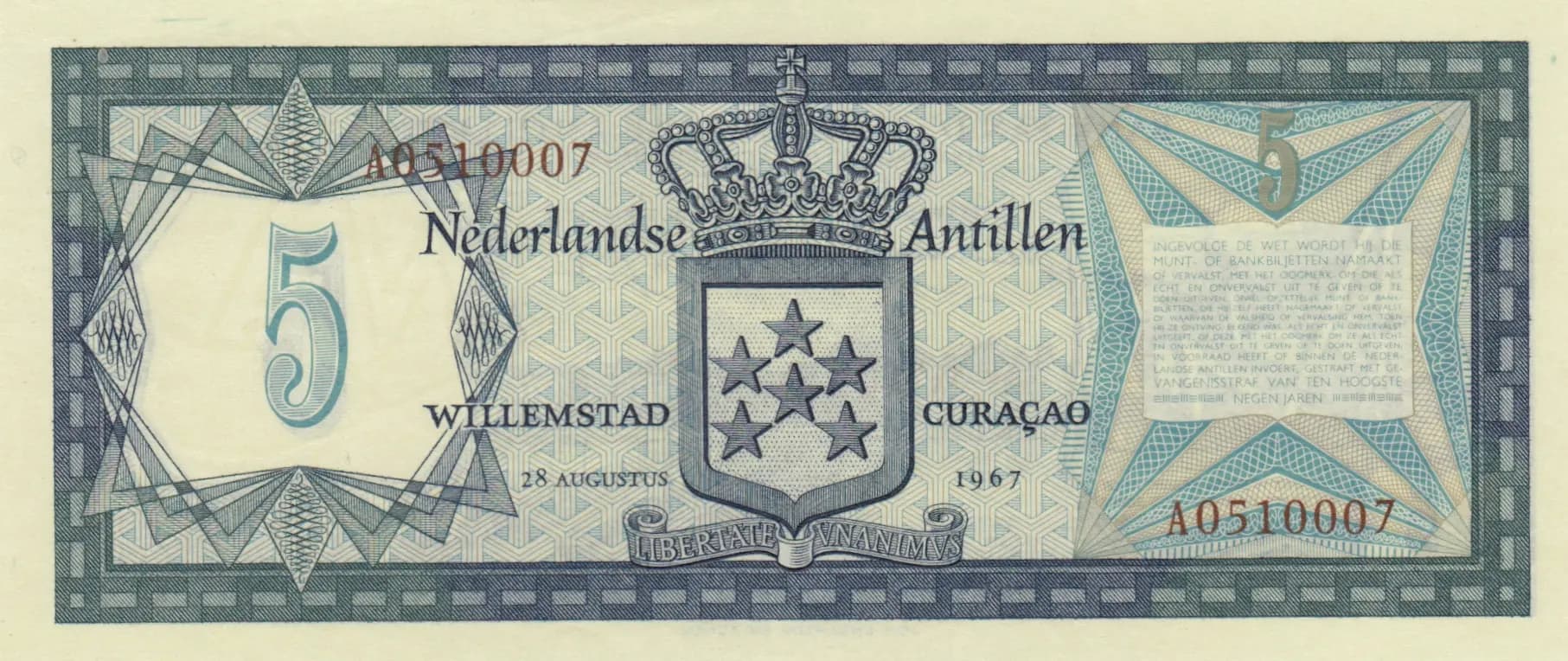
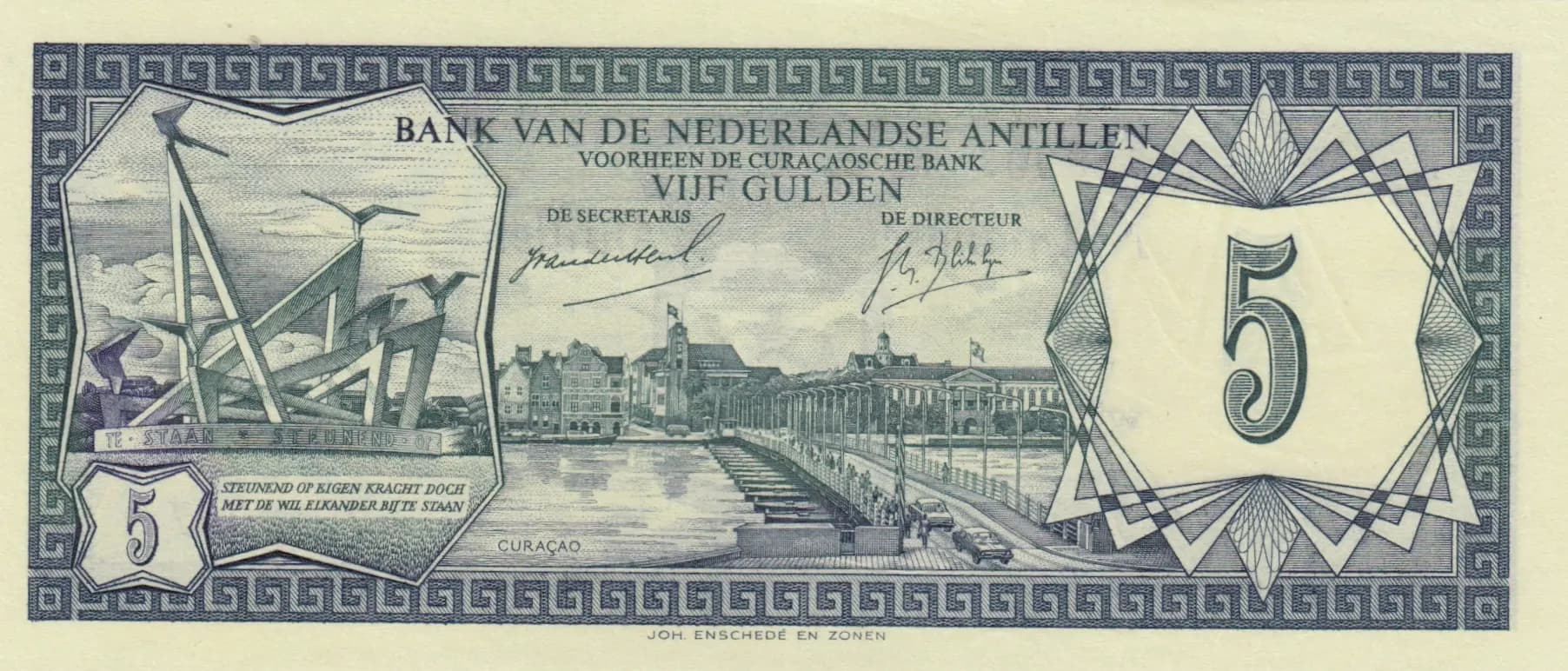
This is an uncirculated example of the 1967 Netherlands Antilles 5 Gulden (Pick P-8a), featuring the iconic coat of arms of Curaçao on the obverse and a detailed engraved view of Willemstad's waterfront on the reverse. The note exhibits pristine condition with sharp printing, crisp geometric patterns, and dual serial numbers in different colors—hallmarks of its uncirculated status. In UNC condition, this note represents a premium example of this early post-colonial Caribbean currency issue.
Common. While this note is from 1967 and represents the early currency of the Netherlands Antilles, eBay market data shows consistent sales across multiple condition grades, with recent VF examples selling for $7–$14 and only historical UNC sales reaching $40–$63. The large print run by Johan Enschede and the steady supply in the secondary market indicate widespread availability. UNC examples command a premium due to condition rather than scarcity of the date or variety.
Issued on 28 August 1967 by the Bank van de Nederlandse Antillen (formerly the Curaçao Bank), this note commemorates Curaçao's prominence within the Netherlands Antilles federation during the decolonization era. The reverse depicts the colonial-era architecture and maritime heritage of Willemstad, the capital, while the obverse's coat of arms bears the motto 'Libertatem Unanimus' (United for Liberty), reflecting the political aspirations of the emerging autonomous territory.
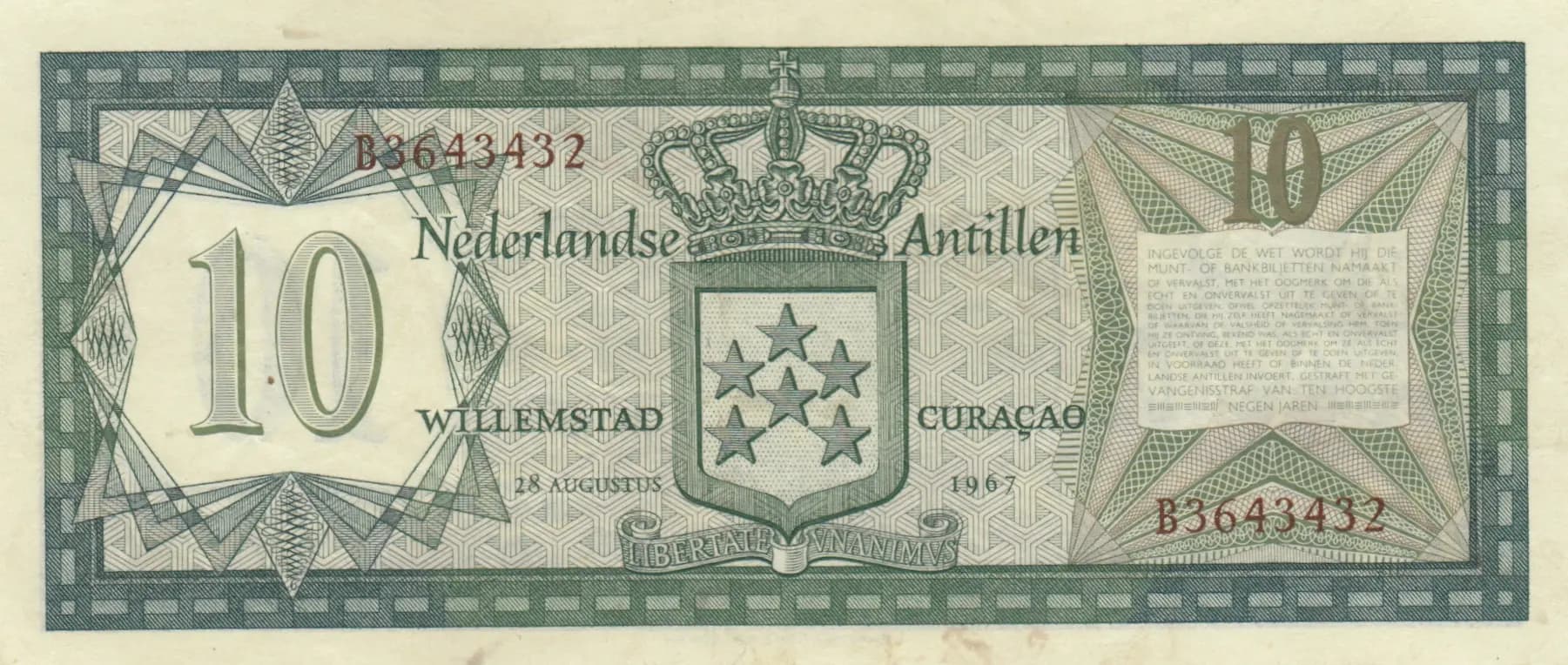
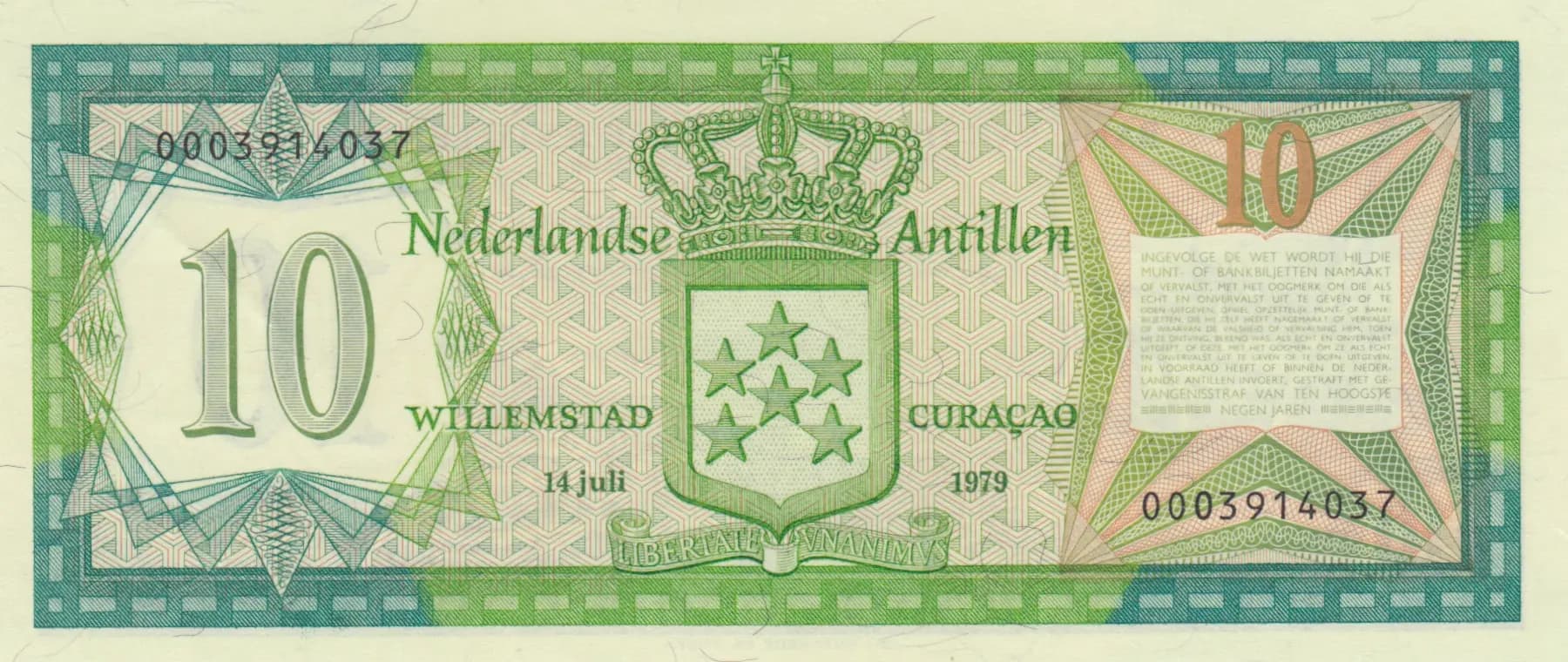
The obverse centers on the crowned coat of arms of Curaçao, featuring six stars arranged within a shield surmounted by a royal crown, rendered in teal and blue-green tones against a cream background with intricate geometric diamond and line patterns. The reverse showcases a detailed engraved panorama of Willemstad's historic waterfront, depicting multi-story colonial-style buildings, an arched bridge or viaduct spanning the harbor, and sailing vessels—all characteristic of 17th-century Dutch Caribbean architecture. A Greek key pattern border frames both sides, with the denomination '5' positioned prominently on each side. The note bears dual signature spaces for bank officials (Secretary and Director) and is printed by Johan Enschede en Zonen, the renowned Dutch security printer.
OBVERSE: 'Nederlandse Antillen' (Netherlands Antilles), 'WILLEMSTAD' (city name), 'CURAÇAO' (island name), '28 AUGUSTUS' (28 August), '1967' (year of issue), 'LIBERTATEM UNANIMUS' (United for Liberty—motto). Serial numbers: A0610007 and A0510007. REVERSE: 'BANK VAN DE NEDERLANDSE ANTILLEN' (Bank of the Netherlands Antilles), 'VOORHEEN DE CURACAOSCHE BANK' (Formerly the Curaçao Bank), 'VIJF GULDEN' (Five Guilders), 'DE SECRETARIS' (The Secretary), 'DE DIRECTEUR' (The Director), 'JOH ENSCHEDE EN ZONEN' (Joh Enschede and Sons—printer), 'CURAÇAO' (island name), 'STEUNEND OP EIGEN KRACHT DOCH MET DE WIL ELKANDER BIJ TE STAAN' (Relying on own strength but with the will to stand by each other), and denomination '5'.
Intaglio (engraved) printing executed by Johan Enschede en Zonen (Netherlands), evident from the fine line engraving visible throughout—particularly in the geometric patterns, architectural details, and border ornamentation. The watermark features the 'NA' monogram (Netherlands Antilles), and the printer's mark 'JEZ' is noted on the reverse. The multi-color printing technique (teal/blue-green, black, and cream on multicolor underprint) reflects standard 1960s security banknote production standards.
This is identified as Pick P-8a, with the printer mark 'JEZ' (Johan Enschede en Zonen). The PMG population report indicates three cataloged variants exist (P-8a, P-8b, and P-8s, all with JEZ printing), suggesting minor printing variations. The specific variety is determined by printer (all JEZ in this series) and signature varieties are possible but not definitively identified from the visible serial numbers A0610007/A0510007 alone. The obverse inscription includes the formal date '28 AUGUSTUS 1967,' which may not appear on all variants issued in 1972.