250 gulden 1967
Market Prices
5 salesAbout This Note
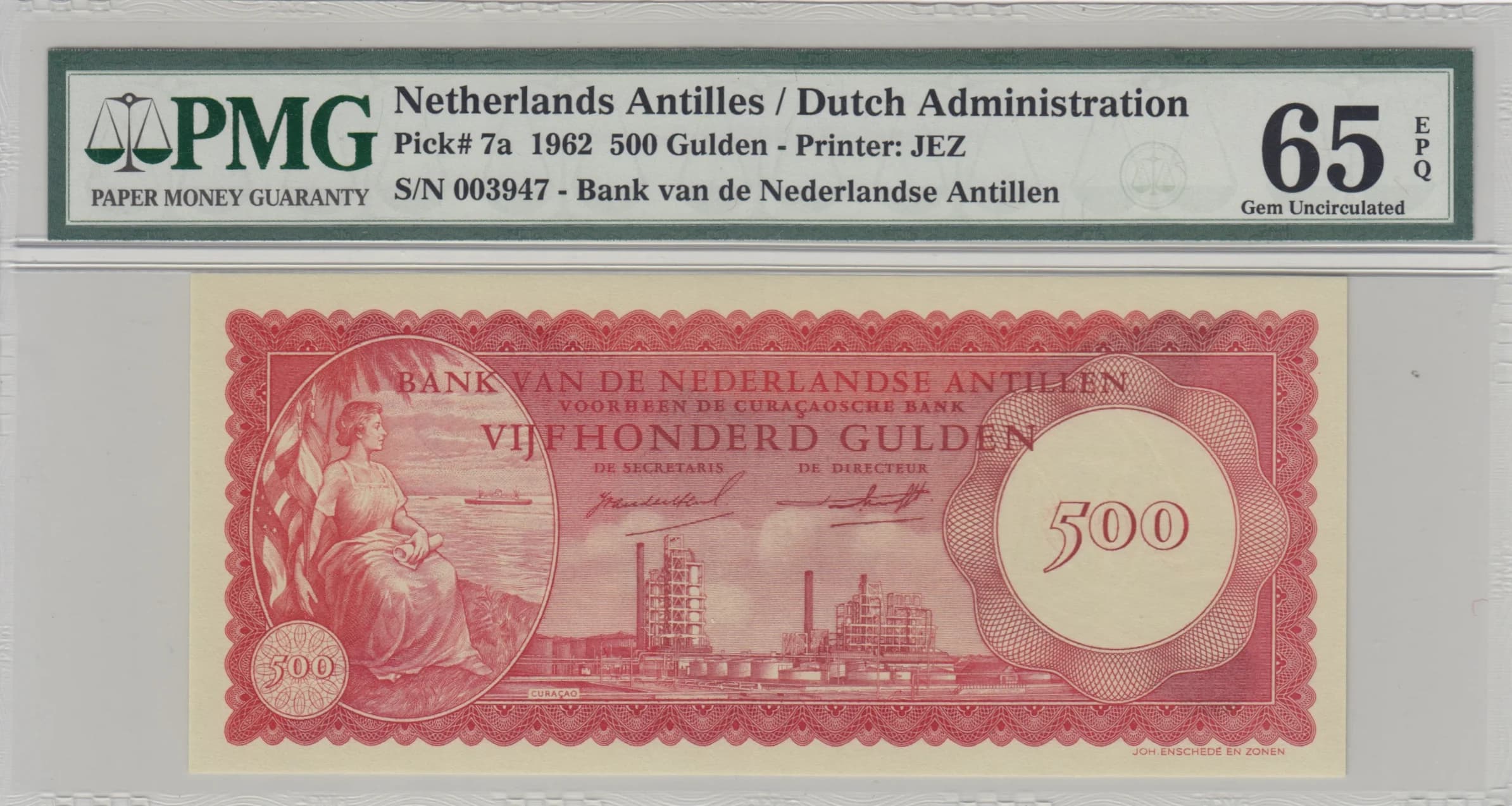
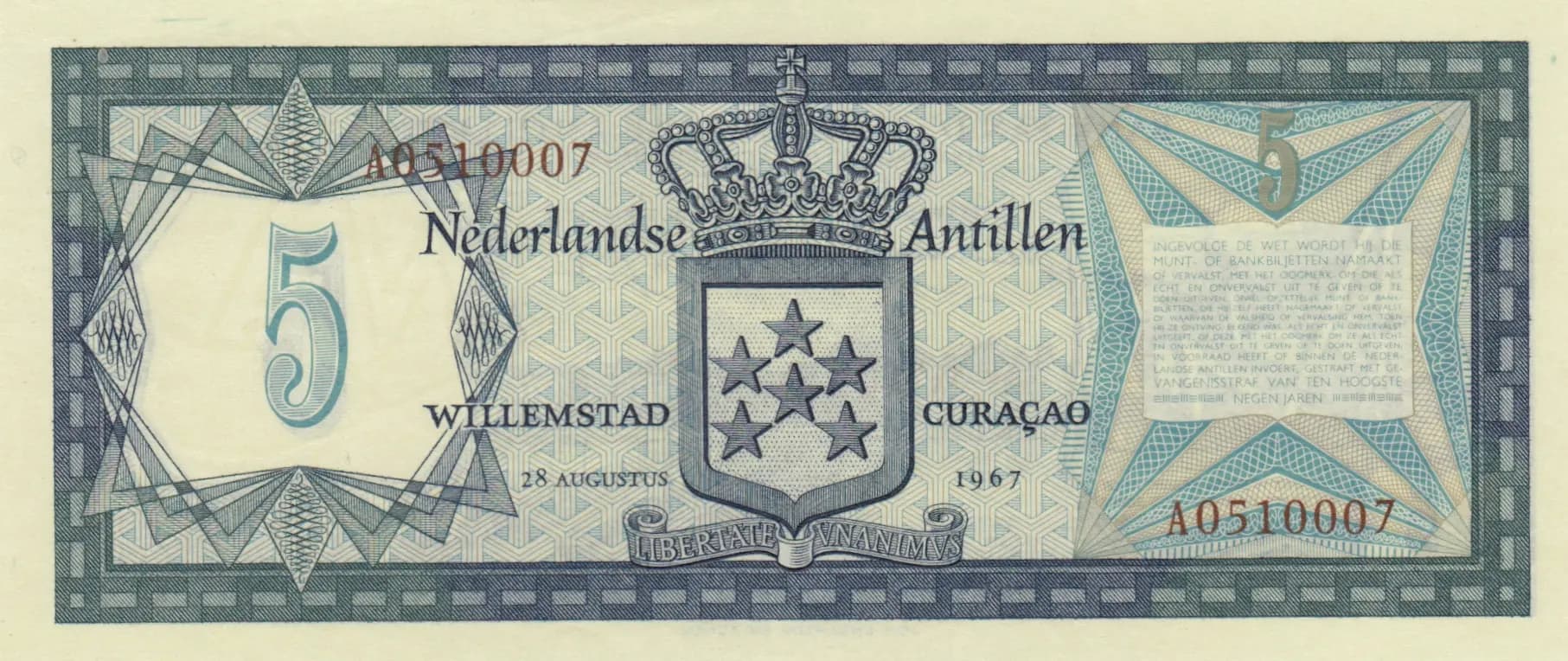
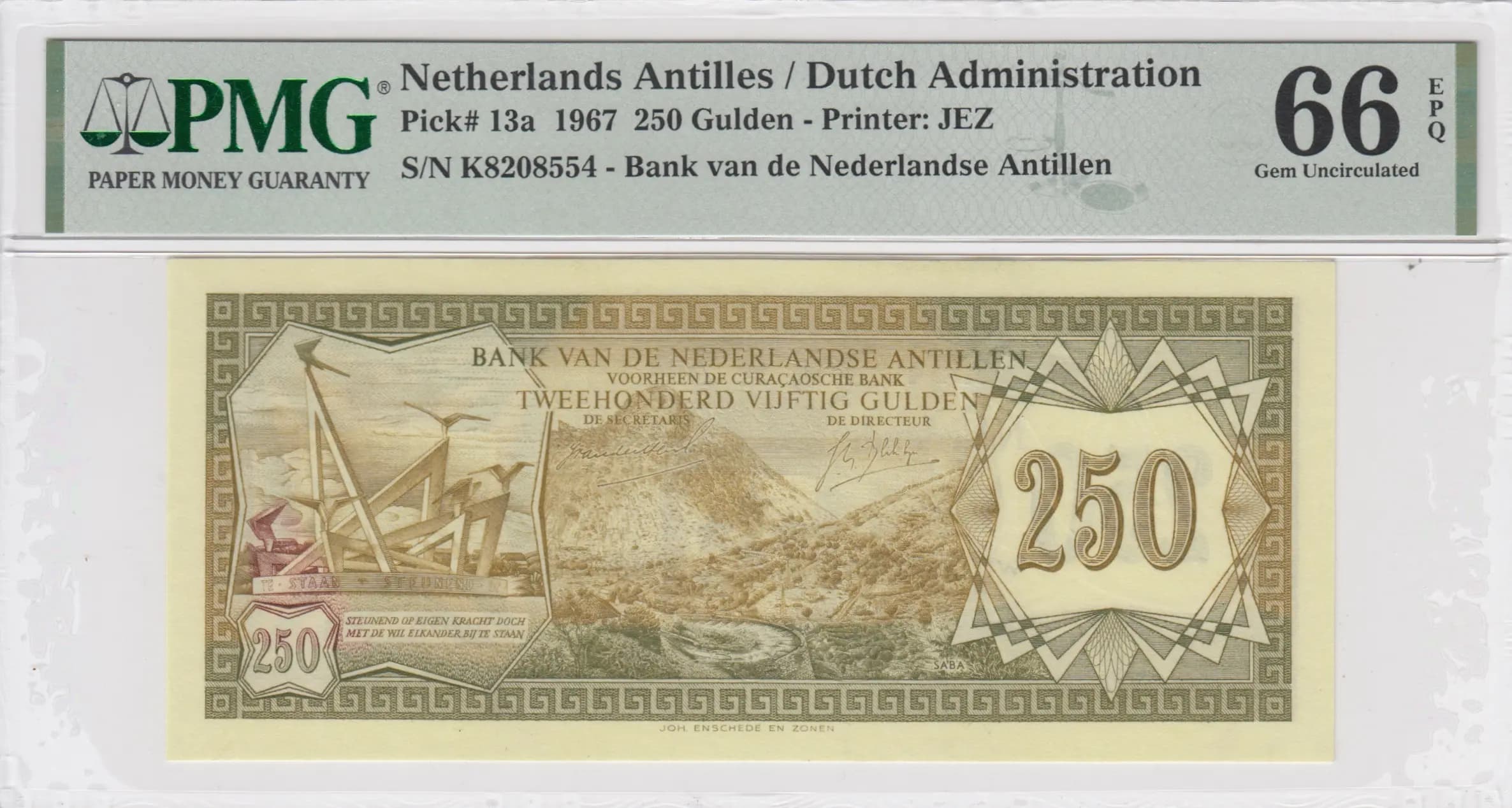
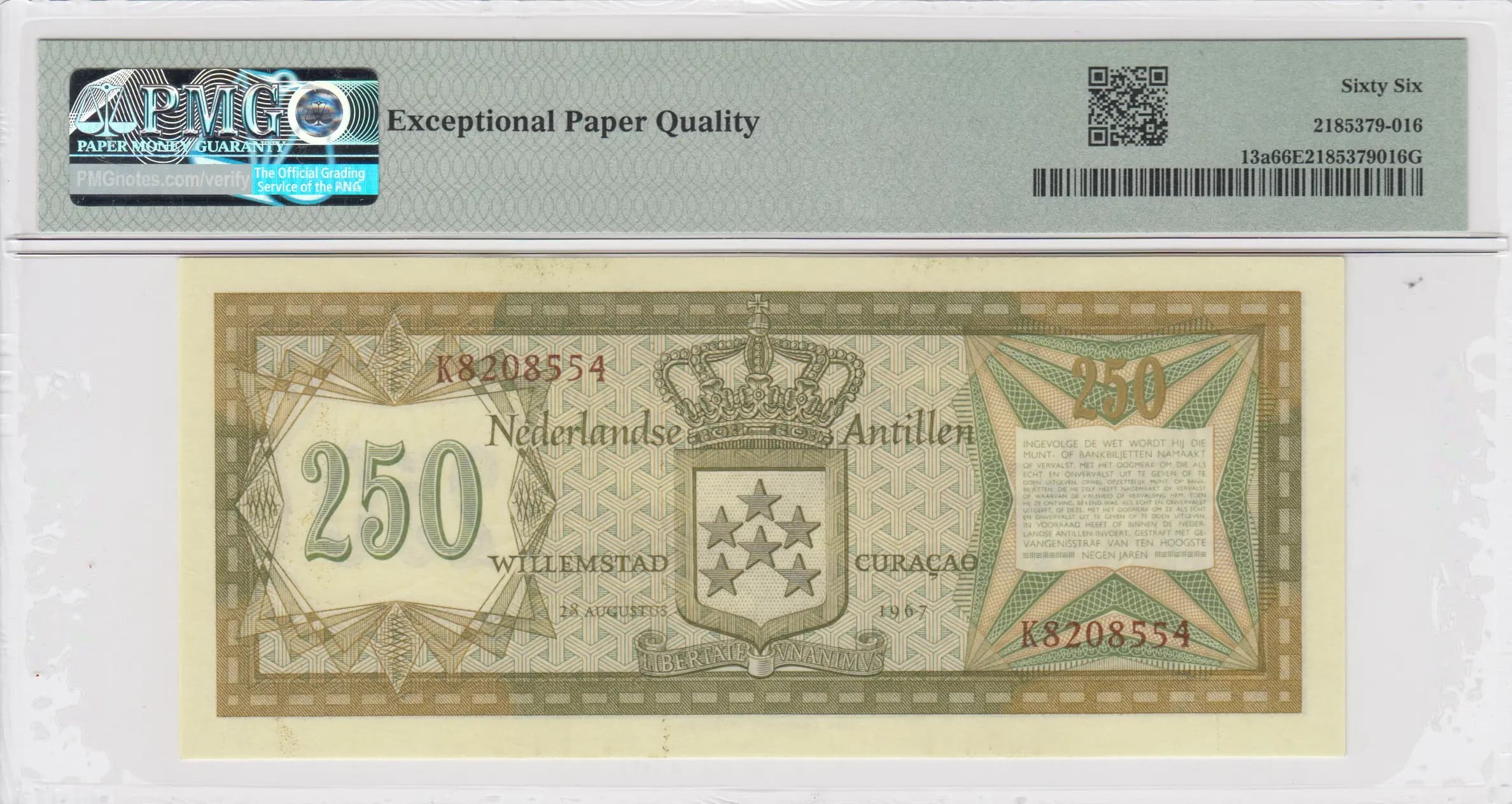
This is a PMG 66 EPQ example of the 250 Gulden issued by Bank van de Nederlandse Antillen in 1967, representing a high-grade specimen of this moderately valued note. The obverse displays a striking seascape with sailing vessels and mountainous landscape (Saba) rendered in olive-green on multicolor underprint, while the reverse features the crowned coat of arms of the Netherlands Antilles with the Latin motto 'Libertatis Unanimis.' The note exhibits pristine condition with sharp details, crisp surfaces, and the intricate geometric border patterns and fine line work characteristic of Johan Enschede's engraved production.
Common. While this denomination and issue are moderately valued among collectors (catalogue values: VF $170, UNC $675), the secondary market data demonstrates consistent availability and repeated sales. eBay records show multiple PMG 66 examples selling in the $200-230 range and UNC examples regularly trading for $180-200+, indicating a healthy supply relative to collector demand. This is a regular issue from a major printer with no evidence of restricted print runs or early withdrawal from circulation.
Issued in 1967, this banknote represents the currency of the Netherlands Antilles during a period of institutional transition, as evidenced by the inscription 'Voorheen de Curacaosche Bank' (Formerly the Curaçao Bank) acknowledging the merger and establishment of the unified Bank van de Nederlandse Antillen. The imagery celebrating Saba and Willemstad reflects the multi-island federation's identity, while the coat of arms with its five stars and the Latin motto 'Libertatis Unanimis' (Liberty in Unity) emphasize the political union of the constituent islands under Dutch sovereignty.
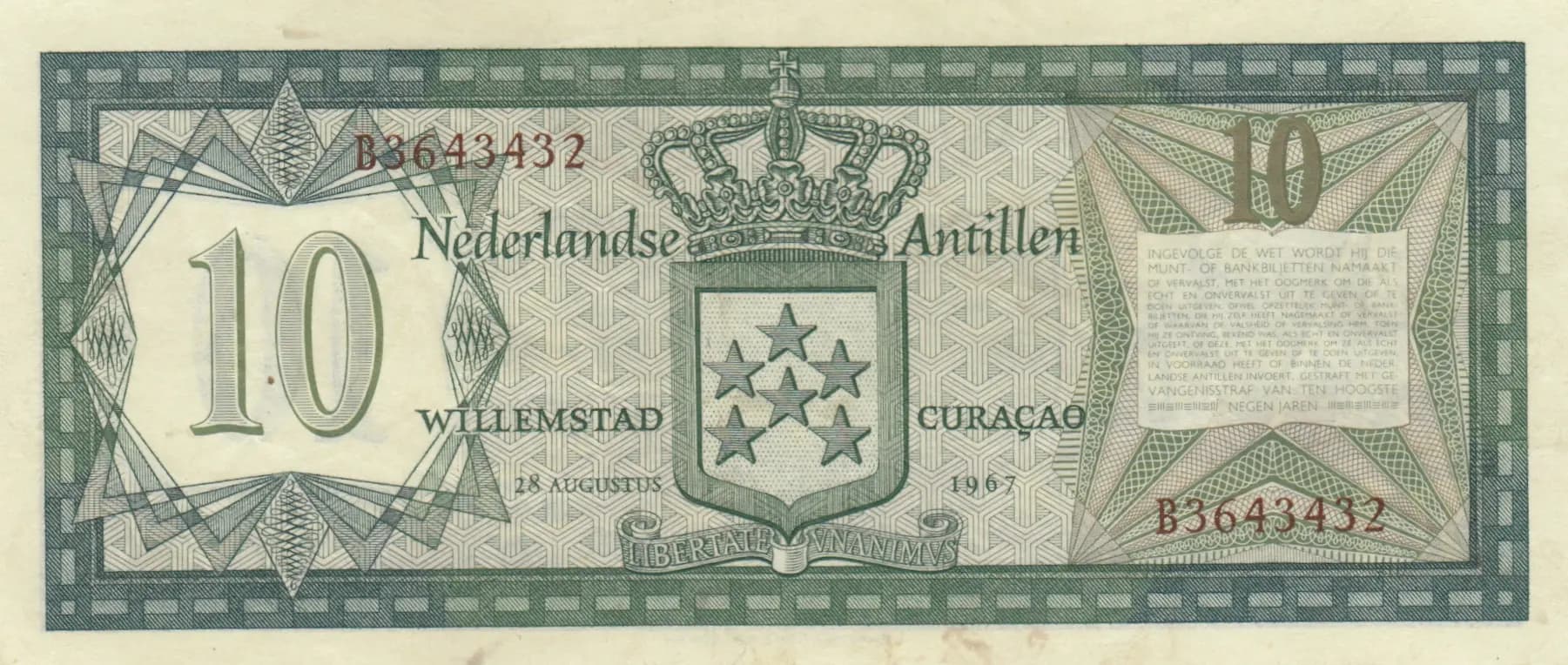
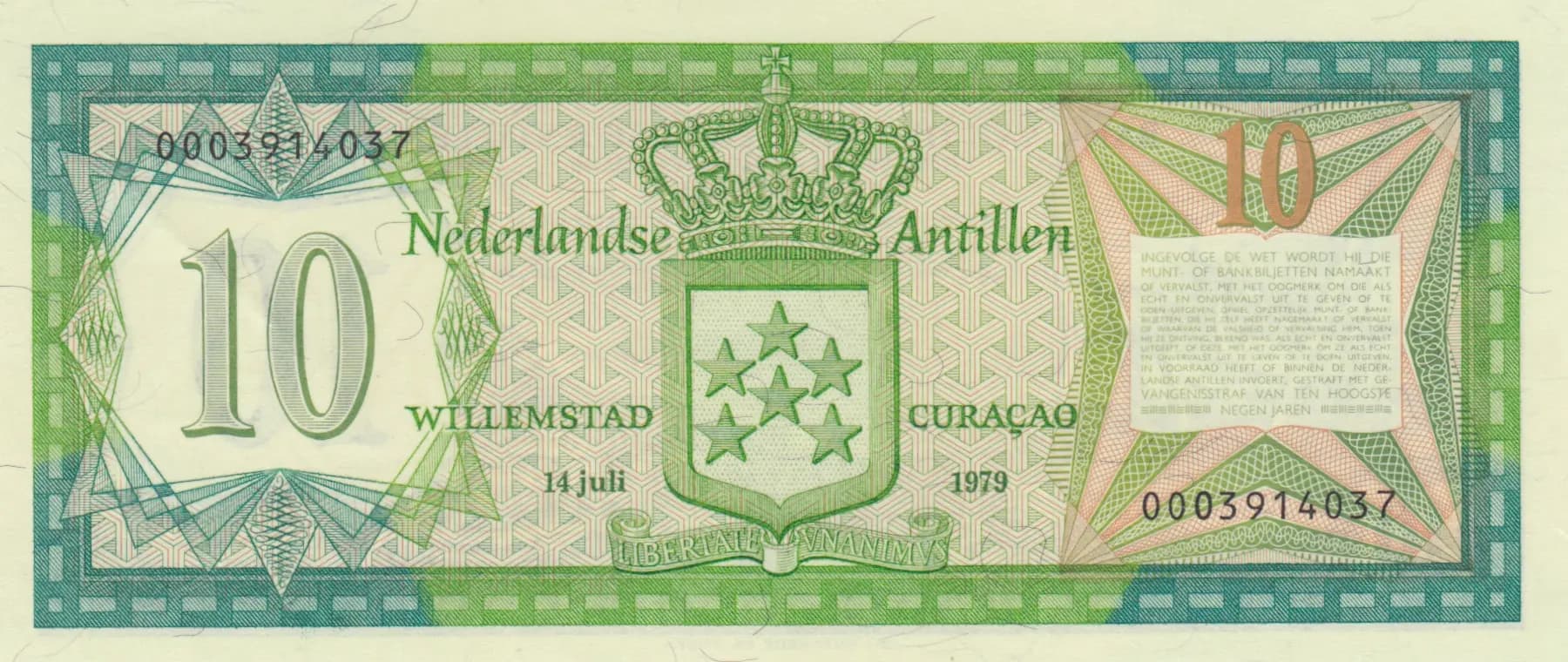
The obverse depicts a detailed seascape scene featuring a multi-masted sailing vessel on the left, representing maritime heritage and trade, with a mountainous landscape in the center representing Saba, one of the constituent islands of the Netherlands Antilles. The design is framed by an ornamental Greek key pattern border with ornate denomination frames on both sides. Signature lines for 'De Secretaris' (Secretary) and 'De Directeur' (Director) occupy the center, and a stylized sunburst or palm frond motif appears on the right side. The reverse presents the formal coat of arms of the Netherlands Antilles with a crowned shield containing five stars, flanked by the place names Willemstad (Curaçao) to emphasize the capital and administrative center. The entire design employs fine engraved line work and geometric patterning in beige, tan, green, and cream tones.
FRONT SIDE: 'Bank van de Nederlandse Antillen' (Bank of the Netherlands Antilles); 'Voorheen de Curacaosche Bank' (Formerly the Curaçao Bank); 'Tweehonderd Vijftig Gulden' (Two Hundred Fifty Gulden); 'De Secretaris' (The Secretary); 'De Directeur' (The Director); 'Stuimend op Eigen Kracht' (Moving forward with our own strength). BACK SIDE: 'Nederlandse Antillen' (Netherlands Antilles); 'Willemstad' (city of Willemstad); 'Curaçao' (island of Curaçao); 'Libertatis Unanimis' (Liberty in Unity - Latin motto); Serial number 'K8208554'; Date indicators 'Augustus' (August) and '1967'.
Intaglio (engraved) printing by Johan Enschede (identified as JEZ in printer markings), the renowned Dutch security printer. The elaborate geometric patterns, fine line work throughout the design, intricate border work, and detailed coat of arms engraving are characteristic of high-quality intaglio production. The watermark featuring the NA (Nederland Antillen) monogram was incorporated during the papermaking process.
This example represents the P-13a variety (printer JEZ/Johan Enschede). The PMG population report identifies two catalogued variants for this base Pick number (P-13a and P-13s), with both printed by JEZ. The observed serial number K8208554 is consistent with the standard production numbering. The date on the reverse confirms the August 1967 issuance.