5 gulden 1966
Market Prices
51 salesAbout This Note
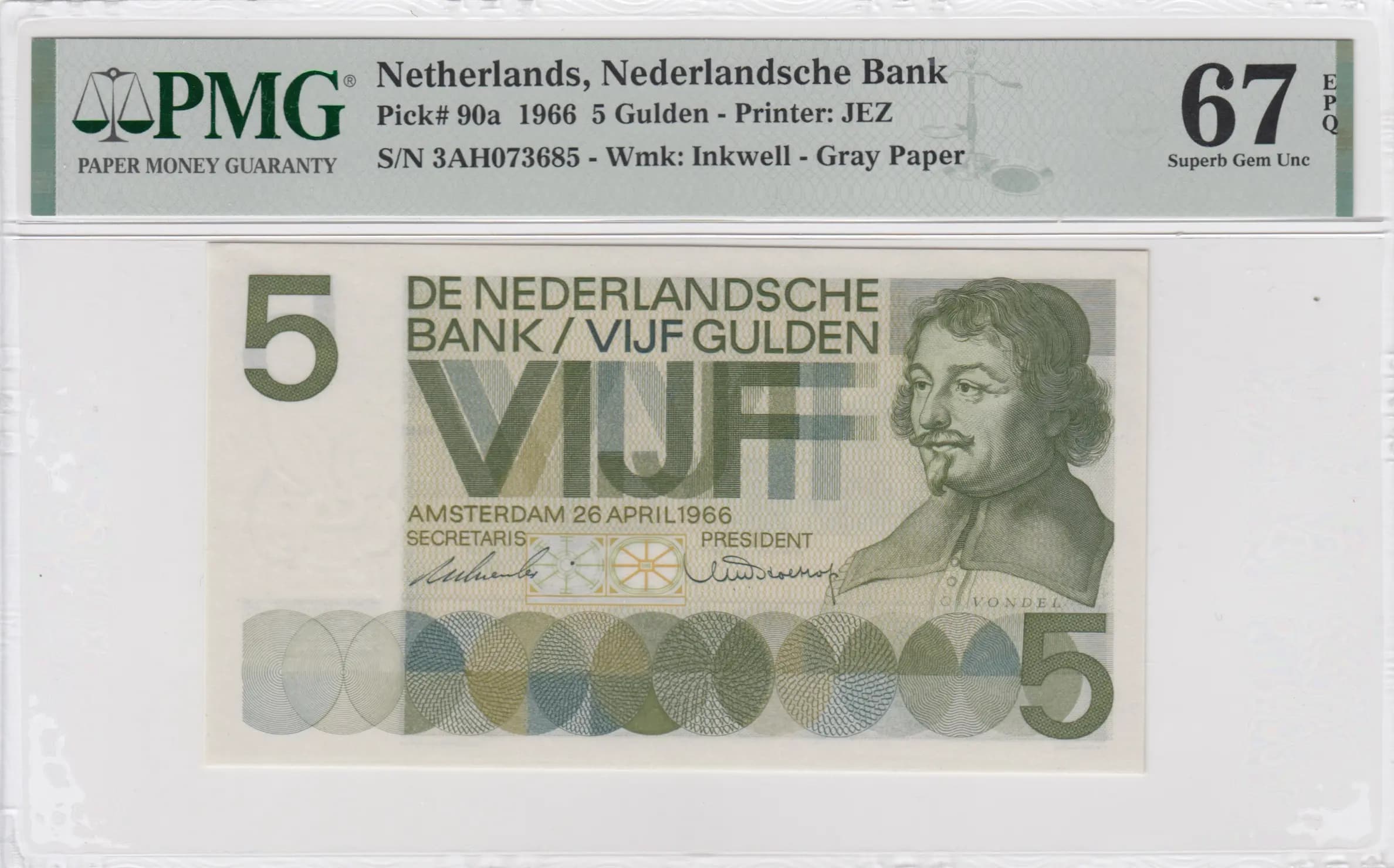
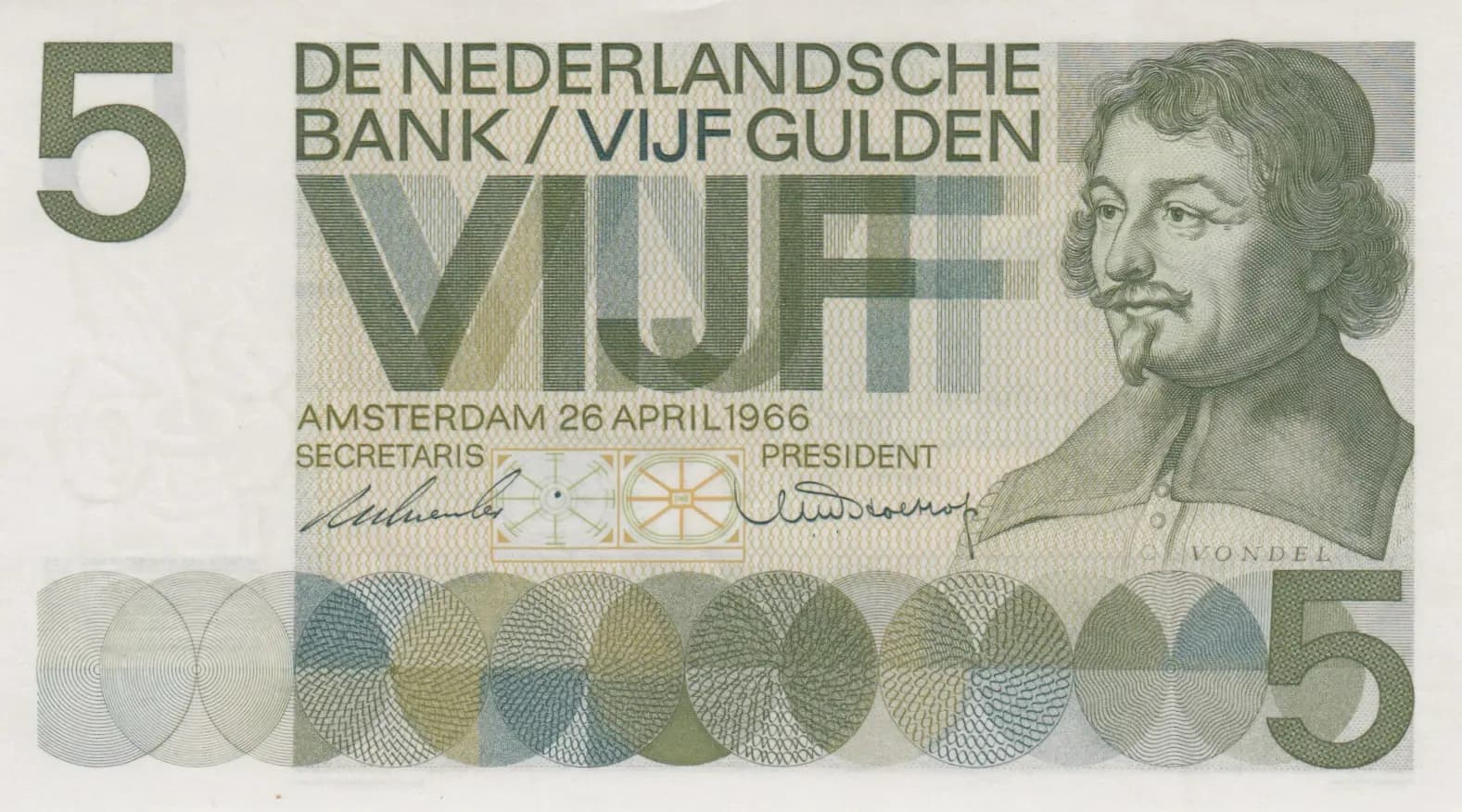
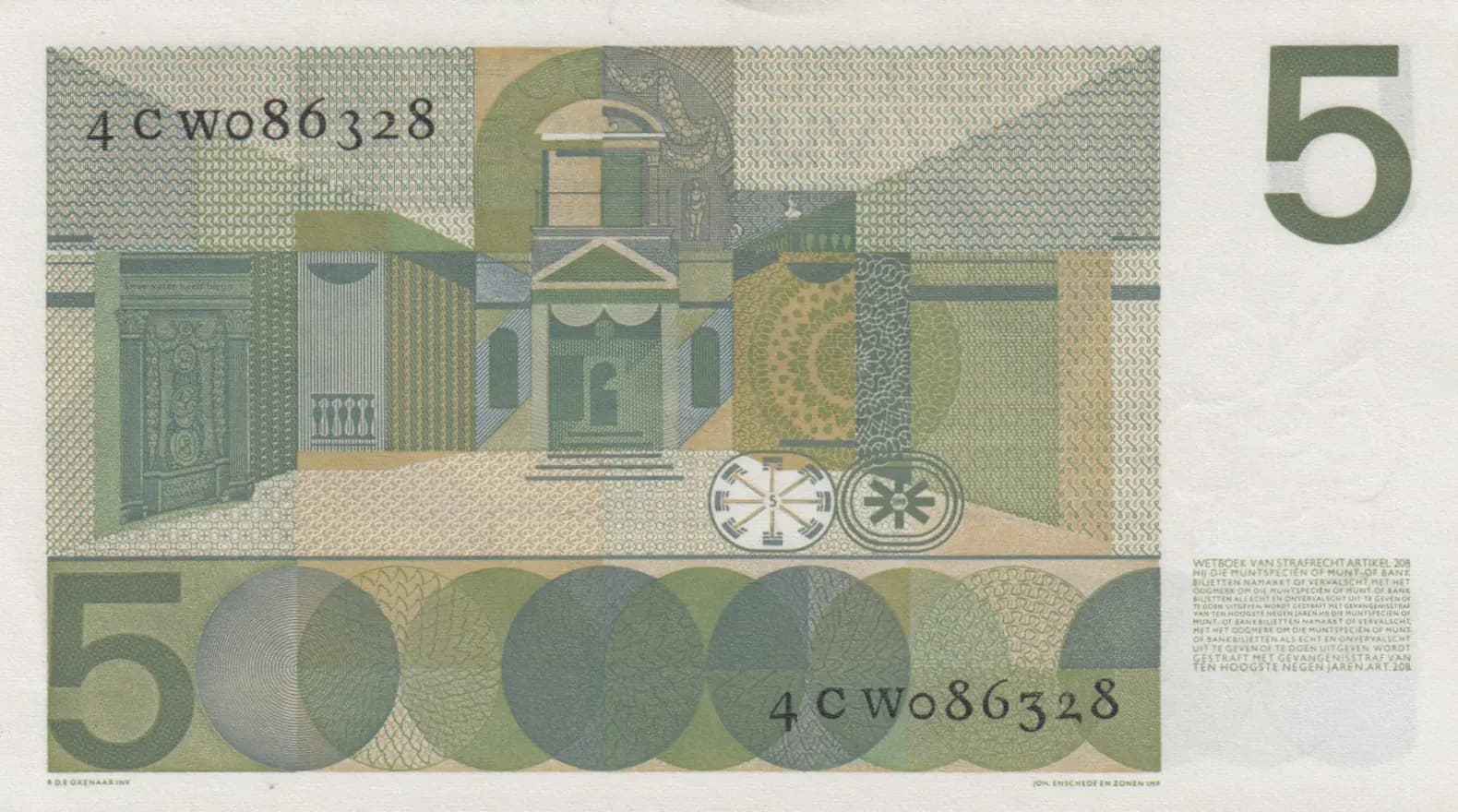
This is an uncirculated 1966 Netherlands 5 Gulden note (Pick P-90a) in pristine condition, featuring a striking portrait of the 17th-century Dutch poet Joost van den Vondel on the obverse and an architectural rendering of the Amsterdam Play-House on the reverse. The note exhibits exceptional clarity with fine line engraving throughout, intricate geometric security patterns, and vibrant green-dominant coloring that exemplifies the high quality of post-war Dutch banknote production by Johan Enschede.
Common. Despite being a 1966 issue, this note remains common in the numismatic market. eBay transaction data shows consistent availability with UNC examples selling in the $7-$28 range historically, indicating substantial print runs and ready supply. The 2019 catalog value of $40 UNC represents collector appreciation rather than rarity premium. PMG graded examples command higher prices ($45-$175+ for graded specimens), but ungraded UNC notes are readily available.
Issued on 26 April 1966 by the Nederlandsche Bank, this note commemorates Dutch cultural heritage through its dual imagery: Joost van den Vondel (1587-1679) was the most celebrated poet of the Dutch Golden Age, while the Amsterdam Play-House represents the theatrical and cultural institutions that flourished during that era. The 1966 date places this note during the height of the modern gulden currency period, prior to decimalization discussions that would eventually lead to the currency's replacement.
The obverse features a three-quarter profile portrait of Joost van den Vondel, the renowned 17th-century Dutch Golden Age poet, depicted with characteristic long curled hair and period clothing on the right side of the note. The reverse showcases the Amsterdam Play-House (likely the Concertgebouw or similar classical Amsterdam cultural institution), rendered in classical architectural perspective with Doric columns, a prominent domed cupola, arched entrance, and surrounding landscaped garden elements. Both sides feature decorative geometric patterns with concentric circles and interlocking designs along the bottom border, serving as both artistic enhancement and security feature. The color scheme of green with olive, beige, and blue-gray tones creates sophisticated visual harmony characteristic of 1960s Dutch currency design.
FRONT SIDE: '5' (denomination in Arabic numerals); 'DE NEDERLANDSCHE BANK' / 'VIJF GULDEN' (The Dutch Bank / Five Guilders); 'AMSTERDAM 26 APRIL 1966' (place and date of issue); 'SECRETARIS' (Secretary - signature line); 'PRESIDENT' (President - signature line). BACK SIDE: '5' (denomination); Serial number appears in upper left and lower right (example shown: '4CWO80328' and '4cWo86328'); 'WETRODE VAN STRAFRECHT ARTIKEL 208' (Penal Code Article 208 - counterfeiting prohibition); Additional fine print legal text in Dutch regarding unauthorized reproduction and counterfeiting penalties.
Intaglio line engraving (fine line entaglio), as evidenced by the exceptional clarity, fine detail work, intricate cross-hatching, and varying line densities throughout both obverse and reverse. The note was printed by Johan Enschede, the renowned Dutch security printer, whose hallmark was sophisticated geometric security patterns and masterful engraving technique. The precision of the portrait rendering and architectural detailing confirms professional intaglio production rather than lithography.
Pick P-90a represents the standard 1966 emission. The PMG Population Report indicates JEZ as the printer identifier (Johan Enschede Zonen). Varieties for this note may include different signature combinations (Secretary and President signatures appear on all examples but signatories may vary) and serial number prefix variations. The serial number format visible in the images (4-letter prefix followed by 5 digits) is consistent with 1960s Dutch bank practice. No major overprints or commemorative varieties are recorded for this Pick number.