5 rupees 1974 specimen
About This Note
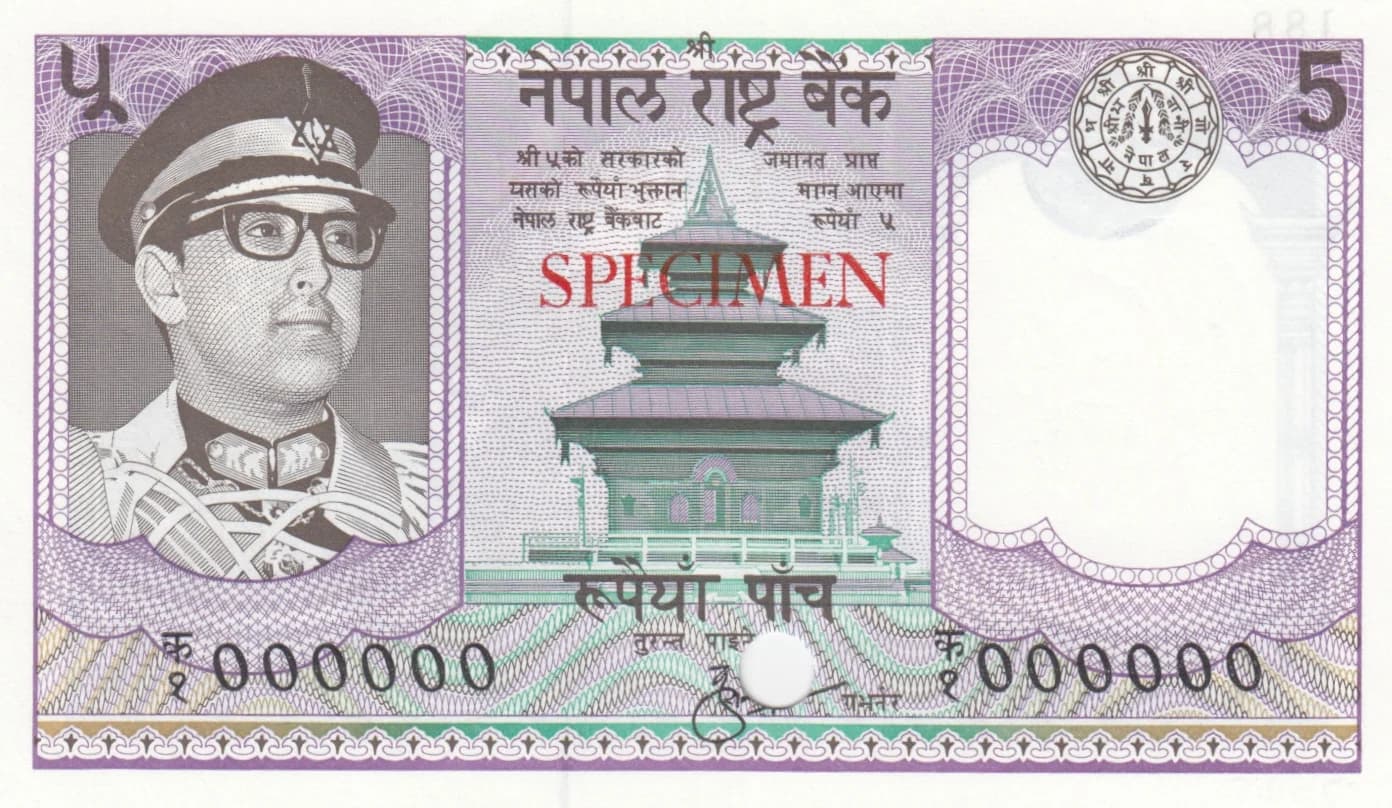
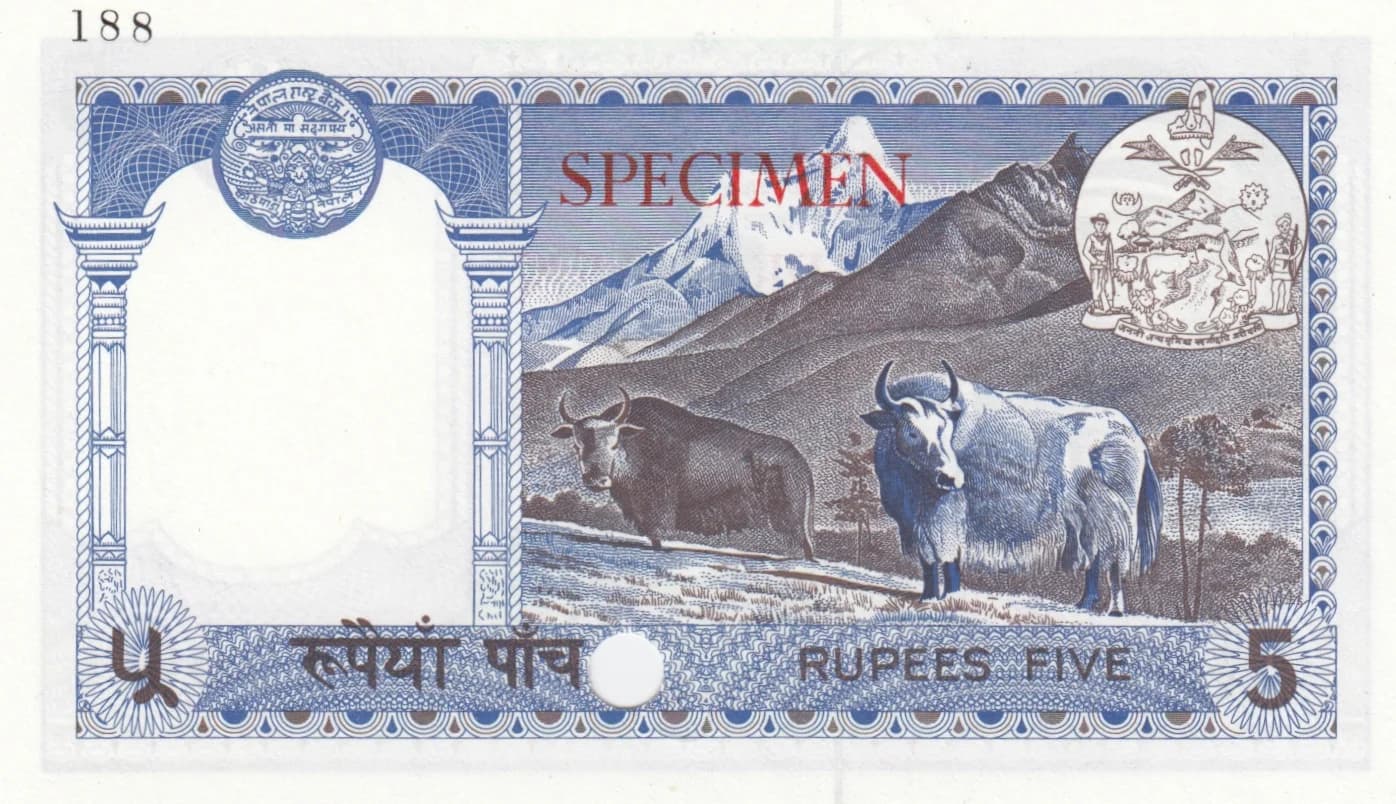
This is a Nepal Rastra Bank 5 rupees specimen note from 1974 (Pick P-23(1)s), presented in uncirculated condition with the characteristic punch holes that identify it as a non-circulating specimen. The note features a striking purple obverse with a military-uniformed portrait (King Birendra Bir Bikram) and the iconic green Taleju Temple, while the blue reverse depicts a Himalayan pastoral landscape with yaks and snow-capped peaks. As a specimen note from the early era of Nepal's modern currency, this piece documents both the artistic design standards and security considerations of the Nepal Rastra Bank during the 1974-1985 series.
Common. The 5 rupees note of the 1974-1985 series (Pick P-23) was produced in large quantities as a standard circulation denomination. While specimen notes are less common than regular issued notes, they were produced in sufficient quantities for distribution to international banking institutions and were not subject to the rarity constraints of recalled or short-run issues. The uncirculated condition is standard for specimen notes due to their non-circulation status.
This note was issued during the reign of King Birendra Bir Bikram (1972-2001), whose military-uniformed portrait on the obverse reflects Nepal's political structure of that period. The Taleju Temple depicted in green on the front is one of Nepal's most sacred Hindu temples and a symbol of national identity, while the reverse's pastoral Himalayan landscape with yaks represents the nation's cultural and economic heritage. The specimen designation indicates this note was part of the international distribution of sample currency used by banks and collectors to familiarize institutions with Nepal's new monetary design standards.
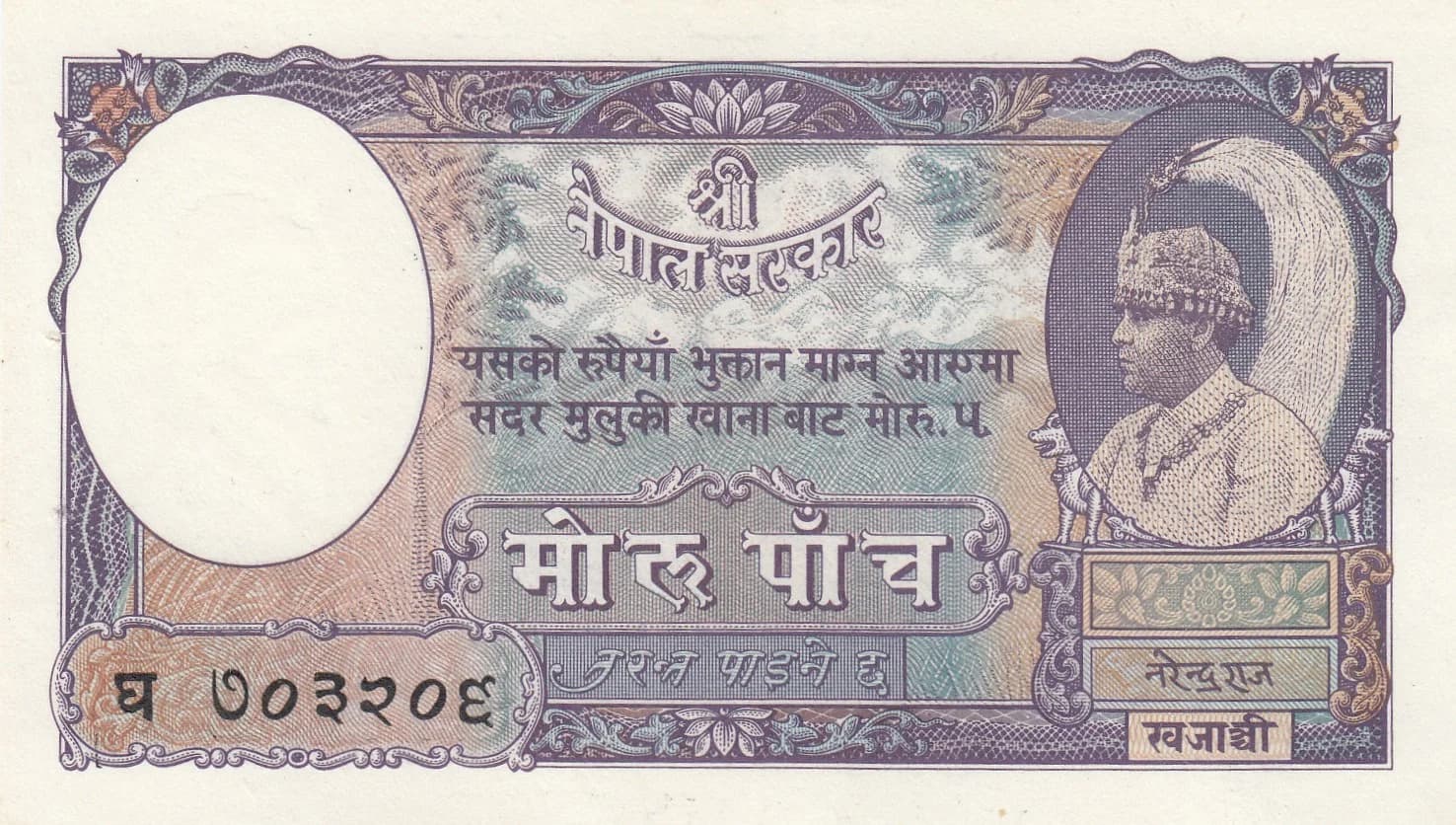
The obverse features King Birendra Bir Bikram in three-quarter profile, wearing a military uniform with decorative insignia, glasses, and a military cap on the left side. The central design element is the multi-tiered Taleju Temple rendered in green, a five-tiered pagoda structure representing one of Nepal's most important Hindu temples located in Kathmandu Durbar Square. The note is predominantly purple/violet with black and white ornamental detailing. A circular zodiac or astrological wheel appears in the upper right corner, with a decorative seal bearing Nepali script at the top center. The reverse depicts a panoramic Himalayan landscape in blue tones, featuring snow-capped mountain peaks in the background and yaks grazing in a pastoral valley below. Decorative column capitals frame the left side, and national emblems including a crowned emblem with wings appear at the top center and right. Fine geometric patterns and intaglio line work provide security and aesthetic enhancement throughout both sides.
Front Side: 'नपाल राष्ट्र बैक' (Nepal Rastra Bank); 'श्रीपञ्चको सत्कार्यको यमको स्वर्ग समृद्धान' (In honor of good works / For the prosperity of the country); 'भान आपूमा' (By the command); 'हयपो पञ्च पञ्च' (Five / Five Five); 'क०००००००' (Serial number with zeros); 'SPECIMEN' (English specimen marking). Back Side: 'रुपाया पञ्च' (Rupees Five); 'RUPEES FIVE' (English denomination); '188' (Issue number or reference); 'SPECIMEN' (English specimen marking).
Intaglio engraving on banknote paper with multi-color printing (separate color passes for purple/violet obverse and blue reverse). The fine line work, geometric patterns, and ornamental details visible throughout indicate traditional currency engraving techniques. The watermark areas and circular security patterns suggest inclusion of security watermarks in the paper itself. Specimen notes of this era typically received punch hole defacement using mechanical dies to prevent accidental circulation.
This is cataloged as P-23(1)s, identifying it as a specimen variant (s suffix) of the first series. The serial number shown consists of zeros (क०००००००), which is typical for specimen notes. The punch holes visible in the images are the standard specimen cancellation marks used by Nepal Rastra Bank. No signature varieties are visible in the provided images, though production runs of this denomination may exhibit minor variations in serial numbering prefixes or security feature positioning.