5 mohru 1961
Market Prices
18 salesAbout This Note
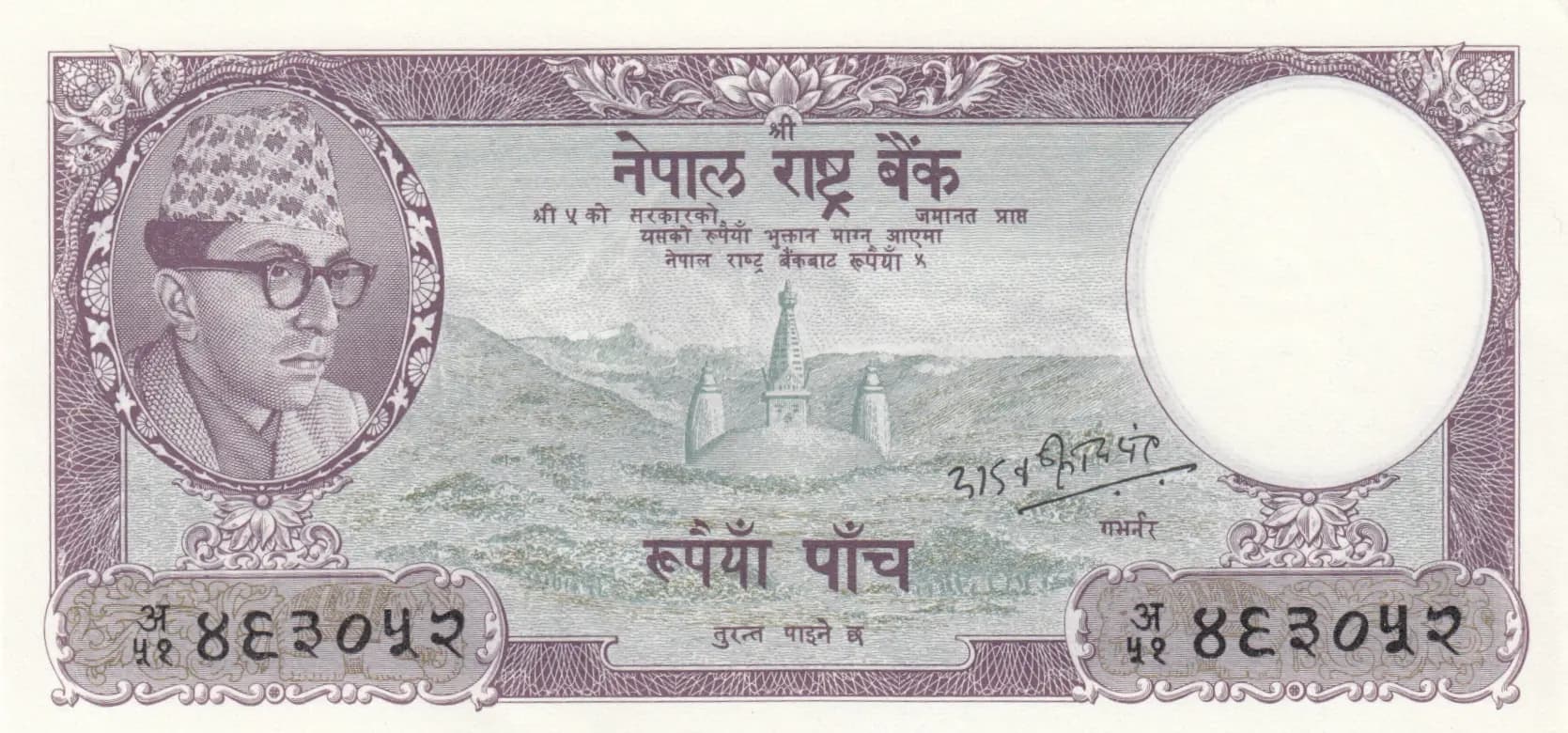
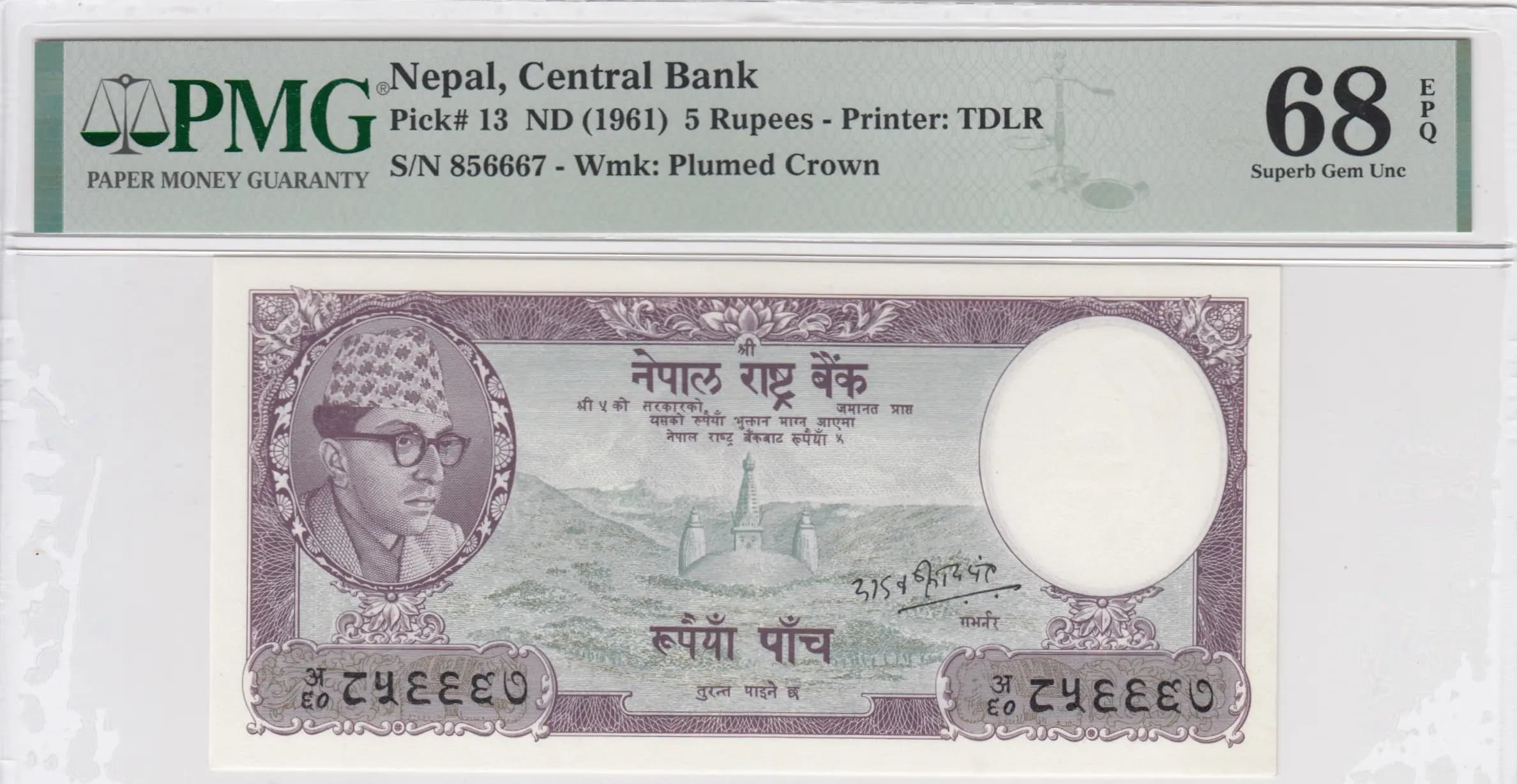
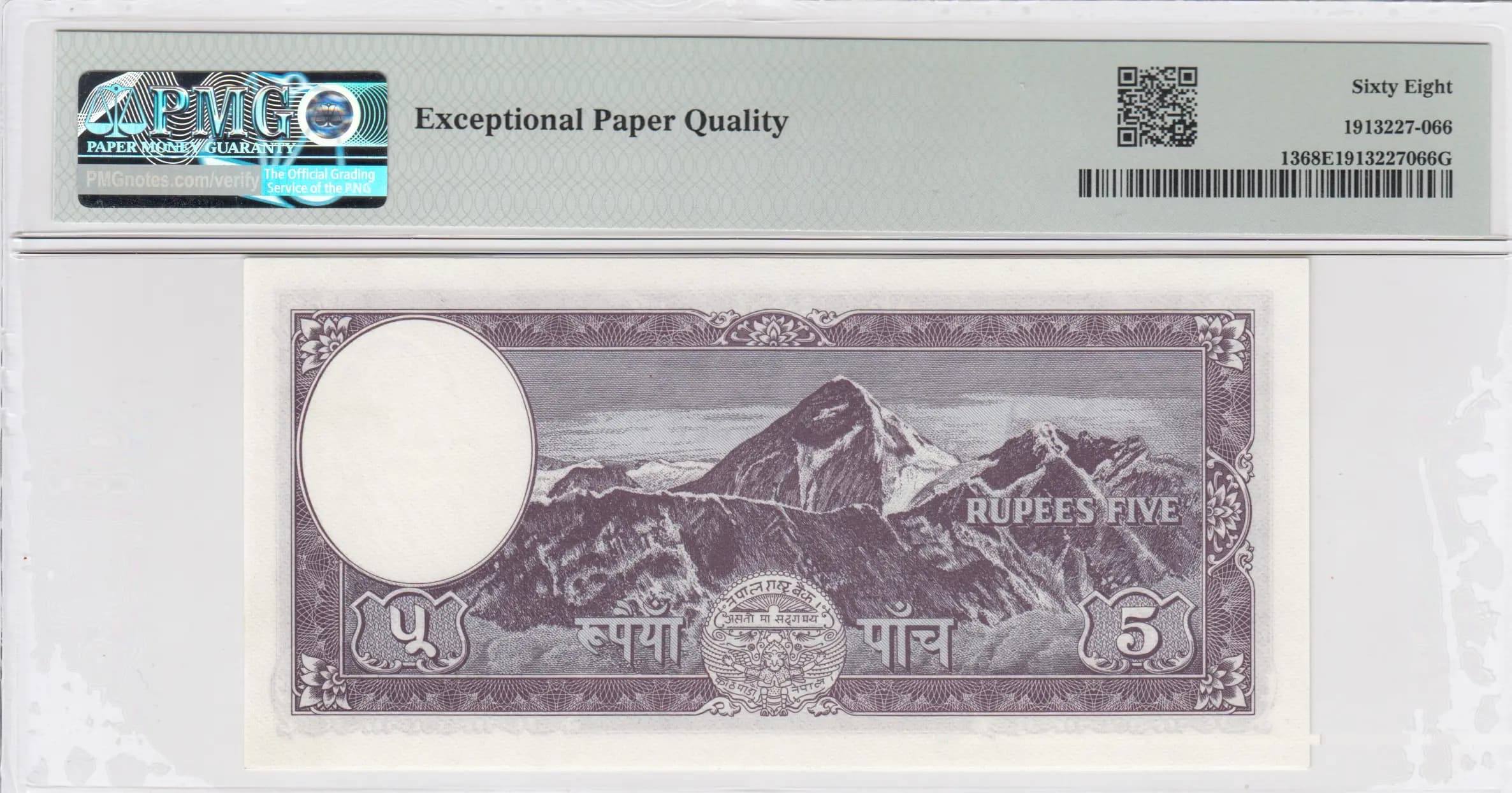
This is a PMG 68 EPQ (Superb Gem Uncirculated) example of Nepal's 1961 5 Rupees banknote (Pick P-13), featuring a striking purple and mauve color scheme with exceptional preservation. The obverse displays King Mahendra Bir Bikram in profile within an ornate oval frame alongside the iconic Swayambhunath stupa in a mountainous landscape vignette, while the reverse showcases snow-capped Himalayan peaks. The crisp printing, sharp details, and absence of wear make this a premium specimen that represents both Nepal's early monetary period and the nation's cultural and geographic identity.
Common. This note is a regular issue from a substantial printing period (1961-1972 according to external catalog data), and secondary market data shows consistent availability. eBay transaction history demonstrates regular sales across multiple grades, with even PMG 66 examples trading in the $17-41 range historically and more recent UNC sales in the $8-11 range. Current catalog values (2019) show $12 for UNC and $3 for VF, consistent with common circulation-era issues. The availability of multiple examples in professional grading services and the active secondary market confirm this is a common banknote despite its historical interest.
Issued in 1961 during the reign of King Mahendra Bir Bikram, this 5 Rupees note marks an important period in Nepal's monetary modernization under the Nepal Rastra Bank. The dual imagery—the reigning monarch paired with Nepal's most sacred Buddhist monument (Swayambhunath stupa) and the nation's most iconic natural feature (Mount Everest region)—reflects the consolidation of national identity in the post-1950 constitutional period. The note's bilingual presentation (Nepali Devanagari and English) demonstrates Nepal's engagement with both traditional culture and international commerce during this transitional era.
The obverse features a left-facing profile portrait of King Mahendra Vira Vikrama (Bir Bikram), depicted bespectacled and wearing formal attire, enclosed in an ornate oval frame with decorative floral and geometric border patterns. The central vignette presents a mountainous landscape with the Swayambhunath stupa—one of Nepal's most sacred Buddhist sites—prominently displayed as a tall structural element rising from alpine terrain. A plume crown watermark space is visible as a blank oval on the right side. The reverse shifts focus to Nepal's geographical identity, displaying an expansive landscape of snow-capped Himalayan peaks with forest vegetation at lower elevations, likely representing the Mount Everest region. Ornate corner decorations and border patterns mirror the obverse design, maintaining visual unity across the note. The overall color palette of purple and mauve provides a distinguished appearance characteristic of mid-century international banknote design.
FRONT: नेपाल राष्ट्र बैंक (Nepal Rastra Bank / Nepal Central Bank); पञ्च (Five); हजारो पाँच (Five Rupees); Devanagari numeral 5 in corner ornaments; Serial number 856667; Various official and legal text in Nepali header. BACK: RUPEES FIVE (English); अमा पाँच (Five Rupees in Nepali); Devanagari numeral 5 in corners. The note uses both Nepali Devanagari script and English language denominations, reflecting the bilingual official standard of mid-20th century Nepal.
The note was printed by Thomas de la Rue and Company Limited (TDLR), as indicated in the PMG population report. The printing exhibits characteristics of high-quality intaglio/offset printing typical of international currency production in the 1960s, evident from the crisp line work, fine detail reproduction in both the portrait and landscape vignettes, and the sharp definition of ornamental border patterns and security features. The registration between colors and the precision of the Devanagari script reproduction indicate professional security printing standards.
The PMG population report indicates two catalogued variants for Pick P-13: the standard P-13 (with TDLR printer attribution) and P-13s (likely a specimen variant). This specific example is the standard P-13 variety printed by Thomas de la Rue and Company Limited. The serial number 856667 visible on this specimen represents an individual printing variant, though no major catalogued sub-varieties based on serial prefixes or design changes are noted for this issue in standard references. The EPQ (Exceptional Paper Quality) designation from PMG indicates exceptional paper preservation without defects.